What is contract lifecycle management?
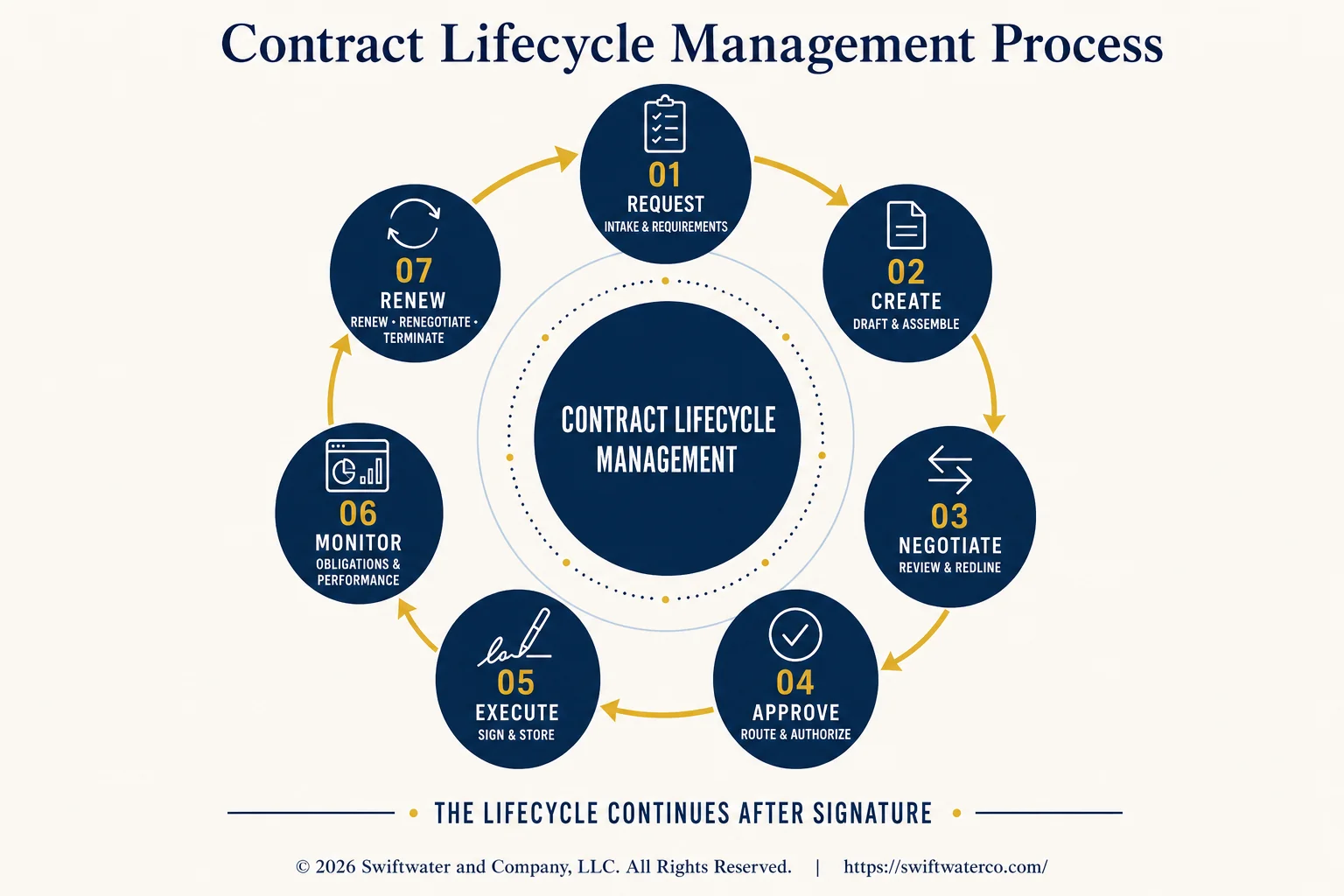
Contract lifecycle management is the end-to-end process of managing a contract from the moment a business need is identified through to expiry, renewal, or termination. It covers every stage: request intake, drafting, negotiation, approval workflows, execution, obligation tracking, amendment management, and renewal.
What is a contract lifecycle management system?
A CLM system is the technology that supports the lifecycle of a contract through initiation, management and renewal or termination. But technology is only one component. The process design, governance model, user adoption strategy, and data architecture that surround it determine whether a CLM implementation delivers value, or becomes another underused platform.
The case for CLM is well-established. The benefits span every business function, from legal and procurement to finance and sales, and extend across more than 50 industries. The question for most organizations isn’t whether CLM delivers value. It’s whether their implementation will.
Not sure a dedicated platform is warranted yet? See whether you need a dedicated CLM system compared against ERP, CRM, and document management.
Why most CLM implementations stall?
Most CLM implementations stall because the technology is only one part. Organizations lose an average of 8.6% of contract value due to poor contract management practices. Underperforming organizations lose more than 20%.1 Despite this, the majority of CLM projects underperform within the first 18 months of go-live.
The reasons are consistent across industries and organization sizes. Scope is set by technology features rather than business outcomes. Implementation timelines are compressed to meet procurement deadlines. Change management is treated as a training exercise rather than a transformation program. Integration with adjacent systems like ERP, CRM, and matter management is underestimated. And the legal team that requested the system is rarely equipped to run the implementation alongside their day jobs.
The result is a platform that is live but not adopted, technically functional but operationally ignored.
Where CLM projects break down:
- 01Scope set around the technology's features instead of the business process
- 02Contract data not migrated, or migrated without normalization
- 03Change management reduced to a training day
- 04Stakeholder alignment across legal, procurement and sales skipped or rushed
- 05No fine-tuning plan after go-live: the system launches and the project team leaves
What is involved in a successful Contract Lifecycle Management Implementation?
A successful launch of a Contract Lifecycle Management solution comprises of three interdependent layers- processes, technology, and change management.
The first is process. Before any platform is configured, the contract process needs to be documented, challenged, and redesigned. This means mapping intake channels, defining approval hierarchies, standardizing templates, and establishing obligation tracking protocols. Most organizations discover significant process gaps at this stage that no amount of technology will resolve. Streamlining the contracting lifecycle is the prerequisite, not the output, of a successful CLM implementation.
The second is technology. Platform selection, configuration, data migration, integration architecture, and testing are specialist activities that require both legal operations knowledge and technical depth. The configuration choices made during implementation determine the flexibility and scalability of the system for years.
The third is change. Legal departments, business stakeholders, and external counsel all interact with contracts differently. A CLM implementation that does not address behavior change, namely how people request contracts, submit invoices, track obligations, and escalate risks, will see adoption collapse within months of go-live.
Get help with contract management
Need process, technology, and change management run as one program rather than three disconnected workstreams? See how we approach Manage Contracts at Scale →
How to handle different types of contracts with a CLM?
Most enterprises don’t manage one type of contract. They manage many. Each contract type has its own approval path, review intensity, and obligation profile. A mature CLM program standardizes the high-volume work without losing the structure that distinguishes one contract type from another.
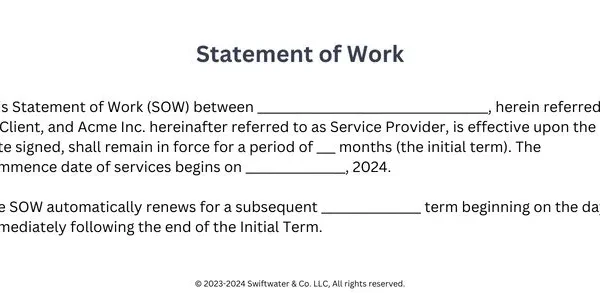
NDAs run daily and benefit from self-service templates and automated review. MSAs structure long-term relationships and call for standardized frameworks with pre-negotiated fallback positions. Statements of work govern specific engagements and need structured templates that capture deliverables, milestones, and pricing. Supplier contracts drive procurement spend and require strategies that integrate vendor onboarding with contract governance. Online contracts handle digital transactions through clickwrap and embedded workflows.
Execution mechanics also matter. Most modern contracts execute electronically. But certain jurisdictions and document types still require a wet signature. A CLM system has to handle both, not pretend the world has fully digitized.
Who owns contract management in an enterprise?
In most mid-to-large enterprises, CLM sits at the intersection of legal, procurement, and finance, and ownership is usually distributed rather than held by one function. Sales owns its customer agreements, procurement owns supplier contracts, and the business functions that create contracts own their commercial obligations, while legal governs the legal and compliance terms across all of them. The Legal Operations Director often coordinates the program and the General Counsel sponsors it, but settling who owns what across functions is the decision that has to come first. Contract managers handle the day-to-day work of drafting, reviewing, tracking, and renewing contracts at scale. Procurement and finance are key stakeholders with their own requirements around vendor contracts, spend visibility, and compliance reporting.
Seventy percent of organizations report difficulty building stakeholder consensus around CLM programs.2 The implementation partner needs to understand all three functions and facilitate alignment between them. Misalignment at the stakeholder level is the single most common reason CLM programs stall before they deliver, which is why readiness and change management matter as much as the platform.
Which system is the contract system of record: CLM, Salesforce or ServiceNow?
Contracts end up spread across Salesforce, ServiceNow and a dedicated CLM when each team lets the system it already uses absorb contract work. Requests can start where they naturally live: sales requests in Salesforce, IT and vendor onboarding in ServiceNow, legal requests in a legal intake tool. The executed contract needs one system of record, and for most organizations that is the CLM, the only one of the three built around the contract as a managed asset.
The other systems read from it or hand off to it instead of keeping competing copies. Deciding that boundary is the architecture question to settle before any vendor conversation. Read where contracts should live across Salesforce, CLM and ServiceNow, and for Docusign and Salesforce specifically, Docusign Salesforce integration.
How to choose a CLM platform without vendor bias
Selection goes wrong when a vendor demo sets the requirements. It goes right when the requirements are written first and every vendor runs the same script on your own contracts.
01Decide before the demo
Ownership, system of record, requirements by theme, readiness to adopt, where intake starts, and the integration boundaries.
02Scripted demos
The same scenarios and your sample documents sent to every vendor in advance.
03Score it
Configuration independence, native AI, demonstrated adoption, integration fit, and total cost, with price considered last.
Our professionals have delivered across Onit CLM, Docusign CLM, Agiloft and Conga, and have helped clients with readiness, assessment and migration on Icertis and Ironclad. We partner with Onit and Docusign and say so; selection is scored on your requirements. Platform pages: Onit CLM · Docusign CLM · Agiloft · Conga · Icertis · Ironclad. The full framework: how to choose a CLM vendor.
Do you need templates and playbooks before CLM?
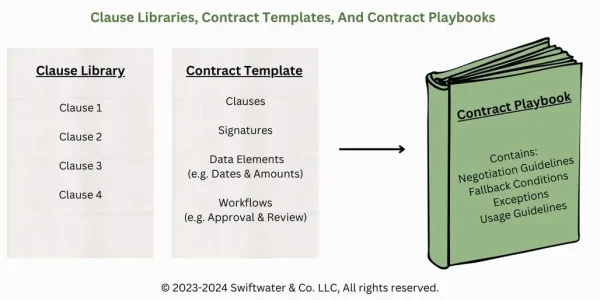
In most cases, yes. A CLM automates the process it is given, so templates that have drifted from approved language and negotiating positions nobody wrote down get automated too. Before configuration, the contracting program needs a standard form suite for the high-volume contract types, a playbook with preferred and fallback positions, and approval frameworks and escalation paths that match how the business signs. Our CLM implementation work builds that program around the system. Background: clause libraries, templates and playbooks.
Onit CLM: implementation, migration and running it beside Onit ELM
Swiftwater is a certified Onit implementation partner. Onit CLM suits departments that want contract work configured around how legal, procurement and sales work, and it raises one extra question for departments already running Onit for matters and spend: how CLM sits beside Onit ELM, which contract workflows move into CLM, what data the two share, and who owns each process.
| Service | What it covers |
|---|
| Implementation | Onit CLM configured around how legal, procurement and sales work, with templates, clause libraries, approval chains and playbooks owned by legal. |
|---|
| Migration to Onit CLM | Contracts and their data moved from shared drives, legacy repositories and other CLMs, normalized, searchable and validated against the source. |
|---|
| Onit ELM alongside CLM | Which contract workflows move into CLM, what data the two share, and who owns each process. |
|---|
| Optimization and administration | Fine-tuning workflows, templates and approvals on existing deployments, then ongoing administration if you want it. |
|---|
Our team includes an early Onit employee and Onit Level 4 certified practitioners. A repository-only implementation can take 45 to 90 days; an end-to-end rollout with a dozen or so templates, 4 to 6 months; with sales or procurement integrations, up to 12 months.
Implementing or fixing Onit CLM?
Implementation, migration and support from a team with Onit depth. See Onit CLM →
Docusign eSignature, CLM and IAM: what each does
| Product | What it does |
|---|
| eSignature | Sends, signs and tracks agreements. |
|---|
| Docusign CLM | The full contract lifecycle: generation, workflow, approvals, clause library and repository. |
|---|
| Docusign IAM | The platform around eSignature: the Navigator repository with AI extraction, Maestro workflows, the Iris AI engine, App Center integrations and, where licensed, Docusign CLM. |
|---|
If the pain is drafting, negotiating and approving contracts at volume, start with a CLM. If agreements are signed but hard to find, report on or move between systems, IAM is the step beyond eSignature. Pricing: Docusign CLM pricing · Docusign IAM pricing.
Already running Docusign?
Most companies have e-signature long before they have a contract program, and the gap is usually governance rather than tooling: unmanaged accounts, templates that drift from approved language, and executed agreements that never reach a governed repository. See how we approach Docusign Consulting →
How a CLM discovery sprint runs
| Phase | What happens |
|---|
| Discover (weeks 1 to 2) | The current contract lifecycle, intake through renewal, with handoffs and gaps. |
|---|
| Analyze (weeks 2 to 4) | Platform boundaries, requirements themes, and readiness and maturity. |
|---|
| Recommend (weeks 4 to 6) | Pilot recommendations, roadmap options and an executive readout. |
|---|
A fixed-fee, vendor-neutral diagnostic. Vendor selection is excluded on purpose: you finish ready to select well.
Before you select a platform
Stakeholder misalignment is the most common reason CLM programs stall. A 4 to 6 week diagnostic maps your process, settles ownership, and de-risks the build before any configuration decision is made. See the CLM Discovery Sprint →
After go-live: fine-tuning, administration and data people trust
The first six months of a live CLM surface the real configuration needs, and the system is only as useful as the data in it.
01Fine-tune the configuration
Workflows, approval rules and templates adjusted to how legal, procurement and sales actually use the system.
02Clean the contract data
Duplicate records merged, missing metadata filled in and legacy agreements mapped, so people trust the repository and the reports, which drives adoption and usage.
03Keep it running
Ongoing administration through Managed Services, including a fractional CLM administrator.
Running a CLM after go-live?
Fine-tuning, administration and a fractional CLM administrator. See CLM Administration →
How Swiftwater approaches contract lifecycle management?
Swiftwater operates at the intersection of legal operations expertise and technology delivery. Our CLM engagements start with a process and readiness assessment, not a platform demo. We identify the gaps, align the stakeholders, and design the implementation program before a single configuration decision is made.
We have delivered CLM implementations for Fortune 100 clients across technology, pharmaceutical, and energy sectors. Every engagement is led by a named senior practitioner, not staffed with junior consultants after the contract is signed.
Frequently Asked Questions
What is contract lifecycle management?
Contract lifecycle management (CLM) is the end-to-end process of managing a contract from request through drafting, negotiation, approval, execution, monitoring, and renewal or termination. It combines process design, governance, technology, and adoption into one managed discipline. The term also refers to the software category that supports the process, though the process comes first.
What are the stages of the contract lifecycle?
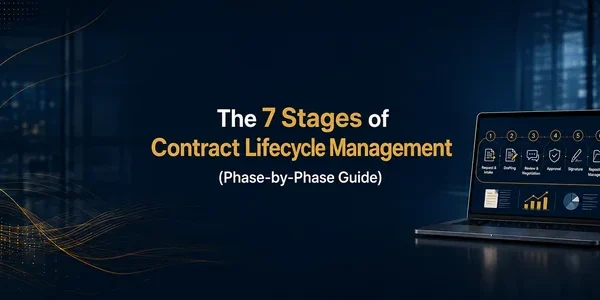
The lifecycle runs through seven stages: intake request, contract creation, negotiation, review and approval, execution and storage, monitoring and performance, and renewal or termination. Each stage has its own owner and failure mode, and stage discipline determines whether a CLM program delivers value. See the full phase-by-phase guide in The 7 Stages of Contract Lifecycle Management.
What is the difference between CLM and contract management?
Contract management broadly means handling agreements. CLM describes the structured, end-to-end version: defined workflows, templates, approval rules, a governed repository, obligation tracking, and reporting that make contract handling repeatable at scale across legal, procurement, sales, and finance.
Who owns CLM in an organization?
Wherever your organization starts, settling ownership explicitly is the decision that has to come first. There is no single answer, and that is the finding itself. World Commerce & Contracting surveys show that contract ownership is fragmented: in some organizations contracting is owned by sales, in others procurement, in others legal, and in many a hybrid of functions or no clear owner at all, often without a central system or process behind it. In legal-run programs, legal governs terms and risk while business functions own their agreements, with a Legal Operations Director coordinating and General Counsel sponsoring.
How long does a CLM implementation take?
It scales with ambition. A small organization standing up a contract repository can be live in 30 to 60 days with professional support. A complete CLM implementation, intake through execution for a defined contract set, is an achievable 3 to 6 month target. For a Fortune 500, a multi-year program is realistic, and even the best-resourced teams should move methodically: segment by contract type, department, jurisdiction, and language, prove the pattern, then extend it. Whatever the timeline, treat implementation as a structured program rather than a software install, and plan for a training and support effort that runs longer than the implementation itself.
What do CLM implementation services include?
They run from discovery to a system people use: CLM discovery, maturity and readiness; system selection and RFP; implementation and configuration; contract migration and data normalization; commercial contracting program design with templates and playbooks; stakeholder alignment across legal, procurement and sales; training and adoption; and post-implementation fine-tuning.
Do we need templates and playbooks before implementing CLM?
In most cases, yes. A CLM automates the process it is given, so drifted templates and unwritten negotiating positions get automated too. A standard form suite for the high-volume contract types, a playbook with preferred and fallback positions, and clear approval frameworks should be in place before configuration.
What happens after a CLM goes live?
The first six months surface the real configuration needs. Workflows, approvals and templates are fine-tuned to how people actually use the system, contract data is cleaned so people trust the repository and reports, and the platform is administered on an ongoing basis, including through a fractional CLM administrator.