


A contract manager job description defines the role that runs contracts from request to renewal. It tells candidates which contracts they will own, which stages of the lifecycle they will run, which industry rules and jurisdictions they must know, who they report to, and what the role pays. A vague one attracts the wrong applicants: a sales contract role written like a procurement one, a senior seat posted with junior duties, or a generalist hired into a regulated business.
This guide is written for the hiring manager, usually the person who owns the contracting function: a General Counsel, head of legal operations, chief procurement officer, or revenue operations leader. It covers what to include, the responsibilities stage by stage, the skills and industry experience to ask for, where the role reports, and what contract roles post for pay. A ready-to-edit template sits at the end. For what the role involves day to day, see what a contract manager does. It is part of our guide to who owns contract management and our contract lifecycle management guide.
What does a contract manager do?
A contract manager runs an organization’s contracts from the first request through signature, performance, and renewal. The role sets up templates and approval routes, negotiates terms within the positions legal has approved, keeps the contract record accurate, tracks obligations and renewal dates, and reports on contract volume, cycle time, and risk. In a small company one person may do all of it; in a large one, the manager leads specialists and administrators. Our article on what a contract manager does covers the role in depth.
What should a contract manager job description include?
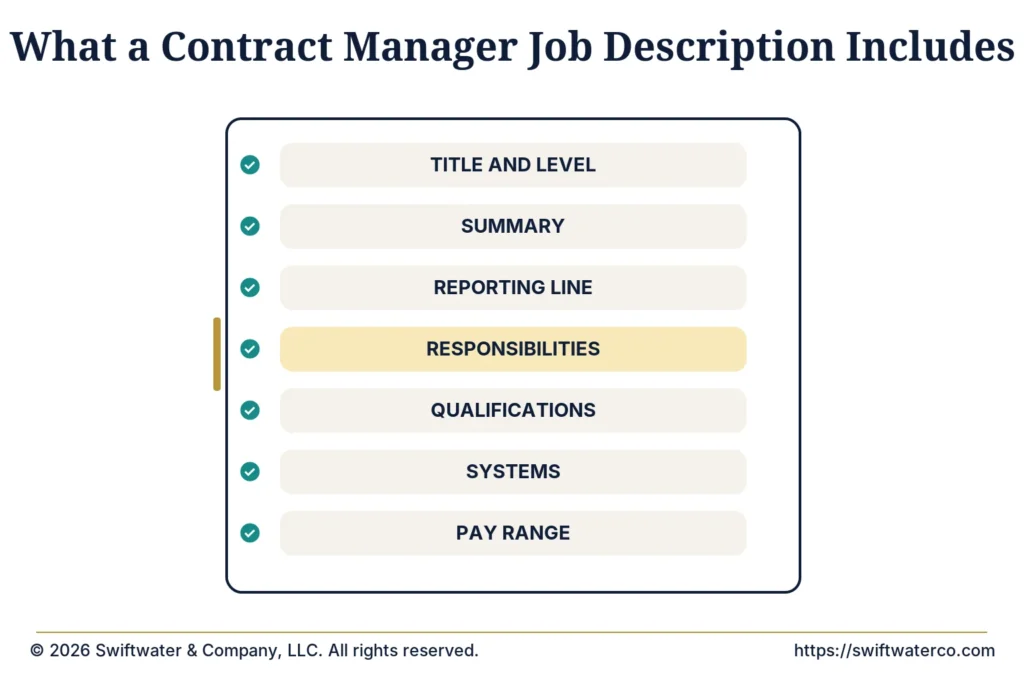
A contract manager job description should include nine sections: the title and level, a short role summary, the reporting line, responsibilities, required qualifications, preferred qualifications, the systems used, the pay range, and the location terms. The responsibilities section carries most of the weight, because it tells candidates whether the seat is buy-side, sell-side, or both.
- Title and level. Contract Manager, Senior Contract Manager, or Contracts Manager, with the level stated.
- Role summary. Two or three sentences on the contracts the role owns and the outcome it is hired for.
- Reporting line. The person and function the role reports to.
- Responsibilities. Grouped by lifecycle stage, so the scope is visible at a glance.
- Required qualifications. Years of experience, contract types, and the systems the role must already know.
- Preferred qualifications. Industry background, certifications, or a law or procurement degree where the seat needs one.
- Systems. The contract lifecycle management platform, CRM, ERP, and e-signature tools in use.
- Pay range. The posted base range, plus bonus or equity.
- Location and work arrangement. Onsite, hybrid, or remote, and where.
What are the responsibilities by lifecycle stage?
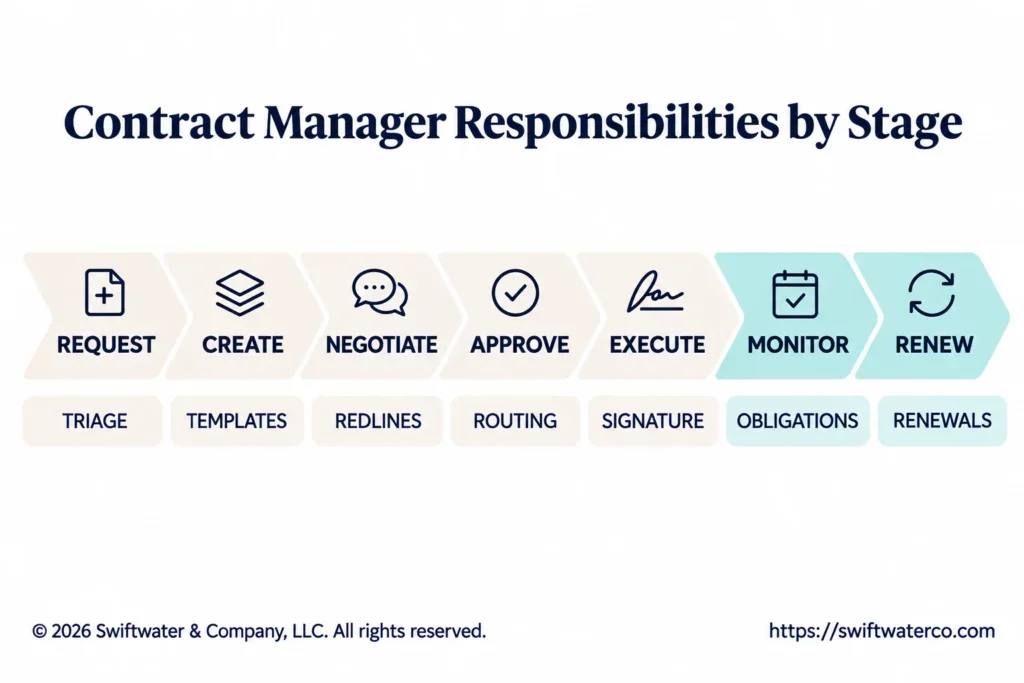
A contract manager’s responsibilities follow the seven stages of the contract lifecycle, from intake to renewal. Writing them by stage shows candidates exactly where the role starts and stops, and it shows the hiring team which stages a second hire or a system has to cover.
| Stage | Responsibility | Output |
|---|---|---|
| Request and intake | Triage requests and assign each one to the right template and approver | A request queue with owners and due dates |
| Authoring and drafting | Maintain templates and draft from them | Current templates and first drafts |
| Negotiation and redlining | Negotiate within approved positions and escalate the rest | Agreed terms and an escalation log |
| Review and approval | Route contracts to the right approvers | Approvals on record |
| Execution, signature, and storage | Manage signature and file the signed contract with its key data | A complete contract record |
| Obligations and performance monitoring | Track obligations, deliverables, and service levels | An obligation register with owners |
| Renewal, renegotiation, or termination | Flag renewals before the notice date and run the decision | A renewal calendar and logged decisions |
What skills and experience are required?
A contract manager needs commercial judgment, negotiation skill, and the discipline to keep records and processes running. Most senior postings ask for five to ten years in contracts, procurement, sales operations, or a legal department, plus hands-on use of a contract lifecycle management platform.
- Commercial judgment. Knowing which terms matter to the business and which can move.
- Negotiation. Working from a playbook and knowing when to escalate.
- Process design. Building intake, templates, and approval routes that people follow.
- Data and reporting. Keeping metadata accurate and reporting on cycle time, volume, and risk, using the measures on our contract management KPIs page.
- Systems. Administering a CLM and working with CRM, ERP, and e-signature tools.
- Stakeholder management. Working with legal, finance, procurement, and sales leaders at the same time.
- Industry and jurisdiction knowledge. The regulations and legal systems your contracts carry, covered in the next section.
Credentials are optional for most commercial roles and common in government contracting. Our guide to contract management certifications compares them.
Evaluating or implementing a CLM platform?
We have guided legal departments through selection, implementation, and adoption, without the vendor bias. Let us talk about where you are and what you actually need.
See CLM ServicesWhat industry and jurisdiction experience should you ask for?
Ask for industry experience when your contracts carry regulatory requirements, and jurisdiction experience when they cross state or national borders. A contract manager in a regulated business needs to recognize the clauses those rules require, route them to the right reviewer, and track the obligations they create. Counsel still decides what the rules mean; the contract manager makes sure nothing that triggers them slips through.
| Industry | What the candidate should know | Why it matters |
|---|---|---|
| Healthcare | HIPAA business associate agreements with vendors that handle protected health information; payer and provider agreements | A missing agreement with a vendor that touches patient data is a compliance gap |
| Life sciences and pharma | Clinical trial agreements, quality agreements, and transparency reporting on payments to physicians | Payments and research terms are tracked and reported |
| Financial services | Third-party risk management under the US interagency guidance (2023) and, in the EU, the Digital Operational Resilience Act (DORA) for technology service contracts | Regulators examine how vendor contracts are chosen, written, and monitored |
| Government contracting | FAR and DFARS clauses, and flow-down terms to subcontractors | Required clauses must reach every tier of the supply chain |
| Technology and data | Data processing agreements under GDPR, service provider terms under US state privacy laws, and export controls | Data and technology terms follow the data across borders |
| Construction | Change orders, notice deadlines, payment applications, and state lien and prompt-payment laws | Missed notice windows can cost a claim |
Jurisdiction experience matters when contracts are signed in several states or countries. Useful experience includes working with different governing law and venue choices, local language and signature formalities, cross-border data transfer terms, and rules that vary by state, such as automatic renewal laws. It also includes knowing which legal entity should sign, which is a common source of errors in multinational groups.
Government roles follow their own rules. If you hire for a federal agency, the role is classified in the GS-1102 contracting series, usually as a Contract Specialist, with education requirements set by the Office of Personnel Management, and signing authority comes only with a written contracting officer warrant. Several states set requirements by statute: Florida, for example, requires a contract manager responsible for contracts over $100,000 a year to become certified within six months, and Texas certifies state agency contract managers after required training. If you are a government contractor, ask for experience working with contracting officers and contracting officer’s representatives, FAR and DFARS clauses, and contract modifications. Our comparison of contract specialist, administrator, and manager roles explains the government definitions.
Name the industries, regulations, and jurisdictions in the posting. Candidates who have worked under them will recognize the seat, and the ones who have not will know to look elsewhere.
Government roles, regulations, and certification requirements on this page are summarized from public sources as of November 2026 for information only. Titles, rules, thresholds, and section numbers change, so confirm the current regulation, statute, or agency guidance before relying on them.
Who does a contract manager report to?
A contract manager reports to whichever function owns the contracts the role handles: the General Counsel or legal operations for a legal-led contracts desk, the chief procurement officer for supplier contracts, or sales operations or finance for customer contracts. Some companies build a central contracts function that serves all of them.
The reporting line decides the role’s priorities, so name it in the posting, and if the role reports to you, say what you expect it to deliver in the first year. Our guide to who owns contract management explains how the split usually works by contract type.
What does a contract manager make?
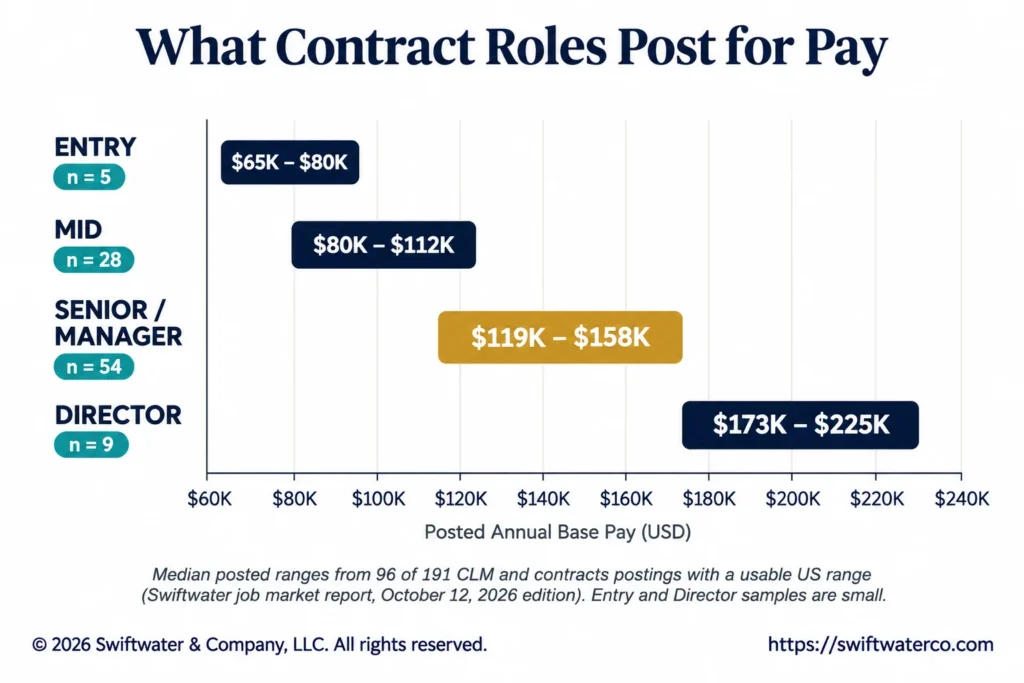
Contract roles post a median base range of $118,850 to $157,500 at the senior or manager level, based on our job market data. In the October 12, 2026 edition of the Swiftwater legal operations job market report, 191 of 914 postings were CLM and contracts roles, and 96 of those 191 gave a usable annual US salary range.
| Level | Postings with a range | Median posted range |
|---|---|---|
| Director | 9 | $173,200 to $225,000 |
| Senior or manager | 54 | $118,850 to $157,500 |
| Mid | 28 | $80,000 to $112,250 |
| Entry | 5 | $65,000 to $80,000 |
These are posted base ranges, before bonus. The Entry and Director samples are small, so read them as direction only. The data set covers legal operations postings, so contract roles that sit inside procurement may post differently. Use the ranges as a check against your own compensation data, and expect to pay more for experience in a heavily regulated industry or across several jurisdictions.
How does the role differ from a contract specialist and a contract administrator?
A contract manager owns the contracting process and its results, while a contract specialist handles contracts within set rules and a contract administrator keeps signed contracts on track. Many teams hire a manager first and add specialists and administrators as volume grows. Our comparison of contract specialist, manager, and administrator roles sets out scope and level side by side, and our guide to contract administration vs contract management covers the post-signature work.
Contract manager job description template
The template below follows the structure above. Replace the bracketed text, delete what does not apply, and post the range.
Job title: [Contract Manager / Senior Contract Manager]
Reports to: [General Counsel / Director of Legal Operations / Chief Procurement Officer / VP Sales or Revenue Operations]
Evaluating legal technology but not sure where to start?
We help legal departments cut through the vendor noise, mapping technology to process maturity and building a roadmap that actually gets adopted.
See Legal TechnologyLocation and work arrangement: [City, hybrid with X days onsite / remote within (country)]
About the role. [Company] is hiring a Contract Manager to run [customer / supplier / all] contracts for [the business or region]. The role owns contracts from request to renewal, works with legal, finance, procurement, and sales, and keeps the contract record and reports accurate. In the first year you will [the one outcome that matters most].
What you will do:
- Triage contract requests and route each one to the right template and approver.
- Maintain contract templates and draft agreements from them.
- Negotiate [customer / supplier] contracts within approved positions, and escalate exceptions to legal.
- Manage approvals and signature, and file each signed contract with its key data.
- Track obligations, deliverables, and renewal dates, and run renewal decisions before notice deadlines.
- Administer [CLM platform], including templates, workflows, users, and reports.
- Report on contract volume, cycle time, and risk to [the General Counsel / CFO / CPO].
- [Lead and develop a team of (number) contract specialists and administrators.]
What you bring:
- [5 to 10] years in contract management, procurement, sales operations, or a legal department.
- Experience negotiating [customer / supplier] agreements within a playbook.
- Hands-on use of a contract lifecycle management platform: [name the system].
- Clear written communication with lawyers and business teams.
- Experience with [the regulations your contracts carry, such as HIPAA business associate agreements, FAR flow-downs, or GDPR data processing agreements].
- Experience with contracts governed by [the states, countries, or regions you contract in].
- Preferred: experience in [industry], [NCMA or WorldCC certification], [platform certification].
Compensation: [Posted range], plus [bonus / equity / benefits].
The same template is in the Word download at the top of this page.
Bottom Line
If you own the contracting function, the contract manager you hire will carry your process, your positions, and your risk into every deal. The job description is the first filter for that hire, and most mismatched hires start with a vague one.
Write it around the contracts the role will own and the stages it will run, name the systems, and say plainly which regulations and jurisdictions the work involves, from HIPAA business associate agreements to FAR flow-downs or contracts governed by EU law. Then post a range that matches the level: senior and manager-level contract roles in our data post a median of $118,850 to $157,500. Write the job description for the contracts your function actually handles, including the regulations and jurisdictions they bring, and post pay that matches the level, so the right candidates recognize the seat as theirs.
When the contracts desk is short a person or the platform has no owner, a fractional administrator through our CLM administration service keeps the work moving while you hire.
Frequently Asked Questions
What is a contract manager job description?
A contract manager job description defines the role that runs contracts from request to renewal. It sets out the contracts the role owns, its responsibilities at each lifecycle stage, the required skills and systems, the reporting line, and the pay range.
What are the main duties of a contract manager?
The main duties are triaging requests, maintaining templates, negotiating within approved positions, managing approvals and signature, keeping the contract record accurate, tracking obligations, and running renewals before the notice date. Senior roles also report on volume, cycle time, and risk, and lead a team.
What qualifications does a contract manager need?
Most senior roles ask for five to ten years in contracts, procurement, sales operations, or a legal department, negotiation experience, and hands-on use of a contract lifecycle management platform. Regulated industries also look for experience with the rules their contracts carry, such as HIPAA or FAR, and multinational companies for experience across jurisdictions. A law or procurement degree and a certification such as NCMA’s or WorldCC’s are preferred for some seats.
What industry experience should a contract manager have?
Ask for experience in your industry when your contracts carry regulatory requirements: HIPAA business associate agreements in healthcare, third-party risk rules in financial services, FAR and DFARS flow-downs in government contracting, or data processing agreements in technology. For multinational work, ask for experience with contracts governed by the relevant countries’ laws.
How much does a contract manager make?
In our October 2026 job market data, senior and manager-level contract roles posted a median base range of $118,850 to $157,500 (54 postings with a range). Mid-level roles posted $80,000 to $112,250 (28 postings). Ranges are posted base pay, before bonus.
Who does a contract manager report to?
A contract manager reports to the function that owns the contracts: the General Counsel or legal operations for a legal contracts desk, procurement for supplier contracts, or sales or revenue operations or finance for customer contracts. Some companies run a central contracts function instead.
Is there a free contract manager job description template?
Yes. The template on this page covers the title, reporting line, role summary, responsibilities by stage, qualifications, systems, and pay. Download the Word version, replace the bracketed text, and post the range.
This article is provided for general informational purposes only and is not legal, financial, or business advice. Hiring and compensation decisions should be validated against your organization’s specific structure, regulatory obligations, and counsel guidance, and you should consult a qualified professional for advice on your situation. Pay figures are posted base ranges from Swiftwater’s job market research, a research project developed in conjunction with Swiftwater AI Labs, and show direction only. Government roles, regulations, and certification requirements described here are summarized from public sources as of November 2026 for information only and may change; confirm them with the relevant agency, statute, or regulation.