


Healthcare contract management covers payer, provider, vendor, and physician agreements under HIPAA and Stark rules. A health system signs thousands of agreements: rate agreements with health plans, employment and services agreements with physicians, supply agreements through group purchasing organizations, and technology agreements with vendors that handle patient data. The physician and data agreements are often small in value and heavy in rules, and a single lapsed one can become a compliance problem.
This guide covers the key contract types in healthcare, the rules behind them, who owns them, and what a CLM has to handle. It is part of our guide to contract management by industry and our guide to the seven stages of the contract lifecycle.
What does contract management cover in healthcare?
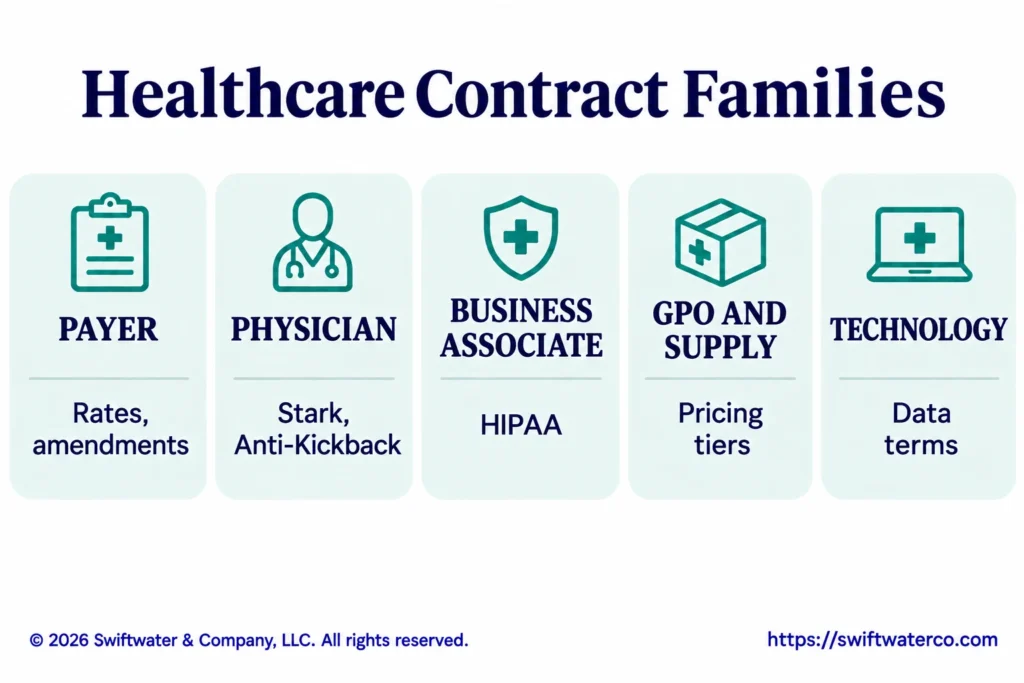
Contract management in healthcare covers payer contracting with health plans, physician and other provider arrangements, supply chain agreements, technology and data vendors, and real estate and affiliation agreements. Hospitals and health systems hold all of these at once, often managed by different departments with different filing habits.
- Payer contracting. Agreements with commercial health plans and government program administrators, with rates and amendments.
- Physician and provider arrangements. Employment, professional services, medical directorships, and on-call agreements.
- Supply chain. Group purchasing organization (GPO) agreements, supply and pharmaceutical supply agreements, and equipment purchases.
- Technology and data. Software, cloud, and service vendors, many of which handle protected health information (PHI).
- Real estate and affiliations. Leases, clinical affiliations, and transfer agreements.
What are the key contract types?
Vendor and supply agreements are the most numerous healthcare contracts, and payer agreements bring in the most revenue. Physician arrangements and business associate agreements carry the most regulatory weight relative to their size, because each one has to meet specific requirements.
| Contract type | Counterparty | What the CLM tracks |
|---|---|---|
| Payer agreements | Health plans | Rates, amendments, renewal and notice dates |
| Physician employment and services agreements | Physicians and groups | Compensation, term, services, approval records |
| Business associate agreements | Vendors handling PHI | Required terms, linked vendor contract, expiry |
| GPO and supply agreements | GPOs and suppliers | Pricing tiers, commitments, renewals |
| Equipment and technology agreements | Vendors | Service levels, data terms, renewals |
| Leases and affiliation agreements | Landlords and partners | Key dates, terms, renewals |
The table is illustrative; a physician group, a hospital, and a health insurer weight these rows differently.
Which laws and regulators apply to healthcare contracts?
Healthcare contracts are affected mainly by privacy law and fraud and abuse laws. Under HIPAA, a covered entity must have a written contract with each business associate that handles PHI on its behalf; HHS publishes guidance and sample business associate agreement provisions.
Financial relationships with physicians fall under the Physician Self-Referral Law, known as the Stark Law, administered by CMS, and under the Anti-Kickback Statute, which the HHS Office of Inspector General describes among its fraud and abuse laws. Many exceptions under these laws depend on a written, signed agreement.
Evaluating or implementing a CLM platform?
We have guided legal departments through selection, implementation, and adoption, without the vendor bias. Let us talk about where you are and what you actually need.
See CLM ServicesThese rules are listed for reference only; counsel and compliance teams should interpret how each applies.
Who owns contracts in healthcare?
In most health systems, managed care or payer contracting owns health plan agreements, physician services owns physician arrangements together with compliance, supply chain owns GPO, supply, and equipment agreements, and IT and privacy own technology agreements and their business associate agreements. Legal owns templates, review, and escalations.
Because so many departments sign, healthcare organizations often discover contracts that no central team knew about. A single intake and a single repository are what make the full list possible. Our guide to who owns contract management covers the roles.
What does a CLM have to handle?
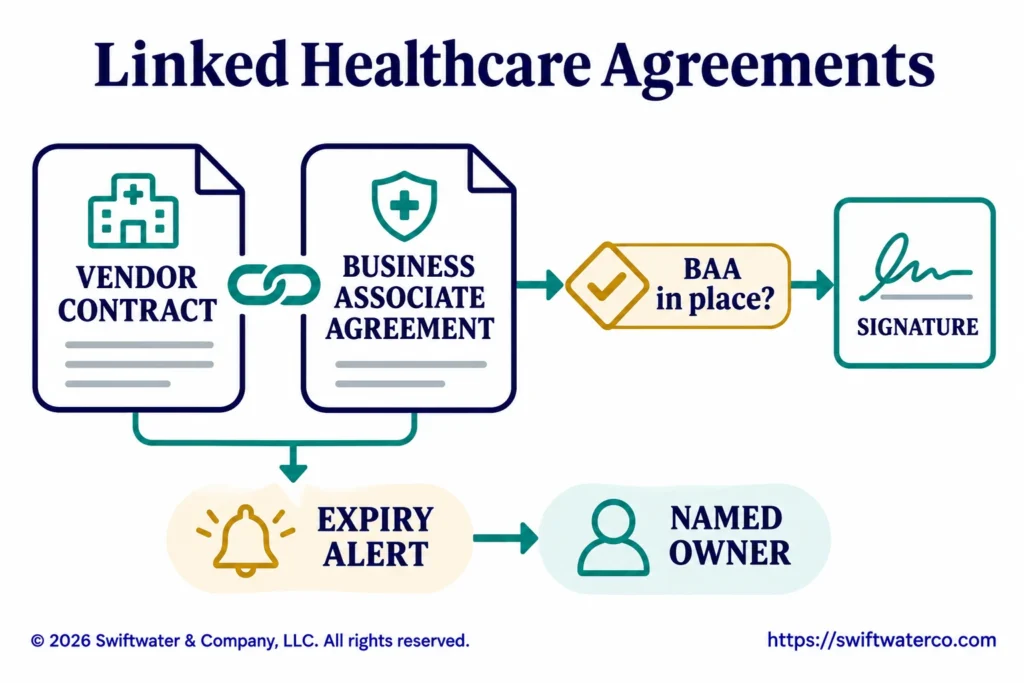
A CLM in healthcare has to link each vendor contract to its business associate agreement, keep a full record for every physician arrangement, track payer amendments and dates, route approvals through compliance, and hold everything in one repository. It keeps the records and runs the checks; the organization remains responsible for compliance.
- Linked agreements. A business associate agreement linked to every vendor contract that involves PHI, with a check that one exists before signature.
- Physician arrangement records. Term, compensation, services, approvals, and signatures for each arrangement, with alerts before expiry.
- Vendor security and AI obligations. Technology vendors that handle patient data owe security assessments, breach notices, and, increasingly, limits on how AI tools use that data. These duties continue after onboarding and need an owner. See contract obligation management.
- Payer amendments and dates. Rate amendments, renewal dates, and notice periods with owners. See contract renewal management.
- Compliance in the approval route. Physician and other sensitive agreements routed through compliance by rule. See contract workflow management.
- One repository. Every agreement in one place, searchable by counterparty, type, and clause. See contract repository.
What does a typical lifecycle problem look like?
A common healthcare pattern is a gap found in an audit: a physician arrangement that expired while the physician kept providing services, or a technology vendor that received patient data before its business associate agreement was signed. Neither started as a legal failure. Both started as a contract that nobody owned between signature and the next renewal.
The fix is a lifecycle with no gaps between the steps:
- Intake that asks the right questions. Does the vendor touch PHI? Is the counterparty a physician or referral source? The answers decide the route and the required documents.
- Linked agreements. The business associate agreement attached to its vendor contract, and amendments attached to the original.
- Expiry alerts with an owner. Notice well before an arrangement ends, sent to a named person who decides to renew, renegotiate, or stop the services.
Our guide to contract request and intake covers how to design those intake questions.
Which pages to read next?
- Contract management by industry, for how healthcare compares with other industries.
- Who owns contract management, for the roles of legal, procurement, and the business.
- Contract obligation management, for obligations after signature.
- Contract workflow management, for approval routing.
- Pharma contract management, for the manufacturer side of the industry.
- Confidentiality agreement vs NDA, for the agreements that often come first with a new vendor.
Bottom Line
Healthcare contract management spans payer agreements that carry revenue, supply and technology agreements that carry volume, and physician and business associate agreements that carry the most rules for their size. Technology vendors that handle patient data now add security and AI obligations that run for the life of the relationship. HIPAA, the Stark Law, and the Anti-Kickback Statute sit behind them, and many departments sign them.
Evaluating legal technology but not sure where to start?
We help legal departments cut through the vendor noise, mapping technology to process maturity and building a roadmap that actually gets adopted.
See Legal TechnologyAudit findings rarely start with the large contracts. Avoiding them means making the small contracts as visible as the large ones: every vendor linked to its business associate agreement, every physician arrangement held with its approvals and dates, every security obligation assigned, and every expiry sent to a named owner well before services would continue unsupported. In healthcare the smallest contracts can carry as much risk as the largest ones, so every physician arrangement and every vendor that touches patient data needs a record, an owner, and a date.
Our contract management solutions help healthcare legal, compliance, and supply chain teams design intake and approval routes, link related agreements, and configure the CLM that keeps the record.
Frequently Asked Questions
What is healthcare contract management?
Healthcare contract management covers payer, provider, vendor, and physician agreements under HIPAA and Stark rules. It includes payer rate agreements, physician arrangements, GPO and supply agreements, technology vendors and their business associate agreements, and leases and affiliations, each with an owner, dates, and a complete record.
How can a CLM help with HIPAA?
A CLM helps by recording which vendors have a business associate agreement, which version they signed, and when it expires, by checking that one exists before a vendor contract involving PHI is signed, and by producing the list on request. It keeps the records; privacy and legal teams remain responsible for HIPAA compliance.
What is a business associate agreement?
A business associate agreement is the written contract HIPAA requires between a covered entity, such as a hospital or health plan, and a business associate that creates, receives, maintains, or transmits protected health information on its behalf. It sets out how the business associate may use and must safeguard that information.
How should physician agreements be tracked?
Keep every physician arrangement in one repository with its term, compensation, services, approvals, and signatures, and route new and renewed agreements through compliance. Set expiry alerts well ahead of the end date, sent to a named owner, so services never continue after an agreement has lapsed.
Who owns payer contracts?
Managed care or payer contracting teams usually own agreements with health plans, including rate negotiations, amendments, and renewals. Finance and revenue cycle teams use the rates, and legal reviews terms and escalations. The repository should hold every amendment so the rates in force are always clear.
This article is provided for general informational purposes only and is not legal, financial, or business advice. Healthcare contract management decisions should be validated against your organization’s specific structure, regulatory obligations, and counsel guidance, and you should consult a qualified professional for advice on your situation.