

Construction contract management covers prime contracts, subcontracts, change orders, payment, and claims from bid to closeout. One project brings many contracts: the owner’s agreement with the general contractor, the subcontracts with each trade, supply agreements, design agreements, bonds, and insurance. The price and the schedule move with every change, and the contract decides who pays for each change, how quickly it has to be raised, and whether a claim survives.
This guide covers the key contract types in construction, how changes work, the laws and regulators behind them, who owns the contracts, what a CLM has to handle, and what a typical lifecycle problem looks like. It is written mainly for general contractors, with the owner’s and the subcontractor’s view alongside. It is part of our guide to contract management by industry and our guide to the seven stages of the contract lifecycle.
What does contract management cover in construction?
Contract management in construction covers every contract on a project from bid to the end of the warranty period: bid and award, the prime contract, buyout of subcontracts and supply, changes, payment applications and retainage, notices and claims, closeout, and warranty. Owners, general contractors, and subcontractors each manage their own layer of the same chain.
On a project, much of this work is called construction contract administration: reviewing payment applications, issuing and pricing changes, tracking notices, collecting insurance certificates and lien waivers, and keeping the contract file. It is the day-to-day side of the lifecycle, and on many projects a contract administrator or project manager does it. Our guides to contract administration vs contract management and the contract manager job description cover the roles.
What are the key contract types?
Prime contracts and subcontracts carry the most value in construction, and change orders, purchase orders, and insurance certificates are the most numerous. Many owner-contractor agreements start from standard forms published by industry associations, edited for the project, so the differences from the standard form are what the team has to track.
| Contract type | Counterparty | What the CLM tracks |
|---|---|---|
| Owner-contractor agreements | Owner | Price basis (lump sum, cost plus, guaranteed maximum), schedule, notice periods, retainage |
| Design and design-build agreements | Architects, engineers, design-builders | Scope, liability, ownership of documents |
| Subcontracts | Trade contractors | Flow-down terms, scope, retainage, insurance, payment terms |
| Purchase orders and supply agreements | Suppliers | Delivery dates, price escalation, warranties |
| Change orders and change directives | Owner and subcontractors | Scope, price, and time changes, approvals, status |
| Bonds and insurance certificates | Sureties and insurers | Amounts, named insureds, expiry dates |
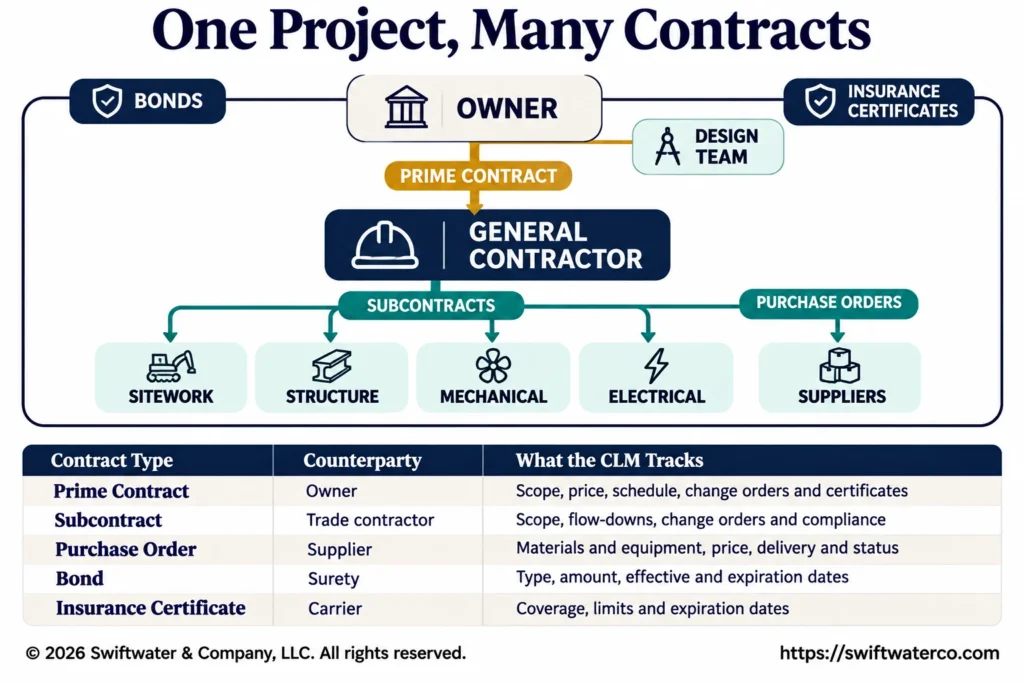
The table is illustrative; an owner, a general contractor, and a specialty subcontractor weight these rows differently.
What happens when the scope changes?
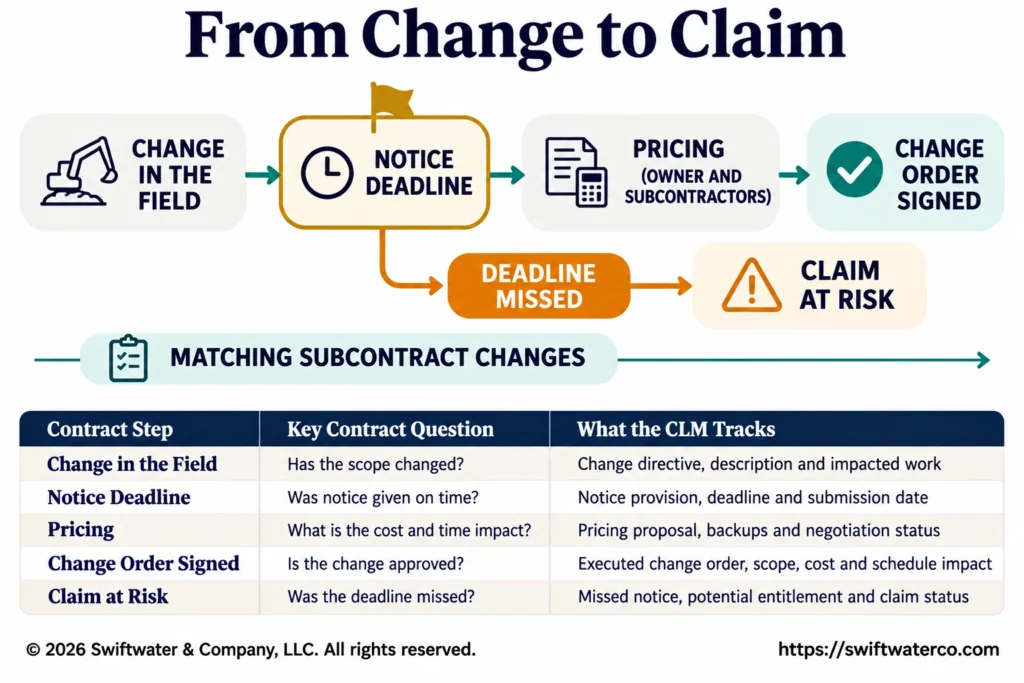
A change order is a written agreement between the parties to change the work, the price, the schedule, or all three, under the change clause of the existing contract. A change directive tells the contractor to proceed with a change before the price and time are agreed. Both work inside the original contract; a separate amendment changes the contract’s own terms, as our guide to amendment vs addendum explains.
Evaluating or implementing a CLM platform?
We have guided legal departments through selection, implementation, and adoption, without the vendor bias. Let us talk about where you are and what you actually need.
See CLM ServicesMost construction contracts set deadlines for giving notice of a change or a claim, often in days. A contractor that misses the notice period can lose the right to extra time or money, even when the change was real. Changes also run down the chain: when the owner changes the work, the general contractor has to issue matching changes to the affected subcontractors, and the prices and dates at each level have to agree.
Which laws and regulators apply to construction contracts?
Public construction carries statutory requirements. On federal projects, the Miller Act requires performance and payment bonds on construction contracts above $150,000, and most states have similar laws for state and local projects. Federal and federally assisted construction is subject to prevailing wage requirements under the Davis-Bacon and related acts, administered by the Department of Labor, and federal projects follow the procurement rules covered in our guide to government contract management.
Private and public projects also answer to state mechanics’ lien laws, which protect unpaid contractors and suppliers through liens on the property, and state prompt payment laws, which set payment deadlines down the chain. Safety rules under OSHA’s construction standards apply to the work and are usually passed to subcontractors by contract.
These rules are listed for reference only; counsel and compliance teams should interpret how each applies to the company and contract.
Who owns contracts in construction?
At a general contractor, preconstruction and estimating own the bid, project managers and contract administrators own the prime contract and the changes during the project, procurement owns buyout of subcontracts and supply, risk and legal own insurance, bonds, and disputes, and finance owns payment applications and retainage. At an owner, the project or development team owns the contracts, often with an owner’s representative. At a subcontractor, the project manager usually owns both the subcontract and the supply agreements below it.
Because the people who negotiate the contract are rarely the people who run the project, the terms that matter most during construction, notice periods, change procedures, and payment terms, have to be handed over in a form the field team can use. Our guide to who owns contract management covers the roles.
What does a CLM have to handle?
A CLM in construction has to handle a project-level repository across many contracts, flow-down terms from the prime contract to each subcontract, notice and claim deadlines as tracked obligations, a change log tied to contract value at every level, insurance and bond certificates with expiry dates, and retainage held and released. It holds the contracts and their terms; project management and accounting systems hold the schedules, costs, and payments.
- A project repository. Every contract on the project, with its amendments and changes, in one place. See contract repository.
- Flow-down terms. The prime contract terms that must reach each subcontract, checked when subcontracts are written.
- Notice and claim deadlines. Notice periods captured as dates with owners, so a change in the field starts the clock in the record. See contract obligation management.
- A change log tied to value. Each change order and directive recorded against the prime contract and the matching subcontracts, with status, price, and time.
- Insurance and bonds. Certificates and bonds with amounts and expiry dates, and alerts before they lapse.
- Retainage. Amounts held at each level and the conditions for release.
- Security, data, and AI terms. Project platforms, drone and site data, and AI estimating and scheduling tools carry data use and security terms that remain obligations for the life of the project.
Many contractors run changes and payment inside construction project management software and keep the signed contracts elsewhere. Linking the two is what lets the team see both the change and the contract terms it depends on. Our guide to contract lifecycle management tools covers the categories.
What does a typical lifecycle problem look like?
The typical problem in construction is a change that moves faster than the contract. An owner directs a change on site. The general contractor tells the affected trades to proceed before the price is agreed. The notice period in the prime contract passes while the team is busy building, the subcontractors’ pricing arrives late, and the claim for extra time or money is weaker than it should be.
Having the data in a system is not enough on its own. In a 2017 review of the Department of Veterans Affairs’ major medical facility construction, including the $1.675 billion hospital project in Denver, the Government Accountability Office found that VA’s contract software recorded when each change order was started and approved, but VA did not use that data to check whether changes were approved within its required time frames. It also did not track why changes occurred, and had no way to oversee design changes as projects progressed. GAO recommended monitoring both, and VA later acquired a system that tracks approval times and the reasons for each change and revised its contract modification manual to require using the data.
The fix in both cases is the same: treat notice periods and change approvals as tracked obligations with owners and dates, and review them every week.
Which pages to read next?
- Contract management by industry, for how construction compares with other industries.
- Amendment vs addendum, for how contract changes are documented.
- How to draft a statement of work, for defining scope.
- Contract obligation management, for notice and payment deadlines.
- Government contract management, for public projects and federal rules.
- Contract lifecycle management tools, for the categories of software.
Bottom Line
Construction contracts move with the project. A single job brings a prime contract, a chain of subcontracts and supply agreements, bonds, insurance, and a steady flow of changes, each with a price, a time effect, and a notice deadline. Bond laws, prevailing wage rules, lien and prompt payment laws, and safety standards sit behind them, and the standard forms most projects start from are edited for every job.
Contractors protect their margin by keeping the change log, the notice dates, and the payment terms current at every level of the chain, and GAO’s findings at VA show that recording the data is only the first step. A CLM that ties every contract and change to the project, with owners for each deadline, turns that discipline into a routine. On a construction project the contract changes with every change order, so the CLM has to keep notice dates, the change log, and payment terms in view of the field team to keep claims alive and payments on time.
Evaluating legal technology but not sure where to start?
We help legal departments cut through the vendor noise, mapping technology to process maturity and building a roadmap that actually gets adopted.
See Legal TechnologyOur contract management solutions help construction owners, contractors, and their legal and project teams build project contract records, track changes and notice dates, and select and configure the CLM that fits.
Frequently Asked Questions
What is construction contract management?
Construction contract management covers prime contracts, subcontracts, change orders, payment, and claims from bid to closeout. It includes managing flow-down terms, tracking notice and claim deadlines, logging changes against contract value at every level, collecting insurance and bond certificates, and holding and releasing retainage.
What is construction contract administration?
Construction contract administration is the day-to-day management of contracts during a project: reviewing payment applications, issuing and pricing change orders, tracking notices and deadlines, collecting insurance certificates and lien waivers, and keeping the contract file. It is usually done by a contract administrator or project manager.
What is a change order in construction?
A change order is a written agreement to change the work, price, or schedule under the change clause of an existing construction contract. A change directive orders the work to proceed before price and time are agreed. Both should be recorded against the original contract and any affected subcontracts.
What does a construction contract manager do?
A construction contract manager prepares and negotiates contracts and subcontracts, manages changes and claims, tracks notice and payment deadlines, checks insurance and bonds, and keeps the contract file from award to closeout. On smaller projects the project manager often does this work.
What is retainage in construction?
Retainage is a portion of each payment held back by the owner from the contractor, and by the contractor from its subcontractors, until the work or a stage of it is complete. The contract sets the percentage and the release conditions, and many states limit retainage by law.
How does a CLM help a general contractor?
A CLM helps a general contractor keep every contract on a project in one record, pass prime contract terms down to subcontracts, track notice and claim deadlines with owners, log changes against contract value at every level, and alert the team before insurance, bonds, and key dates lapse.
This article is provided for general informational purposes only and is not legal, financial, or business advice. Construction contract management decisions should be validated against your organization’s specific structure, regulatory obligations, and counsel guidance, and you should consult a qualified professional for advice on your situation.