


A contract repository is the single, searchable home for every signed agreement and the facts that matter about it: who it is with, what it is worth, when it renews, and who owns it. Most companies already keep their contracts somewhere: shared drives, email inboxes, an old document system. What they usually lack is a record they can question. Without one, nobody can say with confidence how many agreements renew next quarter, which ones allow a price increase, or where the signed copy of a key supplier deal is.
This guide explains what belongs in a repository, which details to capture for each contract, how a repository differs from a document management system or a shared drive, and how to build one and keep it accurate. It is part of our contract lifecycle management guide, which places the repository at the hand-off from signature to monitoring.
What is a contract repository?
A contract repository is the one searchable place where executed agreements live with the metadata that describes them. Search, key-date alerts, version history, and access control all run off that metadata. That is why a folder of signed PDFs holds the documents without working as a repository: nothing in the folder knows which contract renews next, who owns it, or what it is worth.
A working repository does five things:
- Single source of truth. Every executed agreement sits in one place, so no one asks which copy is current.
- Full-text and metadata search. Users find a contract by its words or by fields such as counterparty, type, or end date.
- Key-date alerts. Renewal, notice, and expiry dates remind the contract’s owner before they pass.
- Version control and audit trail. Each document version and each data change is recorded with who made it and when.
- Role-based security. Access follows role, contract type, and business unit.
Few organizations are there yet. In a 2026 survey by WorldCC (formerly IACCM) of 170 organizations, only 27% stored all executed contracts exclusively in a CLM system, and 54% had no automated data flow between systems (the WorldCC and Sirion study, n = 170; a benchmark that shows direction).
What belongs in a contract repository?
A contract repository should hold every executed agreement and everything that changes it or sits under it: amendments and addenda, statements of work and order forms under a master agreement, signed renewals and terminations, and the approval and signature record. Drafts and negotiation history stay with authoring and negotiation; the repository receives the final executed version and the data that describes it.
- Executed agreements. The final signed version of every contract, on either party’s paper.
- Amendments and addenda. Each is filed against the agreement it changes; see how amendments and addenda are recorded.
- Child documents linked to their parent. Statements of work and order forms sit under their master agreement.
- Approval and signature record. The approval and signature record shows who approved and signed, under whose authority.
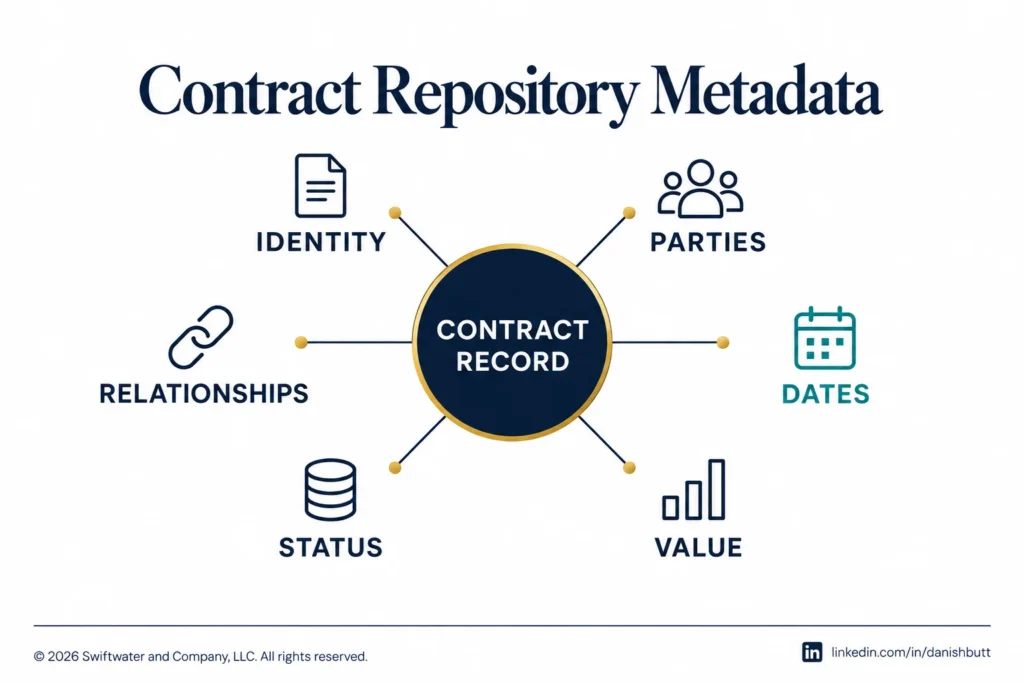
- Metadata record. The structured fields in the next section.
- Obligation and key-date entries. Deliverables and dates captured for obligation management.
What metadata should a contract repository capture?
Capture the fields people search, report, and act on: a unique contract number, contract type, counterparty, internal owner, status, effective and end dates, renewal and notice dates, value, whose paper it was, the parent agreement, and the signatories with the execution date. Each field needs a source and an owner, or it decays, so require only what someone actually uses.
Evaluating or implementing a CLM platform?
We have guided legal departments through selection, implementation, and adoption, without the vendor bias. Let us talk about where you are and what you actually need.
See CLM Services| Field | Why it matters | Who maintains it |
|---|---|---|
| Contract number | One unique reference for search and linking | System, at intake or on filing |
| Contract type | Drives routing, reporting, and alert rules | Requester; confirmed by the contract manager |
| Counterparty | Finds every agreement with one supplier or customer | Requester; matched to the vendor or customer master |
| Internal owner and business unit | Decides who receives alerts | Requester; legal operations when people move |
| Status | Shows what is in force, expired, or terminated | System |
| Effective date | Starts the clock for obligations | System on signature |
| End date | Drives expiry reporting | Contract manager |
| Renewal and notice dates | Drive renewal management alerts | Contract manager |
| Contract value | Supports spend reporting | Requester; confirmed at signature |
| Paper (own or counterparty) | Flags departures from standard terms | Requester |
| Parent agreement | Links child documents to the master | Contract manager, on filing |
| Signatories and execution date | Records who signed and when | System, from the signature step |
How is a repository different from a DMS or a shared drive?
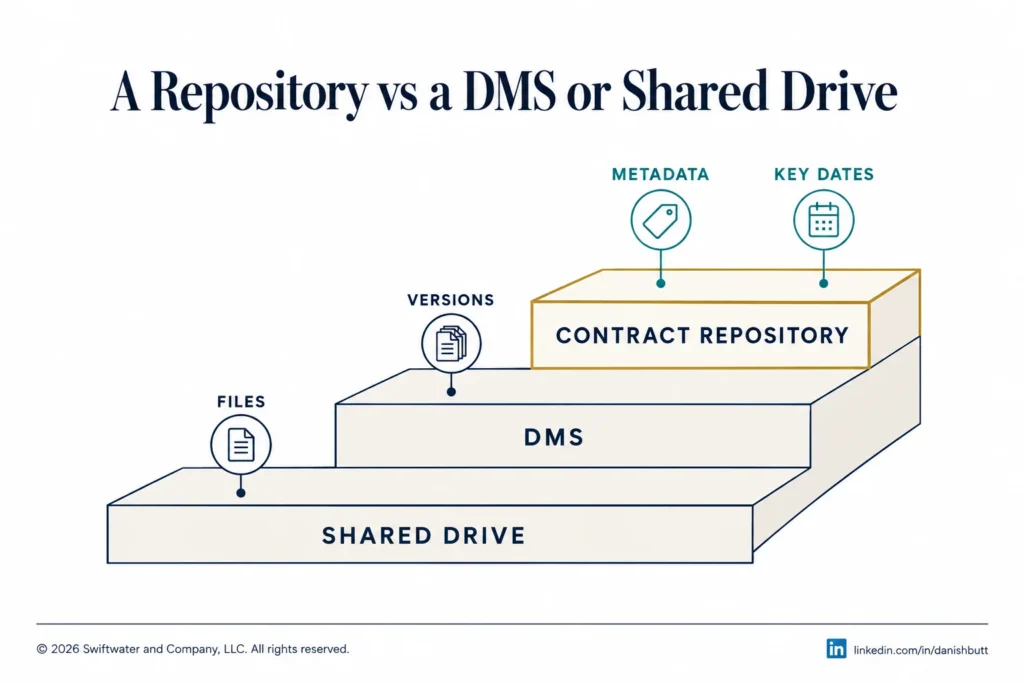
A shared drive stores files, and a document management system adds versioning, security, and matter-centric filing for all legal documents. A contract repository stores executed agreements as records with structured metadata, so it can answer questions such as which contracts renew next quarter or which suppliers are on counterparty paper. Each layer adds capability to the one before.
The three often run side by side: drafts and matter files in the DMS, the executed record in the repository, linked so a user can move between them. Trouble starts when executed contracts sit in several places with a record in none. WorldCC reports that, on average, contract-related data is scattered across 24 different systems. For the full system decision, see CLM vs ERP, CRM, and document management, and for documents more broadly, our guide to legal document management.
How do you populate a repository?
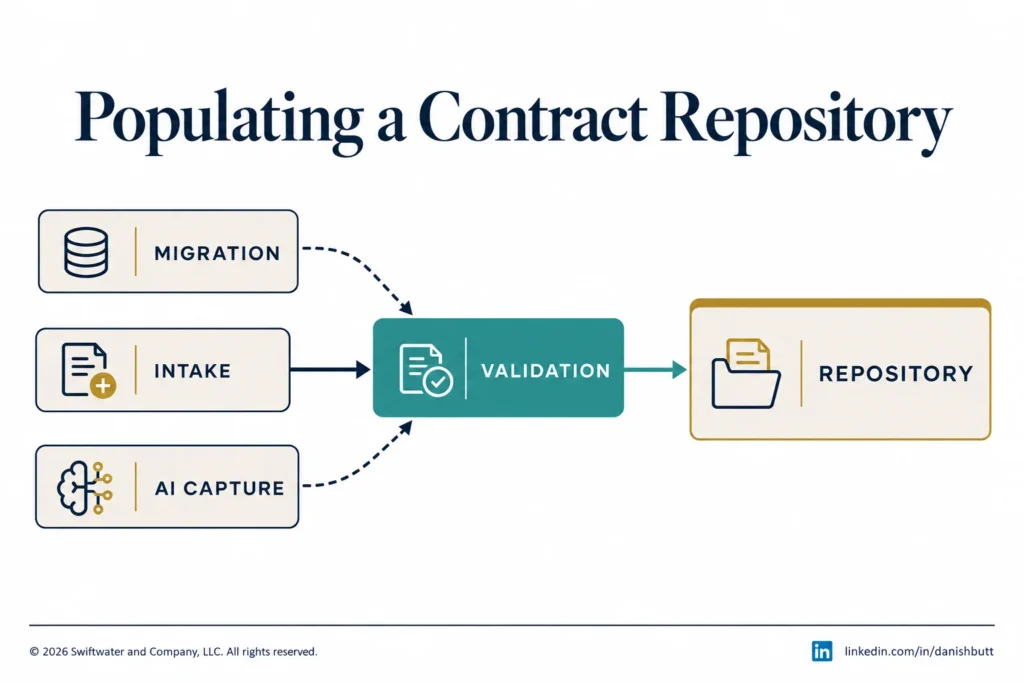
Three routes fill a repository: migration brings in the legacy backlog, intake and signature file every new contract automatically with its metadata, and AI extraction reads terms from documents that arrive without structured data. Most programs run all three, with a person checking the extracted fields before they become the record. Switch on the intake route first so the backlog stops growing.
- Migration. Existing contracts are collected, deduplicated, and loaded with key fields; see legacy contract migration.
- Intake and signature. Contract request and intake captures the core fields, and signature files the executed copy.
- AI capture. Extraction reads dates, values, and parties for a reviewer to validate; see contract intelligence.
Investment has run ahead of complete repositories. In World Commerce & Contracting research covering more than 1,200 organizations, 78% of organizations had made some investment in CLM over the past five years (The ROI of Contracting Excellence, 2023), against the 27% above storing every executed contract in CLM. The samples differ, so read the gap as direction.
Who owns the repository and the system of record?
One function owns the repository’s data standard, usually legal operations or a contracts team, even when several teams add to it. That owner sets the required fields, approves changes to them, and decides which system is the system of record when the CLM, the CRM, and the ERP each hold part of the contract. Shared input works well when one owner sets the rules.
When the CRM holds the deal value and the ERP holds payment details, the owner decides which system is authoritative for each field and how the others sync. The system of record boundary guide works through that decision; see also who owns contract management and the role of the contract manager.
How do you keep repository data clean?
Make the important fields required at intake, let the system fill what it can on signature, validate extracted data before it is saved, and audit a sample of records on a fixed cadence. Track data completeness as a metric, and give each field an owner who fixes errors at the source instead of patching reports downstream. Clean data comes from routine habits kept up over time.
- One numbering convention. Contract numbers follow one format across business units, and child documents carry the parent’s number.
- Audit trail on data changes. The log of who changed which field, when, and from what value is reviewed on schedule.
- A completeness metric. Report data completeness, the share of records with every required field filled, with the department’s other measures.
Bottom Line
The repository is where the lifecycle’s data comes to rest, and every later report, renewal, and audit reads from it. Most organizations have invested in a CLM without getting every executed contract into one place, and closing that gap is mostly a data standard and an intake habit.
Evaluating legal technology but not sure where to start?
We help legal departments cut through the vendor noise, mapping technology to process maturity and building a roadmap that actually gets adopted.
See Legal TechnologySet the fields and the owner first, then switch on the intake and signature route, then load the backlog. A repository is only as useful as its metadata, so set the fields, the owner, and the intake path before you load the first contract.
Swiftwater’s CLM implementations route every executed agreement into a governed repository, and our CLM administrators keep it accurate after go-live, from template and workflow changes to reporting and user support.
Frequently Asked Questions
What is a contract repository?
A contract repository is the single, searchable home for every signed agreement and the facts that matter about it: who it is with, what it is worth, when it renews, and who owns it. It holds the final executed version of every agreement with the fields people search and report on.
How do in-house legal teams maintain contract repositories?
They name one data owner, require the core fields at intake, file executed contracts automatically on signature, and audit a sample of records on a set cadence, with errors fixed at the source.
What features matter in contract repository software?
Metadata and full-text search, key-date alerts, parent and child linking, an audit trail, role-based access, and integration with intake, e-signature, and the CRM or ERP. See our guide to contract lifecycle management tools.
How do you audit contract data changes in a repository?
The audit trail records who changed which field, when, and from what value. Review it on a schedule, and always for records used in financial or compliance reporting.
How does a contract repository stay secure?
Permissions follow role, contract type, and business unit, sensitive fields can be restricted further, and every view and change is logged in the audit trail.
How can finance use a contract repository with AI?
Once AI-extracted value, payment, and renewal fields are validated, finance can use them in forecasting and spend reporting. See our CFO’s guide to CLM and contract intelligence.
How can a CLM track which contracts have been fully executed?
The status changes to executed when the signature step completes and the executed copy is filed. The execution date and signatories are recorded as metadata at the same moment.
How should contract numbers be assigned?
The repository issues a unique number at intake or on filing, using one convention across business units. Child documents carry a reference to the parent agreement’s number.
This article is provided for general informational purposes only and is not legal, financial, or business advice. Contract repository and data decisions should be validated against your organization’s specific structure, regulatory obligations, and counsel guidance, and you should consult a qualified professional for advice on your situation.