
Legal AI · Insights

The board wants to know what you’re doing with AI.
Here’s what actually works.

85% Of legal departments now have dedicated AI oversight or resources — up from less than half two years ago¹
GenAI adoption in corporate legal departments more than doubled in a single year²
94% Of active legal AI users cite contract review as the most widely adopted application²
Only 8.7% Of General Counsel own AI governance — despite owning enterprise risk and compliance³

↓ Check back frequently — we are adding legal AI guides, use cases, and implementation resources regularly. ↓

What is legal AI

Legal AI is the application of artificial intelligence to the work of in-house legal departments: contract review, legal research, document drafting, spend analytics, compliance monitoring, and matter management. It is not a single tool or platform. It is a category of capability that is being built into almost every system legal departments already use, and deployed as standalone tools for specific use cases.

The pace of adoption has been striking. Generative AI use in corporate legal departments more than doubled in a single year, according to the ACC’s 2025 survey of 657 in-house legal professionals across 30 countries.2 The question for most General Counsel and legal ops leaders is no longer whether to adopt legal AI. It is how to do it in a way that delivers measurable results, and how to answer for it when the board or C-suite asks.

Why the board question changes everything

The pressure to show AI progress is now coming from above the legal function. Boards and C-suite executives are asking General Counsel and Chief Legal Officers what the legal department is doing with AI, and they expect a credible answer, not a pilot status update.

That pressure has a structural consequence. According to a 2026 survey by Plexus, only 8.7% of General Counsel own AI governance in their organizations, despite the legal function’s direct responsibility for enterprise risk, compliance, and responsible AI deployment.3 Most AI governance sits with IT or the CIO. Legal departments that are not actively claiming this space are ceding it, and with it, the credibility that comes from demonstrating they understand the technology that is reshaping their risk environment.

The GCs who are answering the board question well are not the ones who deployed the most tools. They are the ones who can point to specific workflows that are faster, specific costs that are lower, and specific risks that are better managed, because they chose deployment over experimentation.

What legal AI is actually being used for

Legal research was the first area where AI proved its value in legal, and remains one of the highest-impact applications. The major research providers (Westlaw, Lexis, Bloomberg Law) moved decisively into AI-assisted research first, embedding large language models directly into the tools in-house teams already used. AI-assisted legal research reduces the time lawyers spend locating relevant precedent, analyzing regulatory history, and synthesizing case law across jurisdictions. For high-volume legal functions dealing with complex, multi-jurisdictional matters, the time savings compound quickly.

Contract review and drafting is the entry point for most legal departments that are moving beyond research. It has the clearest ROI, the lowest implementation risk, and the most immediate time savings.2 AI tools can review NDAs, MSAs, and standard commercial agreements for clause deviations, missing provisions, and non-standard risk positions, at a fraction of the time required for manual review. This is where most teams start after research, and where the results are most defensible to leadership.

Compliance and regulatory monitoring is the third major use case. AI monitoring of regulatory changes, flagging of organizational exposure, and automated analysis of new obligations is delivering measurable value in banking, energy, insurance, and pharmaceutical environments, sectors where the regulatory surface area is largest and the cost of missing a change is highest.2

Legal spend analytics and invoice review is where AI intersects with the financial discipline of the legal function. AI tools applied to billing data can identify non-compliant invoices, flag rate violations, and surface spend patterns that manual review misses. When integrated with eBilling and ELM systems, this creates a feedback loop between legal operations and legal technology that compounds in value over time.

Matter management and intake automation reduces the administrative load on legal teams by routing requests, classifying matters, and surfacing relevant precedents. For high-volume legal functions, automating intake reduces cycle time and frees lawyers for judgment-based work that AI cannot replace.

The shift to agentic AI

Most legal AI in production today augments human judgment. The next shift is toward AI that executes work autonomously, taking action within defined boundaries rather than just suggesting it. Agentic AI is moving legal operations from assistance to execution.

Early enterprise deployments show where this works and where it does not. Practical agentic AI use cases for corporate legal teams include contract triage, matter intake, obligation tracking, and renewal management. The enterprise picture is more nuanced. The same technology that promises autonomous execution also raises governance, accountability, and personhood questions that legal departments are uniquely positioned to engage with.

What separates deployment from a pilot

The ACC’s 2025 survey found that 91% of legal professionals cite efficiency as generative AI’s top benefit, but nearly 60% reported no noticeable cost savings yet.2 That gap is not a technology failure. It is a deployment failure. AI tools installed without process redesign, governance frameworks, and adoption programs deliver efficiency gains on paper that never show up in the budget.

The top barriers to realizing AI’s potential in legal departments are data quality, accuracy and reliability concerns, security and data privacy, and integration complexity. None of which are technology problems in isolation.3 They are organizational and operational problems that require structured programs, not tool purchases.

The departments achieving measurable outcomes from legal AI share three characteristics: they started with a specific, high-volume use case rather than a broad platform, validated through a structured readiness assessment; they built governance before they scaled; and they measured outcomes from the first deployment cycle, not the first vendor demo.

They also took adoption seriously. AI tools deployed against organizational resistance deliver less value than tools chosen and rolled out with the team rather than at it.

How Swiftwater approaches legal AI

Swiftwater’s legal AI practice works with General Counsel, legal leaders, and legal ops managers to move from evaluation to deployment, with a structured framework for identifying where AI creates real leverage in the specific context of their department, managing the governance and data requirements, and measuring outcomes in terms the business can hold the legal function accountable for.

We implement legal AI platforms, integrate them with existing ELM and CLM systems, and build the operational programs around them that determine whether the investment delivers or disappears.

The Swiftwater AI Lab, led by our AI practice, is focused on applied AI research and deployment for legal departments ready to move beyond the pilot stage. (AI Lab page coming soon.)

Every engagement is led by a named senior practitioner with prior experience working in or with in-house legal functions. Not a junior team managed from a distance.

1 CLOC, 2026 State of the Industry Report (Harbor Law Department Survey), March 2026.

2 ACC / Everlaw, Generative AI’s Growing Strategic Value for Corporate Law Departments, October 2025.

3 Plexus, Future-Ready General Counsel 2026, March 2026.

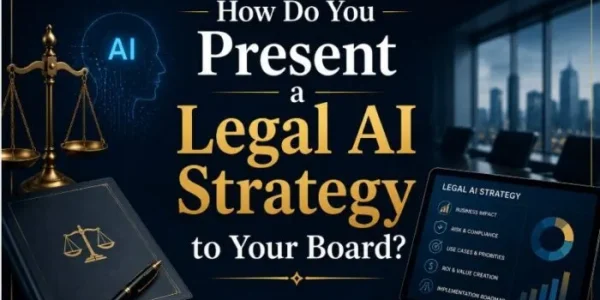
How Do You Present a Legal AI Strategy to Your Board

How Do You Present a Legal AI Strategy to Your Board?

Boards are asking general counsel about AI strategy. This guide explains how to present legal AI as a business initiative, quantify its value, address risk, and deliver a structured roadmap that earns executive confidence.

What Can an AI Legal Assistant Do for In-House Teams

What Can an AI Legal Assistant Do for In-House Teams?

AI legal assistants can automate drafting, research, and contract review, but their value depends on how they are deployed. This guide explains where they deliver impact, where they fall short, and how in-house teams should use them effectively.
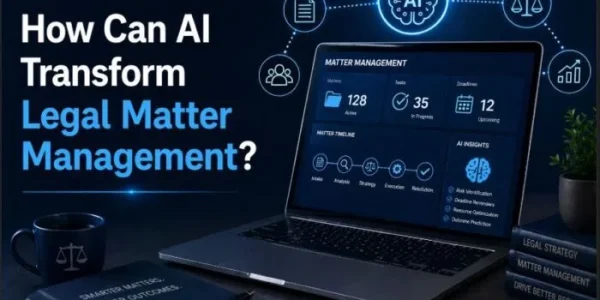
How Can AI Transform Legal Matter Management

How Can AI Transform Legal Matter Management?

AI is transforming legal matter management by automating intake, improving routing, and increasing visibility. This guide explains how in-house teams can manage matters more efficiently and scale legal operations without increasing resources.
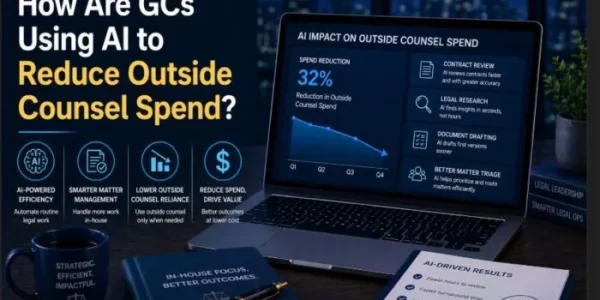
How Are GCs Using AI to Reduce Outside Counsel Spend

How Are GCs Using AI to Reduce Outside Counsel Spend?

General Counsel are using AI to reduce outside counsel spend by bringing work in-house, tightening billing review, and optimizing matter allocation. This guide covers the use cases, the benchmarks, and where current AI bill review tools still fall short.
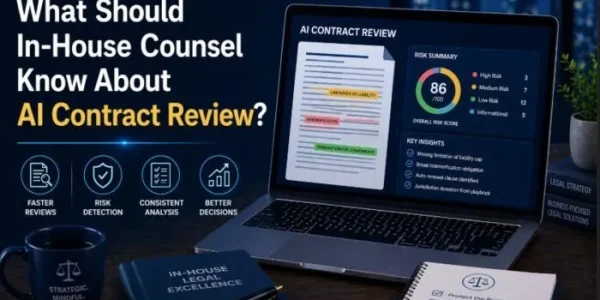
What Should In-House Counsel Know About AI Contract Review

What Should In-House Counsel Know About AI Contract Review?

AI contract review can significantly reduce review time and improve consistency, but only within defined workflows and against a documented playbook. This guide covers the current tool landscape, where AI is actually useful, and how in-house teams should deploy it effectively.
How Is Agentic AI Being Used in Enterprise Legal Operations

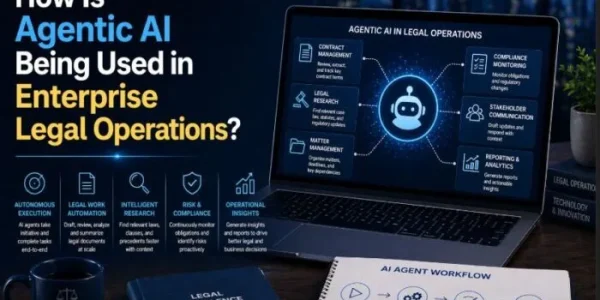
How Is Agentic AI Being Used in Enterprise Legal Operations?

Agentic AI is shifting legal operations from assistance to autonomous execution. This guide covers enterprise use cases, the current platform landscape, the agency and personhood questions agentic AI raises, and how in-house teams can adopt it while maintaining control and governance.

What Is Legal AI Governance

What Is Legal AI Governance?

Legal AI governance is not a policy document. It is the operating model a general counsel uses to oversee AI usage, vendor risk, human review, and accountability across the legal function. Here is what it actually looks like in practice.

Is Your Legal Department Ready to Deploy AI

Is Your Legal Department Ready to Deploy AI?

Most general counsel believe their legal department is ready for AI, but readiness goes beyond tools. This assessment framework helps in-house teams evaluate data, processes, governance, and adoption capability before deploying legal AI.
How Should In-House Legal Teams Evaluate AI Tools

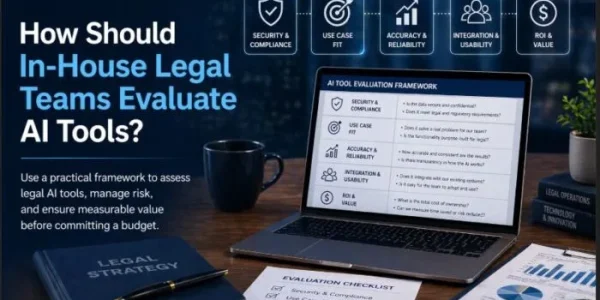
How Should In-House Legal Teams Evaluate AI Tools?

In-house legal teams are rapidly adopting AI, but most lack a structured way to evaluate tools. This guide outlines a practical framework to assess legal AI solutions, manage risk, and ensure measurable value before committing a budget.
Next Step

Know what works. Deploy it safely. Measure what it delivers.

Start with a 30-minute discovery call. A senior Swiftwater practitioner — not a business development executive — will be on the call.

Book a Discovery Call

Or explore our Legal Technology services →