
Retail contract management covers supplier, lease, franchise, and influencer agreements at scale. Retail runs on thin margins, and the money is made on turnover: the right product on the shelf or the site at the right moment, at the right cost. A seasonal product drop or a new year sale can make or lose a quarter, so the supplier, logistics, and influencer contracts behind it have to be signed in days. That puts every retail legal team in the same position: balancing risk with speed, across thousands of agreements and many requesters.
This guide covers the key contract types in retail, the laws and pressures behind them, who owns them, and what a CLM has to handle. It is part of our guide to contract management by industry and our guide to the seven stages of the contract lifecycle.
What does contract management cover in retail?
Contract management in retail covers buying and supply, real estate, franchising and partnerships, marketing and influencers, and the technology and services behind every storefront, digital and physical. Buying and marketing produce the most contracts, real estate holds the longest commitments, and franchising carries the most formal disclosure rules.
- Buying and supply. Supplier and vendor agreements for goods for resale, with pricing, rebates, delivery, and compliance terms, often across many countries.
- Real estate. Store, warehouse, and distribution center leases, with renewal options and rent reviews.
- Franchising and partnerships. Franchise agreements, licensing, and retail partnership agreements.
- Marketing and influencers. Agency, sponsorship, and influencer agreements, often small in value and large in number.
- Storefronts and services. E-commerce platforms, marketplaces, payment, logistics, and software agreements that run the digital and physical stores.
How do retailers balance speed and risk in contracting?
Retailers balance speed and risk by deciding in advance which contracts can move on approved terms without legal and which ones need a lawyer, and by treating supplier size and seasonality as part of that decision. The goal is that the contracts behind a launch or a sale are never the reason it is late.
Three features of retail make this harder than in most industries:
- Seasonal peaks. Holiday, back-to-school, product drops, and sales concentrate contracting into a few weeks. Templates, approvals, and supplier onboarding need to be ready before the peak, because there is no time to negotiate during it.
- Many jurisdictions and storefronts. Suppliers, marketplaces, and influencers may sit in different countries and sell through both online and physical channels, each with its own terms on returns, data, and consumer protection.
- Suppliers of every size. Some suppliers are much larger than the retailer and insist on their own paper; others are small businesses that need short, plain terms to sign quickly. A single template rarely fits both.
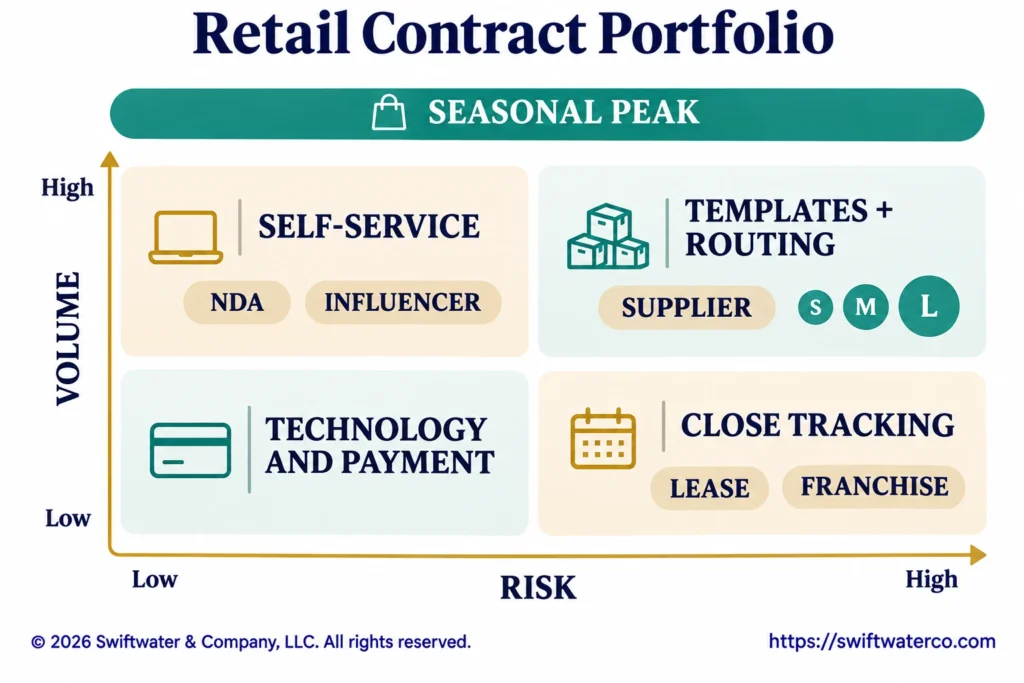
The practical answer is tiers: self-service templates for small, standard agreements, pre-approved fallbacks for mid-sized suppliers, and lawyer review reserved for large suppliers’ paper, high-value deals, and new markets.
What are the key contract types?
Supplier agreements and influencer and marketing agreements are the most numerous in retail, and leases carry the largest long-term commitments. Sorting them by volume and risk shows which belong in self-service and which need close tracking of dates.
Evaluating or implementing a CLM platform?
We have guided legal departments through selection, implementation, and adoption, without the vendor bias. Let us talk about where you are and what you actually need.
See CLM Services| Contract type | Counterparty | What the CLM tracks |
|---|---|---|
| Supplier and vendor agreements | Suppliers of every size | Pricing, rebates, delivery terms, compliance terms, renewals |
| Store and distribution leases | Landlords | Renewal options, rent reviews, key dates |
| Franchise agreements | Franchisees | Disclosure dates, term, renewals, standards |
| Influencer and marketing agreements | Creators and agencies | Fees, usage rights, disclosure terms, campaign dates |
| E-commerce and marketplace agreements | Platforms and partners | Fees, data terms, service levels |
| NDAs | Partners and suppliers | Self-service, expiry |
| Technology and payment agreements | Vendors | Security and data terms, service levels, renewals |
The table is illustrative; a grocery chain, a fashion brand, and a franchise system weight these rows differently.
Which laws and regulators apply to retail contracts?
Retail contracts are affected by franchise disclosure, advertising and endorsement rules, lease accounting, and payment security. In the United States, the FTC’s Franchise Rule requires franchisors to give prospective franchisees a disclosure document before they sign or pay. The FTC’s guidance on endorsements, summarized in Disclosures 101 for Social Media Influencers, sets expectations for how influencers disclose a brand relationship, which is why influencer agreements carry disclosure terms.
Two more drivers sit with finance and IT. Lease accounting under ASC 842 needs lease data, such as term, options, and payments, taken from the lease contracts. Vendors that handle payment card data fall under the PCI Data Security Standard, so their contracts carry security terms. Retailers selling in several countries also face local consumer protection and data rules.
These rules are listed for reference only; counsel and compliance teams should interpret how each applies to the business.
Who owns contracts in retail?
In most retailers, the business function that manages the counterparty owns the contract: merchandising and buying own supplier agreements, real estate owns leases, franchise development owns franchise agreements, marketing owns agency and influencer agreements, and e-commerce owns platform and marketplace agreements. Procurement owns indirect spend. Legal sets the templates, the self-service rules, and the escalation paths.
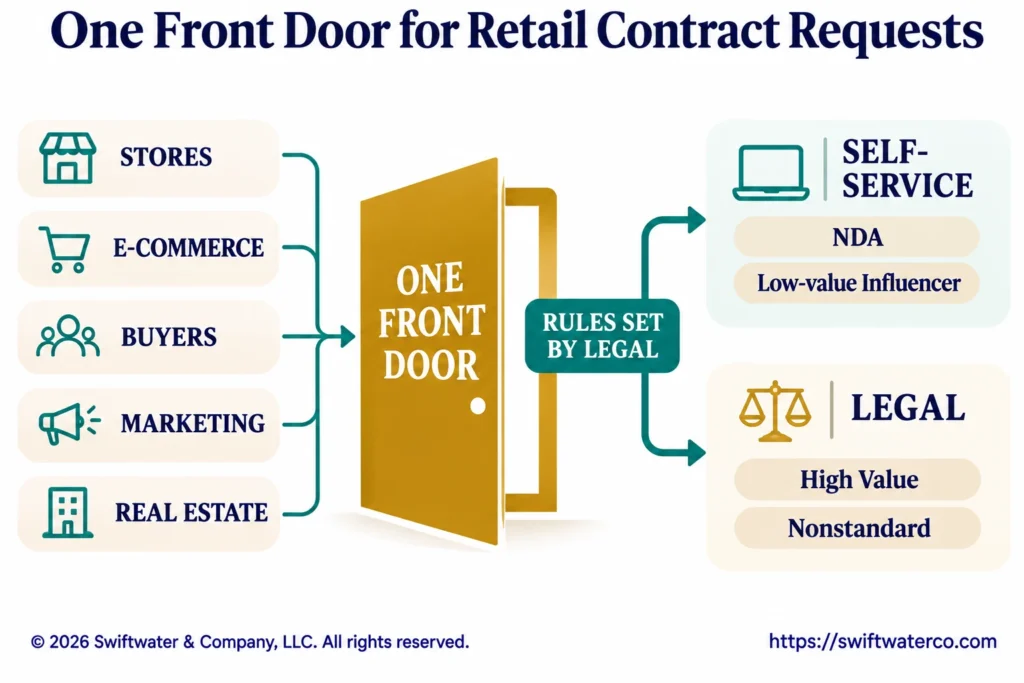
That spread of owners is why retail intake matters so much. Without one front door, each team emails the lawyer it knows, and nobody sees the total volume until the peak season exposes it. Our guides to who owns contract management and contract management in procurement cover the roles.
What does a CLM have to handle?
A CLM in retail has to handle speed and volume from many requesters: one front door, self-service templates for routine agreements, tiered terms for suppliers of different sizes, key-date tracking for leases and franchises, supplier obligations after signature, and reporting by brand, channel, and region.
- One front door. A single request form for every store, brand, buying team, and e-commerce team, with triage behind it. See contract request and intake.
- Self-service templates. NDAs and low-value influencer and marketing agreements completed by the business from approved templates, with rules that pull higher-value or nonstandard deals to a lawyer. See how to automate NDAs.
- Tiered supplier terms. Short terms for small suppliers, approved fallbacks for mid-sized ones, and a review path for large suppliers’ paper, ready before each season. See templates, clause libraries, and playbooks.
- Key dates. Lease options, rent reviews, franchise renewals, and campaign end dates with alerts and owners. See contract renewal management.
- Supplier and vendor obligations. Rebates, delivery and compliance terms, and the security, data, and AI duties of technology vendors, tracked after onboarding. See supplier agreement management.
- Volume reporting. Requests and contracts by brand, channel, region, and type, from one contract repository.
What does a typical lifecycle problem look like?
A typical retail problem is a legal team buried in routine requests it cannot see or count. A global retail conglomerate’s legal function was running on a shared mailbox, with lawyers across several jurisdictions, and the first priority was simply to see the workload: who was asking for what, from where, and how much of it there was.
Our team replaced the mailbox with a structured intake process. All requests landed in a single triage pot owned by named triage leaders. Self-service handled requests that did not need a lawyer, starting with NDAs, which the business now completes without legal involvement. Influencer contracts, which could range from a $150 agreement to a $150,000 deal, were built for self-service at the low end, with escalation rules that pulled higher-value and nonstandard agreements to a lawyer. Routing was invisible to the requester, and the front door reached 100% adoption. Our article on the legal intake process tells the full story.
The influencer rules show the retail balance in practice: speed where the risk is small, a lawyer where the value or the terms call for one.
Which pages to read next?
- Contract management by industry, for how retail compares with other industries.
- Who owns contract management, for the roles of legal, procurement, and the business.
- Contract request and intake, for designing the front door.
- How to automate NDAs, for the usual first self-service project.
- Supplier agreement management, for managing suppliers after signature.
- Contract management in procurement, for buy-side contract work.
Bottom Line
Retail makes its money on turnover at thin margins, so contracts have to move at the speed of the season. Supplier agreements come from businesses of every size across many countries, influencer and marketing agreements arrive by the hundred before a launch, and leases and franchise agreements carry dates years ahead. Every one of them has a business owner, and legal’s job is to set rules that let most of them move without a lawyer.
Speed and control both come from deciding the risk tiers before the peak: one front door for every request, self-service for small standard agreements, approved fallbacks for mid-sized suppliers, and lawyer time saved for large suppliers’ paper and high-value deals. Alerts take care of the lease, franchise, and campaign dates. In retail, speed is margin, so the contract process has to be ready before the season: one front door, templates the business can use on its own, and legal review saved for the deals that carry real risk.
Our contract management solutions help retail and consumer legal teams build one front door for contract requests, set self-service and tiered supplier templates, and configure the CLM behind them.
Evaluating legal technology but not sure where to start?
We help legal departments cut through the vendor noise, mapping technology to process maturity and building a roadmap that actually gets adopted.
See Legal TechnologyFrequently Asked Questions
What is retail contract management?
Retail contract management covers supplier, lease, franchise, and influencer agreements at scale. It includes one intake for requests from stores, brands, buying, and e-commerce teams, self-service templates for routine agreements, tiered terms for suppliers of different sizes, key-date tracking for leases and franchise renewals, and supplier obligations after signature.
Which retail contracts can be self-service?
NDAs are the usual first self-service contract, followed by low-value influencer and marketing agreements, standard terms for small suppliers, and routine services agreements. Self-service works when legal has approved the template and set rules that send higher-value or nonstandard deals to a lawyer.
How should a retailer prepare contracts for a seasonal peak?
Prepare before the season starts: approve the templates and fallbacks the peak will need, onboard new suppliers and influencers early, set approval rules so routine agreements do not wait for legal, and agree who reviews the exceptions. During the peak, track campaign and delivery dates so obligations are met.
How does a CLM handle influencer agreements?
A CLM handles influencer agreements with a template the marketing team completes on its own, rules that route agreements above a value threshold or with nonstandard terms to legal, and fields for fees, usage rights, disclosure terms, and campaign dates. Volume reporting then shows spend and obligations by brand.
Who owns supplier contracts in retail?
Merchandising and buying teams usually own supplier agreements for goods for resale, and procurement owns indirect spend such as services and technology. Legal owns the templates and negotiating positions, and the supplier’s business owner is responsible for rebates, compliance terms, and renewals.
This article is provided for general informational purposes only and is not legal, financial, or business advice. Retail contract management decisions should be validated against your organization’s specific structure, regulatory obligations, and counsel guidance, and you should consult a qualified professional for advice on your situation.