

Contract management KPIs measure how quickly, reliably, and profitably an organization moves contracts from request through renewal. Ask most general counsel without a real-time dashboard how long a contract takes, and the answer is a guess. Ask which renewals are coming next quarter, and someone goes looking through a spreadsheet. A short set of measures replaces those guesses with numbers, and gives legal something concrete to bring to the CFO and the board.
This guide lists the ten KPIs worth tracking, gives a formula for each, walks through a cycle time calculation, and explains how to report the results. It covers contract metrics only. For the wider department view, see our guide to legal department KPIs. It is part of our contract lifecycle management guide.
What are contract management KPIs?
Contract management KPIs are the measures an organization uses to judge how well its contracting works. They cover speed, such as how long a contract takes; value, such as how much is lost after signature; compliance, such as whether obligations are met; and adoption, such as whether people use the process. A useful set is short, comes from data you already hold, and points to a decision someone can make.
Start with what the system can already report. A number that takes two days of spreadsheet work each month tends to stop being produced. If your contract data is still scattered, begin with a contract repository and two or three measures, then add more as the data improves.
Which ten KPIs matter?
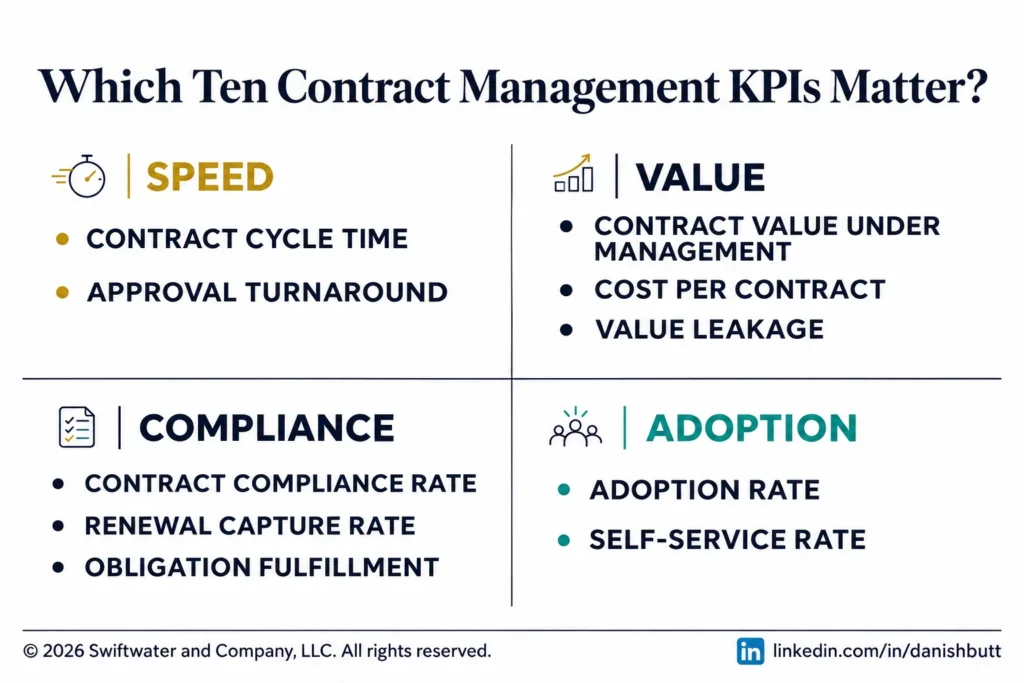
Ten KPIs cover most of what a legal department needs: contract cycle time, approval turnaround, contract compliance rate, renewal capture rate, obligation fulfillment, contract value under management, cost per contract, value leakage, adoption rate, and self-service rate. Few teams should launch all ten at once. Pick the three or four tied to your biggest current problem, and add the others as your data becomes reliable.
- Contract cycle time. Days from a complete request to full signature. Report the median by contract type.
- Approval turnaround. Hours or days from submission for approval to the final approval decision.
- Contract compliance rate. Contracts on approved templates or within playbook positions, divided by all contracts signed.
- Renewal capture rate. Renewals reviewed and decided before the notice deadline, divided by all renewals due.
- Obligation fulfillment. Tracked obligations met on time, divided by all tracked obligations due.
- Contract value under management. Total value of active contracts held in the system of record.
- Cost per contract. Internal time and outside spend on contracting, divided by contracts completed.
- Value leakage. Expected contract value minus realized value, divided by expected value.
- Adoption rate. Contracts that went through the approved route, divided by all contracts signed.
- Self-service rate. Contracts completed by the business with no legal touch, divided by all contracts in eligible categories.
The obligation and renewal measures depend on good records. Our guides to contract obligation management and contract renewal management explain how to set those up.
How do you calculate contract cycle time?
Calculate contract cycle time by counting the days between a complete request and the last signature, then reporting the median for each contract type. Use the median because one contract stuck for six months will distort an average. Keep NDAs and complex agreements apart, since combining them produces a number that describes neither. Define the start and end dates once, in writing, and use them every time.
Evaluating or implementing a CLM platform?
We have guided legal departments through selection, implementation, and adoption, without the vendor bias. Let us talk about where you are and what you actually need.
See CLM ServicesHere is an illustrative example. A team completes five sales agreements in a month, taking 12, 18, 21, 25, and 94 days. The average is 34 days, which suggests a slow process. The median is 21 days, which is closer to the typical experience. The 94-day contract deserves its own look, and it should not set the headline number.
Break the total down by stage when you can. If a contract spends three days in drafting and two weeks waiting on approval, the fix is in contract workflow and routing, and the drafting team was never the problem.
I helped a telecommunications client review its contract cycle time. For one type of MSA, the total was expected to run 30 to 40 days, and the business had long said that most of the delay sat with legal. Once we confirmed the overall number, we looked at the handoffs across six months of prior data. Legal was spending an average of 3 to 4 elapsed days of the entire cycle, including the back and forth. When the business, finance, and the other teams saw that, they did not want to believe it.
Legal had become the contract’s project manager. It was the traffic cop and the signature collector, so the contract always appeared to be with legal, even though it spent most of its time elsewhere. The underlying problem was process and change management, and our recommendations to leadership addressed that cause and the perception it had created.
How do you report KPIs to the General Counsel?
Report a small set on a regular schedule, showing the trend against the previous period and one sentence on what changed. The general counsel needs to know where work is stuck, which risks are approaching, and what decision is needed. A monthly page with four or five measures will get read. Keep operational detail for the team that can act on it.
Board and CFO reporting needs fewer numbers and more money. Value under management, renewals coming due, and value leakage speak directly to finance. Our CFO’s guide to CLM covers how contract data supports the business case.
What does a contract management dashboard show?
A contract management dashboard shows where contracts are now, what is coming due, and whether the process is improving. A good layout answers those three questions on one screen. The top row holds current work: open requests, contracts waiting by stage, and the oldest items. The next row looks ahead at renewals and obligations. The bottom row shows trends in cycle time and adoption, by contract type and by team.
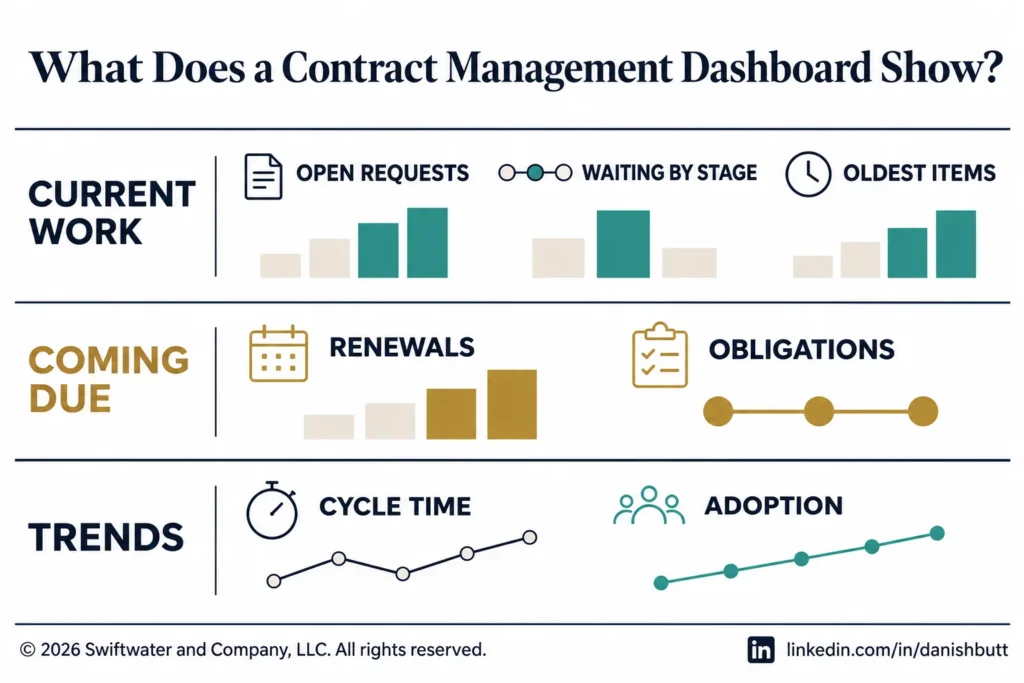
Build the dashboard around the people who use it. Sales wants to know where a deal stands. Procurement wants supplier renewals. Legal operations wants the bottlenecks. Filters by contract type, business unit, and owner usually matter more than extra charts.
How do KPIs connect to legal department KPIs?
Contract KPIs are one part of the wider set a legal department tracks. Department measures cover areas such as outside counsel spend, matter volume, and staffing, while contract measures explain what is happening in one high-volume workflow. Contract cycle time usually feeds the department’s turnaround reporting, and cost per contract feeds its view of spend. Use the same definitions in both places so the numbers agree.
Our legal department KPIs guide covers the department-level view. Where measurement fits in a longer improvement program is covered in the contract management maturity model.
What benchmarks exist?
Published benchmarks exist for a few measures, and they are best read as direction. Definitions and sample groups vary, so a figure from another company’s data may not match how you count. Ironclad’s 2025 Contracting Benchmark Report puts the average time to execute a contract at 42 days, based on data from its own customers. Your own trend over time will usually tell you more.
WorldCC (formerly IACCM) reports that the best performers operate almost 4 times faster than the worst on contract cycle time. On value, its research finds the average business loses almost 9% of value annually through poor contract management; the best performers lose about 3% and the worst 15% or more. And in the Association of Corporate Counsel’s 2019 benchmarking survey, as cited by Onit, billion-dollar companies using contract management technology cut average cycle time by 33%, from 30 days to 20.
Bottom Line
A few agreed measures, defined once and reported on a regular schedule, will do more for most legal departments than another data project. They let a conversation about contracting start from a number.
Begin with the measures tied to your biggest current problem, and add others as your data earns the trust. Choose three or four KPIs, define them in writing, and report the trend every month.
Swiftwater’s CLM administration service keeps the reports legal and the business use accurate after go-live, along with template, workflow, and approval updates.
Evaluating legal technology but not sure where to start?
We help legal departments cut through the vendor noise, mapping technology to process maturity and building a roadmap that actually gets adopted.
See Legal TechnologyFrequently Asked Questions
What are contract management KPIs?
Contract management KPIs measure how quickly, reliably, and profitably an organization moves contracts from request through renewal. Common examples include contract cycle time, renewal capture rate, obligation fulfillment, value leakage, and adoption rate. A useful set is short, comes from data the organization already holds, and points to a decision someone can make.
Which contract KPIs should go to the board?
Keep board reporting to a few measures tied to money and risk: contract value under management, renewals coming due, value leakage, and any overdue critical obligations. Show the trend and a sentence on what changed. Operational measures such as approval turnaround belong in the legal team’s own reporting.
How do legal operations teams measure contract management efficiency?
Legal operations teams usually combine a speed measure, a cost measure, and an adoption measure. Contract cycle time and approval turnaround show speed, cost per contract shows effort, and adoption and self-service rates show whether the process is being used. Reviewing them by contract type shows where the delays are.
How do you use KPIs for successful contract management?
Tie each KPI to a problem you want to solve, name an owner, and agree on what action a bad number triggers. Define every measure in writing so it is calculated the same way each period. Review the results on a regular schedule, and retire any measure that no longer leads to a decision.
What is a good contract cycle time?
It depends on the contract type and on how you count. A standard NDA should move far faster than a negotiated supply agreement. Published averages can give a sense of direction, but your own median by contract type, tracked over time, is a more reliable guide to whether you are improving.
What is the difference between contract analytics and contract KPIs?
KPIs are the specific measures you track over time, such as cycle time or renewal capture rate. Contract analytics is the wider practice of examining contract data to answer questions, such as which terms are most often negotiated. Analytics often helps explain why a KPI is moving.
This article is provided for general informational purposes only and is not legal, financial, or business advice. Contract management and reporting decisions should be validated against your organization’s specific structure, regulatory obligations, and counsel guidance, and you should consult a qualified professional for advice on your situation.