

CLM for General Counsel means setting the contract rules, controlling risk, and reporting on contract value and obligations. The General Counsel answers for every contract the company signs, yet most of them are routine. When each one waits for a lawyer, legal becomes the bottleneck the business complains about. When none of them do, risk slips through on terms nobody approved.
This guide covers what a General Counsel needs from contract lifecycle management, what to measure, how to keep control without slowing the business, and who should run the platform. It is part of our guide to who owns contract management and our contract lifecycle management guide.
What does a General Counsel need from CLM?
A General Counsel needs contract lifecycle management to give visibility of every contract and its risk positions, enforce the company’s standard terms, record who approved what, and report on contracting to the executive team and the board. The platform should make the legal department’s rules the default path for the business, so lawyers spend their time on exceptions.
- Visibility. Every contract, its counterparty, value, dates, and key terms in one repository.
- Enforced standards. Templates and a playbook that set the positions and fallbacks; see templates, clause libraries, and playbooks.
- An audit trail. Who requested, edited, approved, and signed each contract.
- Reporting. Up-to-date reporting for the General Counsel, leadership, and the business on contract value, operations, risk, and obligations, including upcoming renewals.
The order matters. A platform installed before the templates, playbook, and ownership are agreed tends to automate the existing confusion. Most of the problems a legal department blames on its system are readiness and business problems, so the General Counsel’s first decisions are about rules and owners, and the platform comes after. Our guide to CLM readiness and change management covers that groundwork.
What does a General Counsel measure?
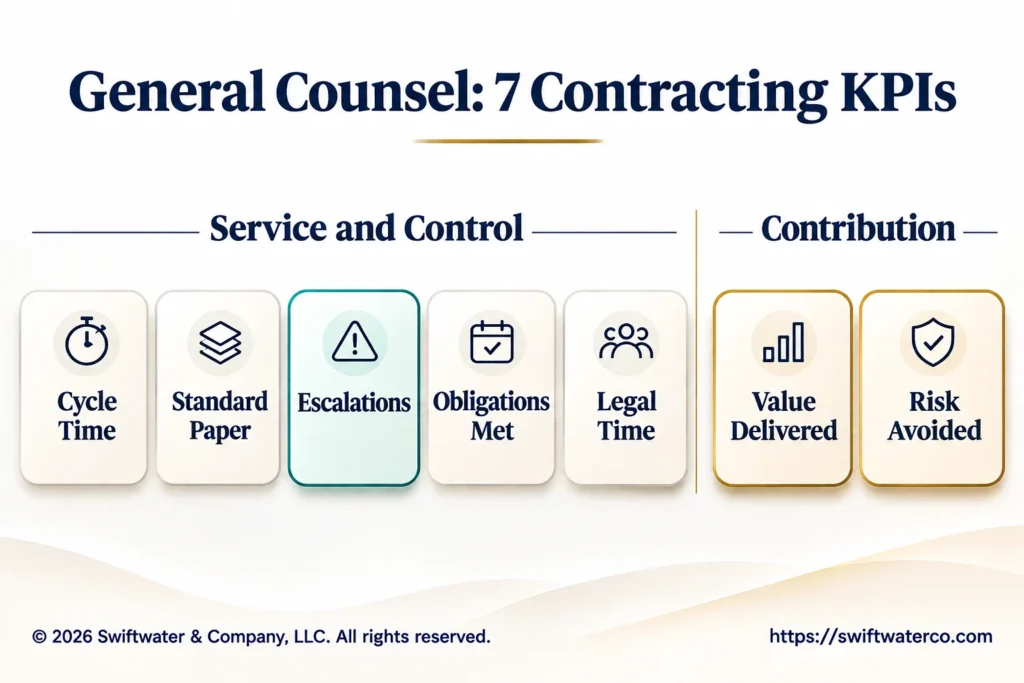
A General Counsel measures how fast contracts move, how much of the volume runs on standard terms, how often exceptions reach legal, whether obligations are met, and how much lawyer time goes to low-value contracts. Just as important are the value the contracts deliver and the risk avoided: nonstandard terms caught before signature, obligations and renewals handled before a deadline passed, and savings or revenue that would otherwise have been lost. Together those measures show service to the business, control of risk, and what the legal department contributes to the bottom line. Our contract management KPIs page defines them, and our legal department KPIs guide covers the wider department.
How does a General Counsel keep control without becoming the bottleneck?
A General Counsel keeps control by writing the rules into templates and playbooks, letting the business self-serve within them, and reviewing only the exceptions. The rules carry the control, and lawyers see the contracts that need judgment. Gartner predicts that by 2029, approximately 50% of contract reviews will be delegated to self-service systems that escalate only one in 10 for human review (Gartner, May 2026).
- Set the rules. Standard positions, fallbacks, and escalation triggers in a playbook.
- Let the business self-serve. NDAs, influencer agreements, order forms, and standard supplier terms generated from templates.
- Route the exceptions. Anything beyond the fallbacks reaches legal with context attached.
- Review the pattern. Exceptions that recur become new fallbacks or new rules.
AI review now carries part of the exception load. Our guides to AI contract review and AI for in-house legal teams cover where it fits.
Evaluating or implementing a CLM platform?
We have guided legal departments through selection, implementation, and adoption, without the vendor bias. Let us talk about where you are and what you actually need.
See CLM Services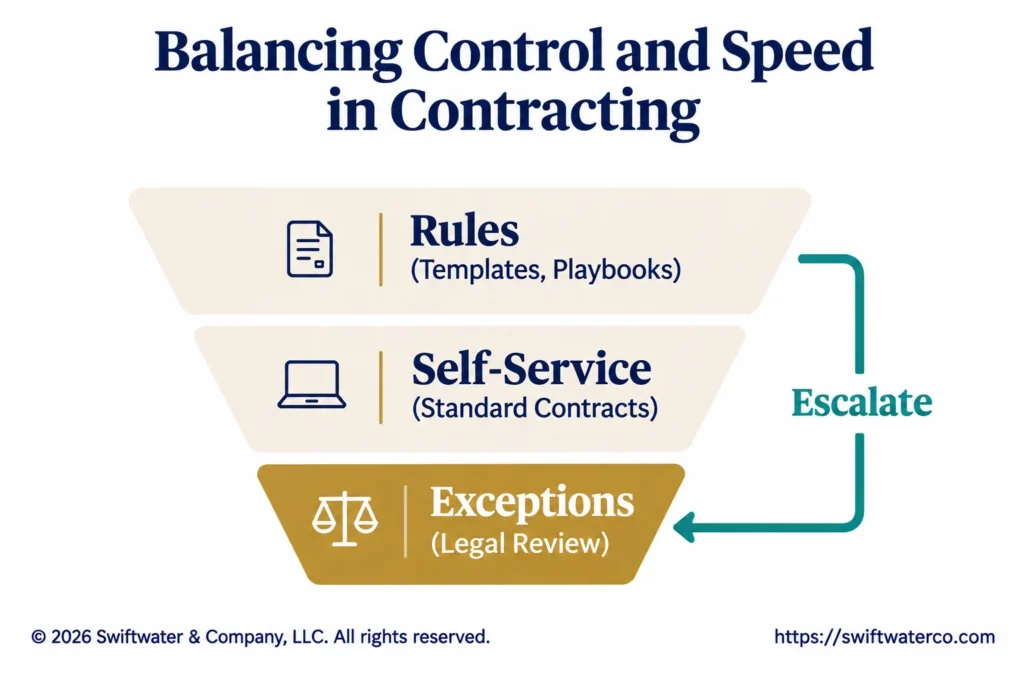
How does legal work with the other contract owners?
Legal works with each contract owner on the terms that carry risk: with procurement on supplier paper and risk allocation, with sales on liability, customer paper, and deal timing, and with finance on approval thresholds and payment terms. Each function owns its contracts and the relationship behind them; legal sets the positions they negotiate within and decides the exceptions. The partnership works best when every owner uses the same playbook in the same system, knows which decisions are theirs, and can see when legal is needed. Our guide to who owns contract management sets out the split by contract type.
The General Counsel can also co-sponsor the CLM program with a business leader, such as the Chief Revenue Officer or the Chief Product Officer. Co-sponsorship ties the program to how the company sells and grows, brings business budget and adoption, and gives legal a seat in decisions about how contracting supports growth. The shared data then points to the work: legal positions conceded on most deals that could move to standard and speed deals up, hand-offs with sales where deals wait, and, with procurement, supplier terms, renewals, and obligations that need tighter control.
Which stages does legal own?
Legal owns the rules for authoring, negotiation, and approval, and the exceptions at every stage. In the seven stages of the contract lifecycle, legal sets the templates (authoring and drafting), the positions and fallbacks (negotiation and redlining), and the approval rules (review and approval). The business owners usually run request and intake, execution, monitoring, and renewal, and legal may be involved in those stages too: triaging requests that need legal review at intake, tracking obligations with regulatory weight during monitoring, and reviewing renewals where the terms change. Legal also steps in on disputes and terminations.
Who runs the CLM for the General Counsel?
Legal operations usually runs the CLM for the General Counsel: the platform, the templates, the workflows, the data, and the reports. The Blickstein Group’s 18th annual survey of 68 companies found that legal operations is responsible for contract management in 53.9% of departments. Teams are small: the 2026 ACC Law Department Management Benchmarking Report puts it at one legal operations professional for every eight lawyers.
When there is no one to run it, the platform stalls after go-live. Our guides to legal operations roles and the legal operations function cover the options, including a fractional CLM administrator.
Which pages should a General Counsel read next?
A General Counsel planning or resetting contract management usually needs five more pieces:
- Who owns contract management: how legal, procurement, sales, and finance split the work.
- Contract management KPIs: what to measure and report.
- The contract management maturity model: where the department stands today.
- CLM readiness and change management: what to fix before a platform.
- The CFO’s guide to CLM: the business case the CFO will ask for.
Bottom Line
CLM gives a General Counsel control of contract risk without reviewing every contract. The control sits in the rules: templates, a playbook with fallbacks, approval routing, and an audit trail. The same platform keeps the General Counsel informed and gives the business up-to-date reporting on contract value, operations, risk, and obligations, so sales, procurement, and finance can see where their contracts stand without asking legal.
That makes the General Counsel a partner in growth as much as a guardian of risk. Co-sponsoring the program with the Chief Revenue Officer or the Chief Product Officer ties it to how the company sells. The data shows where to act: positions to improve so deals close faster, hand-offs with sales that slow deals down, and supplier terms, renewals, and obligations to tighten with procurement. A General Counsel who writes the rules into the platform, co-sponsors it with the business, and acts on its reporting gets faster deals, fewer surprises, and a clear record of the value and risk in every contract.
Our contract management solutions help General Counsel and legal operations leaders set up self-service contracting, implement and run a CLM, and manage the change across the business.
Frequently Asked Questions
What is CLM for General Counsel?
CLM for General Counsel means setting the contract rules, controlling risk, and reporting on contract value and obligations. Legal sets the templates, positions, and approval rules in the platform, routes exceptions to lawyers, keeps an audit trail of approvals, and gives the General Counsel and the business up-to-date reporting on value, operations, risk, and obligations. Self-service for standard contracts is one part of it.
Should the General Counsel own the CLM?
It is recommended that the General Counsel own or co-sponsor the CLM, though this varies with organization size. Ownership is often split in practice: in a 2021 EY Law and Harvard Law School survey, legal, contracting, and business development professionals each said their own function leads contracting. In larger organizations a Chief Commercial Officer may own it, or duties may be divided between procurement and sales, with legal setting the rules.
What should a General Counsel measure in contracting?
Measure contract cycle time, the share of contracts on standard terms, the exception rate reaching legal, obligations met, and lawyer time spent on low-value contracts, plus the value contracts deliver and the risk avoided, such as nonstandard terms caught before signature and renewals handled before the notice date. Together they show service to the business, control of risk, and what legal contributes to the bottom line.
How can CLM support the work of a corporate legal advisor?
CLM takes routine contracts off a corporate lawyer’s desk through templates and self-service, sends exceptions with context attached, and keeps every contract and its history in one place. Its reports show where positions slow deals and where risk sits, so the lawyer can advise leadership with data.
How does a General Counsel reduce legal bottlenecks in contracting?
Put standard positions and fallbacks into a playbook, let the business generate NDAs, influencer agreements, and other standard contracts from templates, route only exceptions to legal, and turn recurring exceptions into new fallbacks. AI review can handle part of the first pass, and cycle-time reports show where deals still wait.
Who runs the CLM day to day?
Legal operations usually runs the CLM: templates, workflows, users, data quality, and reports, with the General Counsel setting priorities. Smaller departments often use a fractional CLM administrator or a managed service while ownership stays with legal.
This article is provided for general informational purposes only and is not legal, financial, or business advice. Contract governance decisions should be validated against your organization’s specific structure, regulatory obligations, and counsel guidance, and you should consult a qualified professional for advice on your situation.