
Energy and utility contract management covers power purchase, interconnection, fuel, and vendor agreements under regulatory oversight. A power purchase agreement can run for 20 years, with price resets, delivery obligations, and credit support terms that continue through several changes of management. A new generation or grid project arrives with its own construction dates, permits, approvals, and rate case filings. Regulators can ask for the contract, and leadership needs an accurate view of every commitment before signing the next one.
This guide covers the key contract types in energy and utilities, the regulators behind them, the new demand from data centers, who owns the contracts, and what a CLM has to handle. It is part of our guide to contract management by industry and our guide to the seven stages of the contract lifecycle.
What does contract management cover in energy and utilities?
Contract management in energy and utilities covers commercial agreements for buying and selling power and fuel, grid agreements for connecting generation and large customers, supply agreements for equipment and materials, field service and construction agreements, and, in oil and gas, joint operating and land agreements. Most of them run for years, and many carry obligations reported to regulators or partners.
- Commercial. Power purchase agreements (PPAs), offtake agreements, large-customer supply agreements, and master agreements for trading power, gas, and other commodities.
- Grid. Interconnection agreements with transmission providers, for new generation and for large new loads.
- Supply. Fuel, equipment, and materials agreements.
- Field services and construction. Engineering, construction, and maintenance contractors working on sites and equipment.
- Oil and gas. Joint operating agreements, leases, and land agreements with partners and owners.
What are the key contract types?
Power purchase and commodity master agreements carry the most value in energy, and vendor and field service agreements are the most numerous. Interconnection, large-customer, and joint operating agreements are fewer in number but carry milestones and cost-sharing terms that run for the life of an asset.
| Contract type | Counterparty | What the CLM tracks |
|---|---|---|
| Power purchase agreements | Buyers and generators | Term, price and resets, delivery, credit support |
| Large-load and data center supply agreements | Data center owners and operators | Load ramp schedule, capacity commitments, cost sharing, credit support |
| Interconnection agreements | Transmission providers | Milestones, cost responsibilities, key dates |
| Fuel and commodity master agreements | Trading counterparties | Master terms, confirmations, netting, credit |
| Vendor, construction, and field service agreements | Contractors | Safety, insurance certificates, milestones, service levels |
| Joint operating and land agreements (oil and gas) | Partners and owners | Cost sharing, operator duties, key dates |
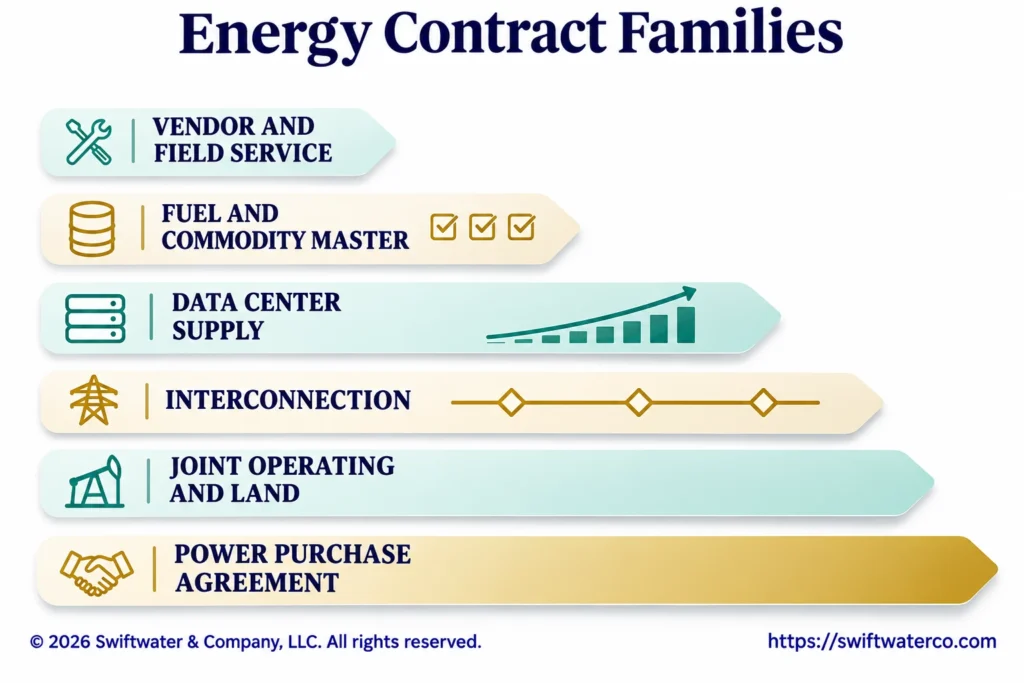
The table is illustrative; a regulated utility, an independent power producer, and an oil and gas company weight these rows differently.
How are data centers changing energy contracts?
Data centers have become one of the fastest-growing groups of large customers for energy companies, and utilities and generators are actively competing for them. Data centers are not a new business, but AI has driven rapid growth in their number, size, and power demand. The market has also matured over the last decade: the large cloud providers are no longer the only buyers, and private data center operators, colocation providers, and new entrants now sign power and grid agreements of their own.
For an energy company, a data center customer brings a set of linked contracts: a supply agreement or PPA, an interconnection or grid upgrade agreement, often a construction schedule for new generation or substations, and credit support for the commitments on both sides. Each carries milestones and obligations, such as load ramp dates, capacity commitments, and cost-sharing payments, and a change in one moves the dates in the others. Tracking them as one project, with one owner, is what keeps leadership’s view of the commitment accurate.
Evaluating or implementing a CLM platform?
We have guided legal departments through selection, implementation, and adoption, without the vendor bias. Let us talk about where you are and what you actually need.
See CLM ServicesWhich laws and regulators apply to energy and utility contracts?
Energy contracts answer to federal and state regulators and to reliability standards. In the United States, the Federal Energy Regulatory Commission (FERC) regulates interstate transmission and wholesale sales of electricity and natural gas, including interconnection to the transmission grid. State public utility commissions regulate retail rates and many utility contracts, including through rate cases.
The North American Electric Reliability Corporation sets reliability standards for the bulk power system; its CIP-013 standard covers supply chain risk management for certain vendors. Swaps and other derivatives used to hedge energy prices fall under the Commodity Futures Trading Commission (CFTC).
These rules are listed for reference only; counsel and compliance teams should interpret how each applies to the company and contract.
Who owns contracts in energy and utilities?
In most energy companies, origination and commercial teams own power purchase, offtake, and large-customer agreements, project owners own the contracts tied to each generation or grid project, supply chain owns vendor and field service contracts, regulatory affairs owns filings and the contracts regulators review, and land teams own leases and land agreements in oil and gas. Legal owns the master agreements, templates, and escalations.
Long terms make ownership harder. Over a 20-year agreement, the team that manages it will change several times, so the owner has to be a role with a named successor, and the obligations have to sit in a record the next owner can read on day one. Our guide to who owns contract management covers the roles.
What does a CLM have to handle?
A CLM in energy and utilities has to handle an obligation register for every project, long-term key dates and price resets, confirmations under master agreements, vendor safety, security, and insurance records, and contract records ready for a regulatory request. It holds the contract terms and obligations; trading, billing, and asset systems hold the transactions.
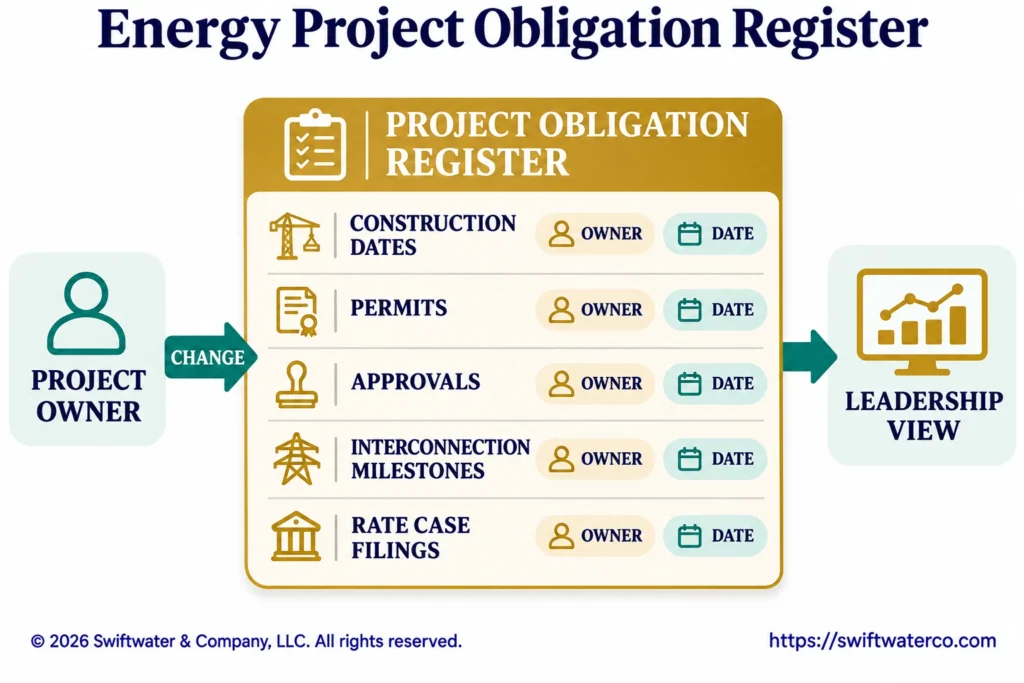
- A project obligation register. Every new project comes with its own deadlines and obligations, internal and third party: construction dates, approvals, permits, interconnection milestones, and rate case filings. Each needs an owner, and every change has to flow from the project owner to leadership with accurate, current information. See contract obligation management.
- Long-term dates. Price resets, delivery start dates, extension options, and expiry, each with an owner and an alert. See contract renewal management.
- Master agreements and confirmations. The master terms recorded once, with confirmations linked to them; the trading system values the trades.
- Vendor safety, security, and insurance. Certificates of insurance, safety terms, and the cybersecurity and AI duties of technology vendors, which continue well after onboarding. See supplier agreement management.
- Regulatory requests. Contracts and their amendments found quickly from one contract repository.
Teams looking for tools to track oil and gas or utility contracts usually choose among a general CLM platform, the contract module in their ERP or procurement suite, or land and joint venture software for oil and gas agreements. Our guide to contract lifecycle management tools covers the categories.
What does a typical lifecycle problem look like?
The typical problem in energy is fragmentation: contract and obligation data spread across so many systems that nobody can see the full set of commitments at once.
I learned very early in my work with energy and utility companies how fragmented contract and obligation data can be. One client told me that whenever a big commercial deal came up, the team had to log in to more than 30 internal systems to do due diligence on the company’s existing commitments. Another client had amassed more than 100 systems that held legal matter and document content. I helped them evaluate each one, determine which was the system of record for each kind of information, and decide whether to consolidate those records or manage them in place.
The same discipline applies to the services energy companies buy. For a global oil and gas company under an accelerated transformation mandate, our professionals built a multi-year legal technology plan, then gathered task and activity data from all outside counsel, prioritized the matter portfolio with a risk and value matrix, and used a Make v. Buy model to decide which work stayed in-house, went to firms, or moved to alternative providers. The outside counsel management program identified millions of dollars in cost-savings opportunities. The oil and gas case study has the details.
In both cases the fix started with the data: find where each commitment lives, name the system of record, and give each category an owner.
Which pages to read next?
- Contract management by industry, for how energy compares with other industries.
- Who owns contract management, for the roles of legal, procurement, and the business.
- Contract obligation management, for obligation registers and tracking after signature.
- Contract renewal management, for long-term dates and options.
- Supplier agreement management, for vendors and contractors.
- Contract lifecycle management tools, for the categories of software.
Bottom Line
Energy and utility contracts are long, large, and watched by regulators. Power purchase and commodity agreements carry the value, field service and vendor agreements carry the volume and the safety terms, and every project adds construction dates, permits, approvals, and rate case filings. Data centers are adding a new class of large, linked commitments, where a change in one contract moves the dates in the others. FERC, NERC, state commissions, and the CFTC sit behind them all.
The work starts with finding the systems of record. From there, a CLM at the center holds one repository for the contracts, an obligation register for every project, and alerts for every reset, option, and filing date, each assigned to a named role with a successor. The CLM connects to the trading, billing, and asset systems so the terms and the transactions agree, and leadership sees an accurate picture before it signs the next deal, without 30 logins. Energy contracts run for decades and projects change constantly, so the CLM has to be the single record of every commitment, with an obligation register that stays accurate from the project owner to leadership for the life of every asset.
Our contract management solutions help energy and utility legal, commercial, and project teams find the systems of record, build obligation registers, and select and configure the CLM that fits.
Evaluating legal technology but not sure where to start?
We help legal departments cut through the vendor noise, mapping technology to process maturity and building a roadmap that actually gets adopted.
See Legal TechnologyFrequently Asked Questions
What is energy and utility contract management?
Energy and utility contract management covers power purchase, interconnection, fuel, and vendor agreements under regulatory oversight. It includes project obligation registers, long-term dates and price resets, master agreements and confirmations, contractor safety and insurance records, and contract records ready for a regulator’s request.
What tools track oil and gas contracts?
Oil and gas companies usually track contracts in one of three kinds of tool: a general CLM platform for commercial and vendor contracts, the contract module of an ERP or procurement suite for purchasing, or land and joint venture software for leases and joint operating agreements. Many use more than one, linked by a shared contract record.
How does a CLM handle power purchase agreements?
A CLM stores the power purchase agreement and its amendments and captures its key terms as fields: term, price and reset dates, delivery obligations, credit support, and termination rights. It sends alerts before each reset and option date. Settlement, scheduling, and invoicing stay in the trading and billing systems.
How should an energy company track data center agreements?
Track each data center customer as one project with linked agreements: the supply agreement or PPA, the interconnection or grid upgrade agreement, construction milestones, and credit support. Hold the load ramp dates, capacity commitments, and cost-sharing payments as obligations with owners, so a change in one agreement updates the view of the others.
How do NERC standards affect vendor contracts?
NERC’s CIP-013 reliability standard covers supply chain risk management for certain vendors of systems that support the bulk power system, and responsible entities often address it in procurement and contract terms. Which vendors and terms are in scope depends on the entity and its systems, so counsel and compliance teams should confirm it.
This article is provided for general informational purposes only and is not legal, financial, or business advice. Energy and utility contract management decisions should be validated against your organization’s specific structure, regulatory obligations, and counsel guidance, and you should consult a qualified professional for advice on your situation.