
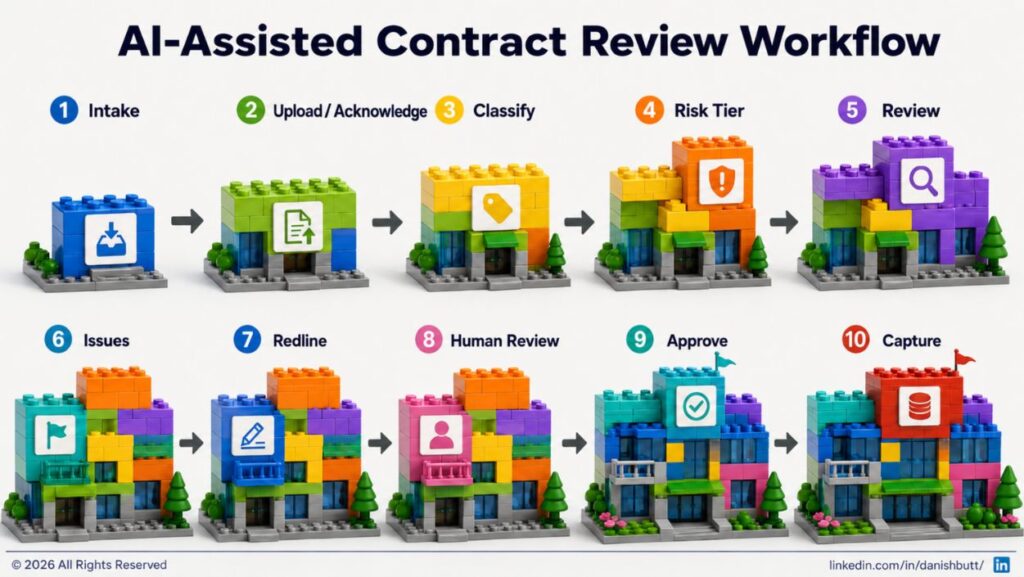
AI contract review software uses artificial intelligence to augment reading, analyzing, and flagging key information in legal agreements to support the human-based contract review and judgement input. Most tools in the market focus on 3-4 differentiators – clause identification, risk analsyes, data extraction, compliance checks – wrapped in an MS Word application. However, from a practitioner’s point of view it is 10 different steps – intake -> acknowledge-> classify-> risk tier-> review-> issues-> redline-> human review & judgment -> approve ->capture. Understanding those steps is the difference between a successful tool selection and adoption.
You can also think of it as a super-powered legal assistant that can learn from the patterns you teach it and help you through your daily contract review activties. It’s built to spot risks and deviations from your company’s standards so your team can focus on more strategic work. To learn more about contract lifecycle management and latest trends visit our knowledge hub containing the latest practitioner’s point of view Contract Lifecycle Management Knowledge Hub.
The End of Manual Contract Review as We Know It
Imagine your legal team finally free from the mountains of tedious, repetitive contract reviews that eat up their day. This isn’t some far-off concept; it’s a practical reality for many businesses today.
The shift toward AI contract review is a huge step in the ongoing trend to automate repetitive tasks that once bogged down legal and procurement teams. This technology isn’t about replacing skilled lawyers. It’s about augmenting their expertise and intuition. For a broader view of how in-house teams are applying AI across contracts, compliance, spend, and matter workflows, see Swiftwater’s Legal AI resource center.
By handling that initial, time-consuming first pass, AI empowers legal professionals to move from mundane clause-checking to high-value strategic counsel. It transforms a process notorious for being a bottleneck into a streamlined, data-driven function. This boost in efficiency helps businesses close deals faster, onboard vendors more quickly, and manage risk with much greater precision. Contract review is usually one of the first practical use cases because it sits at the intersection of speed, risk, and legal capacity. For the broader operating model, read our guide to AI for in-house legal teams.
Evaluating or implementing a CLM platform?
We have guided legal departments through selection, implementation, and adoption, without the vendor bias. Let us talk about where you are and what you actually need.
See CLM Services(If you are looking for tools – scroll below to the section “Not All Tools are Equal“)
What AI Contract Review Actually Does
In convention industry-speak an AI contract review software performs a first-level analysis with incredible speed and accuracy. It is trained to understand complex legal language and pinpoint specific elements within any agreement you feed it.
Here is how every AI contract software is differentiating itself in the market:
- Clause Identification: The AI instantly identifies and categorizes critical clauses such as indemnification, liability, termination, and confidentiality. No more hunting and pecking.
- Risk Analysis: It flags non-standard language or clauses that stray from your pre-approved legal playbook, assigning risk scores to highlight potential problems.
- Data Extraction: Key data points – think party names, effective dates, renewal terms, and payment obligations – are pulled out and neatly organized for easy access.
- Compliance Checks: The system ensures agreements comply with internal policies and external regulations, providing a consistent layer of governance.
In essence, AI acts as a digital concierge for your contracts. It fetches the exact information you need, gets you results in seconds, and analyzes legal concepts that go far beyond a simple keyword search. This capability turns static documents into active, manageable assets.
However, as a practitioner let me remind you that an AI contract review tool is part of a 10-step process (even before the contract goes out for signature). Understanding these ten can be the difference between a succesful selection and adoption of a contract review tool or extreme heartburn (my arbitrary measure).
The real workflow looks more like this:
- Intake: Contract request comes in
- Upload / Acknowledge: Contract or third-party paper is received and acknowledged
- Classify: AI identifies contract type and key facts
- Risk Tier: AI assigns risk level
- Review: AI compares clauses to the playbook
- Issues: AI flags deviations and missing terms
- Redline: AI suggests redlines, comments, or fallbacks
- Human Review and Judgment: Lawyer reviews and adjusts AI output
- Approve: Business and legal approvals are routed
- Capture: Final data, obligations, and learnings are captured
AI contact review is meant to augment human expertise not replace judgment
A common myth is that AI aims to make lawyers obsolete. The reality is the complete opposite. Research shows that lawyers often spend up to 60% of their time just drafting and reviewing documents. AI takes on the most grueling parts of this work, freeing up human experts to do what they do best: negotiate, strategize, and solve complex legal puzzles.
Think of a surgeon using advanced robotics for precision or a pilot relying on a sophisticated autopilot system. The human expert is always in control, but their capabilities are amplified. An AI contract review tool allows a lawyer to assess a contract in minutes, not hours.
For example, an attorney who used to block off 45 minutes for an initial review can now get it done in under 10 minutes by focusing only on the key issues flagged by the AI. This unlocks tremendous efficiency and paves the way for legal teams to become true strategic partners to the business.
How AI Actually Reads and Understands Legal Documents
To really get what AI contract review does, you have to peek under the hood. How can software possibly digest a dense, jargon-filled legal document and make any sense of it? It’s not magic, it’s a powerful duo of technologies working in tandem to imitate, and in many ways, surpass human review.
The first piece of the puzzle is Natural Language Processing (NLP). Think of this as the software’s “brain.” NLP enables the tool to comprehend the grammar, structure, and subtle nuances of human language, especially the complex, sometimes archaic phrasing found in contracts.
The second piece is Machine Learning (ML), which you can think of as the “experience.” A junior lawyer gets better by reviewing hundreds of contracts, right? In the same way, an ML model gets smarter with every single document it analyzes. It learns to spot common patterns, identify standard clauses, and flag anything that looks out of place based on the massive amount of data it has been trained on.
The AI-Powered Review Workflow
When you feed a contract into an AI review tool, it doesn’t just do a simple keyword search. Instead, it kicks off a structured, deep-dive analysis that turns a static document into a source of real, actionable intelligence.
AI helps legal teams accelerate review cycles, which is one of the biggest wins when adopting this technology. It frees legal professionals from the grind of manual document slogging, allowing them to focus on high-value, strategic work.
The typical workflow breaks down into a few critical steps:
Evaluating legal technology but not sure where to start?
We help legal departments cut through the vendor noise, mapping technology to process maturity and building a roadmap that actually gets adopted.
See Legal Technology- Ingestion and Parsing: First, you upload the contract. The AI instantly gets to work, breaking down walls of text into structured data it can analyze. It identifies paragraphs, sentences, sections, and the overall document structure.
- Entity and Clause Recognition: Using its NLP (or similar) capabilities, the tool then identifies and tags key information. This includes crucial details like the parties involved, effective dates, and monetary figures. It also pinpoints specific legal clauses, such as limitations of liability, indemnification, and termination rights.
- Playbook Cross-Referencing: This is where the magic really happens. The AI compares the clauses it found against your company’s pre-loaded legal playbook. This playbook is your single source of truth; it contains your standard positions, preferred clause language, and defined risk thresholds.
- Risk Flagging and Reporting: Any clause that deviates from your playbook gets flagged immediately. The system can assign a risk score – low, medium, or high – to draw a human lawyer’s eyes directly to the most critical issues, all summarized in a report for a quick evaluation.
This systematic approach turns a subjective, time-consuming chore into an objective, data-driven process. The AI doesn’t get tired or miss a critical detail on page 47; it applies the same rigorous standard to every single document.
Manual vs AI-Powered Contract Review
The difference between the old way and the new way is night and day. A human reviewer is, of course, essential for exercising final judgment and strategic thinking. But when you augment their expertise with AI, you unlock massive efficiencies.
Let’s break down the practical differences side by side.
| Aspect | Manual Review | AI-Powered Review |
|---|---|---|
| Speed | Can take hours or days, depending on the document’s length and complexity. | The initial analysis takes minutes, slashing the total review time. |
| Accuracy | Prone to human error, fatigue, and simple oversight, especially on repetitive tasks. | Exceptionally consistent in flagging predefined risks and non-standard language. |
| Cost | High, driven by expensive billable hours from legal professionals or internal team time. | Significantly lowers costs by reducing manual labor and reliance on outside counsel. |
| Scalability | Tough to scale. Reviewing hundreds of contracts for a big project is a monumental effort. | Scales effortlessly to handle large volumes of documents for M&A due diligence. |
Ultimately, AI doesn’t replace lawyers; it empowers them. Advances in AI, especially from large language models (LLMs), have made these tools incredibly powerful and accessible. Modern AI agents can autonomously extract data, suggest clause adaptations, and check for compliance, which is why we’re seeing so much investment in legal tech. This shift is driving faster processing, smarter risk assessment, and significant cost savings for legal teams everywhere. You can discover more about AI contract analysis trends to see just how quickly this technology is advancing.
The Business Case for AI Contract Review
While the technology behind an AI contract review platform is impressive, let’s get down to what really matters for any business: what’s the bottom-line impact? The real case for this tech isn’t built on shiny features, but on tangible, measurable outcomes that directly affect revenue, risk, and how much you spend to operate.
When you bring AI into your contract analysis workflow, you unlock a powerful trio of benefits that ripple across the whole company – from sales and procurement right up to the C-suite. Suddenly, the legal department transforms from a perceived cost center into a strategic partner that helps the business move faster and on surer footing.
The most immediate and talked-about benefit? A massive speed-up in review cycles. And when contracts move faster, so does everything else.
1. Accelerating Deals and Onboarding
Every day a contract sits in a review queue is a day a new sale isn’t booked, or a critical supplier isn’t brought on board. We’ve all seen it: manual reviews are notorious bottlenecks, creating friction that grinds the entire commercial engine to a crawl. An AI-powered first pass completely changes this dynamic, shrinking the timeline from days or even weeks down to just minutes.
Think about it. Your sales team can have a standard NDA or Master Service Agreement (MSA) checked almost instantly, keeping the momentum going with a hot prospect. On the other side of the house, the procurement team can onboard new vendors with incredible speed, making the supply chain more resilient and responsive.
This isn’t just about small improvements; it’s about fundamentally changing the speed of business. By slashing contract review time by as much as 80-90%, companies close deals faster, recognize revenue sooner, and carve out a serious competitive advantage.
2. Sharpening Risk Mitigation and Compliance
Let’s be honest, even the most diligent human reviewer can get tired (and bored). AI never gets fatigued.
It meticulously scans every single clause and compares it against your pre-approved legal contract playbook, flagging any language that steps outside your risk tolerance. This creates an incredibly powerful and consistent line of defense. Imagine a global company trying to enforce standard contract terms across different regions and business units. An AI contract review tool with a single, central playbook turns a massive compliance headache into a manageable, auditable process.
For example, I was working with a big pharma company, and based on certain events, they said that if there were a solution that ensured their contract playbooks were adhered to and the correct entities were used for signing contracts, their whole legal team could sleep well at night. What a way to describe the impact of the business problem. The AI contract review tools can help with most of this. It also makes for a case of having your contract lifecycle management and your ERP/sales system connected.
This heightened oversight is a huge reason companies are making the switch. They’re using AI-powered playbooks to fly through agreements like MSAs, NDAs, and DPAs, automating risk detection and finally getting legal, procurement, and sales teams on the same page. The result? Shorter cycles, stronger governance, and a huge drop in what they’re spending on outside lawyers.
3. Driving Significant Cost Savings
The third pillar of the business case is all about the money you save. This shows up in two main ways:
- Reduced Reliance on Outside Counsel: Many teams automatically send routine or high-volume contracts to external law firms. This isn’t just expensive; it’s slow. AI empowers in-house teams to confidently handle a much larger chunk of this work, saving the big-ticket outside counsel spend for truly complex, high-stakes matters.
- Improved In-House Efficiency: By automating the most repetitive and tedious parts of the review, AI lets your legal team achieve more without adding headcount. This frees up your highly skilled (and highly paid) lawyers to focus on strategic work that delivers real value. It’s not just about contracts; these tools are part of a broader strategy to increase overall team productivity by amplifying your top talent.
For any CFO, this combination of faster revenue, lower risk, and controlled spending is a powerful story. As you weigh these benefits, you might also find our post on The CFO’s Guide to Contract Lifecycle Management helpful, as it dives deeper into the financial impact of modernizing the entire contract process.
Real-World Applications Across Your Business
The true power of AI contract review isn’t some far-off, futuristic concept. It comes alive when you see it solving real-world problems that businesses like yours face every single day. This isn’t just an abstract legal tool; it’s a practical engine that drives serious efficiency across different departments, each with its own unique pile of paperwork.
Not ready to pick a CLM platform yet?
A four to six week diagnostic that maps your current contract lifecycle, sets requirements themes, and tells you what to buy before you sit through another vendor demo.
See the CLM Discovery SprintLet’s move beyond the theory and look at how different teams are putting AI analysis to work. These examples show just how adaptable and valuable this technology is, whether you’re trying to close a deal, bring on a new supplier, or get through a massive corporate transaction.
Empowering Sales Teams to Close Faster
For any sales team, time kills deals. Every day a contract sits in the legal department’s queue is another day revenue isn’t being booked, and another day a competitor can sneak in. Sales cycles get bogged down in the endless back-and-forth over standard agreements like Master Service Agreements (MSAs) and Non-Disclosure Agreements (NDAs).
This is where AI steps in. Imagine a sales rep needs a prospect to sign an NDA before a big product demo. Instead of waiting hours or days for legal, they upload the prospect’s redlined version to the AI platform. Within minutes, the system flags any changes that deviate from the company’s approved template.
The rep can then handle minor issues themselves or escalate only the truly problematic clauses. This kind of self-service capability keeps sales momentum going while ensuring every agreement adheres to company policy.
Streamlining Procurement and Vendor Onboarding
Procurement teams are constantly juggling a mountain of vendor agreements. Each one comes with its own set of risks tied to liability, data security, and payment terms. Trying to review every single one by hand is a monumental effort, often leading to delays that can disrupt the entire supply chain.
An AI-powered system can act as a vigilant gatekeeper for the procurement team. Picture this: the team is onboarding a new software vendor and is faced with a dense, 30-page agreement. They run it through the AI tool, which instantly performs several critical checks:
- It flags an unlimited liability clause that would expose the company to way too much risk.
- It spots payment terms that don’t match the company’s standard Net 60 policy.
- It confirms that the data privacy addendum is fully compliant with GDPR.
The procurement manager gets a concise risk report highlighting these specific issues. What would have been a multi-hour review becomes a focused, ten-minute task. This frees up the team to negotiate better terms and get critical vendors onboarded faster and more safely.
By using AI to “show me the differences between contracts in a table format,” a team can get an instant head-to-head comparison on key terms versus getting slowed down by legal boilerplate wording. This provides a phenomenal understanding of risk exposure.
Accelerating Mergers and Acquisitions Due Diligence
Perhaps the most impressive use case for AI contract review is in the high-stakes world of Mergers and Acquisitions (M&A). The due diligence process is notoriously grueling, requiring teams to pore over thousands of the target company’s contracts to uncover hidden liabilities, change-of-control clauses, and other potential issues.
Traditionally, this work required a small army of lawyers and paralegals grinding away for weeks or even months, at a staggering cost. Today, an AI platform can swallow and analyze a target company’s entire contract portfolio in just a few days.
The AI can systematically scan for specific risks, such as non-assignable contracts that could become void after the acquisition or unusual termination clauses that could cause massive headaches down the line. The M&A team receives a comprehensive, data-driven map of the target’s contractual obligations and liabilities. This lets them make smarter decisions and negotiate from a position of strength, a speed advantage that can be the deciding factor in a competitive deal.
How to Implement AI Contract Review Successfully

Bringing an AI contract review solution into your legal department isn’t just about buying a new piece of software. It’s a fundamental shift in how your team works. A successful rollout is built on a smart, practical plan that starts with your current headaches and ends with your whole team embracing the change.
The journey doesn’t begin with a sales demo, it starts with a hard look in the mirror. Before you even think about vendors, you need to know your biggest pain points. Are your sales cycles dragging because of slow NDA turnarounds? Is the procurement team struggling with inconsistent risk assessments in vendor agreements? Get specific about where the friction lies.
Once you’ve identified the problems, you can set real, measurable goals. Vague objectives like “improving efficiency” won’t cut it. You need concrete targets, like “slashing initial contract review time by 50% in six months” or “cutting our reliance on outside counsel for standard agreements by 30%.” These numbers will be your North Star as you move forward.
Selecting the Right AI Platform
With your goals clearly defined, you can start looking at tools. But be warned: not all AI contract review platforms are built the same. Your selection process should be a careful, deliberate evaluation of features, support, and, most importantly, how well the tool fits your unique needs.
You’re looking for a solution with a solid track record and even stronger customer support. Focus on these key factors:
- Core Functionality: Does the tool nail the basics? Think clause identification, risk flagging, and data extraction.
- Integration Capabilities: How well does it play with the systems you already rely on, like your document management system or CRM? Is it standalone, or is it bundled within your contract lifecycle management system?
- Vendor Support and Onboarding: Will the vendor provide robust training and support to get your team comfortable and productive, fast?
- Pre-Trained Models: Look for platforms that already have AI trained on common agreements such as NDAs or MSAs. This drastically cuts down the time it takes to see a return on your investment.
The market is moving fast, which makes a smart choice even more critical. Recent data shows that 17% of large companies are now actively using AI contract review tools, with another 21% deep in the evaluation phase. That’s a huge leap from just 8% a year ago, a shift driven by the need to reclaim the countless hours lawyers lose to routine review tasks. To see the data for yourself, explore the key findings on rising AI adoption in legal teams.
Building Your Digital Legal Contract Playbook
This is where the magic happens. The most critical part of any implementation is teaching the AI to think like one of your best lawyers. You do this by creating digital contract playbooks – a central, living repository of your company’s standard clauses, fallback positions, and risk thresholds.
The process involves feeding the AI your best-in-class contract templates and approved variations. You’ll define exactly what an acceptable indemnification clause looks like or what level of liability is a non-starter. While this requires some upfront effort from your legal experts, it’s the bedrock of accurate, automated analysis.
Driving Adoption and Managing Change
Finally, remember that even the most brilliant tool is useless if nobody uses it. You have to manage the human side of this change. Get ahead of any anxieties by framing the AI as a powerful assistant, not a replacement.
Show your team how this tool will vaporize the tedious work of first-pass reviews, freeing them up for high-stakes negotiation and strategic counsel. Share success stories, quantify the time saved, and celebrate the wins. When your lawyers see the AI as a partner that makes their jobs more meaningful and less mind-numbing, adoption will feel natural, not forced.
AI Contract Review Software Available (Not All Tools Are Equal)
AI contract review is not one type of tool – see my latest article as of May 2026 that describes in detail how the AI contract review tools come in five (5) different categories. It’s a spectrum of approaches, each optimized for a different maturity level, risk tolerance, and volume profile.
Here’s a practical breakdown:
1. LLM Platform Wrappers
These tools wrap large language models in legal-friendly interfaces with structured prompts and workflows.
They were early to market and are often the easiest to adopt. A single GC or small law department can swipe a credit card and start reviewing contracts the same day. Low friction. Low learning curve. Immediate productivity lift.
They’re often designed to mimic how a typical general counsel reviews agreements, issue spotting, risk flags, suggested language.
But when contract volume increases, playbooks mature, or workflow integration becomes critical, limitations can emerge.
Example: GC AI, A solid starting point, especially for lean teams.
2. Native LLM Platforms
Frontier AI platforms such as ChatGPT (OpenAI) and Claude (Anthropic) increasingly release contract-review-oriented features – often paired with disclaimers about legal advice.
Technically, these models are extremely capable. With improved support for MS Word, PDFs, structured outputs, and enterprise controls, they are beginning to compete directly with wrapper tools.
The tradeoff:
You gain raw power and flexibility, but you must design guardrails, prompting frameworks, and governance yourself.
For sophisticated teams with internal AI literacy, this path can be compelling.
3. Playbook-Based AI Contract Review (CLM-Integrated)
These tools are grounded in your contract playbook, templates, fallback clauses, risk tiers, deviation rules.
Instead of asking, “What’s wrong with this contract?”
They ask, “Where does this contract deviate from our approved standard?”
They often integrate directly into Contract Lifecycle Management platforms, enabling:
-
Checklist-based deviation review
-
First-pass redlining
-
Risk scoring
-
Structured issue lists tied to policy
Examples include:
-
Onit (Review AI within its CLM platform)
-
Agiloft
-
Malbek
-
DocuSign CLM
-
Drafting-focused tools such as LegalSifter and Ivo
This category becomes powerful when:
-
You have defined playbooks
-
You care about repeatability
-
You want auditability
-
You need scale
For enterprise legal departments, this is often where sustainable value lives.
4. Historical / Bulk AI Contract Review
A different use case entirely. If you’re reviewing thousands of contracts for:
-
M&A due diligence
-
Portfolio analysis
-
Obligation extraction
-
Regulatory risk scans
You need different outputs and interaction models. These tools are optimized for bulk ingestion, clause extraction, structured data outputs, and analytics, not just first-pass redlining.
That category deserves its own deep dive.
The Bottom Line
Choosing an AI contract review solution is not about picking “the smartest AI.” The better question is whether the tool fits the legal workflow, data environment, governance model, and measurable business outcome. For a structured selection framework, see how in-house legal teams should evaluate AI tools.
It’s about matching your contract volume, risk tolerance, process maturity, playbook depth, integration requirements and change management readiness. The requirement mapping and change readiness will be the difference in how and what you choose as your AI contract review software.
Therefore, the technology architecture or solution should follow how your legal and contracting function(s) operates, not how a demo looks in isolation.
If you are a contracting and/or legal team evaluating AI contract review, building contract playbooks, or moving from pilot to production, Swiftwater’s Contract Management Requirements Discovery Sprint can help you with your readiness assessment and planning. For more services related to contract governance, selecting tools, and deploying AI in workflows that can be measured click here – Swiftwater Contract Management Solutions.
Answering Your Top Questions About AI Contract Review
When you’re looking at powerful new technology like AI contract review, it’s smart to separate the marketing hype from what it can actually do in practice. Legal teams and business leaders I talk to often have perfectly valid questions about accuracy, security, and what this really means for their day-to-day work.
So, let’s cut through the noise and tackle some of the most common concerns with clear, straightforward answers. The goal here is to help you make an informed decision based on practical realities, not just buzzwords.
How Accurate Is AI Compared to a Human Lawyer?
This is always the first question, and it’s the most important one. The truth is, it depends on the task.
For spotting deviations from your standard clauses or finding a specific term across 100 agreements, AI is incredibly accurate. It’s often more accurate than a human reviewer because it doesn’t get tired, distracted, or bored on page 50 of a dense master services agreement. For those kinds of routine checks, its consistency is a massive win.
But think of it as a brilliant paralegal, not a replacement for a seasoned partner. A human lawyer’s strategic insight remains essential for interpreting novel clauses, understanding complex business context, and navigating high-stakes negotiations. The best approach is a partnership: AI handles high-volume, low-complexity work with speed and precision, allowing the lawyer to focus their expertise where it truly matters.
Can AI Truly Understand Our Unique Agreements?
Yes, but it needs to be taught your way of doing things. This isn’t about some generic, out-of-the-box system. Modern AI platforms are configured based on your company’s specific legal playbook, your library of past agreements, and your defined appetite for risk.
You essentially teach the AI what to look for, what an acceptable liability clause looks like for your business, and which red flags must be escalated for human review. This customization is what makes the analysis so relevant. It’s not just applying general rules; it’s applying your rules.
Think of it like a new hire on your legal team. You wouldn’t expect them to know your company’s preferred indemnification language on day one. You’d give them your templates, your clause library, and your guidelines. The AI works the same way, it just learns instantly and applies that knowledge perfectly every single time.
Is the Implementation Process Difficult and Time-Consuming?
It varies, but modern tools are designed to get you up and running faster than you might think. The most critical part of the setup is feeding the AI your digital contract playbooks – your standard contract templates and clause variations.
While this does require some upfront time from your legal experts, most leading vendors provide extensive support, including pre-trained AI models for common contracts like NDAs or MSAs, to give you a running start.
Where you may need a consulting partner is to help you work through calibrating it, testing it, and the best practice gotchas. Vendors train their systems to the lowest common denominator; an implementation partner like Swiftwater & Company looks at the human component, change management, quality, testing approach, results, etc.
A good solution will start showing its value very quickly. In the long run, the time you save completely dwarfs the initial setup effort.
Will AI Contract Review Replace Our Legal Team?
This is a persistent myth, and the answer is a firm no. The goal of AI is empowerment, not replacement.
AI automates the repetitive, often tedious parts of contract review. This frees up your legal professionals to focus on the work they were actually trained to do: strategic negotiation, complex problem-solving, and providing high-value business counsel.
By handling the initial pass, AI allows your legal team to work more efficiently and strategically. This is how the legal department stops being a bottleneck and starts being a true business accelerator.
Is Our Confidential Information Protected in This Tool?
When procuring AI, security isn’t a feature, it’s a gating issue. Ask directly:
-
Is our data encrypted in transit and at rest?
-
Who can access it, and how is that controlled?
-
Is our data used to train your models?
-
Do you hold SOC 2 or ISO 27001 certification?
-
Where is the data stored, and under what jurisdiction?
A serious AI vendor will answer clearly and in writing. If security feels like an afterthought in procurement, it will become a risk in production. Those questions should sit inside a broader legal AI governance model that defines approved uses, data rules, vendor diligence, escalation paths, and ongoing oversight. For the operating framework, see what legal AI governance means for in-house teams.
Frequently asked questions
What is AI contract review?
AI contract review is the use of artificial intelligence to read, analyze, compare, and summarize legal agreements. It helps legal and business teams identify key clauses, extract contract data, flag deviations from approved standards, and speed up the first-pass review process.
How does AI contract review help legal teams move faster?
AI contract review helps legal teams move faster by handling repetitive review tasks such as clause identification, obligation extraction, risk flagging, and playbook comparison. This allows lawyers to focus more time on negotiation strategy, business judgment, and high-value legal analysis.
What types of contracts are suitable for AI contract review?
AI contract review is commonly used for NDAs, MSAs, vendor agreements, SaaS agreements, DPAs, procurement contracts, sales contracts, and high-volume commercial agreements. It is especially useful when teams review similar contract types against repeatable standards or approved playbooks.
Why are contract playbooks important for AI review?
Contract playbooks are important because they give the AI a clear standard for review. A playbook defines preferred clauses, fallback positions, risk levels, escalation rules, and acceptable deviations, allowing the AI to compare incoming agreements against the organization’s approved approach.
Can AI contract review work without a CLM system?
Yes. AI contract review can work as a standalone tool for first-pass review, document comparison, or clause analysis. However, teams with higher contract volume often gain more value when AI review is connected to a CLM system, repository, intake workflow, approval process, and reporting model.
What should companies evaluate before choosing an AI contract review tool?
Companies should evaluate contract volume, agreement types, risk tolerance, playbook maturity, integration needs, security requirements, reporting needs, and user adoption. The best tool should fit the legal team’s operating model rather than only performing well in a product demo.
How should legal teams start implementing AI contract review?
Legal teams should start by selecting one or two repeatable contract types, defining the review playbook, testing the AI output against real agreements, and creating clear escalation rules. A focused pilot helps teams measure quality, speed, adoption, and business impact before expanding.
Is AI contract review secure for confidential agreements?
AI contract review can be secure when the platform has strong controls for encryption, access management, data retention, model training restrictions, audit logs, and compliance certifications. Security, privacy, and data-use terms should be reviewed before any confidential agreements are uploaded.
Disclaimer: This article is provided for educational and informational purposes only. Swiftwater & Company and the author do not provide legal advice. External links and product references reflect publicly available information from the respective vendors and authorities and are provided for reference. Microsoft, Microsoft 365, Microsoft Copilot, and Microsoft Word are trademarks of Microsoft Corporation. Claude is a trademark of Anthropic, PBC. Onit and ReviewAI are trademarks of Onit, Inc. All other product names referenced are the property of their respective owners.