What is legal operations managed services
Legal operations managed services is the model where an external team provides ongoing operational leadership for your legal department, not just staffing coverage, but sustained delivery against your objectives.
It differs from staffing providers, where you manage the person and direct the work, and ALSPs, which are designed for high-volume commodity tasks at scale. The distinction that matters is accountability: in a managed services engagement, the provider owns the outcome. Your operating objectives become their brief.
Legal departments that engage managed services typically do so for one of three reasons: the permanent team is at capacity and cannot run transformation alongside business-as-usual; a skills gap exists in program management, vendor oversight, or technology operations; or a full-time hire has been budgeted but not yet onboarded. In each case, the managed services model closes the gap faster and with less overhead than the alternatives.
Why managed services matters now
The 2026 CLOC State of the Industry Report documents a shift that most Legal Operations Directors can already feel: outside counsel spend expectations dropped sharply year over year, with only 37% of departments planning increases, down from 58% the prior year.1 Legal departments are being asked to do more with the same or less, and the pressure is not temporary.
At the same time, the function has become more operationally complex. Financial management, vendor oversight, technology governance, and data reporting are now core Legal Operations responsibilities at the majority of departments. The permanent team that was hired to practice law is increasingly being asked to run a business function. Managed services is how organizations close that gap without adding permanent headcount or accepting the quality compromise of untrained nearshore and offshore staffing.
Third-party risk management has added a further layer of operational demand. Legal departments at large enterprises now oversee vendor populations with widely varying risk profiles, from cybersecurity exposure and data privacy obligations to regulatory compliance, contract performance, and reputational risk. Managing that portfolio requires structured processes, consistent documentation, and ongoing oversight that most legal teams cannot sustain with existing capacity. It is one of the workstreams most commonly absorbed by a managed services engagement.
What legal operations managed services covers
A Swiftwater managed services engagement is not a single service. It is an operational model that can be applied across the workstreams your department needs most.
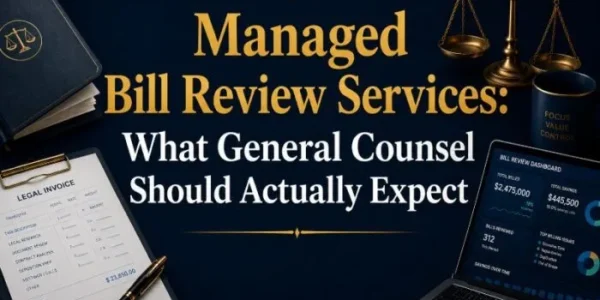
Managed bill review is the most immediate source of measurable value. Systematic review and validation of outside counsel invoices against billing guidelines, agreed rates, and matter scope, enforced at the point of review, not after payment. For most legal departments, this is where the program pays for itself within the first quarter.
PMaaS, Program and Project Management as a Service, gives your department senior program management capability on an ongoing basis. Structure, governance, accountability, and delivery rhythm without the overhead of a permanent hire. Particularly relevant for departments running a technology implementation or transformation alongside business-as-usual operations.
Contract operations covers ongoing management of the contract function: intake, routing, negotiation support, execution tracking, and obligation management. Legal departments that are live on a CLM platform but struggling with adoption typically need operational support as much as technical configuration.
Vendor management provides ongoing oversight of outside counsel and legal technology relationships, performance reviews, rate negotiations, panel maintenance, and billing guideline enforcement. The governance that most departments know they need but cannot resource without deprioritizing something else.
Reporting, analytics, and dashboards builds and maintains the reporting layer that turns your legal system data into decisions rather than noise, spend visibility, matter performance, outside counsel benchmarking, and the operational metrics that legal leadership can present to the CFO with confidence.
The Swiftwater managed services practice
Swiftwater's managed services practice is led by Jeannine Puello, whose legal operations experience comes from inside Verizon and AT&T, two of America's most operationally complex enterprise environments. She has built and run the function, not just consulted on it. That distinction matters because the accountability in a managed services engagement is operational, not advisory. The practitioner who leads your engagement needs to have held that accountability themselves.
Every practitioner in the practice brings in-house operating experience. Bob Frostad, who anchors program governance, brings 30 years of enterprise technology delivery including 15 years at Microsoft. Ed Craft, Swiftwater's CIO with 23 years at Microsoft, provides the technology integration layer behind more complex managed engagements.
Swiftwater offers three engagement models. A full managed engagement means Swiftwater operates the legal ops function end-to-end and your team focuses on legal work. A co-managed engagement integrates Swiftwater practitioners with your existing team, filling capability gaps and running specific workstreams. A project-based engagement covers a defined scope, RFP execution, vendor program setup, contract operations launch, or PMaaS for a transformation initiative, with a clear start and finish.
Why managed services engagements fail
Most managed services engagements underdeliver for the same set of reasons.
The engagement is built around what the provider already does, not around what the department actually needs. The onboarding period is treated as administrative rather than diagnostic, the provider starts executing before they understand the function well enough to lead it. There is no named senior practitioner in the engagement: work is managed from a distance by someone who did not sell the engagement and does not hold the client relationship. And the engagement model is volume-based, designed to process work rather than improve operations.
The result is a provider that reduces some burden without changing the underlying operating model. Work gets processed but outcomes do not improve. The department stays dependent on the engagement rather than becoming more capable because of it.
How Swiftwater approaches managed services
Every Swiftwater managed services engagement starts with an operational diagnostic, not a service proposal. We map the existing workflows, identify the capacity and capability gaps, and design the engagement program before any service delivery begins. This is not advisory work. It is the prerequisite for operational work that actually closes the gap rather than just filling it.
Named senior practitioners lead every engagement. The person you meet in the discovery call is the person running your program. There are no handoffs to junior teams managed from a distance. Swiftwater also maintains a trained offshore bench for round-the-clock support and cost-effective coverage where the work demands it – but that bench is managed by the same senior practitioners who run the engagement, not treated as a separate delivery track.
Engagements are structured around defined outcomes, not billable hours. We measure success by whether your department operates differently at the end of the engagement than it did at the beginning.