
A contract management maturity model is a way to measure how well an organization runs its contracts across four layers: process, data, technology, and people. Most companies have made the investment already. World Commerce & Contracting reports that 78% of organizations invested in CLM over a five-year period, yet contracts still go missing, renewals still slip, and the general counsel still cannot say how long a contract takes. A maturity model explains why, because it shows which part of the operation is holding the rest back.
This guide sets out the Swiftwater Contract Management Maturity Model, what each level looks like in practice, and how to decide what to improve next. It is part of our contract lifecycle management guide, and it is the contract-side companion to our legal operations maturity model.
What is a contract management maturity model?
A contract management maturity model is a structured way to assess how well an organization requests, drafts, approves, signs, tracks, and renews its contracts. It places each part of the operation on a scale, so leaders can see where the work is solid and where it depends on a few people remembering things. Its value is in the comparison. A team learns which gap to close first, and it can measure progress when it looks again a year later.
Maturity models show direction. They are a poor way to set a target, because the right level depends on what the business needs. A company signing forty contracts a year does not need the same operation as a global manufacturer signing forty thousand. Research by WorldCC (formerly IACCM) finds the average business loses almost 9% of value annually through poor contract management; the best performers lose about 3% and the worst 15% or more. That spread is the practical case for knowing where you stand.
What are the four layers?
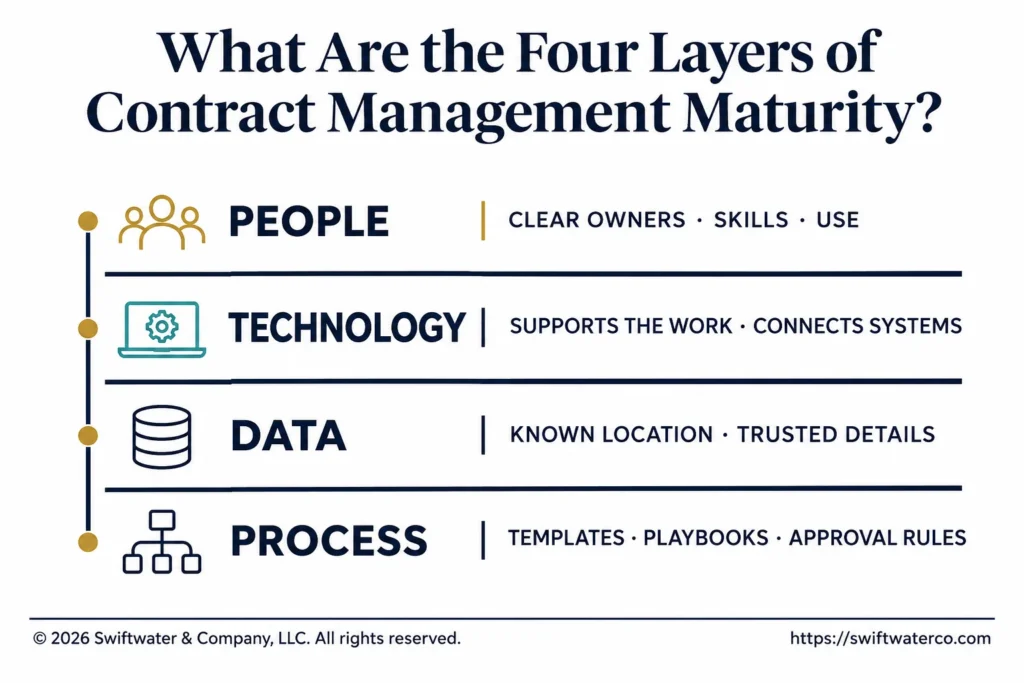
The Swiftwater Contract Management Maturity Model looks at four layers: process, data, technology, and people. Each is scored separately, because a department can be strong in one and weak in another. A team with an excellent CLM and no agreed approval rules has a technology score that hides a process problem. Looking at the layers one at a time keeps a new system from being mistaken for a mature operation.
- Process: how contracts move through the seven stages of the contract lifecycle, and whether templates, playbooks, and approval rules are written down and followed.
- Data: whether contracts are in a known place, and whether key details such as parties, dates, and renewal terms can be found and trusted.
- Technology: whether systems support the work and connect to each other, including the CLM, e-signature, and the sales and procurement platforms where contracts begin.
- People: whether roles and ownership are clear, whether the people involved have the skills, and whether they use the process.
What does each maturity level look like?
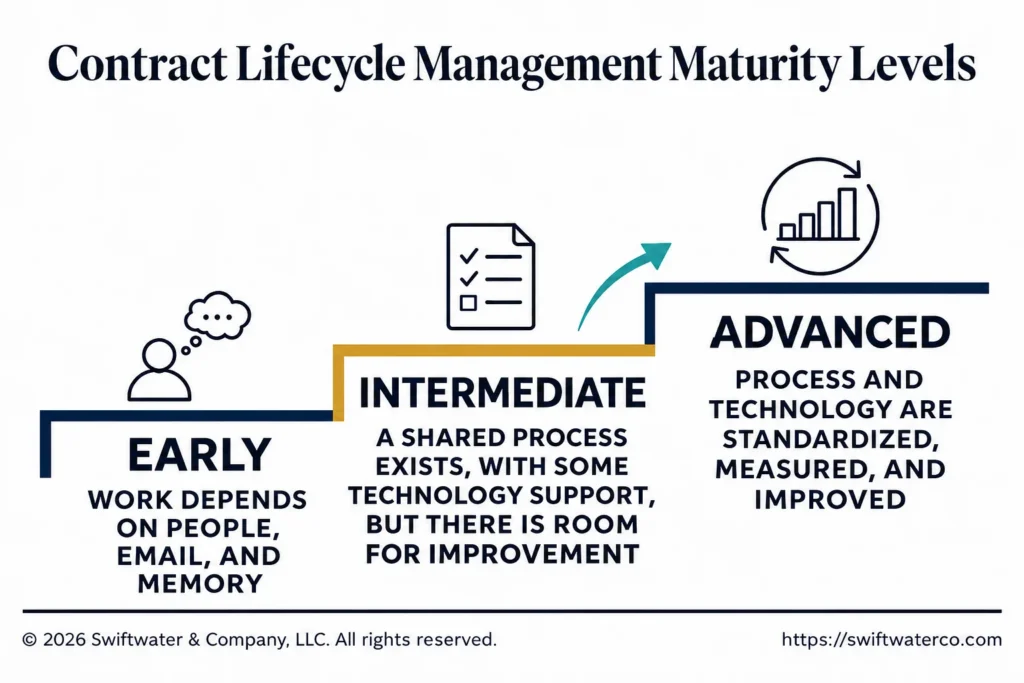
The maturity model uses three levels: early, intermediate, and advanced. Early means the work depends on individuals and memory. Intermediate means the process, system, or report exists and is partly used. Advanced means it is used consistently, measured, and improved over time. Most organizations sit at intermediate in at least two layers, where the gap to advanced is usually adoption and governance more than new spending.
| Level | What you see | What to do next |
|---|---|---|
| Early | Contracts in inboxes and shared drives; approvals by email; nobody can say how many contracts exist | Find the contracts, name owners, and map the current process |
| Intermediate | A CLM or repository is live and partly used; templates exist; reports are built when someone asks | Enforce the intake route, clean the data, and agree on a few measures |
| Advanced | One route in, reliable contract data, regular reporting, and adoption tracked by team | Connect contract data to finance and sales decisions, and review the process each year |
Applied layer by layer, the difference between the two ends of the scale looks like this.
Evaluating or implementing a CLM platform?
We have guided legal departments through selection, implementation, and adoption, without the vendor bias. Let us talk about where you are and what you actually need.
See CLM Services| Layer | Early | Advanced |
|---|---|---|
| Process | Each lawyer has a preferred template and approvals happen by email | Approved templates, written playbooks, and routing rules that everyone follows |
| Data | Contract details live in the documents, if the documents can be found | Key details captured at signature and trusted enough to report on |
| Technology | Shared drives and e-signature, with no connections between systems | A CLM connected to the systems where contracts begin and where the data is used |
| People | Contract work falls to whoever is available | Named owners for each stage, with trained users and a sponsor who follows the numbers |
Intermediate sits between the two in every row: the template exists and half the business uses it, the CLM is live and the signed copies mostly reach it. That is where most programs stall. The technology has been paid for, and the remaining work is getting people to change how they operate.
How do you assess where you are?
Assess maturity by scoring each layer against evidence, using people from more than one function. Ask for the actual report, the actual template, and the actual contract record, because an answer given from memory tends to run high. Start with our CLM readiness guide, which includes a free scored self-assessment, and use contract lifecycle mapping to see how contracts really move today.
Data is often the sobering part. In a 2026 WorldCC survey of 170 organizations, only 27% stored all executed contracts exclusively in a CLM system, and 54% had no automated data flow between systems. Many teams that consider themselves intermediate find, once they check, that their data layer is early. Measurement helps here too: our guide to contract management KPIs sets out what to track at each stage.
What is a contract lifecycle management framework?
A contract lifecycle management framework is the set of stages, roles, policies, and standards an organization uses to run its contracts from request to renewal. A maturity model measures how well that framework works. The two are often confused because vendors and analysts use the terms loosely. In practice, the framework describes how the work should run, and the maturity model tells you how close you are to running it that way.
Two industry reference points are worth knowing. WorldCC (formerly IACCM) publishes a Contract Management Standard as a consistent framework for the contracting lifecycle. CLOC’s Core 12 places contract management among the functions of legal operations, which is useful when contracting has to be planned alongside spend, technology, and data work.
Contract governance is the part of the framework people skip. Governance is the set of decisions about who may sign what, who owns each template, how exceptions are approved, and how often the rules are reviewed. Written policy matters less than whether people follow it, and a short policy that is enforced will do more than a long one nobody opens.
How do you sequence the next stage?
Improve one layer at a time, and start with process and ownership before buying or replacing technology. A system configured around an unclear process copies the confusion into software. Set a target for each layer based on where the company’s risk and money sit, then work on the largest gap between that target and today. Advanced in every layer is rarely the right goal.
A typical order runs like this. First, name owners and map the current process. Next, locate the contracts and agree on the key data to capture. Then configure or tune the system, following a CLM implementation plan. Finally, measure adoption, report on a few numbers, and review the process each year.
Bottom Line
The Swiftwater Contract Management Maturity Model gives a legal department a plain way to see which of four layers is holding back the others. Most organizations will find an uneven picture, with technology ahead of process and people.
Evaluating legal technology but not sure where to start?
We help legal departments cut through the vendor noise, mapping technology to process maturity and building a roadmap that actually gets adopted.
See Legal TechnologyThat unevenness is useful information, because it tells you where the next dollar and the next hour should go. Score each layer against evidence, set a target that fits the business, and close the largest gap first.
Swiftwater’s CLM Discovery Sprint includes a readiness and maturity assessment, along with a lifecycle map and a roadmap, before you commit to a platform.
Frequently Asked Questions
What is a contract management maturity model?
A contract management maturity model is a way to measure how well an organization runs its contracts across four layers: process, data, technology, and people. It places each layer on a scale from early to advanced, so a legal department can see which gap to close first and measure progress when it looks again.
What are the levels of contract management maturity?
The Swiftwater Contract Management Maturity Model uses three levels: early, intermediate, and advanced. Early work depends on individuals and memory. Intermediate means the process or system exists and is partly used. Advanced means it is used consistently, measured, and improved over time. Other models use more levels, and the idea is the same.
How is a maturity model different from a CLM framework?
A CLM framework is the set of stages, roles, policies, and standards used to run contracts. A maturity model measures how well that framework works in practice. The framework describes how the work should run, and the model shows how close the organization is to running it that way.
Should every organization aim for advanced?
No. The right target depends on contract volume, risk, and where the money sits. A company with few, simple contracts may be well served at intermediate in most layers. Set a target for each layer, and put the most effort where a gap would cost the business the most.
How often should you reassess contract management maturity?
Reassess about once a year, or after a major change such as a new CLM, an acquisition, or a new owner for contracting. Use the same questions and evidence each time so that the results can be compared. Between assessments, track a small set of contract management KPIs to see whether the work is moving.
Who should take part in a maturity assessment?
Include legal, legal operations, sales operations, procurement, finance, and IT or platform owners, along with people who handle contracts every day. Managers tend to describe the official process, while practitioners know where work stalls. Scoring with more than one function also exposes disagreements about ownership, which are often the first thing to fix.
This article is provided for general informational purposes only and is not legal, financial, or business advice. Contract management and governance decisions should be validated against your organization’s specific structure, regulatory obligations, and counsel guidance, and you should consult a qualified professional for advice on your situation.