


Non-Disclosure Agreements (NDAs) are legally binding contracts that establish confidentiality obligations between parties to protect sensitive information shared during business interactions. These agreements come in various forms, such as unilateral NDAs (one party disclosing information) or mutual NDAs (MNDA – where both parties share confidential information).

NDAs are essential for business as they support:
- Protection of Confidential Information: Safeguards valuable trade secrets, proprietary information, and sensitive data from unauthorized disclosure or use by competitors, employees, contractors, and other parties.
- Preservation of Competitive Advantage: Allows businesses to share confidential information with partners, investors, or collaborators while maintaining confidentiality and preventing exposure to competitors.
- Facilitation of Business Relationships: Builds trust and confidence in business relationships by demonstrating a commitment to confidentiality and privacy, enabling more open and productive collaboration.
- Legal Recourse and Enforcement: Provides a legal framework for enforcing confidentiality obligations and seeking remedies in case of breach, establishing clear expectations and consequences for non-compliance.
- Compliance with Regulatory Requirements: Assists in meeting industry regulations and legal standards that mandate protection of confidential information, demonstrating a commitment to data privacy and confidentiality.
- Preservation of Intellectual Property Rights: Safeguards intellectual property (IP) assets, including inventions, designs, processes, and creative works, by restricting access to authorized individuals or entities.
- Risk Mitigation and Reputation Protection: Mitigates risks associated with unauthorized disclosure of confidential information, including financial losses, reputational damage, and loss of competitive advantage, thereby safeguarding the organization’s reputation and market position.
Key Takeaways
- NDAs are essential for protecting sensitive business information and intellectual property, safeguarding against unauthorized disclosure.
- Traditional manual NDA processes are inefficient, prone to errors, and pose compliance and security risks.
- Automating NDAs offer consistent processes, improved compliance, cost savings, enhanced collaboration, stronger security, and more time to focus on high-value activities.
- Key elements of NDAs include identifying parties, defining confidential information, specifying scope, outlining obligations, and addressing legal consequences.
- NDAs are critical for fostering trust in business relationships, providing legal recourse, and ensuring compliance with regulations.
- Automation software simplifies NDA processes by streamlining drafting, submission, review, approval, and collaboration among stakeholders.
What are the Key Elements Typically Included in Non-Disclosure Agreements (NDAs)?
The key elements commonly found in NDAs ensure clarity, enforceability, and effective protection of confidential information. Because NDAs are high-volume and repeatable, they are strong candidates for standardized templates, clause libraries, and playbooks. For more detail, see clause libraries, contract templates, and contract playbooks. Below are the essential elements typically included in Non-Disclosure Agreements:
1. Identification of Parties: NDAs begin by identifying the parties involved in the agreement. This includes:
- The disclosing party: The entity or individual sharing confidential information.
- The receiving party: The entity or individual receiving and agreeing to protect confidential information.
2. Definition of Confidential Information: The NDA clearly defines what constitutes confidential information. This can encompass:
Evaluating or implementing a CLM platform?
We have guided legal departments through selection, implementation, and adoption, without the vendor bias. Let us talk about where you are and what you actually need.
See CLM Services- Trade secrets
- Intellectual property
- Business strategies and plans
- Financial data
- Customer lists
- Technical data or designs
Tip: Typically, not every transaction requires a detailed Intellectual Property protection clause. If you see your NDAs negotiations getting prolonged every time, then consider making the detailed IP protection clause contingent on certain business transaction types. You can include this information in the NDA or program it into your NDA workflow automation tool.
3. Scope of Confidentiality: The agreement specifies the scope of the confidential information covered by the NDA. This includes:
- Describing the categories or types of information deemed confidential.
- Outlining any exclusions or exceptions to what is considered confidential.
Tip: Ensure your business team knows about these areas and they are ready to handle them. Such exclusions can help get NDAs expedited. However, the business team needs to be aware of what will be covered.
4. Obligations of Receiving Party: NDAs outline the obligations and responsibilities of the receiving party regarding the confidential information, including:
- Non-disclosure: Prohibiting the sharing or disclosure of confidential information to third parties.
- Non-use: Restricting the use of confidential information for purposes other than the agreed-upon business relationship.
5. Duration of Confidentiality: NDAs specify the duration for which the confidentiality obligations remain in effect. This can include:
- A specific time period (e.g., two years) after which the information is no longer considered confidential.
- Indefinite confidentiality for information that remains valuable over the long term.
6. Exclusions from Confidentiality: NDAs may include exceptions or exclusions where the confidentiality obligations do not apply. These may include:
- Information already in the public domain through lawful means.
- Information independently developed by the receiving party without reference to the disclosing party’s confidential information.
7. Legal Remedies and Consequences: The non-disclosure document typically outlines the legal remedies or consequences in case of breach of confidentiality. This can include:
- Injunctive relief to prevent further disclosure or use of confidential information.
- Monetary damages for losses incurred due to breach.
8. Miscellaneous Provisions: Non-Disclosures often include miscellaneous provisions addressing other important aspects, such as:
- Governing law and jurisdiction.
- Severability of provisions.
- Amendments and waivers.
What are the Challenges with Traditional NDA Processes?
Traditional methods of drafting and managing Non-Disclosure Agreements often present significant obstacles. These challenges highlight the necessity of adopting modern, technology-driven approaches to enhance efficiency and effectiveness in confidentiality management.

Key challenges with traditional NDA processes include:
- Manual handling leads to time-consuming workflows and administrative burden.
- Significant or senior resources may be tied to this contract-type which is typically categorized as low value.
- Dealing with repetitive NDAs can lead to resource burnout.
- Version control issues arise from managing multiple document versions.
- Inefficient negotiation and approval processes delay finalizing agreements.
- Ensuring compliance with confidentiality obligations is challenging.
- Limited visibility and auditability hinder effective monitoring and review.
- Security risks associated with physical storage and email communication.
- Resource-intensive tasks such as printing, scanning, and storing documents.
- Lack of scalability and adaptability to changing business needs.
- Insufficient integration with other business systems like CRM or document management.
What are the Business Benefits of Self-Service and Automating the NDA process?
Automating Non-Disclosure Agreements (NDAs) with technology-driven solutions provides several advantages over manual processes. This approach allows organizations to streamline NDA management, leading to enhanced efficiency, improved compliance, and substantial cost savings.
Additionally, automation delivers benefits such as heightened security, improved stakeholder experiences, and optimized confidentiality practices. Embracing automation enables organizations to mitigate risks and unlock strategic value in their operations.
Evaluating legal technology but not sure where to start?
We help legal departments cut through the vendor noise, mapping technology to process maturity and building a roadmap that actually gets adopted.
See Legal Technology
Below are key benefits of enabling self-service and automating NDAs:
- Simplified NDA Processes: Accelerates NDA creation, negotiation, and signing processes, reducing turnaround times, and accelerating deal closures.
- Speedy Self-service: NDAs with standard changes to party, jurisdiction, and other clauses can be completed without legal review. Automated NDA playbooks can ensure the options are available and guidelines are followed. For a broader CLM operating model, see 10 Contract Lifecycle Management Best Practices for 2026, which covers repositories, workflows, templates, playbooks, renewals, risk monitoring, analytics, integrations, AI readiness, and legacy migration. Unless an exception is claimed a business user can complete the NDA themselves increasing the speed of the transaction and reducing burden on legal.
- Creating Legal Capacity: Creating legal capacity to focus on high-value tasks that require legal strategy and input.
- Improving Legal Staff Work-Life: Some organizations sign thousands of repetitive NDAs which create additional email, mental, and professional burdens on the legal staff. Implementing self-service and automation will triage important work to legal staff yet support the speed and risk appetite of the business.
- Consistent Application of Terms: Ensures consistent application of NDA terms and conditions across agreements, ensuring accuracy and reducing compliance risks.
- Enhanced Security: Utilizes digital storage, encryption, access controls, and audit trails to minimize the risk of data breaches.
- Cost Savings: Reduces administrative overhead associated with drafting/reviewing (self-service), printing, scanning, mailing, and storing physical documents, leading to cost savings.
- Volume Handling: NDAs are frequently used in business dealings involving a high volume of transactions. Automating the NDA process reduces manual effort and accelerates the handling of numerous agreements efficiently.
- Ease of Modification: Minor modifications to NDAs, such as clause adjustments or changes in jurisdiction, can be swiftly implemented through automation. This ensures consistency and accuracy across documents without extensive manual intervention.
- Integration with Electronic Signatures: Automation allows seamless integration with electronic signature platforms like DocuSign and Adobe Sign. This enables quick and secure execution of NDAs, reducing turnaround times and enhancing the overall efficiency of the agreement process. For a broader view of digital acceptance, e-signature, audit trails, version control, and online enforceability, see Online Contracts: A Complete Guide.
- Integration with Source Systems: Automation facilitates seamless integration with source systems like CRMs (Customer Relationship Management) or ERPs (Enterprise Resource Planning). This integration enables users to request NDAs directly from these systems, streamlining the process and reducing data entry duplication.
- Improved Collaboration and Communication: Facilitates better collaboration and communication among stakeholders involved in NDA processes, fostering engagement and responsiveness.
- Scalability and Adaptability: Scales to accommodate growing volumes of NDAs and adapts to changing business needs without compromising efficiency.
- Robust Auditability and Reporting: Provides comprehensive audit trails and reporting functionalities, offering insights into NDA activities and compliance status for informed decision-making.
- Enhanced Customer and Partner Experience: Delivers faster processes, timely notifications, and adherence to NDA timelines, strengthening relationships with customers and partners.
How to Automate NDA Requests?
Using automation software, such as low code/no code workflow systems, document generation tools, or contract lifecycle management (CLM) tools, simplifies the process of drafting, submitting, and reviewing Non-Disclosure Agreements (NDAs). For a broader view of how intake, drafting, review, approval, signature, storage, renewal, and post-signature tracking connect, see contract workflow management.
Here’s how NDA software streamlines the review process:
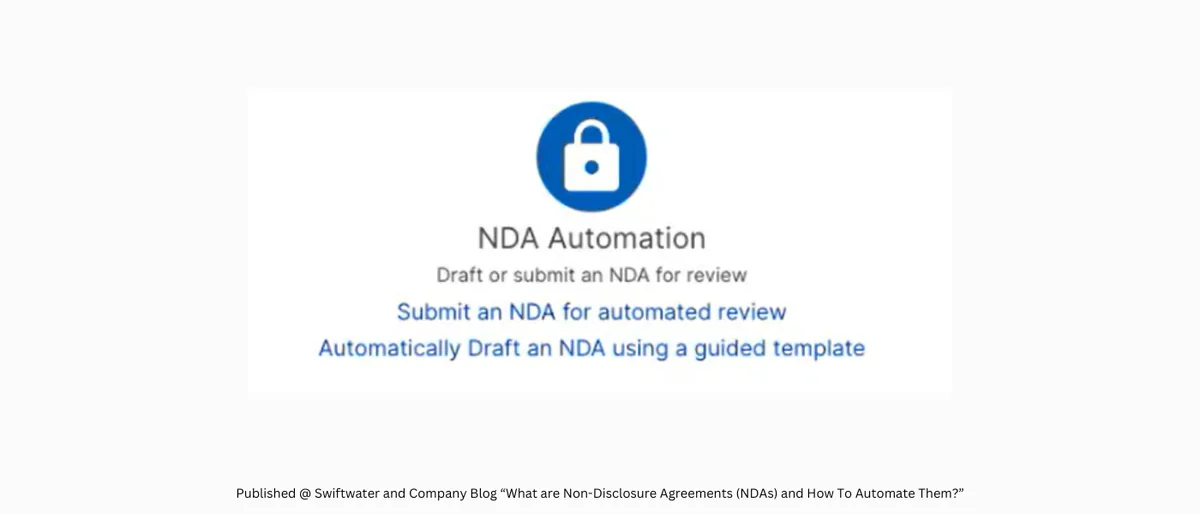
Step 1: Start the Non-Disclosure Agreement Intake Request: Start by navigating to the software homepage or dashboard. Look for the option labeled “Submit an NDA for automated review.”
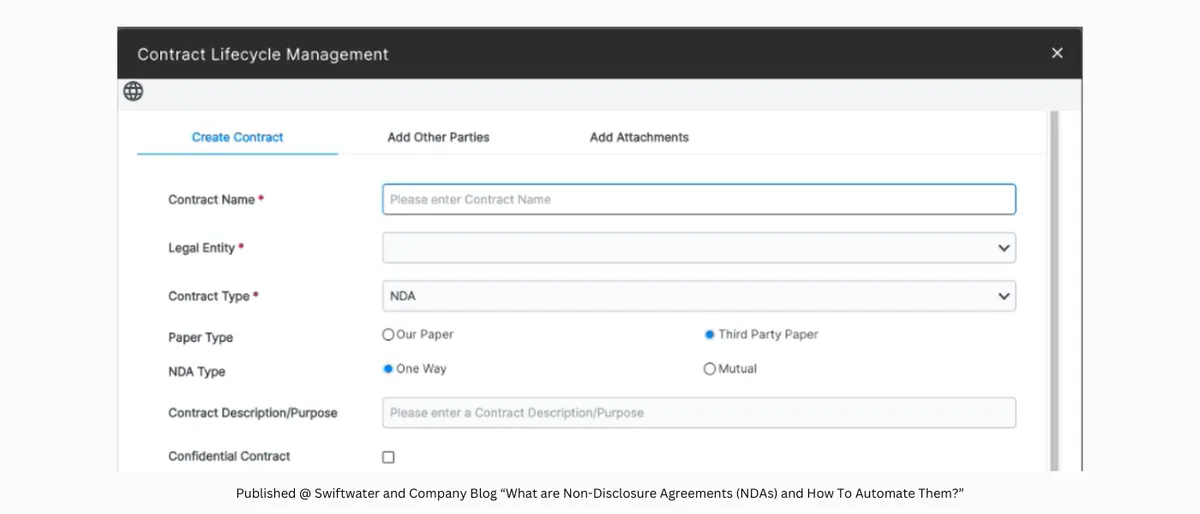
Step 2: Fill Out Details to Complete Request: On the contract creation page, provide essential contract details such as:
- Contract name
- Legal entity
- Contract type
- Paper type
- NDA type
- Contract description/purpose
- Confidentiality status (confidential or not)
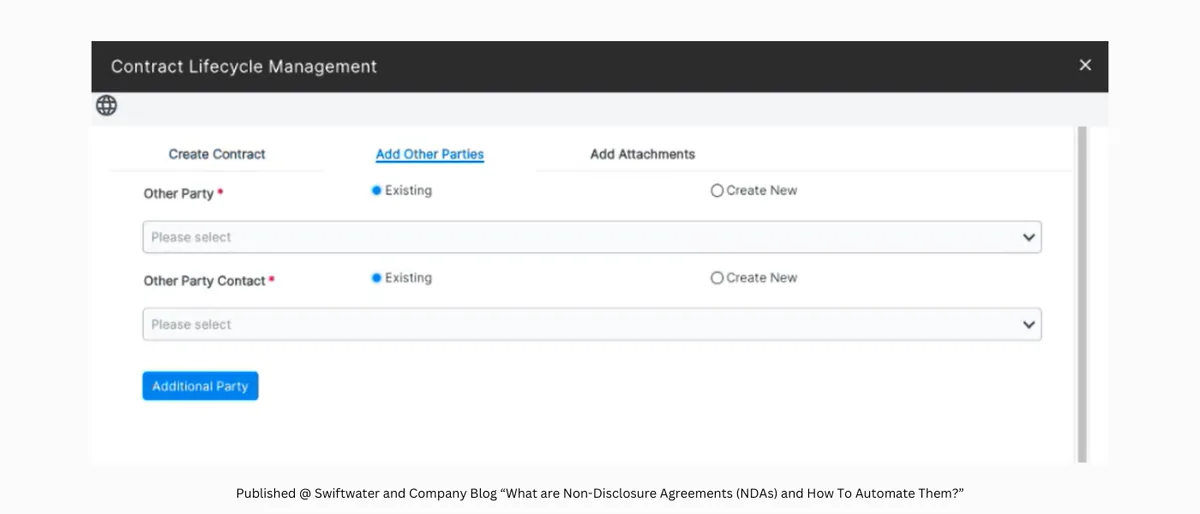
Step 3: Identify All Parties Involved: Proceed to fill out information about the other parties involved in the contract, including their contact details. A connection to the CRM or ERP system will facilitate the retrieval of the party information.
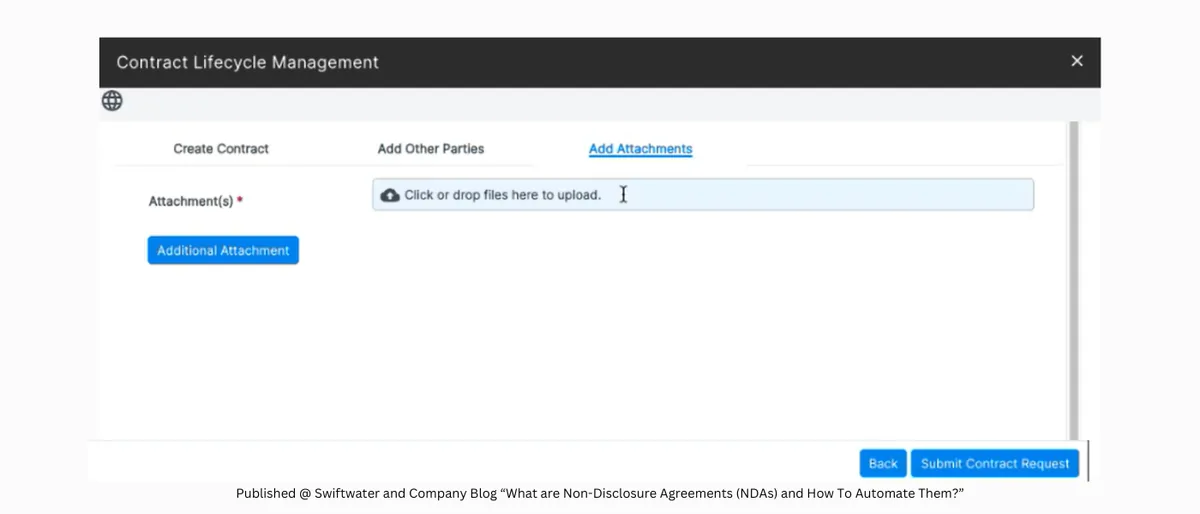
Step 4: Attach Relevant Documents: If necessary, attach any relevant documents related to the NDA. Ensure all required documents are included before proceeding to submit the request.
Step 5: Kick-start Legal Review: Once submitted, the software automatically notifies designated reviewers or stakeholders about the pending NDA review, sending notifications via email or within the software interface to inform them of the review request.
OR, if no flags or exceptions are triggered, it might send the document to Step 7 for signatures. In this case, it can truly be a self-service NDA.
Reviewers benefit from easy access to all pertinent information related to the NDA, including contract details, parties involved, and associated documents, all within a centralized system. This eliminates the need to search through emails or paper documents for review materials, improving efficiency and ensuring completeness of information.
Not ready to pick a CLM platform yet?
A four to six week diagnostic that maps your current contract lifecycle, sets requirements themes, and tells you what to buy before you sit through another vendor demo.
See the CLM Discovery Sprint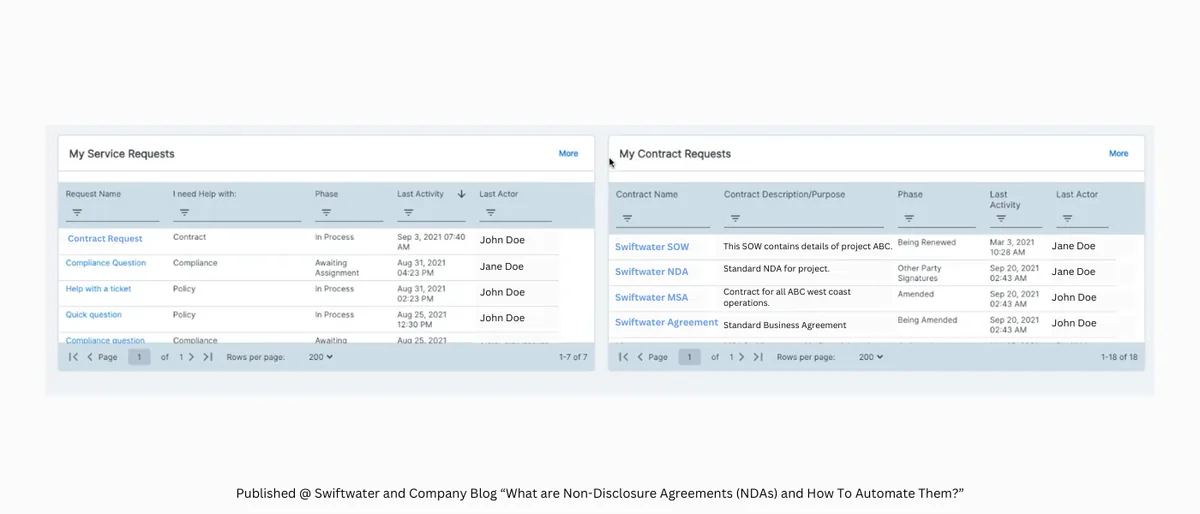
Step 6: Based on intake request legal will redline your standard NDA or third-party document provided. For high-volume NDA review, AI can support first-pass review, playbook comparison, clause analysis, risk flagging, and contract data extraction. For more detail, see AI contract review.Reviewers can directly annotate or comment using built-in collaboration tools, facilitating real-time feedback and discussion among stakeholders.
The software maintains version control, tracking changes and comments made by reviewers, allowing them to compare different versions of the NDA document and track the status of review tasks seamlessly.
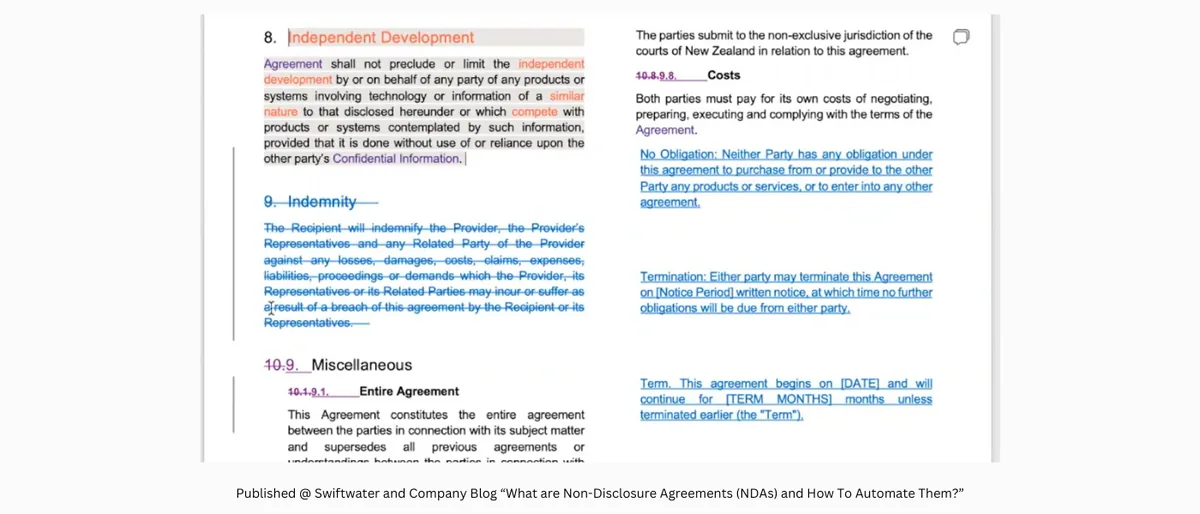
Step 7: Once the review process is complete, reviewers easily approve or request revisions to the NDA document within the software platform.
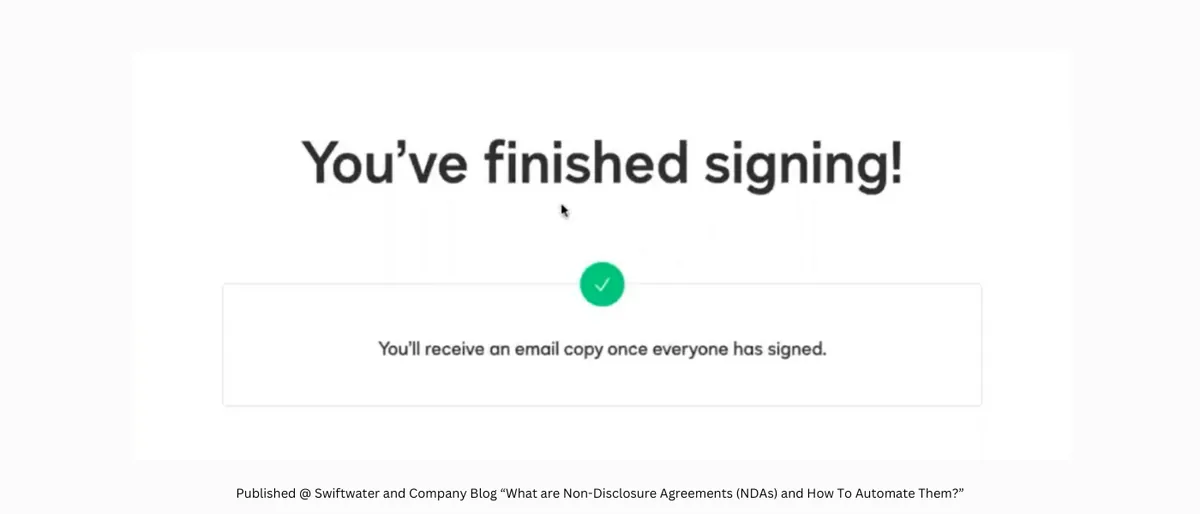
Automated workflows within the software then route approved NDAs for electronic signatures or further actions, ensuring a streamlined and compliant process.
The appropriate authorities can provide an electronic signature (or if the jurisdiction requires a wet signature).
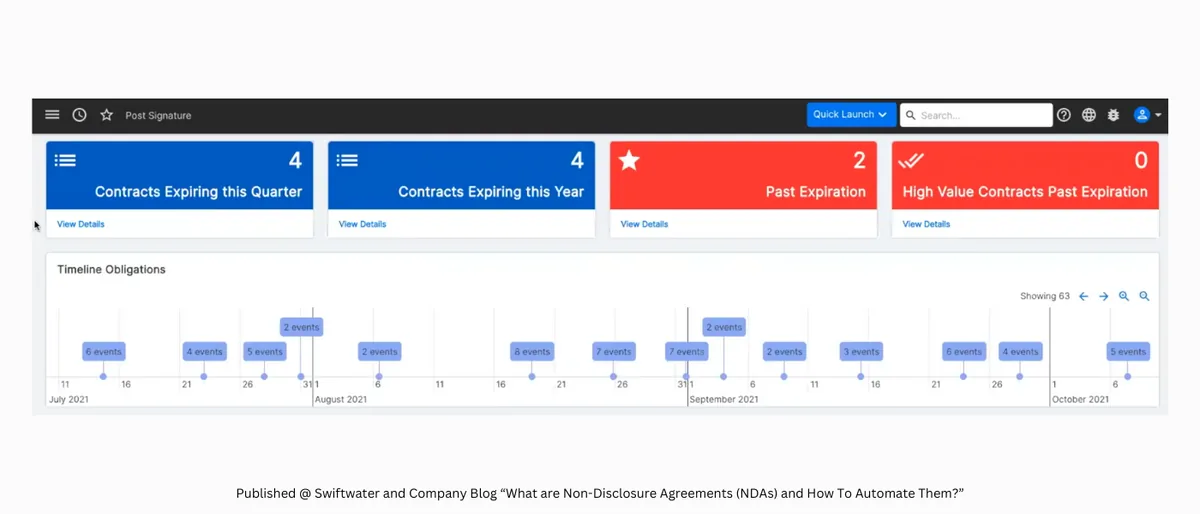
Step 8: The software keeps track of the contracts post-signature and generates a timeline of contract expiration and obligations.
Creating Self-Service NDAs and Automated NDAs Speed Up Business and Reduce Legal Workload
Non-Disclosure Agreements (NDAs) are legal safeguards that shield confidential business data from unauthorized disclosure or use. They are as much a business tool as they are a legal instrument. Therefore, drafting them in a manner consistent with your business and your industry stakeholder expectations is important.
Since it is such a ubiquitous instrument its high volume and repetitiveness can create opportunities and challenges. Its challenges can manifest as high workload but a mundane activity for legal. This presents the opportunity to leverage technology and playbooks to automate and make it self-service.
Since it is such a ubiquitous instrument, its high volume and repetitiveness can create opportunities and challenges. Its challenges can manifest as high workload but a mundane.
Above, we reviewed drafting NDAs and the benefits of using technology to automate and self-serve. By transitioning from manual to automated processes, businesses can streamline NDA workflows, enhance compliance adherence, and realize substantial cost savings.
The transformative shift towards automation and self-service not only optimizes confidentiality practices but also fosters a culture of collaboration and efficiency.
If your legal, sales, procurement, or business team is ready to automate high-volume NDAs, create self-service templates, define playbooks, and connect confidentiality agreements into a broader contract lifecycle, Swiftwater’s Contract Lifecycle Management practice helps organizations assess readiness, design workflows, standardize templates and playbooks, implement platforms, improve adoption, and measure business value.
Frequently asked questions
What is a Non-Disclosure Agreement?
A Non-Disclosure Agreement, or NDA, is a contract that creates confidentiality obligations between parties. It defines what information is confidential, how it may be used, who may receive it, and what duties apply to the party receiving the information.
When should a business use an NDA?
A business should use an NDA when sharing confidential information with another party, such as during vendor discussions, customer negotiations, investor conversations, partnerships, employee onboarding, product development, or professional services engagements.
What are the main types of NDAs?
The main types of NDAs are unilateral NDAs and mutual NDAs. A unilateral NDA protects information disclosed by one party. A mutual NDA protects confidential information exchanged by both parties during a business relationship or transaction.
What should an NDA include?
An NDA should usually include the names of the parties, a definition of confidential information, permitted uses, disclosure restrictions, exclusions, confidentiality duration, return or destruction requirements, remedies, governing law, and signature blocks.
Why are NDAs good candidates for automation?
NDAs are good candidates for automation because they are high-volume, repeatable, and often based on standard terms. With the right templates, playbooks, intake questions, approval rules, and e-signature process, many NDAs can move through a self-service workflow.
How does NDA automation work?
NDA automation usually starts with an intake form that collects party details, NDA type, jurisdiction, purpose, confidentiality status, and any exceptions. The system then generates the document, routes it for approval when needed, sends it for signature, stores the final agreement, and tracks key dates or obligations.
How can self-service NDAs help legal teams?
Self-service NDAs help legal teams by allowing business users to generate and process standard NDAs within approved rules. This reduces repetitive legal review, speeds up business activity, improves consistency, and lets legal teams focus on higher-value or higher-risk work.
What should companies prepare before automating NDAs?
Before automating NDAs, companies should prepare approved NDA templates, fallback positions, intake questions, approval rules, exception triggers, signature authority rules, storage requirements, reporting needs, and a simple playbook that explains when legal review is required.
Disclaimer: This article is provided for educational and information purposes only. Neither Swiftwater & Co. or the author provide legal advice. External links are responsibility and reflect the thinking of their respective authors – those are provided for informational purposes only.