

Contract administration keeps signed contracts on track: obligations, changes, records, and renewals. It is the work that starts when the signature page comes back: making sure each side does what it promised, recording every change, and catching the renewal date before it passes. Most of the value a contract loses is lost here, after the deal team has moved on.
Contract management is the wider discipline. It covers the whole lifecycle, from the first request through drafting, negotiation, approval, and signature, and it includes administration. This guide explains the difference, what an administrator does day to day, and the practices that keep administration routine. It is part of our contract lifecycle management guide and follows the seven stages of the contract lifecycle.
What is contract administration?
Contract administration is the management of a contract after signature: tracking obligations and deliverables, monitoring performance, processing amendments and change orders, keeping records and correspondence, and acting on renewal and termination dates. It is done by contract administrators, contract managers, or the business owner of the contract, depending on the organization. The output is a contract that performs as agreed and a record that shows what happened.
How is contract administration different from contract management?
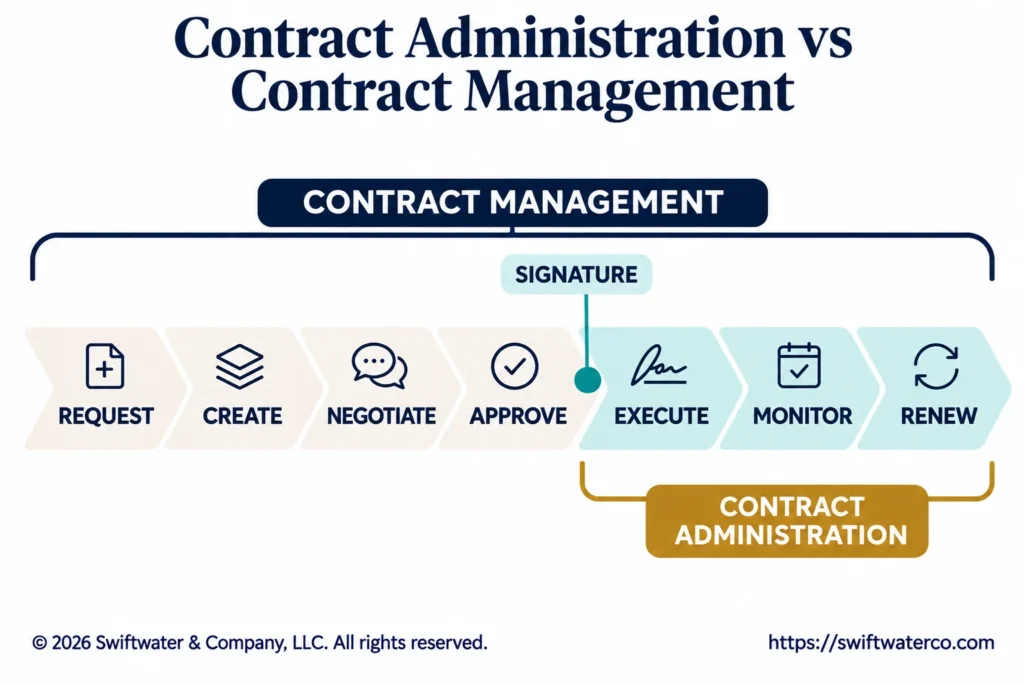
Contract administration is the post-signature part of contract management, while contract management covers the full lifecycle from request to renewal. A contract manager is accountable for the whole process; an administrator keeps the signed contracts performing.
| Aspect | Contract administration | Contract management |
|---|---|---|
| Scope | Signed contracts | The full lifecycle, from request to renewal |
| Stages | Storage, obligations and performance, renewal | All seven stages |
| Typical owner | Contract administrator or the business owner | Contract manager or a contracts function |
| Main output | Obligations met, changes recorded, renewals decided | Contracts that are fast to agree and safe to perform |
What does a contract administrator do day to day?
A contract administrator spends the day keeping signed contracts current and answering questions about them. Typical work includes logging new contracts and their key dates, chasing deliverables and confirmations, recording amendments, checking invoices against contract prices, sending renewal alerts to owners, and pulling the contract when someone asks what it says.
- Logging each signed contract with its parties, value, dates, and obligations.
- Tracking deliverables, service levels, and milestones, and following up when they slip.
- Processing amendments, change orders, and notices, and keeping the version history.
- Checking that invoices and payments match contract terms.
- Sending renewal and expiry alerts to the contract owner ahead of the notice deadline.
- Answering questions from finance, procurement, sales, and legal about what a contract allows.
Our comparison of contract specialist, administrator, and manager roles shows how the administrator role fits beside the others.
How does a contract administrator manage obligations?
A contract administrator makes obligation management happen by turning every promise in a signed contract into a tracked item with an owner, a due date, and proof that it was met. Obligations run both ways: what your organization owes, such as payments, reports, and notices, and what the other party owes, such as deliverables, service levels, and insurance certificates. Most value is lost when nobody is watching either side after signature, which is why this is the core of the administrator’s job.
Evaluating or implementing a CLM platform?
We have guided legal departments through selection, implementation, and adoption, without the vendor bias. Let us talk about where you are and what you actually need.
See CLM ServicesThe administrator runs obligation management as a cycle:
- Capture at signature. Read the signed contract, including amendments and statements of work, and record each obligation in the obligation register: what is owed, by whom, by when, and how often.
- Assign owners on both sides. Name the person in the business who delivers or receives each obligation, and the contact at the other party.
- Set alerts. Turn due dates, notice windows, and recurring reports into reminders that reach the owner early enough to act.
- Monitor and collect evidence. Chase confirmations, service-level reports, certificates, and invoices, and file the evidence against the obligation.
- Escalate and resolve misses. Raise late or missed obligations with the owner and, where the contract allows, claim service credits or issue notices; record any waiver or change as an amendment.
- Report. Give the business and leadership a regular view of obligations due, met, and missed.
- Feed the renewal decision. Use the performance record to decide whether to renew, renegotiate, or exit.
| Obligation type | Example | How the administrator tracks it |
|---|---|---|
| Performance | Deliverables, milestones, service levels | Due dates, acceptance records, service-level reports |
| Financial | Payments, price changes, rebates, service credits | Invoice checks against contract terms, credit claims |
| Compliance | Insurance certificates, audits, data protection, regulatory reports | Expiry dates, evidence on file, audit schedules |
| Notices | Renewal, termination, and change notices | Notice deadlines with alerts to the owner |
AI extraction can now pull most obligations from a contract in seconds, but the administrator still checks what it found, adds what it missed, and makes sure each item has an owner before it goes live. Our guide to contract obligation management covers the discipline in depth.
What are contract administration best practices?
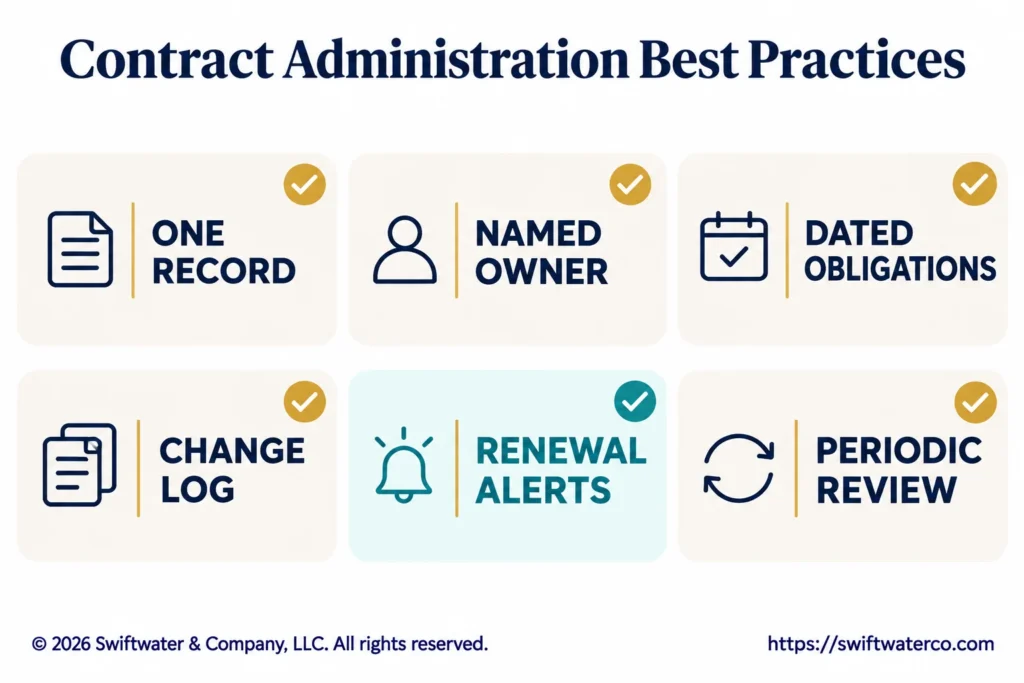
The best practices of contract administration are operational: one record per contract, a named owner for every obligation, dates held as data fields, a change log, renewal alerts tied to notice deadlines, and a regular review of active contracts. Each one closes a gap where value is usually lost. WorldCC finds that organizations lose an average of 11% of contract value after signature, which is the gap administration exists to close.
- One record per contract. The signed version, its amendments, and its key data live in one contract repository.
- A named owner for every obligation. Each deliverable, service level, and payment term has a person responsible, tracked in an obligation register.
- Dates as data. Start, end, notice, and renewal dates are fields that can trigger alerts and reports.
- A change log. Every amendment, change order, and notice is recorded against the contract.
- Renewal alerts tied to notice deadlines. Alerts fire early enough to decide; see contract renewal management.
- A review cadence. High-value contracts are reviewed on a set schedule against performance and spend.
How does construction contract administration differ?
Construction contract administration is heavier and more formal, because the work happens on site over months or years and changes are constant. Administrators manage change orders, payment applications and retention, requests for information, formal notices with strict deadlines, daily site records, and closeout documents. Missing a notice window can cost a claim, so dates and records matter even more than in commercial work. Our construction contract management guide covers the industry in detail.
How does contract administration work in government?
Government contract administration follows the same idea under stricter rules: it covers everything from award to closeout, and the people who do it act only within written authority. The National Association of State Procurement Officials describes contract administration as a subset of contract management, covering the monitoring and administration that take place from award or signature until closeout.
In US federal contracting, the contracting officer can delegate contract administration functions to a contract administration office, under Part 42 of the Federal Acquisition Regulation. The delegated work ranges from post-award orientation conferences to approving progress payments and reviewing contractor systems. An administrative contracting officer holds the authority to act on the contract, and for many Department of Defense contracts that office sits in the Defense Contract Management Agency. A contracting officer’s representative monitors technical performance day to day but has no authority to change price, quantity, delivery, or other terms.
For a company that holds government contracts, the practical point is that every change has to come from someone with the authority to make it. A contract administrator on the contractor side needs to know who that is, keep the record of every modification, and track the obligations the contract’s required clauses create. Our comparison of contract specialist, administrator, and manager roles explains how federal and state governments define these titles.
Government roles, regulations, and certification requirements on this page are summarized from public sources as of November 2026 for information only. Titles, rules, thresholds, and section numbers change, so confirm the current regulation, statute, or agency guidance before relying on them.
Which stages does contract administration own?
Contract administration owns the stages after signature: storage of the signed contract, obligations and performance monitoring, and renewal, renegotiation, or termination. Those are stages five (the storage part), six, and seven of the contract lifecycle. The stages before signature, from request and intake through approval, belong to the wider contract management process.
How does a CLM support contract administration?
A contract lifecycle management platform supports administration by holding each contract with its key data, turning dates and obligations into alerts, recording amendments against the original, and reporting on what is due. The administrator’s job moves from searching folders and spreadsheets to working from a queue of what needs action. The platform helps only when the data is entered consistently, so administration standards come first. Our contract management KPIs page lists the measures worth reporting.
Bottom Line
Contract administration is the post-signature part of contract management. It keeps obligations met, changes recorded, and renewals decided, and it is where most lost contract value can be recovered. Obligation management is the center of it: every promise in the contract, on both sides, needs an owner, a date, and evidence that it was kept.
The practices are simple and easy to skip: one record per contract, a named owner for every obligation, dates held as data, a change log, renewal alerts tied to notice deadlines, and a review cadence. Give every signed contract an owner, dated obligations, and a renewal alert, and administration becomes routine work.
When signed contracts have no one keeping the record current, a fractional administrator through our CLM administration service keeps obligations, changes, and renewals on track in the platform you already run.
Evaluating legal technology but not sure where to start?
We help legal departments cut through the vendor noise, mapping technology to process maturity and building a roadmap that actually gets adopted.
See Legal TechnologyFrequently Asked Questions
What is contract administration?
Contract administration keeps signed contracts on track: obligations, changes, records, and renewals. It covers tracking deliverables and service levels, processing amendments and change orders, keeping the contract record current, and acting on renewal and termination dates.
Is contract administration the same as contract management?
No. Contract administration is the post-signature part of contract management. Contract management covers the full lifecycle, from request and drafting through negotiation, approval, and signature to renewal, and includes administration.
What does a contract administrator do?
A contract administrator logs signed contracts and their key dates, tracks obligations and deliverables, processes amendments and notices, checks invoices against contract terms, sends renewal alerts to owners, and answers questions about what a contract allows.
How does a contract administrator manage obligations?
A contract administrator captures every obligation at signature in an obligation register, assigns an owner on each side, sets alerts for due dates and notice windows, collects evidence that each obligation was met, escalates misses, reports status, and uses the performance record to inform the renewal decision.
What are contract administration best practices?
Keep one record per contract, give every obligation a named owner, hold dates as data fields, log every change, tie renewal alerts to notice deadlines, review high-value contracts on a set schedule, and bring the performance record to every renewal decision.
What is construction contract administration?
Construction contract administration manages construction contracts after award: change orders, payment applications and retention, requests for information, formal notices with strict deadlines, site records, and closeout. It is more formal than commercial administration because missed notice windows can cost claims.
How does government contract administration differ?
Government contract administration covers the period from award to closeout and is done under written authority. In federal contracting, administrative contracting officers act on the contract, often through the Defense Contract Management Agency for defense contracts, and contracting officer’s representatives monitor performance without authority to change terms.
What software supports contract administration?
A contract lifecycle management platform with a repository, obligation tracking, alerts, and amendment history supports contract administration. Construction teams often add project management tools for change orders and site records.
This article is provided for general informational purposes only and is not legal, financial, or business advice. Contract administration decisions should be validated against your organization’s specific structure, regulatory obligations, and counsel guidance, and you should consult a qualified professional for advice on your situation. Government roles, regulations, and certification requirements described here are summarized from public sources as of November 2026 for information only and may change; confirm them with the relevant agency, statute, or regulation.