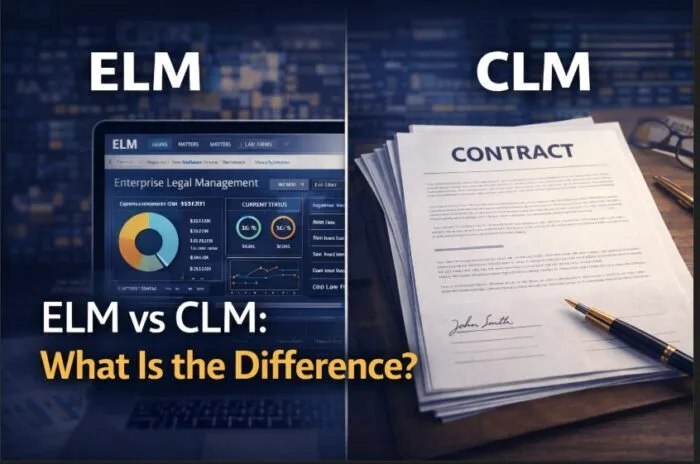

ELM (Enterprise Legal Management) and CLM (Contract Lifecycle Management) serve different primary functions. ELM manages the full operational infrastructure of a legal department: matters, billing, spend, and outside counsel. CLM manages the contract lifecycle specifically: drafting, negotiation, approval, execution, and obligation tracking. Most enterprise legal departments need both, and the leading platforms offer integration between them.
For foundational context on the ELM category, see what is enterprise legal management.
What is ELM?
Enterprise legal management (ELM) is the operating system of a legal department. It provides structured visibility into all legal work across the function: what matters are open, who is working on them, what they are costing, and how outside counsel relationships are performing.
Core ELM capabilities include matter management, legal spend management, eBilling and invoice governance, legal service request intake, workflow automation, and reporting and analytics. The common thread is operational scope. ELM is concerned with how the legal department runs as a function, not with any single document or process within it.
For a full breakdown of what ELM covers and how the leading platforms compare, see the ELM software buyer’s guide.
What is CLM?
Contract lifecycle management (CLM) is software that manages contracts from the moment a request is made through drafting, negotiation, approval, execution, and post-signature obligation tracking and renewal.
Core CLM capabilities include contract request and intake, template and clause library management, negotiation and redlining workflows, e-signature integration, executed contract repository, obligation and milestone tracking, and renewal and expiry alerts. The focus is narrow compared to ELM: CLM manages one type of legal work in depth rather than providing oversight of the entire legal function.
Running an ELM or eBilling implementation?
Swiftwater has three Level 4 Onit-certified practitioners. If you are evaluating, implementing, or rescuing an ELM program, let us talk about what that actually takes.
See ELM ServicesThe CLM market includes pure-play platforms designed specifically for contract management, including Agiloft, DocuSign CLM, Malbek, SpotDraft, and GC AI, alongside CLM modules offered within broader ELM and legal operations platforms such as Onit, Mitratech, and Wolters Kluwer. Pure-play CLM platforms typically offer deeper contract-specific functionality, while integrated CLM modules offer the advantage of a single connected environment with the rest of legal operations.
According to Gartner’s definition of contract lifecycle management, CLM solutions automate and manage the entire contract lifecycle to improve efficiency and compliance. Modern CLM platforms increasingly incorporate AI and agentic workflows for contract review, clause analysis, and obligation extraction. For a practical guide to CLM best practices including AI adoption, see contract lifecycle management best practices.
For a full view of what CLM covers and how Swiftwater approaches CLM programs, see the CLM hub.
Where do ELM and CLM overlap?
The overlap between ELM and CLM is the source of most of the confusion in the market. Several ELM platforms include native CLM modules, and several CLM platforms include matter tracking or workflow features that touch ELM territory. That functional overlap does not make them the same system.
| Capability | ELM | CLM |
| Matter management | Core | Sometimes peripheral |
| Contract drafting and negotiation | Not typically | Core |
| eBilling and invoice management | Core | Not typically |
| Contract repository and search | Sometimes included | Core |
| Legal service request intake | Core | Sometimes included |
| Obligation and renewal tracking | Sometimes included | Core |
| Spend analytics and reporting | Core | Not typically |
| Workflow automation | Core | Core |
The table above illustrates where each system is strong and where capabilities start to converge. Workflow automation is present in both, which is why vendors sometimes position their platform as covering both categories. In practice, a CLM’s workflow engine is optimized for contract processes. An ELM’s workflow engine is optimized for legal operations more broadly.
Does your legal department need both ELM and CLM?
Most mature legal departments need both, but the answer depends on the volume and complexity of contracting activity alongside the broader operational needs of the legal function.
A legal department with high outside counsel spend, limited contract volume, and no structured matter tracking typically needs ELM first. The operational visibility gap is the primary problem, and ELM addresses it directly.
A legal department with high contract volume, slow approval cycles, and poor contract visibility but relatively controlled outside counsel spend may need CLM first. Contracts are where the friction is, and that is where the investment delivers the fastest return.
A legal department managing both challenges simultaneously, which describes most enterprise legal functions, needs both. The question then becomes sequencing and integration rather than one versus the other.
According to McKinsey and Company, organizations that integrate systems across workflows achieve significantly better operational efficiency than those that manage processes in silos. The same principle applies directly to legal departments running ELM and CLM as disconnected tools.
| Situation | Recommended Priority |
| High outside counsel spend, limited contract volume | ELM first |
| High contract volume, slow approvals, poor visibility | CLM first |
| Both challenges present at meaningful scale | Both, with integration planned from the start |
| Early-stage legal function with minimal outside counsel | CLM or mid-market ELM with CLM module |
How do Onit’s ELM and CLM capabilities integrate?
Onit is one of the clearest examples of a platform that offers both ELM and CLM within a connected ecosystem. OnitX and Onit Unity include native CLM capability alongside matter management, eBilling, legal service requests, and workflow automation through Onit Apptitude. This means the contract lifecycle is managed within the same environment as the rest of legal operations, rather than requiring a separate integration between two standalone platforms.
In practice, this integration means a contract request can be captured through legal service request intake, routed through a CLM approval workflow, executed, and then tracked as a matter with associated spend in ELM, all within one system. The data stays connected throughout. Matter records reference the underlying contract. Spend is attributed to the correct matter. Reporting reflects the full picture.
Other leading ELM platforms, including Mitratech and Wolters Kluwer, also offer CLM capabilities within their ecosystems or through structured integrations with dedicated CLM vendors. Legal departments that prefer a best-of-breed approach often pair an ELM platform with a pure-play CLM such as Agiloft, Malbek, SpotDraft, or GC AI, connecting them through integration so that contract data flows into matter records and reporting. The right approach depends on whether the legal department prefers a single unified platform or specialized tools connected through a well-designed integration layer.
Want the review function run for you?
Every outside counsel invoice checked against your guidelines, rates, and matter context, inside the eBilling platform you already own, with the exception handling, vendor coaching, and savings reporting that separate a review program from invoice processing.
See Bill Review ServicesFor a full view of how Onit’s platform capabilities span ELM and CLM, see what is Onit ELM. To explore how Swiftwater approaches CLM implementation alongside ELM programs, see CLM advisory and implementation services.
Bottom Line
ELM vs CLM is not a competition. It is a distinction. ELM manages how the legal department operates as a function. CLM manages how contracts move through the organization. The most effective legal departments run both, integrated so that contract data informs matter records, spend, and reporting.
The practical question is not which system to choose but which gap to close first and how to plan the integration from the start rather than treating it as a future problem.
A legal department with ELM but no CLM has operational visibility without contract control. A legal department with CLM but no ELM has contract control without operational visibility. The complete picture requires both.
If you are planning a legal technology program that covers both ELM and CLM, explore how Swiftwater’s legal technology implementation services approach integrated deployment across both systems.
Disclaimer: This article is provided for educational and informational purposes only. Neither Swiftwater and Company nor the author provides legal advice. This content does not constitute professional legal, financial, or operational advice and should not be relied upon as such. Readers are encouraged to consult a qualified professional before making decisions based on the information provided. External links are included for reference only and reflect the views of their respective authors. Swiftwater and Company takes no responsibility for third-party content.