
Contract management by industry differs in the contract types, regulations, owners, and systems, while the same five weak points appear in every industry. A bank negotiates outsourcing agreements that a regulator may ask to see. A retailer signs thousands of supplier and influencer agreements a year across stores, brands, and countries. A pharmaceutical company runs clinical trial budgets with hundreds of sites. Each needs something different from its contract process and its CLM, yet the problems look alike: requests that arrive by email, templates that vary by team, obligations nobody owns, and renewals found too late.
The cost is measurable, and it rises with complexity. Research by WorldCC (formerly IACCM) finds the average business loses almost 9% of value annually through poor contract management; the best performers lose about 3% and the worst 15% or more. The same WorldCC whitepaper places organizations in more complex industries at the high end, often losing 15% or more.
This guide compares contract management across ten industries and links to a page for each. It is part of our guide to the seven stages of the contract lifecycle and our contract lifecycle management guide.
How does contract management differ by industry?
Contract management differs by industry in four things: the mix of contracts, the laws and regulators behind them, the team that owns them, and the volume. What stays the same is the lifecycle itself: every industry requests, drafts, negotiates, approves, signs, monitors, and renews its contracts, and every industry needs one intake, one repository, and named owners.
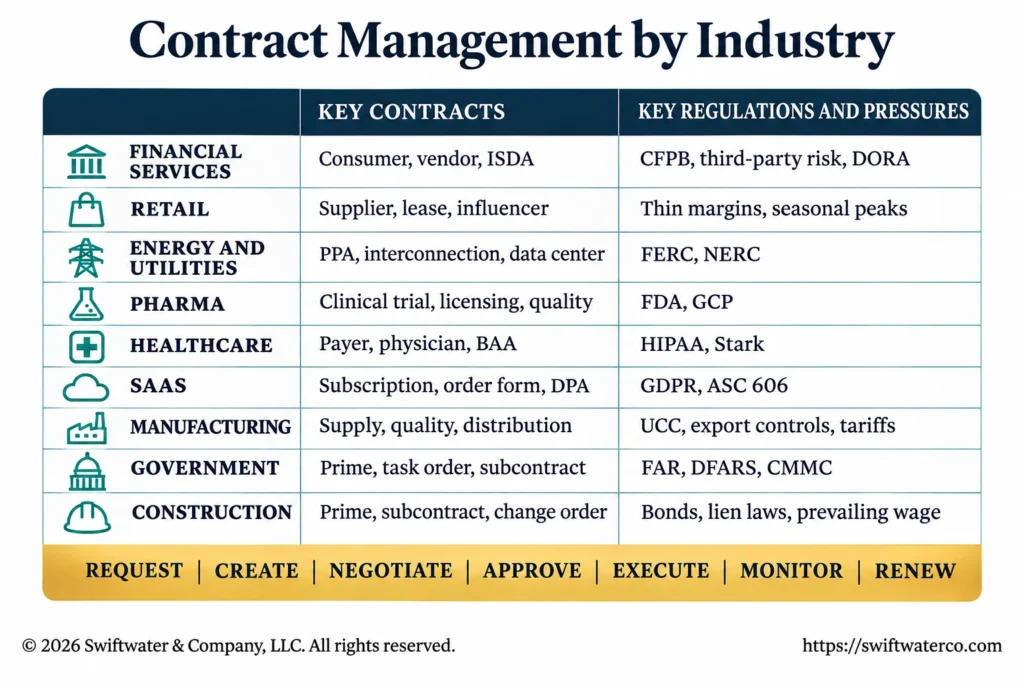
The table below is a starting map. Each row names the key contracts and the regulations and business pressures that set the rules around them.
| Industry | Key contracts | Key regulations and pressures |
|---|---|---|
| Financial services | Consumer and account agreements, vendor and outsourcing, ISDA master agreements | CFPB rules, third-party risk guidance, DORA |
| Retail | Supplier, lease, franchise, marketing and influencer | Thin margins, seasonal peaks, FTC rules |
| Energy and utilities | Power purchase, interconnection, large-load customers, field services | FERC, NERC, state utility commissions |
| Pharma and life sciences | Clinical trial, CRO, licensing, quality, distribution | FDA, Good Clinical Practice, Open Payments |
| Healthcare | Payer, physician, business associate, supply | HIPAA, Stark, Anti-Kickback |
| SaaS and technology | Subscription, order form, DPA, reseller | GDPR, revenue recognition, auto-renewal laws |
| Government contractors | Prime contracts, task orders, subcontracts, teaming agreements | FAR and agency supplements, records and audit duties |
| Construction | Prime and subcontracts, change orders, bonds | Bond, lien, and prompt payment laws, prevailing wage |
| Higher education | Research, sponsored program, vendor, affiliation | Grant terms, public procurement rules |
| Manufacturing | Supply, quality, OEM, distribution, tooling | UCC, export controls, supply continuity |
Which industries does this guide cover?
This guide covers ten industries. Nine have an in-depth page today; higher education is covered in the table above. Each industry page answers the same five questions, so they can be read side by side: what the key contracts are, which laws and regulators apply, who owns the contracts, what a CLM has to handle, and what a typical lifecycle problem looks like.
- Financial services: banks, insurers, and asset managers, where consumer agreements carry the volume and the contract is the evidence of third-party oversight.
- Retail: supplier, lease, franchise, and influencer agreements, signed at speed on thin margins.
- Energy and utilities: long-term power, grid, and data center agreements with obligations that run for decades.
- Pharma and life sciences: clinical trial, licensing, and supply agreements, each with a different owner from lab to market.
- Healthcare: payer, physician, and vendor agreements, where the smallest contracts often carry the most rules.
- SaaS and technology: subscription agreements, order forms, and DPAs signed thousands of times on both sides of the business.
- Manufacturing: supply, quality, OEM, and distribution agreements on both sides of the plant, where price and notice terms protect thin margins.
- Government contractors: prime contracts, task orders, and subcontracts that carry procurement rules by clause from award to closeout.
- Construction: prime contracts, subcontracts, and change orders, where notice deadlines decide whether a claim survives.
Where does contract management fall short in every industry?
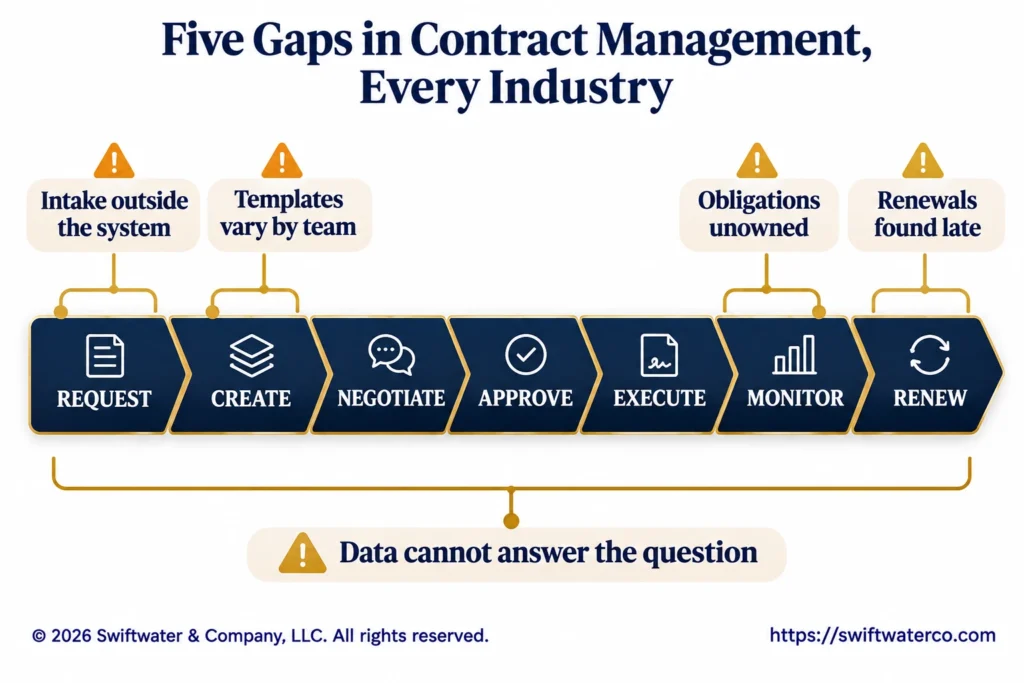
Contract management falls short in the same five places in every industry: at intake, in the templates, after signature when obligations need an owner, at renewal, and when someone asks a question the contract data cannot answer. The industry changes the cost of each gap, and the gaps themselves stay the same.
Evaluating or implementing a CLM platform?
We have guided legal departments through selection, implementation, and adoption, without the vendor bias. Let us talk about where you are and what you actually need.
See CLM Services- Intake outside the system. Requests arrive by email, chat, and hallway conversation, so nobody can see the volume or the queue. Our guide to contract request and intake covers the front door.
- Templates that vary by team. Each business unit or region edits its own copy, and the approved positions stop matching the signed contracts. See templates, clause libraries, and playbooks.
- Obligations nobody owns. The contract is signed and filed, and the reporting duties, service levels, and audit rights inside it go unwatched. See contract obligation management.
- Renewals found late. Notice dates pass before anyone reviews the terms, and the contract renews on the old price. See contract renewal management.
- Data that cannot answer the question. A regulator, auditor, or acquirer asks which contracts contain a clause, and the answer takes weeks. See contract repository.
Why do third-party, cybersecurity, and AI terms matter in every industry?
Every industry now depends on vendors that hold its data, run its systems, or use AI on its behalf, and the contract terms that govern them create obligations long after onboarding. Third-party risk, cybersecurity, data protection, and AI terms are clauses at signature and duties for the life of the relationship.
Typical examples include:
- Security reviews and certifications. Annual assessments, audit reports, and certifications the vendor must provide, with dates.
- Incident notice. How quickly the vendor must report a security incident, and to whom.
- AI use. Whether the vendor may use company data to train AI models, how it discloses AI features, and what notice it gives before adding new ones.
- Subcontractors and subprocessors. Notice before the vendor adds a new party that will touch the data.
- Exit. Return or deletion of data and transition support when the relationship ends.
Each of these needs an owner, a date, and evidence that it happened. A CLM that records them as obligations, alongside the clauses, turns a one-time onboarding check into ongoing oversight. Our guide to contract obligation management covers how to track them.
Why do regulated industries need more from a CLM?
Regulated industries need a CLM that can prove what happened as well as one that speeds up the work. Banks, healthcare organizations, pharmaceutical companies, and utilities may be asked to show a contract, its approvals, its required clauses, and the oversight behind it. The system has to keep that record without extra effort from the people using it.
Five capabilities matter most:
- Audit trail. Who requested, approved, changed, and signed each contract, with dates.
- Required clauses. Checks that the clauses a rule requires are present, such as the terms in a business associate agreement or an ICT services contract.
- Retention. Contracts and their records kept for the period the business and its regulators need.
- Third-party records. The risk tier, owner, and review dates for each counterparty, linked to its contracts.
- Ongoing obligations. Security, privacy, and AI duties tracked after signature, with evidence.
A CLM keeps the records and runs the checks; the organization remains responsible for meeting the rules. The financial services, healthcare, and pharma pages list the main rules in each sector, with links to the official sources.
Who owns contracts in different industries?
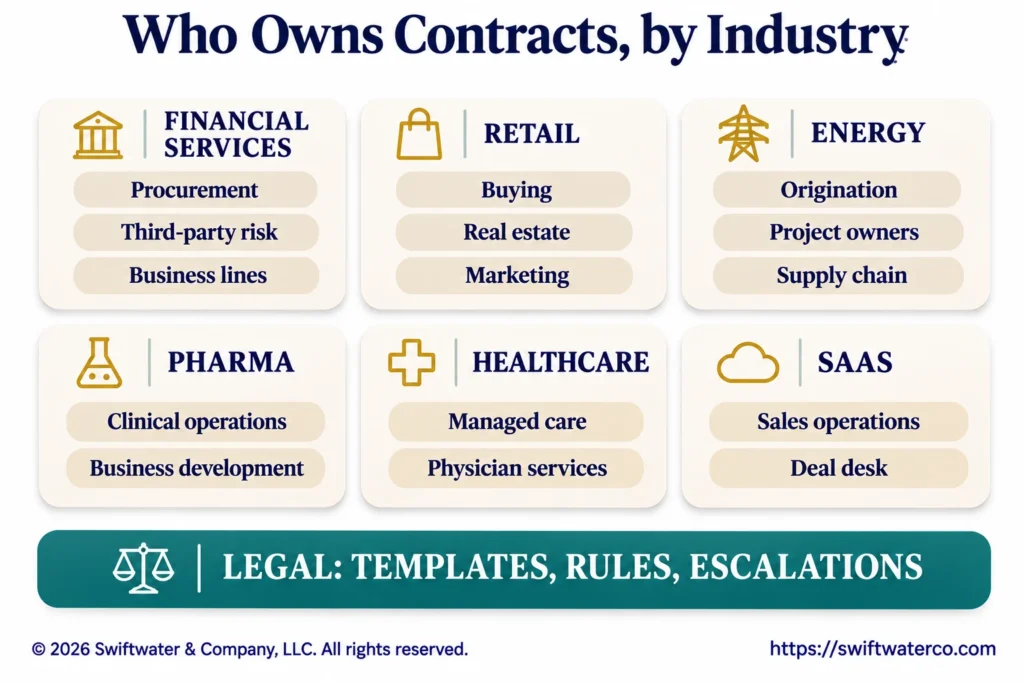
Contract ownership follows the money and the risk in each industry, so the owner changes even when legal sets the rules. In SaaS, sales operations and the deal desk own most customer contracts. In retail and manufacturing, supply chain and buying teams own supplier agreements. In pharma, clinical operations owns trial agreements. In financial services, third-party risk management sits beside procurement. In energy, origination and commercial teams own power and fuel agreements.
| Industry | Usual owner of the main contracts | Legal’s role |
|---|---|---|
| Financial services | Procurement or vendor management, with third-party risk; business lines for consumer agreements | Templates, required clauses, escalations |
| Retail | Buying, real estate, franchise, marketing | Templates and self-service rules |
| Energy and utilities | Origination, supply chain, project owners, land | Master agreements, regulatory terms |
| Pharma | Clinical operations, business development, quality | Templates, IP and compliance terms |
| Healthcare | Managed care, physician services, supply chain | Compliance review, required terms |
| SaaS | Sales operations, deal desk, procurement | Templates, fallbacks, privacy terms |
Our guide to who owns contract management covers the roles in detail, including procurement, sales, and the general counsel.
What has Swiftwater seen across industries?
Our professionals have worked on contract and legal operations problems across these industries, and the lessons repeat. Each example below links to the industry page that tells it in full.
- Financial services: a Fortune 1000 financial services firm’s stalled CLM rollout, stabilized with Salesforce intake, 30 core templates evaluated, and a go-live plan for 30+ contract types. See financial services contract management.
- Retail: a global retail conglomerate’s legal function, moved off a shared mailbox to one front door with self-service NDAs and 100% adoption. See retail contract management.
- Energy: energy and utility clients whose commitments sat in 30 to more than 100 systems, and a global oil and gas company’s outside counsel program. See energy and utility contract management.
- Pharma: a global pharmaceutical company that harmonized 19 patent lifecycle processes after an acquisition, before designing one system. See pharma contract management.
- Technology: a Fortune 50 technology company that replaced a fractured set of tools and vendors with one system under a negotiated 5-year contract. See SaaS contract management.
The common thread is that the process and the owners were agreed before the system was configured.
How should an industry team start?
An industry team should start by mapping its current contract lifecycle, then listing its contract types with their owners and rules, and only then writing requirements for a system. The map shows where requests enter, where work waits, and where data is lost; the list shows which contracts carry regulatory weight.
- Map the current lifecycle. Follow real contracts from request to renewal. Our guide to mapping the contract lifecycle explains how.
- List contract types, owners, and rules. Use the industry page as a checklist, and name one owner per contract type.
- Write requirements. Turn the gaps into requirements, using the CLM requirements themes.
- Compare the tools. Our guide to contract lifecycle management tools covers the categories.
For teams that want the map and requirements done in weeks, a CLM discovery sprint covers the same ground before a platform is chosen.
Bottom Line
Contract management in a bank, a retailer, a utility, a drug maker, a hospital, and a software company starts from different contracts, different regulators, and different owners. A bank answers to examiners, a retailer to its margins and its peak season, a utility to commissions and to decades-long commitments. Each industry page covers those differences in detail.
Evaluating legal technology but not sure where to start?
We help legal departments cut through the vendor noise, mapping technology to process maturity and building a roadmap that actually gets adopted.
See Legal TechnologyUnderneath, the same five gaps decide whether contract management works: intake outside the system, templates that vary by team, obligations nobody owns, renewals found late, and data that cannot answer a regulator, auditor, or acquirer. Vendor security, privacy, and AI terms now add obligations that run long after onboarding, in every industry. Closing them starts with mapping the lifecycle, naming the owners, and agreeing the process before any system is configured. Every industry signs different contracts under different rules, and the fix starts the same way: one intake, one set of templates, one owner for every obligation from onboarding to exit, and one record a regulator can read.
Our contract management solutions help legal, procurement, and business teams in regulated and high-volume industries map their contract lifecycle, set the templates and owners, and select and configure the CLM that fits.
Frequently Asked Questions
How does contract management differ by industry?
Contract management by industry differs in the contract types, regulations, owners, and systems, while the same five weak points appear in every industry. A bank manages consumer, third-party, and outsourcing agreements under risk guidance, a retailer manages supplier and franchise agreements at volume, and a pharmaceutical company manages trial and licensing agreements, all through the same seven lifecycle stages.
Which industries need contract management software most?
Industries with high contract volume or heavy regulation gain the most: financial services, healthcare, pharma and life sciences, energy and utilities, retail, and SaaS. Volume makes manual tracking fail, and regulation makes a missing record costly. Any organization with more contracts than its team can track by memory benefits.
How can a CLM help with industry rules such as HIPAA or GDPR?
A CLM keeps the records and checks that the rules depend on: which vendors have a business associate agreement or data processing agreement, which version they signed, whether the required clauses are present, and when the agreement expires. With that record complete, the evidence is ready to produce; compliance itself stays with the organization’s privacy and legal teams.
Can one CLM serve several business units or subsidiaries?
Yes. Most CLM platforms support several legal entities and business units in one system, with permissions, templates, and approval rules set per entity. Agree the shared parts first, such as the core templates, metadata, and contract types, and allow local variation only where a rule or market requires it.
Who owns contracts in a regulated industry?
Legal usually sets the templates, required clauses, and escalation rules, while the business function that manages the counterparty owns each contract day to day. In banks that is procurement or vendor management with third-party risk; in healthcare, managed care and physician services; in pharma, clinical operations and business development.
Where does contract management usually fall short?
In five places: requests that arrive outside the system, templates that vary by business unit, obligations nobody owns after signature, renewals found after the notice date, and contract data that cannot answer a regulator’s or auditor’s question. The industry changes the cost of each gap, and the fixes are the same.
This article is provided for general informational purposes only and is not legal, financial, or business advice. Contract management decisions in regulated industries should be validated against your organization’s specific structure, regulatory obligations, and counsel guidance, and you should consult a qualified professional for advice on your situation.