


Pharma contract management covers clinical trial, licensing, supply, and distribution agreements under regulatory duties. A single drug program can involve hundreds of trial sites, each with its own agreement and budget, a contract research organization running the studies, a licensing partner owed milestones and royalties, and a contract manufacturer bound by a quality agreement. Research, business development, manufacturing, and commercial teams each sign different contracts with different owners, under rules from the FDA and other health authorities.
This guide covers the key contract types in pharma and life sciences, the rules behind them, who owns them, and what a CLM has to handle. It is part of our guide to contract management by industry and our guide to the seven stages of the contract lifecycle.
What does contract management cover in pharma?
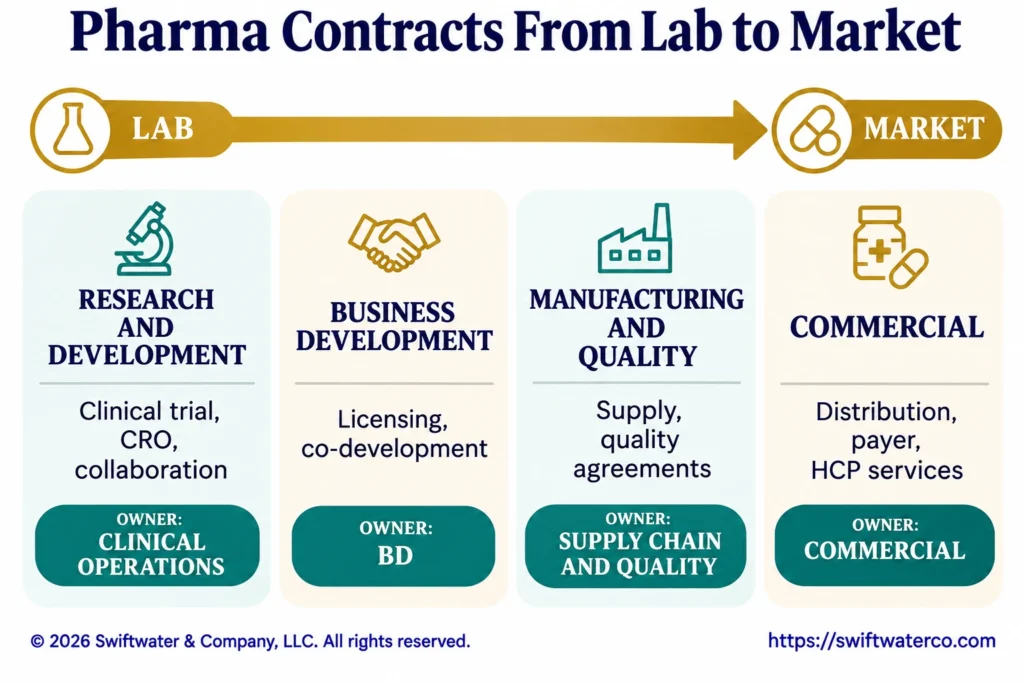
Contract management in pharma covers four groups that follow a product from lab to market: research and development, business development, manufacturing and quality, and commercial. Each group has its own contract types, owners, and rules, and many companies run them in separate teams with separate templates.
- Research and development. Clinical trial agreements and budgets with sites and investigators, master service agreements with contract research organizations (CROs), and research collaborations.
- Business development. Licensing, co-development, and other collaboration agreements with partners.
- Manufacturing and quality. Supply agreements and quality agreements with contract manufacturers and suppliers.
- Commercial. Distribution agreements, agreements with payers, and service agreements with healthcare professionals (HCPs).
What are the key contract types?
Clinical trial agreements are the most numerous pharma contracts, because every study site needs one, often with its own budget negotiation. Licensing and collaboration agreements are the largest by value. Quality agreements and HCP service agreements carry the most regulatory weight for their size.
| Contract type | Counterparty | What the CLM tracks |
|---|---|---|
| Clinical trial agreements and budgets | Sites and investigators | Payments, publication and data terms, study dates |
| CRO master service agreements | Contract research organizations | Work orders, oversight duties, service levels |
| Licensing and collaboration agreements | Partners | Milestones, royalties, IP ownership, reporting |
| Supply and quality agreements | Contract manufacturers and suppliers | Quality responsibilities, versions, audits |
| Distribution agreements | Distributors | Territories, volumes, renewals |
| HCP service agreements | Healthcare professionals | Fees, services, transfer-of-value records |
The table is illustrative. Device and biotech companies add their own types, such as material transfer agreements and technology transfer agreements.
Which laws and regulators apply to pharma contracts?
Pharma contracts are affected by FDA rules, international clinical trial standards, and transparency laws. The FDA’s 21 CFR Part 11 sets requirements for electronic records and electronic signatures used for records the FDA requires. The ICH E6 guideline for Good Clinical Practice sets out the responsibilities of sponsors, investigators, and the CROs that sponsors delegate work to.
For manufacturing, the FDA’s guidance on quality agreements in contract manufacturing describes how owners and contract facilities define their quality responsibilities. On the commercial side, the CMS Open Payments program requires manufacturers to report payments and other transfers of value to physicians and teaching hospitals.
Evaluating or implementing a CLM platform?
We have guided legal departments through selection, implementation, and adoption, without the vendor bias. Let us talk about where you are and what you actually need.
See CLM ServicesThese rules are listed for reference only; counsel and compliance teams should interpret how each applies.
Who owns contracts in pharma?
In most pharmaceutical companies, clinical operations owns trial agreements and CRO work orders, business development owns licensing and collaborations, supply chain and quality own supply and quality agreements, and commercial and market access own distribution and payer agreements. Compliance oversees HCP agreements, IP teams join licensing deals, and legal owns templates and escalations.
The handoffs between these groups are where obligations get lost. A licensing deal signed by business development creates royalty and reporting duties that finance and alliance management have to track for years. Our guide to who owns contract management covers the roles.
What does a CLM have to handle?
A CLM in pharma has to handle volume in clinical trial contracting, long-running obligations in licensing deals, versions of quality agreements, a reliable audit trail with electronic signatures, and clean handoffs to the systems that report HCP payments. It holds the agreements and their terms; finance and reporting systems hold the payments.
- Trial agreement volume. Templates, budget approvals, and routing for site agreements across many studies. See contract workflow management.
- Milestones and royalties. Licensing and collaboration obligations with owners and dates. See contract obligation management.
- Quality agreement versions. The version in force with each manufacturer, linked to its supply agreement.
- Vendor security, data, and AI obligations. CROs, data vendors, and technology providers handle trial and patient data, so security assessments, incident notices, and AI use terms continue as obligations after onboarding, each with an owner.
- Audit trail and e-signature. Who approved and signed what, and when. Our guide to wet and electronic signatures covers when each is used.
- Handoff to reporting. HCP agreement data passed to the systems that report payments. Our guide to CLM, ERP, and CRM covers where each record belongs.
CROs usually work under a master service agreement with study-level work orders, so the CLM has to link each work order to its master.
What does a typical lifecycle problem look like?
A typical pharma problem is process fragmentation after a merger, where each site or legacy company runs the same work differently. After its $50B acquisition, a global pharmaceutical company began consolidating its IP departments, including into a single intellectual asset management system. The processes behind that system were fragmented across global IP sites.
Our professionals ran a process review, which recommended harmonizing the patent processes before continuing with system design. The team then led a global harmonization initiative, with off-site and virtual workshops for 40+ patent attorneys and paralegals, and harmonized 19 patent lifecycle processes with named owners and metrics for each. The harmonized processes became the functional design specifications for the consolidated system’s screens, workflows, and reports. The pharma case study has the details.
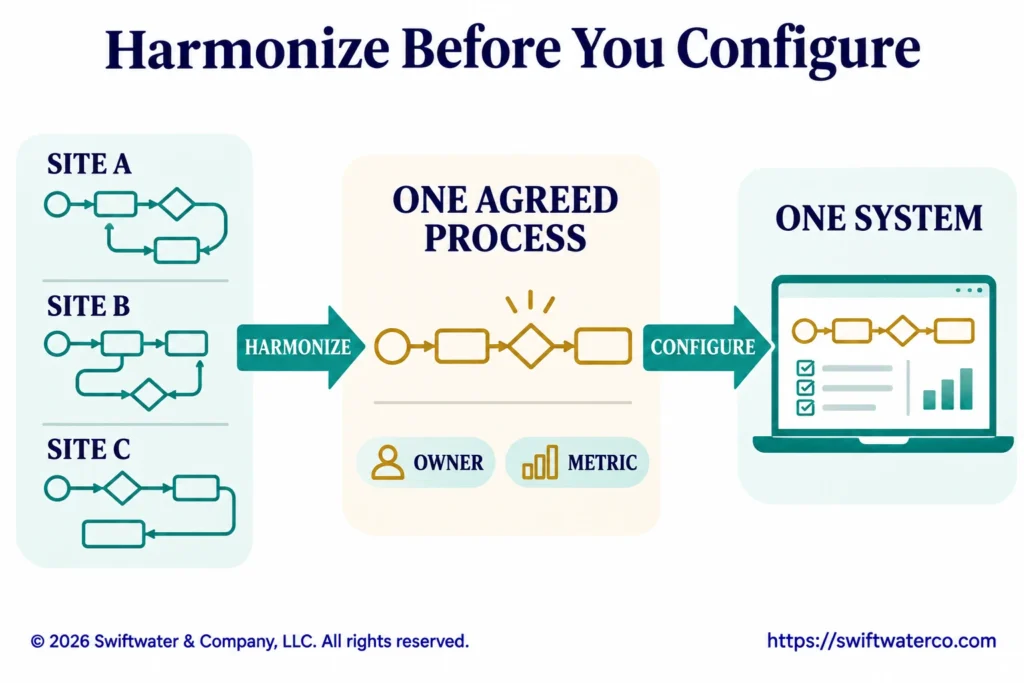
The same order applies to contracts: agree one process for each contract type, with owners and metrics, and configure the system after. Our guide to CLM after an acquisition covers combining contract programs.
Which pages to read next?
- Contract management by industry, for how pharma compares with other industries.
- Who owns contract management, for the roles of legal, procurement, and the business.
- Contract obligation management, for milestones, royalties, and reporting.
- CLM after an acquisition, for combining contract programs.
- Master service agreements, for CRO and vendor frameworks.
- Healthcare contract management, for the provider side of the industry.
Bottom Line
Pharma contract management follows a product from lab to market. Clinical operations signs trial agreements in volume with hundreds of sites, business development signs licensing deals whose milestones and royalties run for years, manufacturing depends on quality agreements kept current with every contract manufacturer, and commercial teams sign distribution and HCP agreements under transparency rules. CROs and data vendors add security, privacy, and AI obligations that continue long after onboarding. The FDA, Good Clinical Practice, and Open Payments sit behind them.
Evaluating legal technology but not sure where to start?
We help legal departments cut through the vendor noise, mapping technology to process maturity and building a roadmap that actually gets adopted.
See Legal TechnologyThe order of work decides the outcome: agree one process for each contract type, with a named owner and metrics, before configuring a system, then track every obligation after signature as carefully as the negotiation before it. That order matters most after an acquisition, when every site brings its own way of working. Pharma signs different contracts at every step from lab to market, so each contract type needs one agreed process, a named owner for every obligation, and a system designed around both.
Our contract management solutions help pharmaceutical and life sciences legal and operations teams harmonize contract processes, set owners and metrics, and design the CLM around them.
Frequently Asked Questions
What is pharma contract management?
Pharma contract management covers clinical trial, licensing, supply, and distribution agreements under regulatory duties. It includes trial agreement templates and budgets, CRO work orders, milestone and royalty tracking, quality agreement versions, and HCP agreements whose payment data feeds transparency reporting.
What is a clinical trial agreement?
A clinical trial agreement is the contract between a study sponsor, or the CRO acting for it, and a trial site or investigator. It sets out the study work, the budget and payment terms, confidentiality, publication rights, data ownership, and responsibilities for subject safety and regulatory compliance.
How does a CLM support Part 11 e-signature requirements?
A CLM can support 21 CFR Part 11 with electronic signatures linked to the signer, audit trails of changes and approvals, and access controls. Whether a system and its use meet Part 11 depends on how the company validates and operates it, so quality and compliance teams should confirm it for records the FDA requires.
Who owns contracts in a pharmaceutical company?
Clinical operations usually owns trial agreements and CRO work orders, business development owns licensing and collaborations, supply chain and quality own supply and quality agreements, and commercial owns distribution and payer agreements. Legal owns templates and escalations, and compliance oversees agreements with healthcare professionals.
How should contracts be combined after a pharma acquisition?
Start with the processes, then the system. Map how each legacy company handles each contract type, agree one process with an owner and metrics, standardize the templates and metadata, and migrate contracts into one repository. Configuring the system before the process is agreed carries the fragmentation into the new platform.
This article is provided for general informational purposes only and is not legal, financial, or business advice. Pharma contract management decisions should be validated against your organization’s specific structure, regulatory obligations, and counsel guidance, and you should consult a qualified professional for advice on your situation.