
Contract obligation management is the work of tracking what each side of a signed contract has promised to do, pay, or deliver, and making sure it happens on time. A supplier misses its uptime target and owes a service credit, but nobody claims it. A price increase the contract allowed never reaches the invoice. A quarterly report your company owes a customer is forgotten when its owner changes jobs. Each is value the business negotiated and then lost after signature. Even with AI and a well-designed process, capturing obligations and keeping them current takes human oversight at a minimum: someone has to confirm what was extracted, assign each owner, and update the record when terms change. That is where Swiftwater helps, setting up the obligation register properly and keeping it current through ongoing support.
This guide explains how to sort obligations into categories, build a register that tracks them, follow service levels, support audits, set alerts, name owners, and hand a clean record to the renewal decision. It covers operational tracking only. It is part of our contract lifecycle management guide, and the contract repository guide covers the contract record each obligation links to.
What is contract obligation management?
Contract obligation management is the practice of turning each executed contract’s commitments into tracked items with an owner, a due date or trigger, and evidence of completion. It covers both sides of the agreement: what your organization owes the counterparty and what the counterparty owes you. Without it, commitments sit in signed documents that nobody reads again until something goes wrong.
The cost is measurable. WorldCC (formerly IACCM) research finds that organizations lose an average of 11% of contract value after signature (WorldCC, Closing the Procurement Value Gap, 2025). That leakage comes from missed deliverables, unclaimed credits, price changes that never took effect, and service levels nobody measured.
Obligation management is one discipline inside contract lifecycle management, running from signature until the agreement renews or ends.
What counts as an obligation?
An obligation is anything a party must do, deliver, pay, report, or notify by a date or on a trigger. Five operational categories cover most of them: deliverables, payments, service levels, notices, and reporting duties. Deadlines run across all five, since every tracked item carries a due date or a triggering event, and each one needs an owner who can show it was met.
- Deliverables: goods, services, or work products due by a date or a milestone.
- Payments: amounts, schedules, invoicing triggers, credits, and price adjustments to track.
- Service levels: measured performance commitments with a reporting cadence and thresholds.
- Notices: dates by which a party must notify the other, including renewal and termination notices, which hand off to contract renewal management.
- Reporting duties: recurring reports, certifications, or data a party must provide.
These categories describe what to track. What a commitment means, and whether it has been met in a disputed case, is a question for counsel.
Evaluating or implementing a CLM platform?
We have guided legal departments through selection, implementation, and adoption, without the vendor bias. Let us talk about where you are and what you actually need.
See CLM Services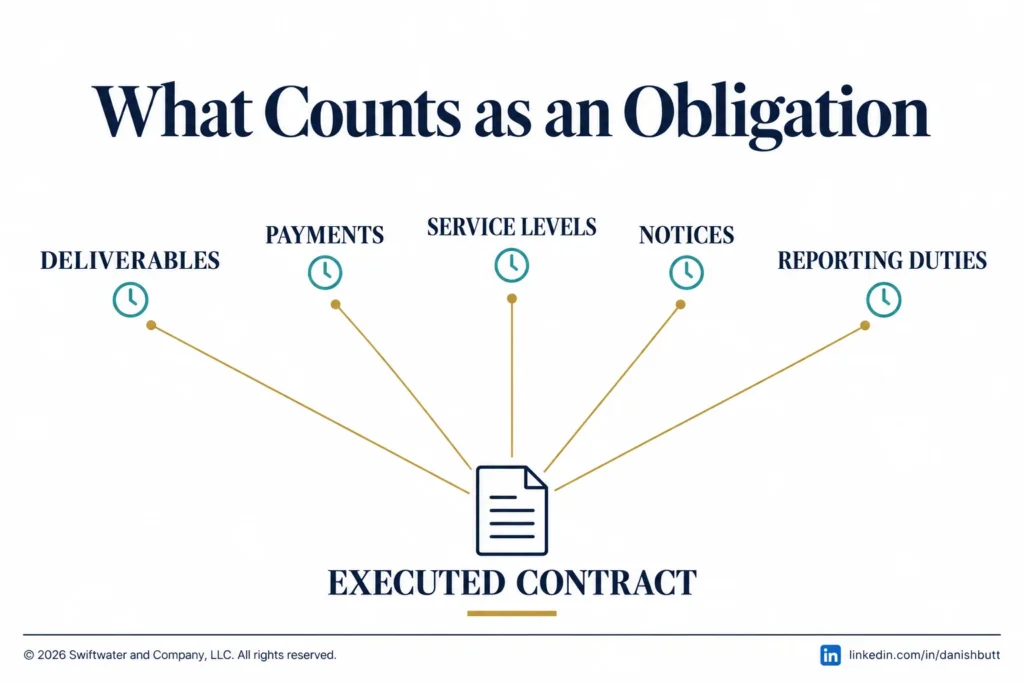
What is an obligation register?
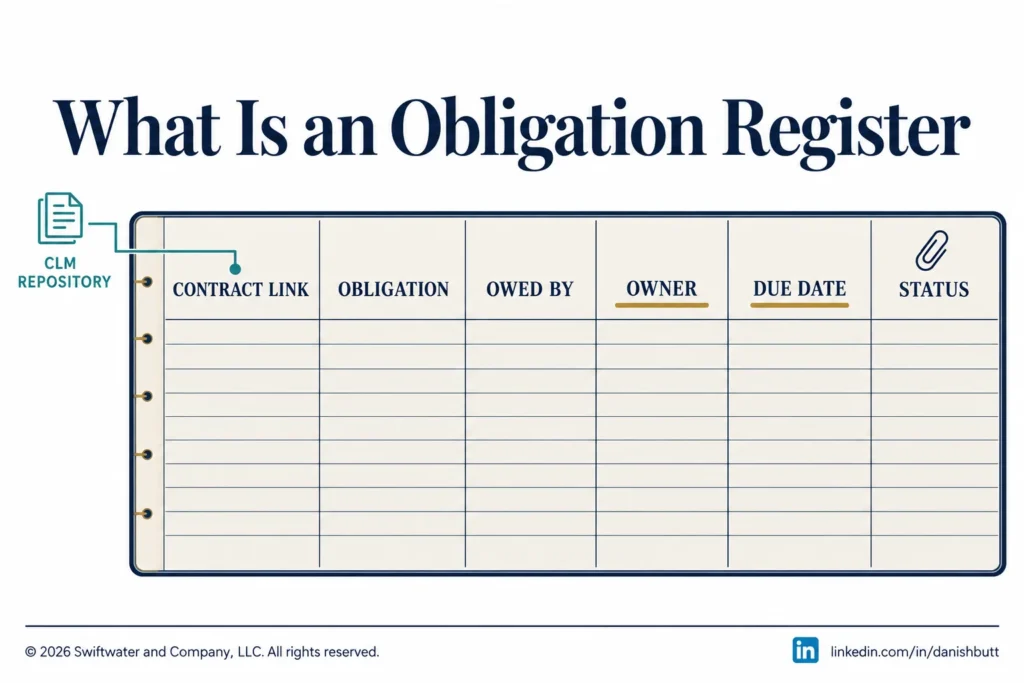
An obligation register is the structured list of every tracked obligation, linked to its contract record in the repository, with an owner, category, due date or trigger, frequency, status, and evidence for each item. It is the working view of stage 6: one place where anyone can see what is due, who is responsible, and what has already been done, across every executed contract.
The register holds one row per obligation and points back to the contract record in the contract repository, so counterparty names, dates, and the executed copy are held once.
| Field | What it records | Why it matters |
|---|---|---|
| Contract link | The contract record in the repository | Keeps contract data in one place |
| Obligation and category | What is owed, in one of the five categories | Lets you filter and report by type |
| Owed by | Your organization or the counterparty | Separates what you deliver from what you receive |
| Owner | The named person responsible | Gives every alert somewhere to go |
| Due date or trigger | A date, or the event that starts the clock | Drives the alert schedule |
| Frequency | One-time or recurring, and how often | Creates the next instance automatically |
| Status and evidence | Open, met, missed, or waived, with proof attached | Answers an audit without a search |
| Alert lead time | How far ahead of the due date the owner is told | Gives the owner time to act |
Start with your highest-value contracts and the categories that carry money, then extend.
How do you track service levels and milestones?
Track each service level and milestone as an obligation with four extra details: a measure, a reporting frequency, a data source, and a threshold that raises an alert. Review performance with the business owner on a set cadence, record misses and any credits due, and carry the performance history into the renewal decision so the next negotiation starts from evidence.
For each service level, the register records:
- The measure: what is counted, such as availability, response time, or delivery accuracy.
- The data source: the system or report the figure comes from, and who supplies it.
- The threshold: the level that counts as a miss, and the level that triggers escalation.
- The review cadence: monthly or quarterly, with the business owner and, for suppliers, the vendor.
Milestones work the same way, with a date in place of a measure. For supplier agreements, our guide to supplier agreement management covers how performance reviews fit the wider supplier relationship.
How does obligation management support contract compliance and audits?
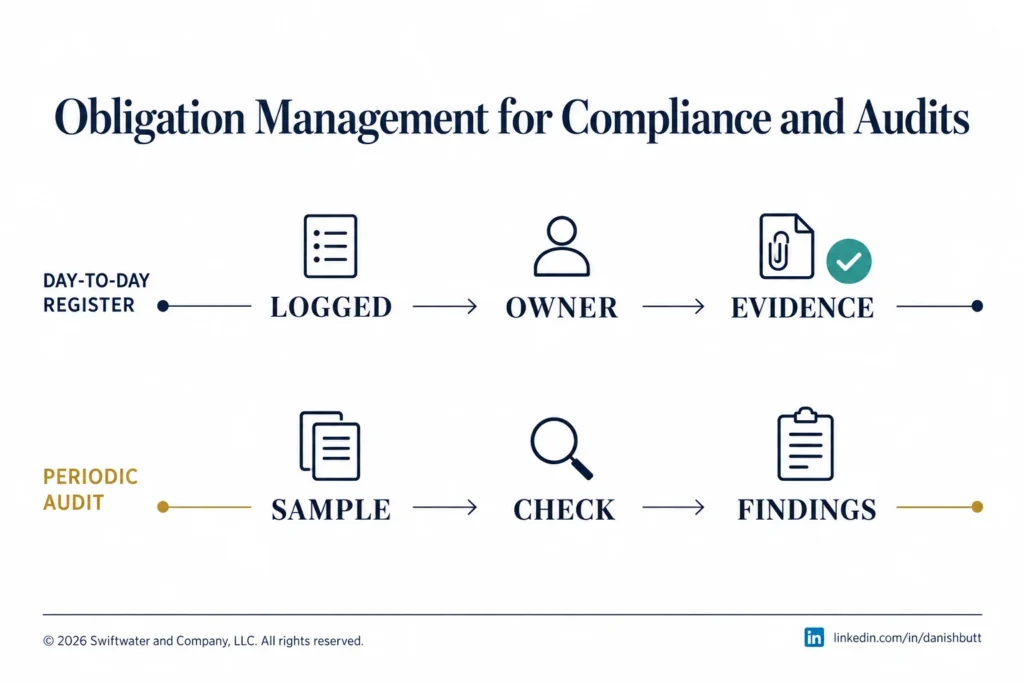
Obligation management supports compliance and audits by keeping a record of what was owed, who did it, and the evidence that it was done. A compliance check or audit can then sample the register and the repository directly and find each answer in one place, without emailing business owners for proof months after the fact.
Compliance work often lands with legal. The ACC 2026 Law Department Management Benchmarking Report (576 departments) finds compliance managed by legal in 77% of departments.
A periodic contract audit can follow a short operational checklist:
- What to sample: a set of executed contracts by value band, contract type, and business unit.
- What to check in the repository: the executed copy is present, the metadata is complete, the obligations are logged, each has an owner, evidence is attached, and alerts fired on time.
- How to record findings: note each gap against the contract and the owner, set a date to fix it, and report the totals to the contract owner and legal.
Obligations that come from regulation can be tagged in the register by source, so a review can pull them together. What a regulation requires is a question for counsel.
Which obligation alerts matter?
The alerts that matter are tied to due dates and triggers and give the owner enough time to act. Add escalation when an item is overdue, alerts on counterparty deliverables you depend on, threshold alerts on service levels, and a periodic digest for the contract owner. Alerts with no owner or no action attached get ignored, so every alert names both.
| Alert | When it fires | Who gets it |
|---|---|---|
| Upcoming due date | Ahead of the due date, with enough time to complete the work | The obligation owner |
| Overdue | When the due date passes with no evidence logged | The owner and their manager |
| Counterparty deliverable missed | When an item owed to you passes its date | The business owner and the contract manager |
| Service level threshold breached | When reported performance crosses the threshold | The business owner, with legal if credits apply |
| Notice or reporting date | Ahead of the date, with time to prepare and send | The contract owner |
| Periodic digest | On a set cadence | The contract owner and legal or contracts |
Set each lead time from the work the obligation needs: a report that takes a week to compile needs more notice than a payment.
Who owns obligations after signature?
The business owner who receives or delivers the value owns each obligation after signature. Legal or a contracts function owns the register and the escalation path, and a CLM administrator keeps the data and alerts working. Each role needs to be named for every contract, because an obligation with no owner is the one that gets missed when people change jobs.
Evaluating legal technology but not sure where to start?
We help legal departments cut through the vendor noise, mapping technology to process maturity and building a roadmap that actually gets adopted.
See Legal TechnologyThe contract manager often runs the register day to day and chases evidence. The wider question of who owns contract management across legal, procurement, and sales is covered in our guide to who owns contract management.
How does obligation management connect to renewal management?
The obligation register holds the term dates, notice periods, and performance record that the renewal decision needs, so stage 6 hands stage 7 a ready file. When a renewal review starts, the owner can see which obligations were met, which service levels were missed, and which credits were claimed, and can decide to renew, renegotiate, or terminate on evidence.
Our guide to contract renewal management covers alert design, auto-renewal tracking, and the renewal decision. Obligation fulfillment, the share of obligations met on time, is one of the measures in our legal department KPIs guide and is a useful check on whether the register is working.
Bottom Line
Obligations are where signed value is kept or lost. The method is simple to describe: sort commitments into five categories, keep them in one register linked to the contract record, give each an owner and a date, and send alerts early enough to act.
Start with your highest-value contracts, attach evidence as each obligation is met, and let the register feed audits and renewals. Obligation management works when every commitment in an executed contract has an owner, a date, and evidence in one register that audits and renewals can read.
Swiftwater’s CLM administrators run a live CLM after go-live, handling template and clause changes, workflow and approval updates, reporting, and user support, the upkeep an obligation register depends on.
Frequently Asked Questions
What is contract obligation management?
Contract obligation management is the work of tracking what each side of a signed contract has promised to do, pay, or deliver, and making sure it happens on time. Each commitment becomes a tracked item with an owner, a due date or trigger, and evidence of completion, for both your obligations and the counterparty’s.
How does a CLM track obligations and deadlines?
A CLM tracks obligations by capturing them at signature, either entered by the contracts team or extracted and then checked, and linking each one to the contract record. Each obligation is assigned an owner and a due date or trigger, and the system sends alerts ahead of the date and escalates when evidence is missing.
What is an obligation register?
An obligation register is the structured list of every tracked obligation, one row per item, linked to its contract record. It records the category, who owes it, the owner, the due date or trigger, frequency, status, evidence, and the alert lead time.
How do you track service levels?
Record each service level as an obligation with a measure, a data source, a reporting frequency, and a threshold that raises an alert. Review performance with the business owner on a set cadence, log misses and credits, and carry the history into the renewal decision.
How does obligation tracking support contract audits?
Auditors sample executed contracts and check the register and repository for each one: the executed copy, complete metadata, logged obligations, a named owner, attached evidence, and alerts that fired on time. A complete register means each answer is found in one place.
Who owns obligations after signature?
The business owner who receives or delivers the value owns each obligation. Legal or a contracts function runs the register and the escalation path, and a CLM administrator keeps the data and alerts working.
How do obligations connect to renewals?
The register holds the term dates, notice periods, and performance history that the renewal decision needs. Our guide to contract renewal management covers how that record is used to renew, renegotiate, or terminate.
This article is provided for general informational purposes only and is not legal, financial, or business advice. Contract obligation and compliance tracking decisions should be validated against your organization’s specific structure, regulatory obligations, and counsel guidance, and you should consult a qualified professional for advice on your situation.