
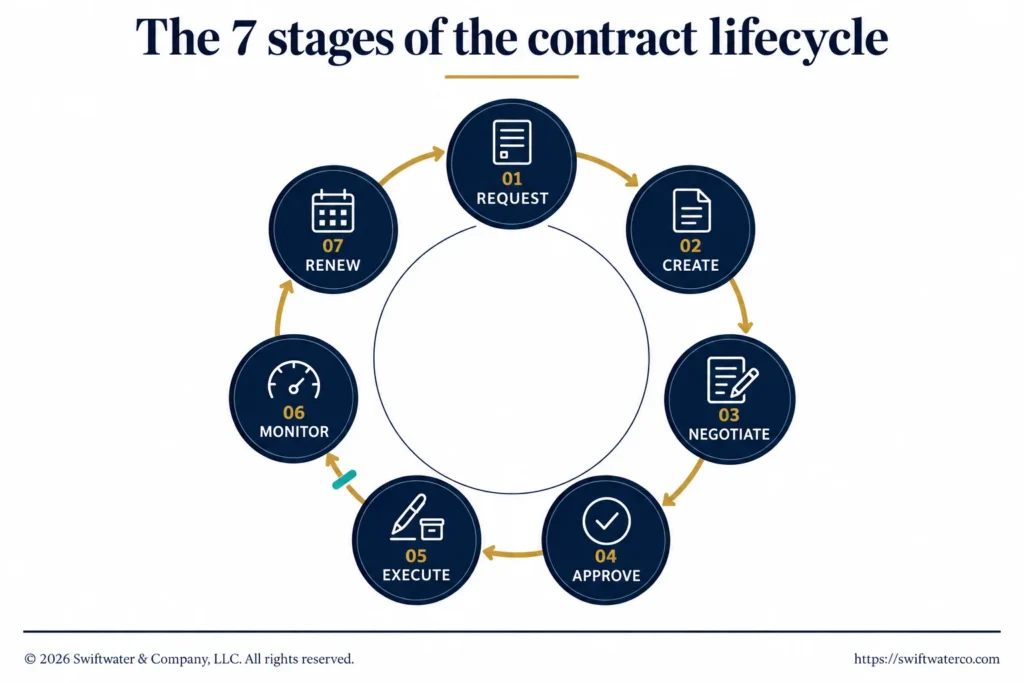
The seven stages of contract lifecycle management are request and intake; authoring and drafting; negotiation and redlining; review and approval; execution, signature, and storage; obligations and performance monitoring; and renewal, renegotiation, or termination. Every contract a business signs passes through these stages, whether or not anyone has written them down. A sales deal that waits two weeks for sign-off, a signed supplier agreement nobody can find, and a software subscription that renews at a higher price before anyone notices are each a problem at one of these stages. Each stage has its own owner, its own handoff to the next, and its own way of failing.
This guide explains what happens at each stage, in order, and where contracts most often stall between them, with a link to the detailed guide for each stage, starting with contract request and intake. It is part of our contract lifecycle management guide.
How many stages does the contract lifecycle have?
The contract lifecycle has seven stages, running from the first request for a contract to the decision to renew, renegotiate, or end it. Each stage has an owner and a clear finish line, and a contract should not move to the next stage until the current one is complete. Most delays happen when that rule is missing and a contract drifts from one team to the next without anyone taking charge of it.
The seven stages, in order:
- Request and intake. A business need becomes a structured contract request that triage can route.
- Authoring and drafting. The first draft comes from approved templates, clause libraries, and playbooks.
- Negotiation and redlining. Both sides exchange redlined versions until the open points close.
- Review and approval. The agreed draft routes through an approval workflow to the people with authority to sign it off.
- Execution, signature, and storage. Authorized signatories sign, and the executed copy is filed in the contract repository.
- Obligations and performance monitoring. What each party owes is tracked against dates through obligation management.
- Renewal, renegotiation, or termination. The owner decides, before the end date, whether the agreement continues, through contract renewal management.
To see how your own process lines up, map your current contract lifecycle.
What happens at the request and intake stage?
Request and intake is the stage where a business need becomes a contract request. The requester submits one form through a single front door, and the form captures the counterparty, contract type, value, timing, and risk flags up front. Triage then routes the request: self-service for low-risk, high-volume paper, a standard template for routine agreements, and legal, procurement, or sales operations for everything else.
Self-service NDAs are the usual first candidate. The most common problem here is a request that arrives by email with half the information, then bounces between teams while the business waits.
Evaluating or implementing a CLM platform?
We have guided legal departments through selection, implementation, and adoption, without the vendor bias. Let us talk about where you are and what you actually need.
See CLM ServicesWhat happens during authoring and drafting?
Authoring and drafting is the stage where the first draft is produced, ideally from a pre-approved template. A clause library supplies approved language, and a playbook sets the fallback positions and escalation rules, so drafting stays fast and consistent while risk stays inside agreed boundaries. Two habits keep the stage healthy: refresh templates and the library on a set cadence, and train the people who draft from them.
Drafting goes wrong when there is no single approved version: ten copies of the “standard” NDA end up in ten shared drives, each slightly different. The templates, clause libraries, and playbooks guide covers how the three work together.
What happens during negotiation and redlining?
Negotiation and redlining is the stage where internal stakeholders and the counterparty converge on final terms. Input comes from finance, insurance, and compliance inside the organization, and from the counterparty and outside counsel outside it, usually through rounds of tracked changes. The playbook decides what the business can concede without escalation, and one system holding versions, comments, and approvals keeps everyone working on the current draft.
AI contract review has moved this stage furthest in recent years. Gartner predicts that by 2029, approximately 50% of contract reviews will be delegated to self-service systems that escalate only one in 10 for human review (Gartner, May 2026). Negotiation breaks down when drafts travel as email attachments and nobody can say which version is current. For the mechanics, see how to redline in Word.
This short video from the Kellogg School of Management covers practical habits for negotiating agreements.

Tips for negotiating agreements, from the Kellogg School of Management.
What happens at review and approval?
Review and approval is the stage where the negotiated contract is formally checked and signed off inside the organization. The agreed draft routes to the people with authority for its type, value, and risk, following an approval matrix: legal for terms and risk, finance for commercial exposure, compliance for regulatory fit, and other functions where the contract touches them.
Define the review path by contract type and value, so a routine renewal does not travel the same road as a large master agreement, and name each role in the chain. Without that, a routine agreement can sit for eleven days because one approver is on vacation and nothing escalates. The approval workflow guide covers routing rules and approval matrices in detail.
What happens at execution, signature, and storage?
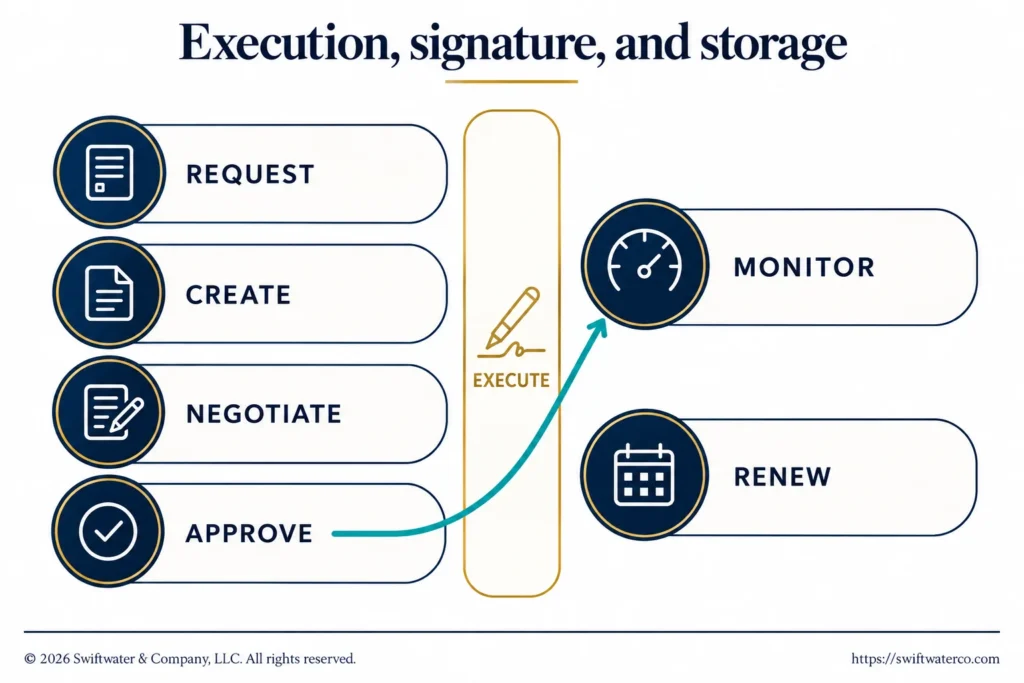
Execution, signature, and storage is the stage where authorized signatories bind the organization and the signed contract becomes a managed record. A delegation of authority governs who may sign what. Most execution runs through e-signature, though some document types still call for a wet signature. The fully executed copy is then filed, with its signature record and metadata, in the system of record. This is where pre-signature work ends and post-signature work begins.
The contract repository should store contracts the way the business retrieves them, by counterparty, obligation, and renewal date, with access controls around sensitive terms. The risk at this stage is a signed contract that exists only as a PDF in an email thread, where nobody can search it or see its renewal date.
What happens in the obligations and performance monitoring stage?
Obligations and performance monitoring is the stage where the organization tracks whether both parties are doing what the contract says. Working from the record filed at execution in the repository, each deliverable, payment, service level, and deadline gets an owner and a date, with alerts set well before each deadline. Periodic reviews then show which counterparties underperform and which terms keep causing friction.
Understaffed teams tend to skip this stage first, so it needs a named owner from day one. The obligation management guide covers the method and the data each obligation needs.
What happens at renewal, renegotiation, or termination?
Renewal, renegotiation, or termination is the stage where the organization decides, deliberately, whether a contract continues. Before the end date, the owner reviews the current terms, the counterparty’s performance from the monitoring stage, and the business’s future need, then renews, renegotiates, amends, or exits. Alerts set early enough before the notice deadline keep auto-renewals from deciding for you, and give the owner time to prepare a renegotiation.
For long-running master agreements, renewal is the natural moment to revisit pricing and terms accumulated across years of changes, often recorded as an amendment. See contract renewal management for alert design and auto-renewal risk.
Evaluating legal technology but not sure where to start?
We help legal departments cut through the vendor noise, mapping technology to process maturity and building a roadmap that actually gets adopted.
See Legal TechnologyWhy do some guides list five or eight stages?
Some guides count five stages and others eight, but they describe the same work grouped differently. Five-stage versions usually combine request with drafting, and negotiation with approval. Eight-stage versions usually treat storage as its own step after signature. Whichever count a team uses, the test is the same: every stage needs an owner, and every handoff needs a rule, so nothing waits between stages.
Where do contracts stall between stages?
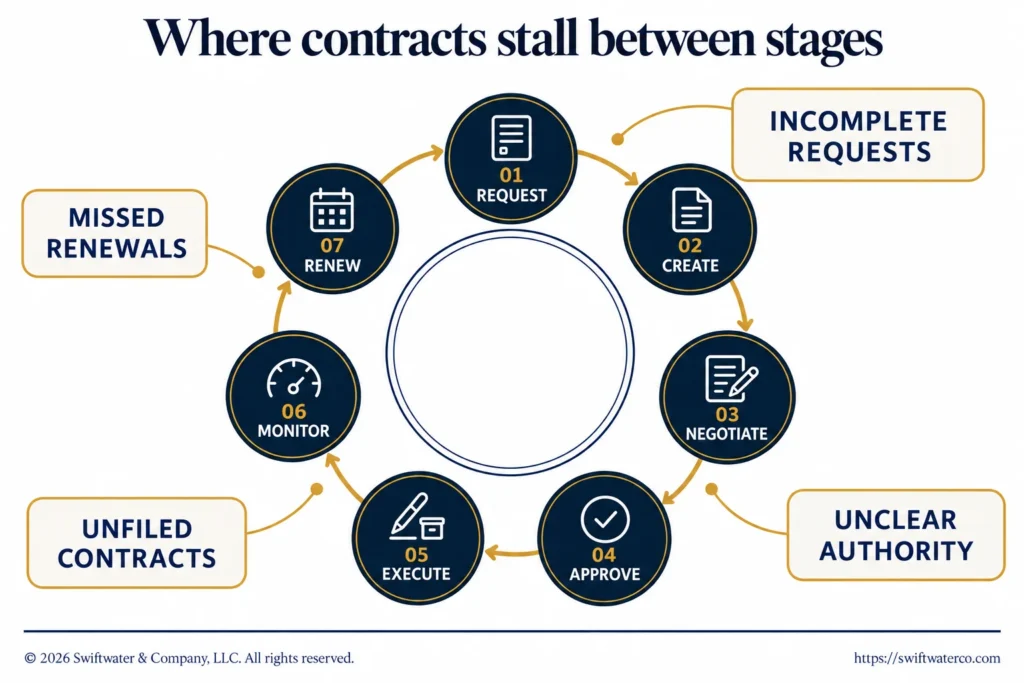
Contracts stall at the handoffs between stages more often than inside them. The four common stalls are incomplete requests at intake, unclear approval authority between negotiation and approval, signed copies that never reach the repository, and renewal dates that pass with nobody alerted. Each handoff needs a rule: what must be complete before the contract moves on, and who receives it next. Most delays trace back to a handoff without one.
Ironclad’s 2025 Contracting Benchmark Report, drawn from its customers’ contracting data, puts the average time to execute a contract at 42 days. Research by WorldCC (formerly IACCM) finds the best performers operating almost 4 times faster than the worst on cycle time. Both show direction; measure your own contract cycle time as the baseline.
Every handoff gets worse when departments run their own templates, when status lives in email, and when people meet new routines without readiness and change management. Agreeing who owns each stage is part of the fix, a CLM implementation plan sequences the rest, and contract lifecycle management best practices covers the practices that keep them fixed.
| Handoff | Where it stalls | What fixes it |
|---|---|---|
| Request and intake to authoring and drafting | The request arrives without counterparty, value, or contract type and bounces back | A required-field request form and triage rules (contract request and intake) |
| Negotiation and redlining to review and approval | Nobody knows who holds authority for this contract type and value | An approval matrix and routing rules (approval workflow) |
| Execution, signature, and storage to obligations and performance monitoring | The signed copy stays in an inbox and never reaches the repository | Filing the executed copy and its metadata straight into the contract repository |
| Obligations and performance monitoring to renewal, renegotiation, or termination | The notice date passes with nobody alerted | Renewal alerts tied to the notice deadline, with a named owner (contract renewal management) |
Bottom Line
What keeps contracts moving through the seven stages is an owner for every stage and a rule for every handoff, so a request arrives complete, an approver is known, a signed copy is filed, and a renewal date reaches someone in time.
The cost of leaving those gaps open is real. Research by WorldCC finds the average business loses almost 9% of value annually through poor contract management; the best performers lose about 3% and the worst 15% or more. Start by walking a few recent contracts through the seven stages, noting where each one waited, and map your current contract lifecycle. Fix the handoffs between stages first, because automating a stage that hands off badly only moves the delay downstream.
A Swiftwater CLM discovery sprint maps your contract lifecycle from intake through renewal, with the handoffs and gaps between stages, and recommends a pilot on one priority contract workflow, typically 6 to 12 weeks.
Frequently Asked Questions
What are the 7 stages of contract lifecycle management?
The seven stages of contract lifecycle management are request and intake; authoring and drafting; negotiation and redlining; review and approval; execution, signature, and storage; obligations and performance monitoring; and renewal, renegotiation, or termination. The first five take a contract from request to signature, and the last two govern it after signature.
What are the five stages of the contract life cycle?
Five-stage models combine neighboring steps of the same lifecycle. A common version is request and drafting, negotiation and approval, execution, monitoring, and renewal. The work is the same as in the seven-stage model; splitting request from drafting and negotiation from approval makes ownership and handoffs easier to see.
Which stage of the contract lifecycle causes the most delays?
Review and approval is the most common bottleneck, because it involves the most people with the least structure: legal, finance, compliance, and other functions touching the same document, often without defined paths or escalation rules. Routing by type and value, with named approvers, fixes most of it. The approval workflow guide covers the design.
How can a CLM facilitate communication between legal and business teams?
A CLM replaces email chasing with one shared record for each contract. The request, the drafts, the comments, and the approvals sit on the contract itself, and status is visible to the requester and to legal at every stage. Business teams can see where a contract is and what it is waiting for, and legal receives complete requests through one front door.
Can you explain the contract management workflow from creation to renewal?
A contract starts as a request through an intake form, is drafted from an approved template, and is negotiated through redlined versions. The agreed draft then routes for review and approval, is signed, and is filed in the repository with its metadata. After signature, obligations and dates are monitored, and before the end date the owner decides to renew, renegotiate, or terminate. Routing between steps is covered in the approval workflow guide.
How can a CLM help track obligations and deadlines?
A CLM captures obligations and key dates when the contract is signed and filed, then tracks them in the repository with owners and alerts. Deliverables, payments, service levels, and notice deadlines each get a date and a responsible person, and reminders go out before each deadline. The obligation management guide covers the method and the data each obligation needs.
What is the difference between the contract lifecycle and the contract management process?
The contract lifecycle is the sequence of stages a single agreement passes through, from request to renewal or termination. The contract management process is how a given organization runs those stages: its forms, routing rules, approvals, owners, templates, and systems. Two companies with the same seven stages can have very different processes, and very different cycle times.
This article is provided for general informational purposes only and is not legal, financial, or business advice. Contract lifecycle and process decisions should be validated against your organization’s specific structure, regulatory obligations, and counsel guidance, and you should consult a qualified professional for advice on your situation.