

A contract review process routes each agreement to the right reviewers, sets turnaround targets, and tracks status to approval. It decides who looks at a contract, in what order, and how long each step should take. Without one, contracts wait in inboxes, the business chases legal for updates, and no one can say where a deal is stuck.
Contract review is also the part of contracting most targeted by AI. Legal AI platforms, CLM vendors, and now the largest AI companies all offer tools that review a draft against a playbook and propose redlines. Those tools change the queue, but they still need a process around them: routing, a playbook, and people who decide.
This guide covers the steps in a contract review process, who reviews what, how AI and automated redlining fit, where AI is not very helpful, and how to set targets, track status, and measure the result. It describes the process and the routing; how to review the terms themselves is a legal question for your counsel. It is part of our guide to the seven stages of the contract lifecycle and our contract lifecycle management guide.
What is a contract review process?
A contract review process is the set of steps and rules that take a contract from a complete request to an approved draft ready for signature. It sits between request and intake and execution in the contract lifecycle, and it covers triage, routing to reviewers, review and redlining, negotiation, and approval, with status tracked at every step.
The process matters because review is where most of the time goes. Ironclad’s 2025 Contracting Benchmark Report, drawn from its customers’ contracting data, puts the average time to execute a contract at 42 days, with direct legal involvement in 76% of contracts and 60% of contracts on the other side’s paper.
What are the steps in a contract review process?
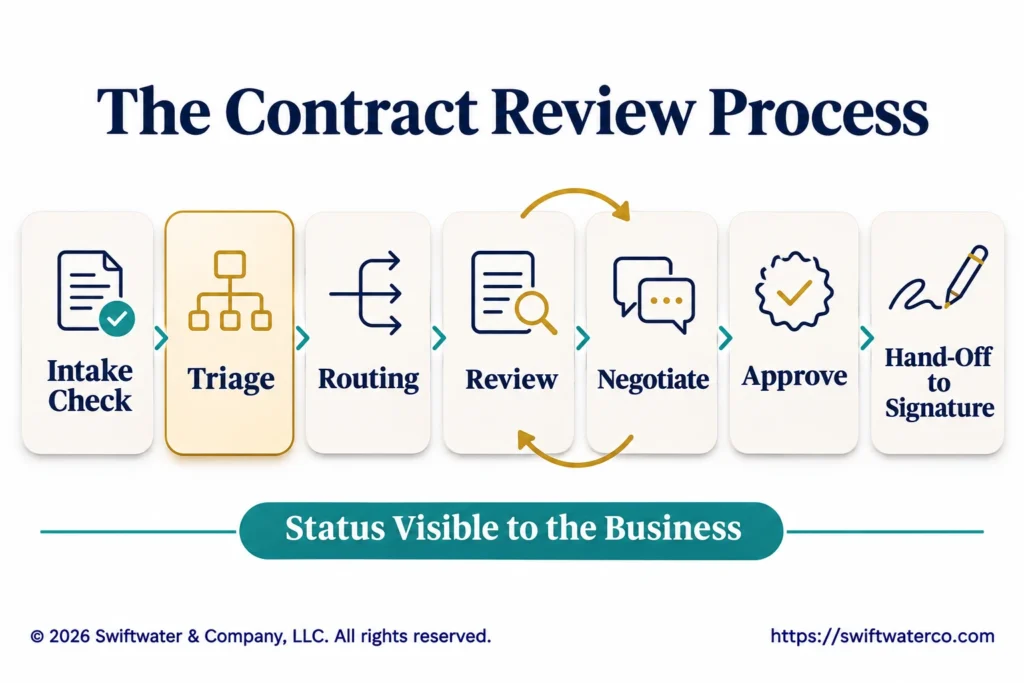
A contract review process usually runs in seven steps: an intake check, triage, routing to reviewers, review against the playbook, negotiation and redlining, approval, and hand-off to signature. Each step has an owner, a target time, and a status the business can see.
- Intake check. The request is complete: form filled, documents attached, value and term stated.
- Triage. The contract is classified by type, value, and risk, and by whose paper it is on.
- Routing. It goes to the reviewers its tier requires.
- Review. An AI first pass, where one is in place, flags deviations from the playbook; reviewers confirm what matters.
- Negotiation and redlining. Changes are exchanged with the counterparty and tracked by version.
- Approval. The approvers on the matrix sign off, in parallel where possible.
- Hand-off. The final version goes to signature and the record moves to the repository.
Our guides to contract request and intake and contract workflow management cover the steps on either side.
Evaluating or implementing a CLM platform?
We have guided legal departments through selection, implementation, and adoption, without the vendor bias. Let us talk about where you are and what you actually need.
See CLM ServicesWho reviews what?
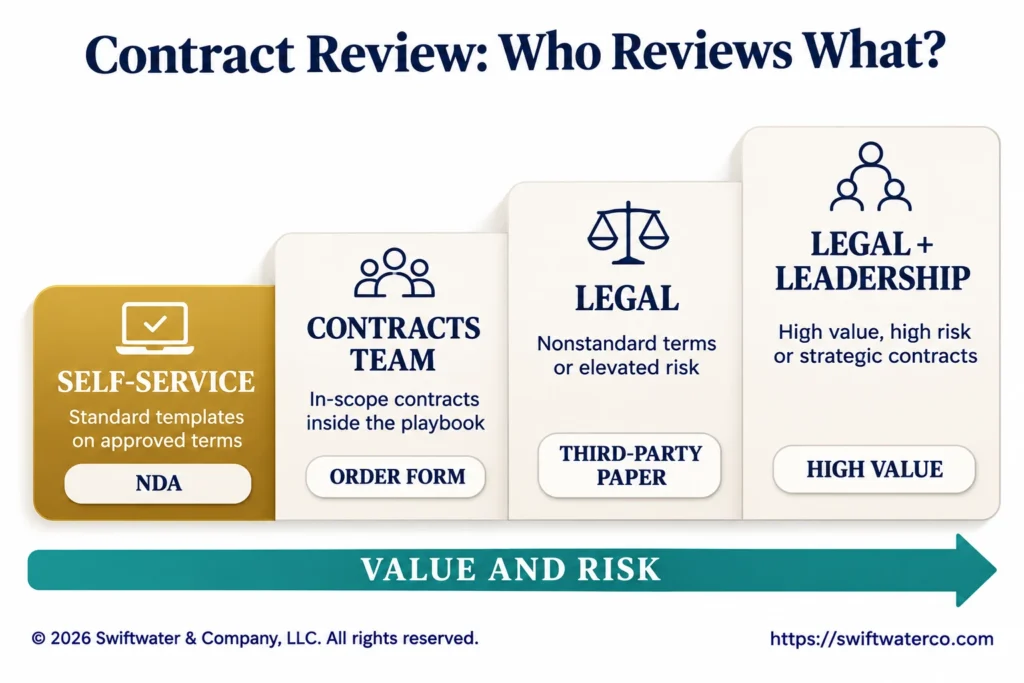
Routing decides who reviews what by contract type, value, and risk, so that lawyers see the contracts that need judgment and standard contracts move without them. Most organizations use three or four tiers, from self-service on approved templates to legal plus finance and executive approval for high-value or high-risk agreements.
| Tier | Typical contracts | Reviewers |
|---|---|---|
| Self-service | NDAs and standard order forms on approved templates, unchanged | None; the business signs within its authority |
| Contracts team | Standard agreements with changes inside the playbook’s fallbacks | Contract manager or specialist, often with an AI first pass |
| Legal | The other side’s paper, changes outside the fallbacks, new contract types | In-house counsel, with the contracts team |
| Legal and leadership | High value, unusual liability, regulatory exposure | Legal, finance, and the executive approver |
The tiers, thresholds, and approvers belong in an approval matrix that everyone can see. Our guide to contract workflow management covers matrix design.
How is AI changing contract review?
AI is changing contract review by doing the first pass: comparing a draft against the playbook, flagging terms outside the agreed positions, proposing redlines as tracked changes, and triaging requests so standard contracts never reach a lawyer. Contracts arrive at legal with the issues marked, and more contract types become self-service.
The market has moved fast. LawSites reported in October 2026 that four of the largest AI companies built legal products in five months, ending with Microsoft’s Copilot for Legal, which reviews contracts in Word against a playbook and drafts tracked-change edits for the user to accept. Legal AI platforms and most CLM vendors offer similar playbook review. Gartner predicts that by 2029, approximately 50% of contract reviews will be delegated to self-service systems that escalate only one in 10 for human review (Gartner, May 2026).
Every one of these tools reviews against a playbook, so the playbook is the work that comes first. Our guides to templates, clause libraries, and playbooks, AI contract review, AI contract review for in-house counsel, and redlining in Word cover each piece.
Where is AI not very helpful in contract review?
AI is least helpful where review depends on judgment, context, or information outside the document: bespoke or first-of-a-kind deals, commercial trade-offs, negotiation strategy, terms spread across several related agreements, and anything the playbook does not cover. It also cannot take accountability for the decision.
- No playbook. AI reviews against the positions you give it; without a written playbook it applies generic ones that may not be yours.
- Bespoke deals. Joint ventures, complex licensing, and first-of-a-kind agreements have no standard to compare against.
- Business context. The tool does not know the relationship, the deal’s value to the business, or what was agreed on a call.
- Negotiation strategy. Which points to concede, and when, is a judgment about people and leverage.
- Linked documents. A master agreement, statements of work, and amendments can change each other’s meaning.
- Poor inputs. Scanned or marked-up documents and unusual formatting reduce accuracy.
- Accountability. A lawyer or authorized approver still owns the decision and the sign-off.
What are reasonable turnaround targets?
Reasonable turnaround targets depend on the contract tier, so set them by tier and publish them as service levels the business can plan around. The fastest tier is self-service with no reviewer; the slowest is high-value contracts on the other side’s paper.
Set the targets from your own data. Measure the current time per tier for a month or a quarter, set targets that improve on it, publish them with the routing rules, and review them every quarter. Count time in the review queue separately from time waiting on the counterparty, because only the first is within the team’s control. When an AI first pass is added, measure again, since targets set before it will be too slow.
How do you track contract review status?
Track contract review status in one queue, with a status field for every contract, the owner of the current step, the date it entered that step, and an escalation when a step runs past its target. The business should be able to see where its contract is without emailing legal.
- One queue. Every request in one system, never in personal inboxes.
- Status values. A short, fixed list: submitted, in triage, in review, with counterparty, in approval, ready to sign.
- Owner and age. Who holds it now, and how long it has been there.
- Escalation. A reminder, then a backup reviewer or manager, when a step passes its target.
- Visibility. A view for requesters and a dashboard for managers.
A CLM or intake tool does this natively. A shared tracker can work at low volume, as our guide to the contract tracking spreadsheet explains, but it depends on people updating it.
What is a contract review checklist?
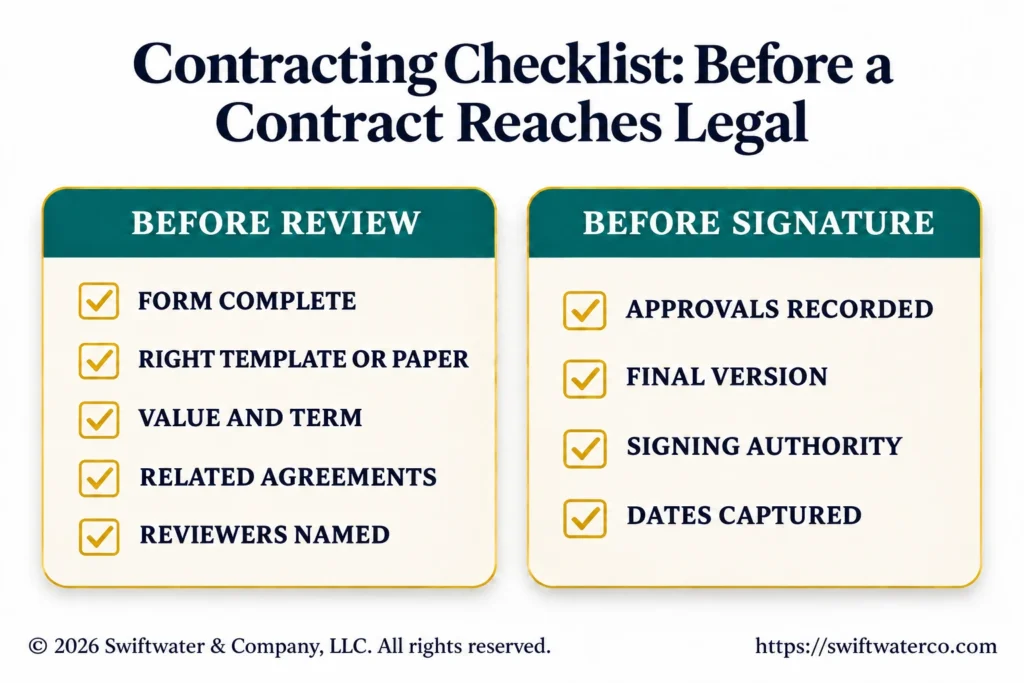
A contract review checklist is the list of items a request must have before review starts and the sign-offs it must collect before signature. It checks that the request is complete and routed correctly; the review of the terms themselves follows your playbook and counsel’s guidance.
Before review starts:
- Request form complete, with business owner, counterparty, and purpose.
- Contract type identified, and the right template used or the other side’s paper attached.
- Value, term, renewal type, and payment terms stated.
- Related agreements attached, such as the master agreement for a statement of work.
- Tier assigned and reviewers named.
Before signature:
Evaluating legal technology but not sure where to start?
We help legal departments cut through the vendor noise, mapping technology to process maturity and building a roadmap that actually gets adopted.
See Legal Technology- All required approvals recorded on the matrix.
- Final version marked, with redlines closed.
- Signatory confirmed within their signing authority.
- Key dates and obligations captured for the repository.
How do you measure contract review performance?
Measure contract review performance by cycle time per tier and per step, queue age, the share of contracts handled without legal, the rate of rework, and how often targets are met. Where AI does a first pass, also track how often reviewers accept its flags and redlines.
- Cycle time by tier and step: where the time goes.
- Queue age: how many contracts are past target today.
- Self-service rate: the share of contracts that needed no reviewer.
- Rework rate: requests sent back as incomplete or misrouted.
- AI acceptance rate: the share of AI flags and redlines reviewers keep.
Our guide to contract management KPIs covers the calculations and how to report them.
Bottom Line
A contract review process is routing and tracking: it decides who reviews each contract by type, value, and risk, sets a turnaround target for each tier, and shows every contract’s status from intake to signature. AI now does the first pass in more and more teams, comparing drafts to the playbook and proposing redlines, while lawyers keep the bespoke deals, the commercial judgment, and the sign-off.
The teams that get the most from AI write the playbook first, put the AI pass inside the routing, publish the tiers and targets, and measure what reviewers accept. Route each contract by type, value, and risk, let AI take the first pass against a written playbook, and track every review in one queue so nothing waits without an owner.
Our contract management solutions help legal teams design review tiers and routing, write the playbooks AI review depends on, and configure intake, workflow, and reporting in the CLM.
Frequently Asked Questions
What is a contract review process?
A contract review process routes each agreement to the right reviewers, sets turnaround targets, and tracks status to approval. It runs from an intake check through triage, routing, review, negotiation, and approval to the hand-off for signature, with an owner and a status at every step.
Who should review a contract?
The reviewers depend on the contract’s type, value, and risk. Standard contracts on approved templates can be self-service, changes within the playbook go to the contracts team, the other side’s paper and larger changes go to legal, and high-value or high-risk contracts add finance and an executive approver.
Can AI review and redline contracts?
Yes, for the first pass. AI tools compare a draft against your playbook, flag terms outside your positions, and propose redlines as tracked changes for a reviewer to accept or reject. They work only as well as the playbook, and a lawyer or authorized approver still decides.
Where is AI not helpful in contract review?
AI is least helpful on bespoke deals, commercial trade-offs, negotiation strategy, terms that depend on several related agreements, and anything the playbook does not cover. A lawyer or authorized approver still owns the decision.
How long should contract review take?
It depends on the tier, so set a target for each one from your own data. Measure the current time per tier, set targets that improve on it, and publish them as service levels. Ironclad’s 2025 report, drawn from its customers’ data, puts the average time to execute at 42 days.
What is a contract review checklist?
A contract review checklist lists what a request needs before review starts, such as a complete form, the right template or the other side’s paper, value and term, and named reviewers, and the sign-offs needed before signature. Review of the terms follows your playbook and counsel’s guidance.
How do you track contract review status?
Keep every request in one queue with a fixed list of status values, the owner of the current step, and the date it entered that step. Escalate when a step passes its target, and give requesters a view so they can check status without emailing legal.
This article is provided for general informational purposes only and is not legal, financial, or business advice. It describes review routing, tracking, and the role of AI tools; it does not cover how to review contract terms, which should be done with your counsel. Contract review process decisions should be validated against your organization’s specific structure, regulatory obligations, and counsel guidance, and you should consult a qualified professional for advice on your situation.