
Contract lifecycle management tools are software platforms that handle a company’s contracts from the first request through signature, storage, and renewal. Many platforms compete for the same budget, and in a demo they can look alike. A tool built around a legal team can frustrate a procurement team that works in its ERP, and a sales team that lives in its CRM may need something else again. The useful way to compare them is by fit: who owns your contracts, and which systems they must work with.
This guide groups the platforms into seven categories, from enterprise suites to AI review tools, and describes each one from its vendor’s own website as of November 2026. It is part of our contract lifecycle management guide; when you are ready to compare a shortlist, how to choose a CLM vendor sets out the scorecard.
What are contract lifecycle management tools?
Contract lifecycle management tools are software that captures contract requests, holds templates and clause libraries, routes drafts for negotiation and approval, collects signatures, stores executed contracts with their metadata, and tracks obligations and renewals. A full CLM covers all seven stages of the contract lifecycle in one system. Narrower tools cover one or two stages, such as signature, storage, or review.
The seven stages are request and intake; authoring and drafting; negotiation and redlining; review and approval; execution, signature, and storage; obligations and performance monitoring; and renewal, renegotiation, or termination. A platform’s category says which of those stages it treats as the center of gravity, and which team it was built for first.
The market is growing. Grand View Research valued the global contract management software market at USD 3.1 billion in 2025 and projects USD 7.3 billion by 2033 (12.6% compound annual growth). Growth brings new entrants, mergers, and renamed products, so any landscape is a snapshot.
What are the categories of CLM tools?
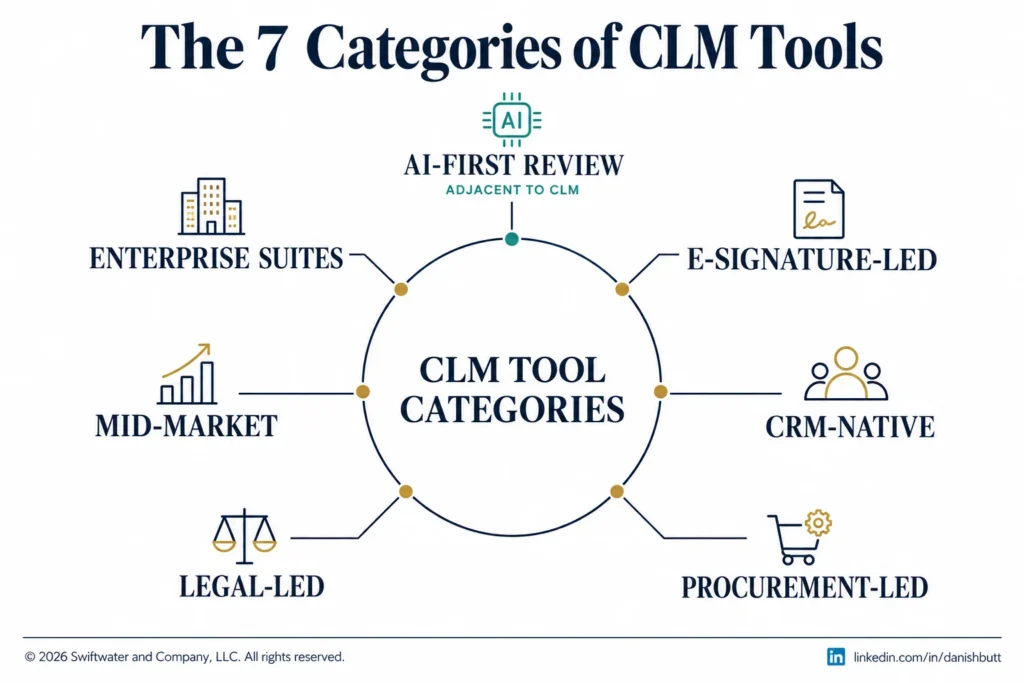
CLM tools fall into seven categories by fit, defined by who owns the contracts, which side of the deal they sit on, and which system of record the tool extends. The first five are enterprise suites, mid-market CLM, legal-led, procurement-led, and CRM-native platforms. E-signature-led platforms and AI-first review tools complete the list. Categories overlap, and a platform is placed by how it positions itself.
- Enterprise suites handle high volume, many contract types, and global, multi-entity programs. Most market to legal teams as a key stakeholder, alongside procurement, sales, and finance.
- Mid-market CLM offers faster setup and lighter administration for growing teams.
- Legal-led platforms are built around legal’s intake, drafting, negotiation, and repository.
- Procurement-led tools manage supplier contracts inside source-to-pay or ERP suites (see contract management in procurement).
- CRM-native tools build sell-side contracts inside the CRM, close to quote and opportunity data (see sales contract management).
- E-signature-led platforms add lifecycle features to an e-signature system that many teams already use.
- AI-first review tools read contracts to review, extract, and analyze them, alone or beside a CLM (see AI contract review).
Which platforms sit in each category?
Each platform below is placed by its primary fit as the vendor describes it on its own website, checked in November 2026. The one-line descriptions paraphrase the vendors’ own positioning. The table carries no pricing, rankings, or review scores, and platforms are listed alphabetically within each category. Most platforms serve more than one team, so a platform’s category marks its starting point and leaves room for wider use.
Evaluating or implementing a CLM platform?
We have guided legal departments through selection, implementation, and adoption, without the vendor bias. Let us talk about where you are and what you actually need.
See CLM Services| Platform | Primary fit | How the vendor describes it (as of November 2026) |
|---|---|---|
| Agiloft | Enterprise suite | A data-first CLM and AI platform for enterprises, configurable without code |
| Icertis | Enterprise suite | An AI-native contract intelligence platform for large enterprises across legal, procurement, finance, sales, and IT |
| Malbek | Enterprise suite | An enterprise CLM platform with AI and no-code integrations, for sales, legal, procurement, and finance |
| Sirion | Enterprise suite | An agentic CLM platform for enterprises, with AI agents for drafting, redlining, extraction, and obligation tracking |
| Juro | Mid-market | An AI-native contract platform for fast-growing businesses, led by legal and used across sales, HR, finance, and procurement |
| SpotDraft | Mid-market | AI-native CLM for in-house legal teams at growth-stage and mid-market companies |
| Ironclad | Legal-led | An AI CLM platform with solutions for legal operations, general counsel, procurement, IT, and sales |
| LinkSquares | Legal-led | Contract management software for legal leaders and the business, with solutions for legal, procurement, finance, and sales |
| Onit | Legal-led | CLM products, including ContractWorks and OnitX CLM, on the Unity platform, aimed at legal operations teams |
| Workday Contract Lifecycle Management | Legal-led | CLM powered by Evisort AI, listed among Workday’s legal products |
| SAP Ariba Contracts | Procurement-led | Contract management within SAP Ariba’s source-to-pay suite, connected to sourcing, buying, and supplier management |
| Conga | CRM-native | CLM alongside CPQ and revenue tools, with apps that run inside Salesforce |
| Docusign CLM | E-signature-led | CLM within Docusign’s Intelligent Agreement Management platform, beside Docusign eSignature |
| Leah (formerly ContractPodAi) | AI-first | An agentic AI platform for contracting, legal, procurement, and finance that includes CLM |
Workday and Evisort. As of November 2026, Workday sells two contract products, Workday Contract Lifecycle Management and Workday Contract Intelligence, both powered by Evisort AI. Workday announced in March 2025 that Evisort’s contract products were available through Workday, so Evisort appears here as part of the Workday row. Workday Contract Intelligence, the AI layer without the workflow, sits closer to the AI-first category.
What is the best contract lifecycle management tool?
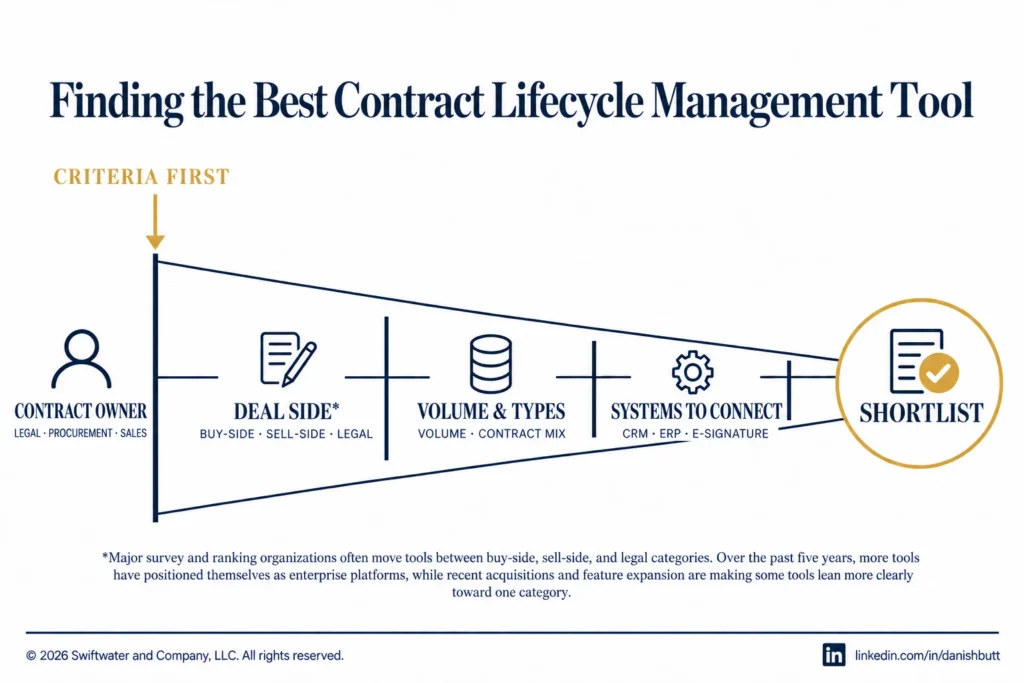
The best contract lifecycle management tool is the one that fits who owns your contracts, which side of the deal they sit on, your volume and contract types, and the systems it has to connect to. Decide those criteria before any demo, then score a shortlist against them. A platform that suits a procurement team running an ERP can be a poor fit for a legal team on a CRM, and the reverse.
Write the criteria with the CLM requirements checklist, and score the shortlist with the scorecard in how to choose a CLM vendor. Analyst reviews such as Gartner’s CLM market coverage are a useful reference for what each platform offers; read them as input to your own criteria.
| If your situation is | Start your shortlist in | Check first |
|---|---|---|
| Legal owns most contracts | Legal-led or mid-market CLM | Intake, templates, and negotiation for your main contract types |
| Procurement owns supplier contracts in an ERP | Procurement-led | How contracts connect to sourcing, purchasing, and invoices |
| Sales contracts start in a CRM | CRM-native | How quote and opportunity data flow into the contract |
| An e-signature platform is already the standard | E-signature-led | Which lifecycle features sit on top of the signature tool you have |
| The main need is review or extraction of existing contracts | AI-first review tools | Accuracy on your own documents, and where the data goes next |
| High volume, many entities, many contract types | Enterprise suites | Configuration effort and administration after go-live |
| A growing team replacing spreadsheets | Mid-market CLM | Setup time and who will administer it |
How do CLM tools integrate with CRM, ERP, and e-signature?
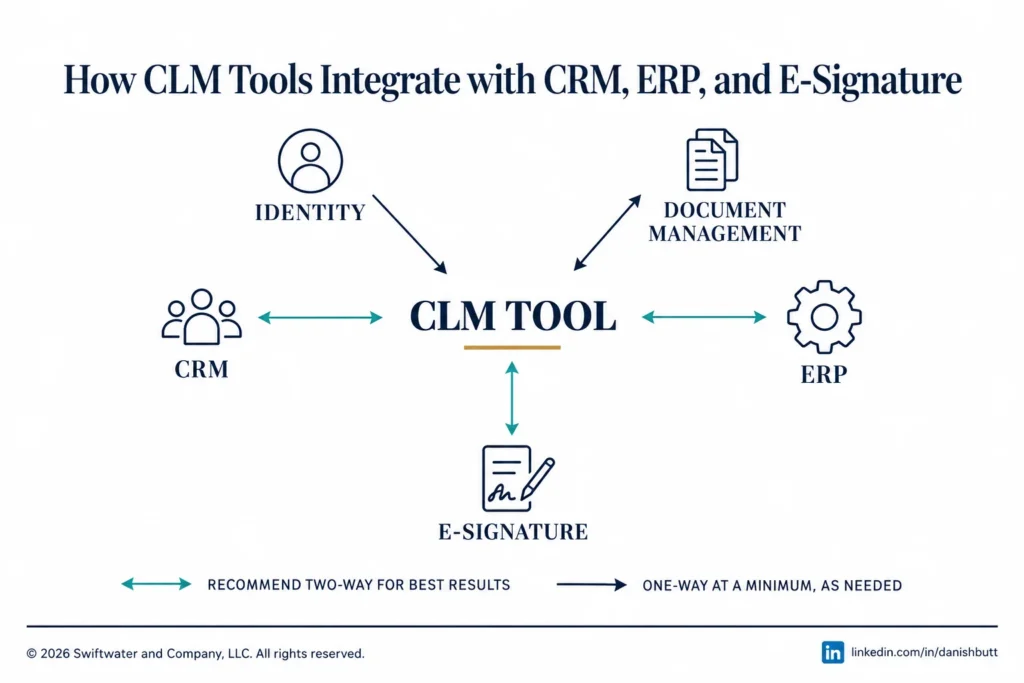
CLM tools integrate through native connectors or APIs. The CRM or ERP starts the contract request and passes deal or supplier data into it, the e-signature tool executes the agreement, and signed contract metadata flows back to the systems that need it. Identity management controls who sees what, and document management holds files that live outside the CLM. Which system owns which data is the core design decision.
Integration is where many programs fall short. WorldCC (formerly IACCM) reports that, on average, contract-related data is scattered across 24 different systems. In the WorldCC and Sirion study of 170 organizations (2026), 54% had no automated data flow between systems, and only 9% had bidirectional synchronization.
The boundary decisions (what stays in the ERP or CRM, and what moves to the CLM) are covered in CLM vs ERP, CRM, and document management. For teams running Salesforce and ServiceNow, the Salesforce, CLM, and ServiceNow boundary guide sets out which system holds the record.
Where does contract analytics software fit?
Contract analytics software reads contracts: it extracts terms and metadata from executed agreements, compares drafts with a playbook, and reports on the portfolio. Many CLM suites now include these features, and standalone AI tools sit beside a CLM to review or extract at volume. Analytics adds insight to a CLM’s workflow and repository, and the workflow, approvals, and obligations still run in the CLM.
Gartner predicts that by 2027, 50% of organizations will support supplier contract negotiations through the use of AI-enabled contract risk analysis and editing tools (Gartner, May 2024).
For how review tools work and how to deploy them, see AI contract review. Extraction and reporting on executed agreements are covered in contract intelligence.
How does Swiftwater work on these platforms?
We at Swiftwater work on the CLM platforms our clients already run or are choosing, with the same services on each: health checks, process mapping and optimization, user adoption support, subject matter expertise in process, design, and documentation, project management, managed services, and business training. We also evaluate a platform whether a client is buying new, already running it, or planning to move, and we plan the migration.
Our solutions pages cover our implementation and support work on Onit CLM, Docusign CLM, Agiloft, and Conga, and readiness and migration work for Icertis and Ironclad. For teams weighing two of those platforms side by side, there is a direct comparison. The landscape above describes every platform on equal terms.
Bottom Line
The CLM tools landscape sorts by fit: enterprise suites, mid-market CLM, legal-led, procurement-led, CRM-native, e-signature-led, and AI-first review tools. The categories overlap, and the platforms in them keep adding features, merging, and renaming, so treat any list as a dated snapshot.
Write the criteria first, shortlist from the category that matches who owns your contracts and the systems they touch, and score every platform the same way. The right contract lifecycle management tool is the one that matches who owns your contracts and the systems they must work with, so set the criteria before you look at a single demo.
Evaluating legal technology but not sure where to start?
We help legal departments cut through the vendor noise, mapping technology to process maturity and building a roadmap that actually gets adopted.
See Legal TechnologySwiftwater’s contract management consultants run vendor-neutral CLM selection: they assess how your contracts run today and check your readiness, so the shortlist starts from your own requirements.
Frequently Asked Questions
What are contract lifecycle management tools?
Contract lifecycle management tools are software platforms that handle a company’s contracts from the first request through signature, storage, and renewal. They group by fit: enterprise, mid-market, legal-led, procurement-led, and CRM-native, with e-signature-led platforms and AI-first review tools beside those five.
What is the best CLM tool?
The best CLM tool is the one that fits who owns your contracts, which side of the deal they sit on, your volume, and the systems it must connect to. Set those criteria before demos and score a shortlist against them; the guide to choosing a CLM vendor includes a scorecard.
How are CLM tools categorized?
By fit, in seven categories: enterprise suites, mid-market CLM, legal-led, procurement-led, CRM-native, e-signature-led, and AI-first review tools. A platform is placed by how its vendor positions it, and many platforms serve more than one category.
Which CLM tools suit legal-led versus procurement-led teams?
Legal-led platforms center on legal’s intake, drafting, negotiation, and repository. Procurement-led tools sit inside source-to-pay and ERP suites, close to sourcing, purchasing, and invoices. The table on this page places each platform in one category by its vendor’s own description.
What do CRM-native CLM tools do differently?
CRM-native tools build the contract from opportunity and quote data inside the CRM, so sales teams request, track, and close contracts without leaving the system they work in. Legal review and approvals still need a defined route, which CLM vs ERP, CRM, and document management covers.
Do AI review tools replace a CLM?
AI review tools cover review and extraction. Intake, workflow, approvals, the repository, and obligation tracking still need a CLM, or a suite that includes one. Many CLM suites now include AI review features; see AI contract review for how the tools work.
How do CLM tools integrate with CRM, ERP, and e-signature?
Through native connectors or APIs. The CRM or ERP starts the request and passes deal or supplier data, the e-signature tool executes, and signed metadata flows back. Decide which system owns each field before the build.
This article is provided for general informational purposes only and is not legal, financial, or business advice. CLM tool selection decisions should be validated against your organization’s specific structure, regulatory obligations, and counsel guidance, and you should consult a qualified professional for advice on your situation. Vendor details reflect each vendor’s public website as of November 2026 and should be verified with the vendor before any decision.