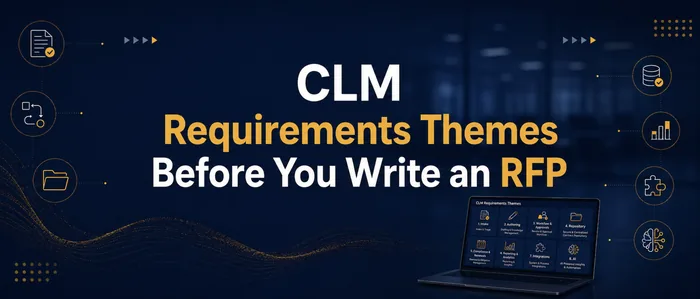

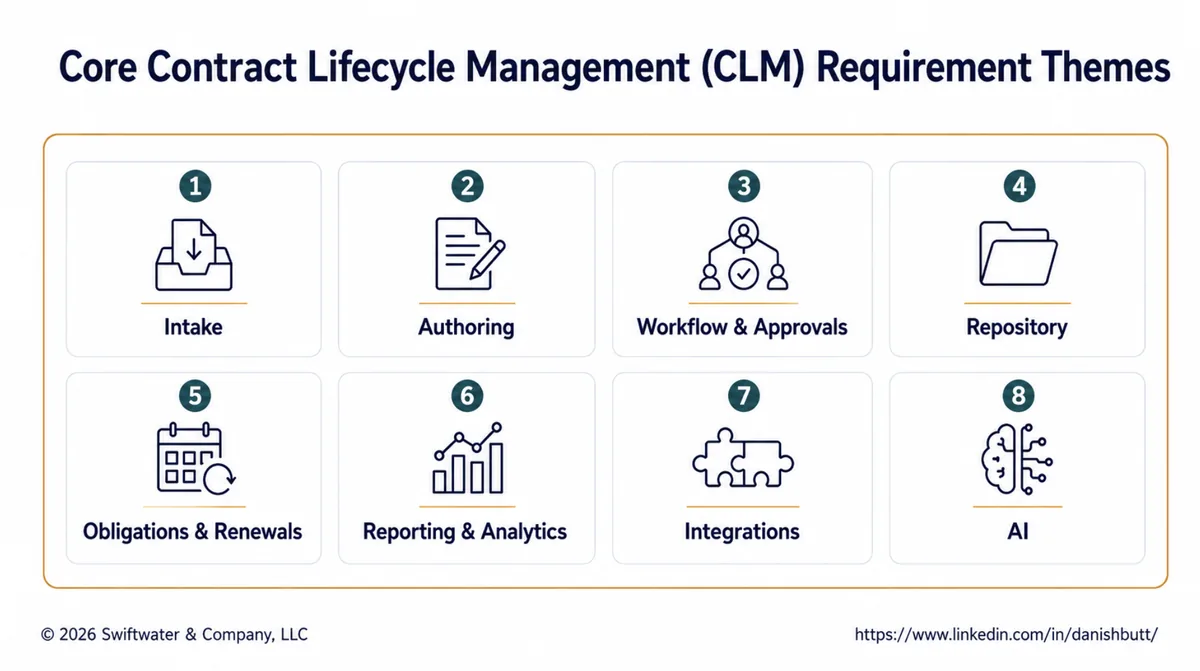
The core CLM requirements themes are intake, authoring, workflow and approvals, repository, obligations and renewals, reporting and analytics, integrations, and AI, and they are the first layer of any contract lifecycle management requirements process, the layer you define before you ever write a granular requirement.
Themes do three things a detailed requirements list cannot do on its own. They validate that a general area actually matters to your organization before you invest in defining it in detail. They give you a structure to construct granular requirements within. And they ensure full coverage even when you have not yet written fine-grained requirements, because every general area is at least identified and accounted for.
This is the step that turns a mapped process into the scaffolding for a defensible set of contract lifecycle management requirements, and it belongs before the RFP, while you still own the definition of what good looks like.
Why should CLM requirements start with themes rather than detailed specs?
CLM requirements should start with themes because themes let you validate what matters and build coverage before you spend effort on granular detail, which is the sequence that keeps a requirements process efficient and complete. Jumping straight to detailed specifications tends to produce a long list that is deep in the areas someone happened to think about and silent in the areas nobody raised.
See the CLM requirements-theme matrix below for the eight themes, what each covers, and the stakeholder who owns it.
Themes solve that by working top down. First you confirm the eight general areas that a contract lifecycle management system must address. Then you decide which of those areas matter most for your organization, which validates your needs before you invest in defining them. Only then do you write granular requirements inside each theme, and because the themes are fixed, you can see at a glance where you have detail and where you still have a gap.
The coverage benefit matters most for the organizations that never reach full granular detail, which is most of them. Because the eight themes are fixed, even a half-finished requirements set still names every part of the lifecycle, so no area is silently dropped just because nobody got to it.
Not ready to pick a CLM platform yet?
A four to six week diagnostic that maps your current contract lifecycle, sets requirements themes, and tells you what to buy before you sit through another vendor demo.
See the CLM Discovery SprintA theme structure keeps the document usable too. A general counsel and a platform owner can both reason about eight themes and see whether each is covered. Neither can meaningfully review a flat list of 200 specifications, which is how detailed requirements quietly hand the decision to whoever wrote them.
What are the major CLM requirement themes?
There are eight themes that cover the contract lifecycle end to end, and every requirement you have belongs under one of them.
Intake covers how contract requests originate and get triaged. Authoring covers drafting, templates, and clause libraries. Workflow and approvals cover routing, review, and sign-off. Repository covers storage, search, and version control. Obligations and renewals cover what happens after signature, the part most organizations underbuild. Reporting and analytics cover visibility across the portfolio. Integrations cover how the CLM connects to the systems you already run. AI covers obligation extraction, clause comparison, and risk surfacing.
WorldCC research underscores why the post-signature themes matter most: its 2023 benchmark put average contract value erosion at nearly 9 percent, and most of that leaks after signature, in the obligations and renewals nobody is tracking. Underbuild those themes and you buy a fast way to sign contracts you then fail to manage.
How do intake requirements differ across sell-side and buy-side?
Intake requirements differ because contracts originate in different enterprise platforms on each side of the house, and your requirements have to meet them where they start.
On the sell side, contracts originate in Salesforce, close to the opportunity and the quote. The intake requirement is that a sell-side request flows from the deal into authoring without re-keying, and that the CLM can receive it from Salesforce cleanly. On the buy side, contracts originate in ServiceNow for service and vendor requests and in procurement systems like SAP and Coupa for supplier agreements. The intake requirement there is that a buy-side request reaches the CLM from those systems with the procurement context attached.
A single generic intake requirement misses both realities. Write the intake theme to name where requests actually originate, so the RFP tests whether a vendor can serve your sell-side and buy-side enterprise platforms rather than a hypothetical one. Where each side should hand off, and which system owns the record, is the subject of the Salesforce vs CLM vs ServiceNow boundary model.
What do the authoring and obligations themes need to cover?
The authoring theme needs to cover how your team drafts, reuses, and controls contract language, and the obligations theme needs to cover everything that happens after signature.
Authoring is where clause libraries, templates, and playbooks live, and the requirement is that your standard language is reusable and your fallback positions are governed. The depth that this theme can reach is covered in clause libraries, templates, and playbooks. The mistake is treating authoring as a document-generation feature rather than a governance capability.
Obligations and renewals are where contract value is won or lost. The requirement is that the system tracks commitments, dates, and renewals, and routes the action to whoever owns it, with legal orchestrating rather than executing every item. This is the theme that most directly attacks the nearly 9 percent value erosion, because erosion is mostly unmanaged obligations and missed renewals.
How do you write requirements for stakeholders who own different contracts?
Write requirements per stakeholder by recognizing that sales, procurement, IT, real estate, and legal each need different things from the same eight themes. A requirement that satisfies procurement may not satisfy sales, and a system that serves only the function that bought it gets routed around by everyone else. Whether those stakeholders will actually adopt the system they specified is the separate question of CLM readiness and change management.
The practical method is to run each theme through each owning stakeholder. Under intake, sales needs speed from the opportunity; procurement needs supplier context; legal needs risk triage. Under obligations, the business owner needs renewal alerts; the general counsel needs compliance visibility; legal operations needs portfolio reporting.
Going stakeholder by stakeholder also surfaces requirements no single person could list from memory. McKinsey found that up to 80 percent of procurement functions are not fully aware of the competitive terms inside their own contracts, so requirements gathered from one vantage point will always miss what other stakeholders know. Running every theme past every owner is how those gaps get caught before the RFP, not after go-live.
Evaluating or implementing a CLM platform?
We have guided legal departments through selection, implementation, and adoption, without the vendor bias. Let us talk about where you are and what you actually need.
See CLM ServicesThis is also where contract type matters, because contracts span procurement, sales, nondisclosure, leasing, and licensing agreements, as Gartner’s CLM definition reflects. A requirements set that assumes one contract type will underserve the others. Mapping themes to stakeholders and contract types is the work that makes the eventual RFP fit your organization rather than a generic one.
How do you turn requirements themes into an RFP?
Turn themes into an RFP by first writing granular requirements inside each theme, then expressing each as an outcome statement that asks vendors to demonstrate how they achieve it rather than whether they own a feature.
The themes give the RFP its sections, and the granular requirements you developed inside each theme give those sections their substance. For each requirement, state the outcome you need, the stakeholders it serves, and the systems it must touch, then ask the vendor to show it against your own scenarios rather than a canned demo. This makes vendors compete on fit and gives your evaluators a structured way to score, theme by theme.
The benchmark context supports the discipline. WorldCC found that over 90 percent of executives recognize the need for better contracts and that 40 percent of organizations are considering a new CLM, so most buyers are entering the market at once, and the ones who enter with a themed, outcome-based RFP will choose better than the ones who enter with an unstructured list. How that RFP fits into the wider selection process is covered in how to choose a CLM vendor.
What does a CLM requirements-theme matrix look like?
A requirements-theme matrix maps each theme to what it covers and the stakeholder who most owns it.
| Theme | What it covers | Primary owner stakeholder |
|---|---|---|
| Intake | How requests originate and get triaged, across sell-side and buy-side systems | Sales and procurement, legal triages |
| Authoring | Drafting, templates, clause libraries, playbooks | Legal |
| Workflow and approvals | Routing, review, sign-off | Legal and business owner |
| Repository | Storage, search, version control | Legal or contract management |
| Obligations and renewals | Post-signature commitments, dates, renewals | Business owner, legal orchestrates |
| Reporting and analytics | Portfolio visibility and performance | Legal operations and the sponsor |
| Integrations | Connections to Salesforce, ServiceNow, SAP, Coupa | Platform owner with IT |
| AI | Obligation extraction, clause comparison, risk surfacing | Legal and legal operations |
The matrix is the bridge between your lifecycle map and your RFP. Every theme traces back to a stage on the map and forward to a section of the RFP.
Bottom Line
Requirements themes are the first layer of a CLM requirements process, the structure that lets you validate what matters, scaffold your detailed requirements, and guarantee coverage before you ever write a granular spec. Define your themes before you go deep, and your detailed requirements and your RFP will be both complete and grounded in what your business actually needs.
Building themed requirements is core to a Swiftwater CLM discovery sprint. We translate your mapped lifecycle into requirement themes across intake, authoring, obligations, integrations, and the rest, run each theme through the stakeholders and contract types that own it, and hand you an RFP that tests vendors on fit rather than feature count. If you are heading toward a CLM RFP and want it to reflect your operating model instead of a vendor’s, a CLM discovery sprint produces those requirements in four to six weeks.
Frequently asked questions
What are CLM requirements?
The capabilities your organization needs from a contract lifecycle management system, best organized under eight themes: intake, authoring, workflow and approvals, repository, obligations and renewals, reporting and analytics, integrations, and AI. Each theme states an outcome the business needs, not a feature a platform has.
Should you define themes or detailed requirements first?
Themes first. Themes let you validate which areas matter, give you a structure to build detailed requirements within, and guarantee coverage even if you never reach full granular detail. Detailed requirements written without themes tend to run deep where someone happened to focus and silent everywhere else.
What are the main categories of CLM requirements?
Eight themes cover the lifecycle: intake, authoring, workflow and approvals, repository, obligations and renewals, reporting and analytics, integrations, and AI. The post-signature themes, obligations and renewals, are the ones most organizations underbuild and where most contract value erosion occurs.
How do CLM requirements differ across legal, sales, and procurement?
Each function needs different things from the same themes. Sales needs intake speed from the opportunity, procurement needs supplier context, and legal needs risk triage and compliance visibility. A system that serves only the function that bought it gets routed around by the others.
How do you turn requirements into an RFP?
Write each theme as outcome statements naming the outcome, the stakeholders served, and the systems it must touch, then ask vendors to demonstrate the outcome against your own scenarios rather than a canned demo. This makes vendors compete on fit and gives evaluators a structured way to score.
This article is provided for general informational purposes and does not constitute legal or procurement advice. CLM requirements and RFP decisions should be validated against your organization’s specific structure, regulatory obligations, and counsel guidance.