

A contract specialist handles contracts within set rules, an administrator keeps signed ones on track, and a manager owns the process. The three titles overlap, and employers can use them loosely, so two postings with the same title can describe different jobs. What separates them in practice is scope: which stages of the lifecycle the role runs, how much negotiating it is trusted with, and how much authority it carries.
This guide is written for the person who owns the contracting function and is deciding which roles to hire, and for contract professionals weighing their next step. It compares the three roles on scope and level, sets out the skills and competencies each needs, including negotiation, and explains how US federal and state governments define the same titles more strictly. It is part of our guide to who owns contract management and our contract lifecycle management guide.
What is a contract specialist?
A contract specialist prepares, reviews, and processes contracts within rules someone else has set. In most companies the work centers on volume before signature: drafting from approved templates, checking third-party paper against a playbook, supporting negotiations, preparing approval packages, and keeping records complete. A specialist escalates anything outside the playbook. In US federal government the title means more: it is the official title for contracting professionals who award, administer, and close out government contracts, as the government section below explains.
What is a contract administrator?
A contract administrator keeps contracts on track after they are signed. The role tracks obligations, deliverables, and renewal dates, records amendments and change orders, keeps the contract record current, and answers the question every business team asks: what does the contract say? In construction and government contracting, contract administration is a recognized discipline of its own. Our guide to contract administration vs contract management covers it in detail.
What is a contract manager?
A contract manager owns the contracting process and its outcomes from request to renewal, including the templates, the approval routes, the negotiations that need judgment, and the reporting. In larger teams the manager leads the specialists and administrators. Our article on what a contract manager does covers the role in full.
How do the three roles differ?
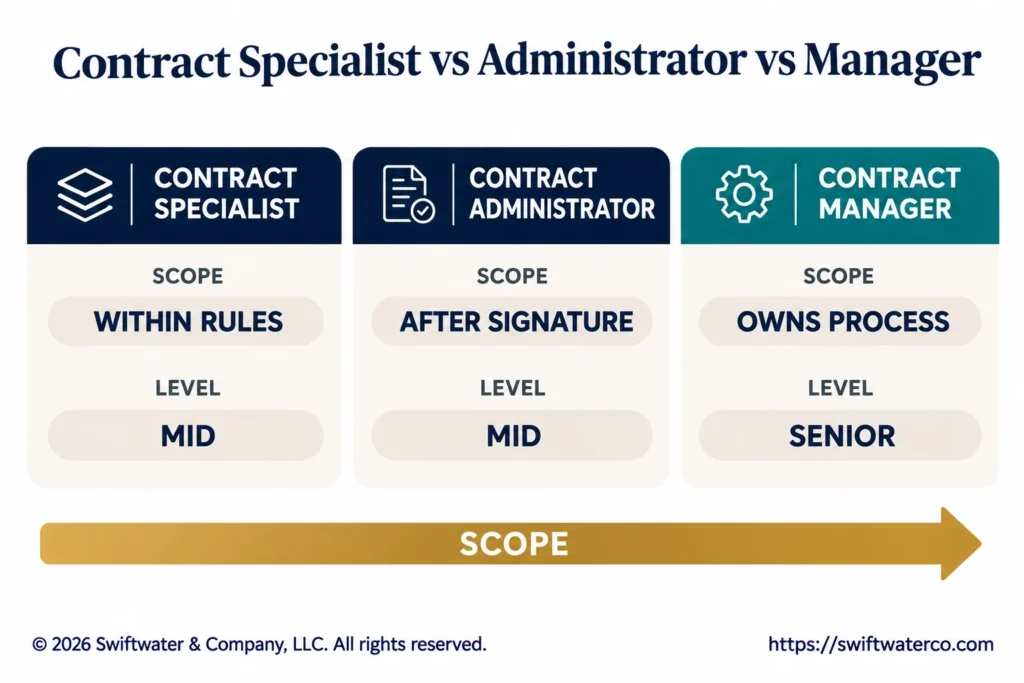
The three roles differ by scope and level: the specialist works within set rules before signature, the administrator keeps signed contracts on track, and the manager owns the process and the results. Titles vary by employer, so read the duties in a posting before the title.
| Role | Scope | Typical level |
|---|---|---|
| Contract specialist | Drafting, review, and processing within a playbook; escalates exceptions | Entry to mid |
| Contract administrator | Obligations, changes, records, and renewals after signature | Entry to mid |
| Contract manager | The process end to end: templates, approvals, negotiations that need judgment, reporting, and the team | Senior or manager |
The manager seat is where most of the market sits. In the October 12, 2026 edition of the Swiftwater legal operations job market report, 107 of 191 CLM and contracts postings (56%) were at the senior or manager level, and the most common titles were Contracts Manager (15 postings), Contract Manager (10), and Senior Contracts Manager (9).
Evaluating or implementing a CLM platform?
We have guided legal departments through selection, implementation, and adoption, without the vendor bias. Let us talk about where you are and what you actually need.
See CLM ServicesWhat skills and competencies does each role need?
Each role needs a different mix of skills and competencies. Skills are the specific things a person can do, such as drafting from a template or running a renewal report. Competencies are the broader areas of capability that professional frameworks use to define the field, and the most widely used is the Contract Management Standard published by NCMA and WorldCC. It groups contract work into guiding principles, pre-award, award, and post-award competencies, and NCMA’s body of knowledge adds leadership, management, and continuous learning.
| Role | Core skills | Competency focus |
|---|---|---|
| Contract specialist | Drafting from templates, review against a playbook, clear escalation notes | Pre-award and award work within set rules |
| Contract administrator | Date and obligation tracking, record keeping, change control, repository reports | Post-award: performance, changes, disputes, closeout |
| Contract manager | Negotiation, commercial judgment, process design, reporting, leading people | All phases, plus leadership and management |
The skills behind each competency are practical. Administrators need comfort with the contract repository and its reports, and managers need to report against contract management KPIs. Our guide to contract management certifications covers the credentials built on these frameworks, and our contract manager job description shows how to write them into a posting.
What negotiation competencies does each role need?
Negotiation competency grows with the role: specialists negotiate routine terms within a playbook, administrators negotiate changes and disputes after signature, and managers negotiate the complex, high-value deals and set the positions others negotiate within. The Contract Management Standard places preparing and conducting negotiations in the award phase, and returns to negotiation after award when contracts change or disputes arise.
- Contract specialist. Applies approved positions and fallbacks, documents what the other side asked for, and escalates anything outside the playbook.
- Contract administrator. Negotiates amendments, change orders, claims, and renewals within the limits set for the role.
- Contract manager. Plans negotiation strategy, negotiates nonstandard and high-value contracts, sets and updates the playbook positions, and decides when to bring in legal or leadership.
Government definitions make the progression explicit. The US Office of Personnel Management’s classification standard for the contracting series scales negotiation knowledge from contracting actions that are “well defined and well precedented” at the lower grades to negotiations balancing conflicting interests of extreme intensity at the top, and it includes Contract Negotiator as a title of its own. Florida goes further: for state contracts over $1 million a year, at least one person conducting the negotiations must be a certified contract negotiator.
How do the roles map to the lifecycle stages?
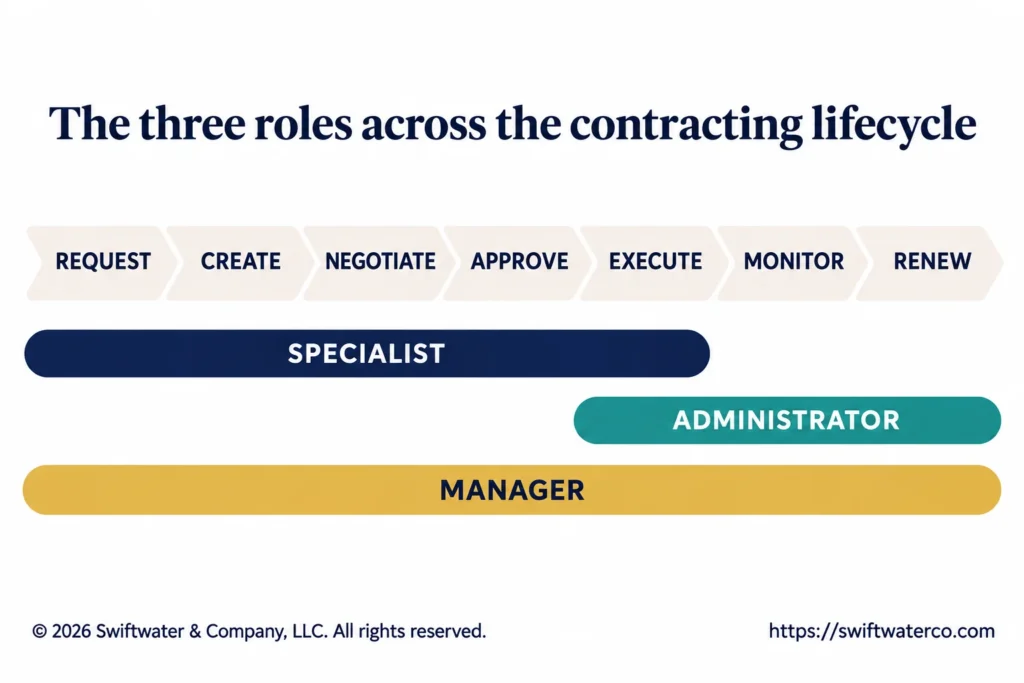
The roles map to the seven stages of the contract lifecycle: specialists carry most of the work before signature, administrators most of the work after it, and the manager is accountable for all seven.
- Request and intake. Specialist triages; manager designs the intake.
- Authoring and drafting. Specialist drafts from templates; manager owns the templates.
- Negotiation and redlining. Specialist works within the playbook; manager handles exceptions with legal.
- Review and approval. Specialist prepares approvals; manager owns the routing.
- Execution, signature, and storage. Specialist or administrator files the signed contract and its data.
- Obligations and performance monitoring. Administrator tracks obligations and service levels.
- Renewal, renegotiation, or termination. Administrator flags renewals; manager runs the decision.
How do US federal and state governments define these roles?
US federal and state governments define contract roles more formally than most companies, and federal definitions are the strictest, because the authority to commit public money is personal, written, and limited. A commercial contract manager may sign within an internal delegation of authority; a federal employee can bind the government only if they hold a written appointment as a contracting officer, and only within its limits.
| Term | In most companies | In US federal government |
|---|---|---|
| Contract specialist | Handles contracts within set rules, mostly before signature | The official title for professionals in the GS-1102 contracting series, who award, administer, and close out contracts |
| Contract administrator | Keeps signed contracts on track | A GS-1102 title for post-award compliance work; administrative contracting officers hold delegated authority |
| Contract manager | Owns the contracting process and its results | Not a federal classification title; some states define it in statute |
| Authority to sign | An internal delegation of authority | Only a warranted contracting officer, appointed in writing, within the stated limits |
Federal roles. OPM’s contracting series authorizes six titles: Contract Specialist, Contract Negotiator, Contract Administrator, Contract Termination Specialist, Contract Price/Cost Analyst, and Procurement Analyst. “Contracting officer” is a separate designation of authority. Under the Federal Acquisition Regulation, contracting officers are appointed in writing on a certificate that states any limits on their authority, and they bind the government only to the extent of the authority delegated to them. A contracting officer’s representative (COR) monitors technical performance on the government’s behalf, is designated in writing, and has no authority to change price, quantity, delivery, or other terms. Simpler purchasing sits in separate series: Purchasing Agent (GS-1105) and Procurement Technician (GS-1106).
Federal qualifications. OPM requires a bachelor’s degree or at least 24 semester hours in business-related fields for contracting positions from GS-5 to GS-12, and both, plus four years of contracting experience and required training, at GS-13 and above. Warrant holders and contracting series professionals must hold the FAC-C (Professional) certification; CORs hold a separate FAC-COR certification at three levels. The FAR is being rewritten under the Revolutionary FAR Overhaul, so section numbers may change; check the current text before relying on a citation.
State roles. States use their own titles and rules. New York classifies Contract Management Specialists from level 1 to 4, and Texas uses Contract Specialist I to V. Several states require certification by statute: Texas certifies state agency contract managers through its comptroller after required training, North Carolina requires certification for state employees who award contracts or monitor compliance, and Florida requires a contract manager responsible for contracts over $100,000 a year to become certified within six months. Public procurement professionals also hold credentials such as the UPPCC’s CPPO and CPPB and the NIGP-CPP.
For a company that sells to government, these definitions matter on both sides of the table: your contract manager will deal with contracting officers and CORs whose authority is fixed in writing, and a request outside that authority cannot be agreed, however reasonable it seems.
Government roles, regulations, and certification requirements on this page are summarized from public sources as of November 2026 for information only. Titles, rules, thresholds, and section numbers change, so confirm the current regulation, statute, or agency guidance before relying on them.
Where do they sit: legal, procurement, or a contracts function?
Contract roles sit wherever the contracts are owned: in legal or legal operations for a central contracts desk, in procurement for supplier agreements, and in sales or revenue operations or a deal desk for customer agreements. Larger companies sometimes build a contracts function that serves all of them. Our guide to who owns contract management explains how the split usually works by contract type.
How do these roles compare to legal operations roles?
Contract roles overlap with legal operations roles where the legal department runs the contracting process and its platform. A legal operations manager may own the contract lifecycle management system, while a contract manager owns the contracts that run through it. In our job market data, CLM and contracts roles made up 20.9% of legal operations postings, the third-largest group. Our guide to legal operations roles covers the rest of the function.
Evaluating legal technology but not sure where to start?
We help legal departments cut through the vendor noise, mapping technology to process maturity and building a roadmap that actually gets adopted.
See Legal TechnologyBottom Line
If you own the contracting function, the three titles are building blocks: specialists add capacity before signature, administrators protect value after it, and a manager makes the whole process accountable. Hire against the stages and the negotiating authority each seat will carry, and check whether your industry or your government customers define the role for you.
If you work in contracts, the path runs from executing within rules to owning the process, and the competencies that move you along it are negotiation, commercial judgment, and the ability to lead across functions. Define each contract role by the stages it runs, the negotiations it is trusted with, and the authority it holds, and the right title follows.
When a contracts team needs administration covered while it grows, a fractional administrator through our CLM administration service keeps the platform and the records current.
Frequently Asked Questions
What is the difference between a contract specialist, a contract administrator, and a contract manager?
A contract specialist handles contracts within set rules, an administrator keeps signed ones on track, and a manager owns the process. Specialists work mostly before signature, administrators after it, and the manager is accountable for the whole lifecycle and usually leads the other two.
What does a contract specialist do?
A contract specialist handles contracts within set rules. The role drafts from approved templates, reviews third-party paper against a playbook, supports negotiations, prepares approvals, and keeps records complete, escalating anything outside the playbook. In US federal government, the title covers acquisition professionals who award and manage contracts.
What is the difference between a contract administrator and a contract manager?
A contract administrator keeps signed contracts on track: obligations, changes, records, and renewals. A contract manager owns the whole lifecycle from request to renewal and is accountable for the outcomes, including the administrator’s work.
What skills does a contract specialist need?
A contract specialist needs accuracy, drafting from templates, review against a playbook, clear escalation, and working knowledge of the contract types the team handles. Comfort with a contract lifecycle management platform is expected in most corporate roles.
How does the US federal government define a contract specialist?
In US federal government, Contract Specialist is the official title for professionals in the GS-1102 contracting series, who plan, award, administer, and close out government contracts. Only those appointed in writing as contracting officers can bind the government, and only within the limits of their warrant.
What negotiation skills does a contract manager need?
A contract manager plans negotiation strategy, negotiates nonstandard and high-value contracts, sets the playbook positions others negotiate within, and decides when to bring in legal or leadership. Specialists negotiate routine terms within the playbook, and administrators negotiate changes and disputes after signature.
Which certifications help contract specialists and managers?
NCMA’s credentials (CCCM, CPCM, and CFCM) and World Commerce & Contracting’s certification pathway are the best known, and CLM platform certifications matter to employers who run that system. Federal warrant holders need the FAC-C (Professional), and some states, such as Texas and Florida, certify contract managers by statute. Our certifications guide compares them.
What is the career path from contract specialist to contract manager?
The usual path runs from specialist or administrator to senior specialist, then contract manager, and later to a director of contracts or legal operations role. Moving up means taking on negotiations that need judgment, owning templates and approval routes, and reporting to leadership.
This article is provided for general informational purposes only and is not legal, financial, or business advice. Staffing and role design decisions should be validated against your organization’s specific structure, regulatory obligations, and counsel guidance, and you should consult a qualified professional for advice on your situation. Job market figures are from Swiftwater’s job market research, a research project developed in conjunction with Swiftwater AI Labs. Government roles, regulations, and certification requirements described here are summarized from public sources as of November 2026 for information only and may change; confirm them with the relevant agency, statute, or regulation.