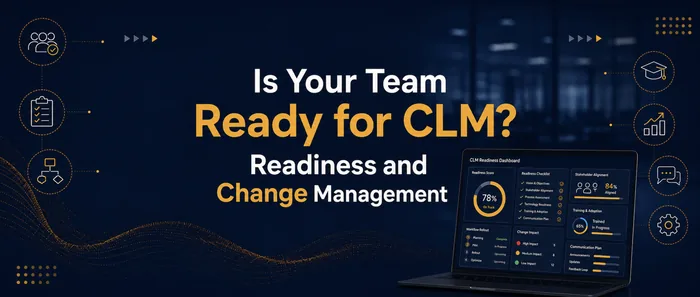

Your team is ready for contract lifecycle management when your process is mapped, your data is in a known state, your stakeholders are aligned on ownership, and your organization has the capacity to absorb the change, and you are not ready when any of those four is missing.
Readiness can be the difference between whether your contract lifecycle management platform will be adopted by your organization or not. This is the part of a contract lifecycle management (CLM) effort that decides success, and the part many teams tend to gloss over on the way to choosing a technology solution.
This article gives you the four dimensions of readiness and a simple way to score where you stand.
Why does readiness decide CLM success more than the platform?
Readiness decides success because contract lifecycle management implementations fail on adoption far more often than on technology. Gartner reports that nearly half of first-time CLM implementations fall short of expectations, and the cause is rarely a missing feature. It is a process nobody mapped, data nobody cleaned, owners nobody named, or a change nobody prepared the organization to absorb.
See the readiness self-check below to score where your organization stands across the four dimensions.
This pattern is not unique to contract management. McKinsey has found that around 70 percent of large, complex transformations fall short of their objectives, and the dominant cause is resistance to change among people at all levels rather than the technology itself. A CLM rollout is one of those transformations, which is why readiness, not the platform, is the better predictor of the outcome.
The platform is the most visible part of the project and the least decisive. A capable platform dropped onto an unready organization produces an expensive system people work around, while a modest platform adopted by a ready organization produces results. Readiness is the variable you actually control.
This is why the assessment comes before selection, not after. The disciplines that make an implementation succeed are covered in the CLM Implementation Blueprint, and every one of them assumes a baseline of readiness that this assessment measures.
Not ready to pick a CLM platform yet?
A four to six week diagnostic that maps your current contract lifecycle, sets requirements themes, and tells you what to buy before you sit through another vendor demo.
See the CLM Discovery SprintWhat are the dimensions of contract lifecycle management readiness?
In its simplest form, there are four dimensions of CLM readiness: process, data, stakeholders, and change capacity. Each one is a precondition, and a gap in any one predicts trouble regardless of how strong the other three are.
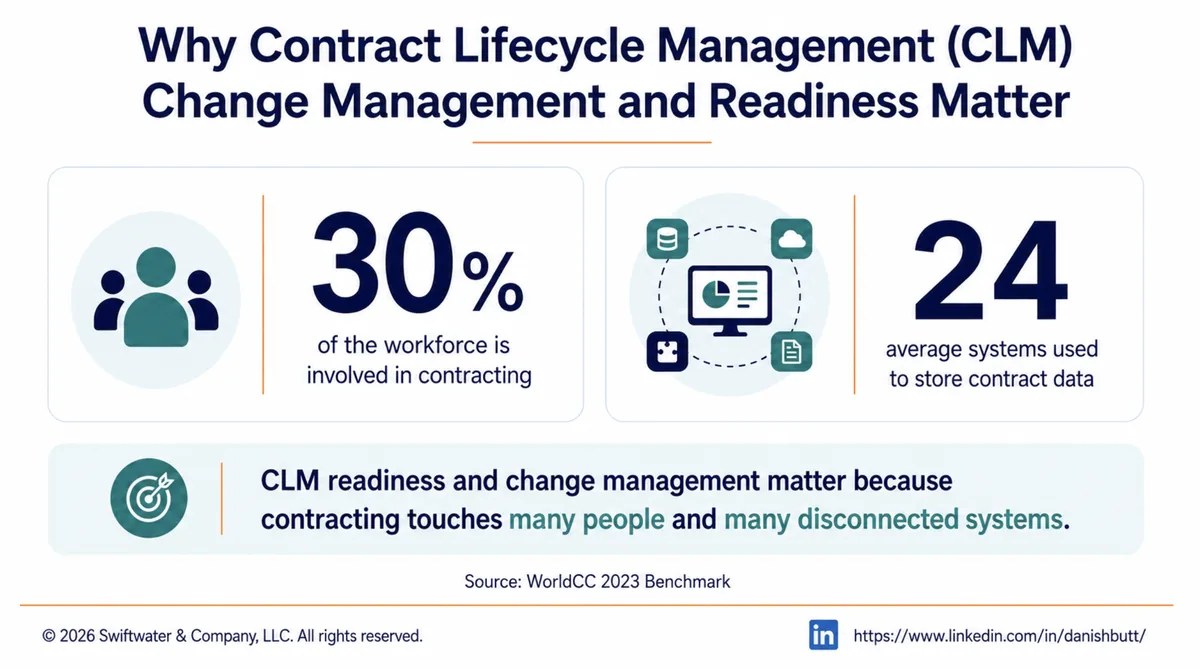
Process readiness asks whether you have mapped how contracts actually move today, because you cannot configure a system around a process you have not documented. Data readiness asks whether you know where your contracts and their data live and what condition they are in, which matters because WorldCC found contract data scattered across an average of 24 systems in larger organizations.
Stakeholder readiness asks whether the functions that own contracts, sales, procurement, IT, legal, have agreed on who owns what, because an undetermined ownership model yields lackluster system adoption. Change capacity asks whether the organization has the bandwidth and sponsorship to absorb a new way of working on top of everything else it is doing.
How do you assess change-management readiness specifically?
Assess change-management readiness by checking for executive sponsorship, a defined set of users who will change their behavior, and the capacity to support them through the transition. Change capacity is the dimension teams most often overestimate, because it is the hardest to see and the easiest to assume.
A useful frame is the Prosci ADKAR model, which holds that change succeeds only when people move through awareness, desire, knowledge, ability, and reinforcement. Applied to CLM, it means the people whose work changes need to understand why, want the outcome, know the new process, be able to perform it, and be reinforced in it. A platform launch addresses none of those by itself. It all starts with the tone-at-the-top and having a clear vision of WIIFM – What’s In It For Me?
The scale of the change is larger than most teams expect. WorldCC found that roughly 30 percent of the workforce is involved in contract management in some way, so a CLM rollout touches far more people than the legal team alone. Underestimating that reach is how change capacity gets overestimated.
What are the signs you are not ready yet?
The clearest signs you are not ready are an unmapped process, contract data in unknown condition, an unsettled ownership model, and no named executive sponsor. Most successful contract lifecycle management implementations require joint sponsorship at the C-level e.g. CIO-CLO, CLO-CPO, CRO-COO, etc. Lack of these signs is enough to stall an implementation.
Other warning signs are subtler. If the project is owned entirely by IT or procurement with no legal operations involvement, stakeholder readiness is likely missing. If the timeline assumes training is the same as change management, change capacity is likely overestimated. If nobody can say how many contracts the organization has or where they are, data readiness is absent.
None of these is fatal, and none is a reason to abandon the effort. Each is a reason to close the gap before you select a platform rather than after, when fixing it is far more expensive. The data-condition problem in particular is the subject of legacy contract migration.
What do you do if you are not ready?
If you are not ready, close the specific gaps the assessment exposes before you move to selection, in the order that unblocks the most. An honest not-ready result is the most valuable outcome the assessment can give you, because it redirects spend from a platform you cannot yet adopt to the readiness work that makes adoption possible.
Map the process if process readiness is the gap. Inventory and assess the data if data readiness is the gap. Convene the owning functions and settle the ownership model if stakeholder readiness is the gap. Secure a sponsor and build a change plan if change capacity is the gap. The practices that mature a contract function are covered in CLM best practices.
Readiness is not a permanent state you either have or lack. It is a set of gaps you can close deliberately, and closing them is the cheapest investment you will make in the entire program. Once those gaps are closing, a contained first move like piloting contract intake builds the visible momentum that change capacity depends on.
How do you score your CLM readiness?
Score your readiness by checking each dimension against the criteria below and counting how many come back as not ready. The table gives you a fast first read, but a reliable score depends on assessing each of the four dimensions in detail, not at a glance.
Evaluating or implementing a CLM platform?
We have guided legal departments through selection, implementation, and adoption, without the vendor bias. Let us talk about where you are and what you actually need.
See CLM ServicesEach dimension contains more than the single line a table can hold. Process readiness alone covers your playbooks, clause libraries, contract templates, workflows, and routing. Data readiness covers volume, location, format, and quality. A surface answer of “we think we are fine” is exactly how organizations score themselves ready and then stall. This is where expert help earns its place, because an experienced assessor knows which questions expose the gaps a self-review tends to miss, and can ensure each detail is genuinely understood rather than assumed.
| Dimension | Ready looks like | Not ready looks like |
|---|---|---|
| Process | Current-state lifecycle, playbooks, clause libraries, contract templates, workflows, and routing are mapped and agreed | The process and its playbooks, templates, and routing are assumed, undocumented, or disputed |
| Data | You know where contracts live and their condition | Contract data is scattered and its state is unknown |
| Stakeholders | Owning functions agree on who owns what | Ownership is unsettled or assumed by one function |
| Change capacity | Executive sponsor named, users and support identified | No sponsor, and training is mistaken for change management |
How to score yourself: count your “not ready” answers. Zero means proceed to requirements and vendor selection. One means proceed while you close that gap in parallel. Two means pause and close the gaps first. Three or more means stop, because selecting a platform now would buy a system the organization is not prepared to adopt.
The point of the score is not the number. It is knowing exactly which gaps to close before you spend, so that the platform you eventually choose lands in an organization ready to use it.
Bottom Line
Contract lifecycle management readiness across process, data, stakeholders, and change capacity predicts whether an implementation succeeds far better than the platform you choose does.
Assess your readiness honestly before you select, close the gaps the assessment exposes, and you convert the most common cause of CLM failure into the foundation of its success.
A structured readiness and change assessment is built into every Swiftwater CLM discovery sprint. We assess your process, data, stakeholder alignment, and change capacity, give you an honest readiness picture, and lay out the specific gaps to close before you commit to a platform. If you want to know whether your organization is ready for CLM before you spend on one, a CLM discovery sprint gives you that answer in four to six weeks.
Frequently asked questions
What is CLM readiness?
The degree to which your organization can actually adopt a contract lifecycle management system, measured across four dimensions: process, data, stakeholders, and change capacity. Readiness has little to do with the platform and everything to do with whether the organization can absorb it.
What matters more for CLM success, the platform or readiness?
Readiness. Gartner reports that nearly half of first-time CLM implementations fall short, and the cause is almost always adoption rather than technology. A capable platform dropped on an unready organization becomes an expensive system people work around.
What does a CLM readiness assessment cover?
Four dimensions: whether your process is mapped, whether your contract data is in a known condition, whether the owning functions agree on who owns what, and whether the organization has the sponsorship and capacity to absorb the change.
Why do CLM implementations fail on adoption?
Because the organization is not prepared for the change. Roughly 30 percent of the workforce is involved in contracting, so a rollout touches far more people than the legal team, and treating training as a substitute for change management leaves those people unprepared.
What should you do if you are not ready for CLM?
Close the specific gaps the assessment exposes before selecting a platform. Map the process, inventory the data, settle the ownership model, or secure a sponsor and a change plan, depending on which dimension is missing. Closing these gaps is far cheaper before selection than after.
This article is provided for general informational purposes and does not constitute legal advice. Readiness and change-management decisions should be validated against your organization’s specific structure, regulatory obligations, and counsel guidance.