
Manufacturing contract management covers supply, OEM, distribution, and quality agreements with suppliers and customers. A manufacturer sits between two sets of contracts. On one side are the suppliers of materials, components, tooling, and logistics. On the other are the customers, OEMs, distributors, and dealers who buy the finished product. Margins are thin, so the price, volume, and quality terms on both sides decide how much of each sale the plant keeps.
This guide covers the key contract types in manufacturing, the laws and regulators behind them, who owns the contracts, what a CLM has to handle, and what a typical lifecycle problem looks like. It is part of our guide to contract management by industry and our guide to the seven stages of the contract lifecycle.
What does contract management cover in manufacturing?
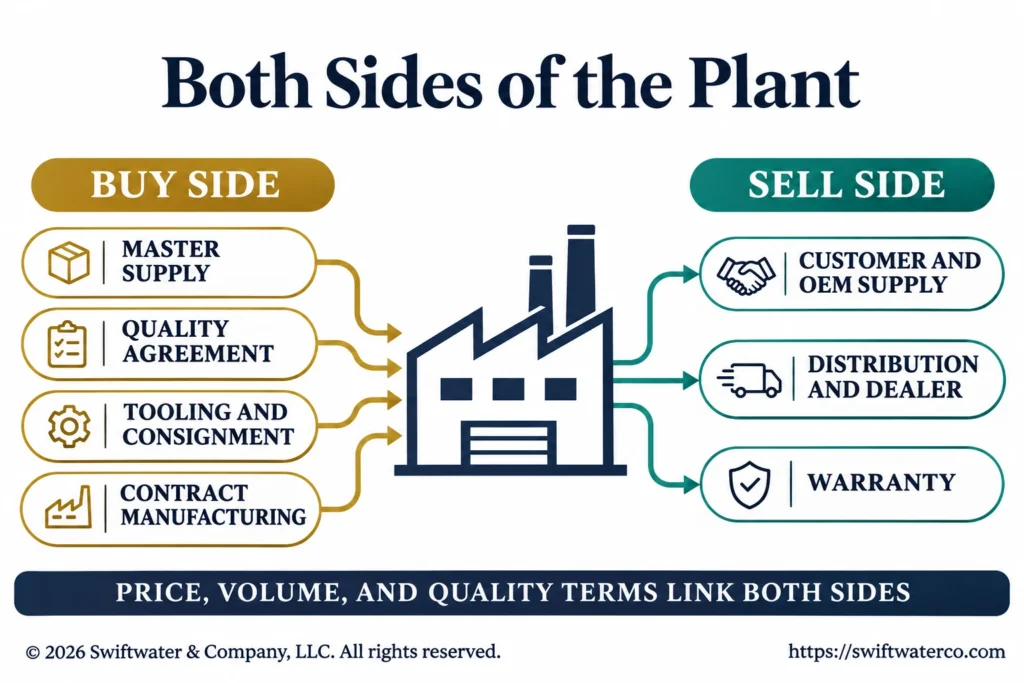
Contract management in manufacturing covers the buy side and the sell side of the plant with equal weight. The buy side secures materials, parts, tooling, and capacity at an agreed price and quality. The sell side commits the plant to deliver products to customers and distributors on agreed terms, with warranties that run long after delivery.
- Buy side. Master supply agreements for direct materials and components, quality agreements, tooling and consignment agreements, contract manufacturing agreements, and logistics agreements.
- Sell side. Customer and OEM supply agreements, distribution and dealer agreements, pricing and rebate agreements, and product warranties.
- Across both. NDAs for new product and supplier work, technology and software agreements for the plant and its connected equipment, and intellectual property licenses.
The two sides are linked. A price increase from a supplier only protects the margin if a customer contract allows some of it to pass through, and a delivery promise to a customer is only as reliable as the supply agreement behind it.
What are the key contract types?
Supply agreements carry the most value on both sides of a manufacturer, and purchase orders, NDAs, and quality agreements are the most numerous. Distribution and contract manufacturing agreements are fewer, but they carry territory, capacity, and intellectual property terms that matter for years.
| Contract type | Counterparty | What the CLM tracks |
|---|---|---|
| Master supply agreements | Suppliers | Pricing, volume commitments, price adjustment and change-in-law clauses, notice periods |
| Quality agreements | Suppliers and contract manufacturers | Specifications, audit rights, change notification, nonconformance handling |
| Tooling and consignment agreements | Suppliers | Tooling ownership, location, maintenance, return at exit |
| Contract manufacturing agreements | Contract manufacturers | Forecasts, capacity, intellectual property, quality terms |
| Customer and OEM supply agreements | Customers and OEMs | Service levels, delivery penalties, price terms, warranty |
| Distribution and dealer agreements | Distributors and dealers | Territory, pricing and rebates, minimums, termination |
The table is illustrative; a component maker selling to OEMs, a consumer products manufacturer, and an industrial equipment maker weight these rows differently.
Which laws and regulators apply to manufacturing contracts?
Most manufacturing contracts are contracts for the sale of goods, so in the United States they sit under Article 2 of the Uniform Commercial Code, adopted by each state, which supplies default rules on offer and acceptance, warranties, delivery, and remedies when the contract is silent. Parts and technology that are subject to export controls fall under the Export Administration Regulations, administered by the Bureau of Industry and Security, and supply and distribution agreements often carry export compliance clauses as a result.
Evaluating or implementing a CLM platform?
We have guided legal departments through selection, implementation, and adoption, without the vendor bias. Let us talk about where you are and what you actually need.
See CLM ServicesOther rules depend on the product and the customer. Consumer products fall under the Consumer Product Safety Commission. Listed companies report on conflict minerals in their products to the Securities and Exchange Commission, which depends on supplier information. Suppliers to the defense market receive cybersecurity and other clauses from their customers’ government contracts, covered in our guide to government contract management. Tariff changes reach contracts through price adjustment, change-in-law, and country-of-origin clauses.
These rules are listed for reference only; counsel and compliance teams should interpret how each applies to the company and contract.
Who owns contracts in manufacturing?
In most manufacturers, procurement and supply chain own supplier agreements, sales and commercial operations own customer and distributor agreements, quality owns quality agreements, finance owns pricing, rebates, and credit terms, and legal owns templates, nonstandard terms, and disputes. Plant teams often hold the local agreements for services, maintenance, and logistics.
Ownership splits by side of the plant, so the contracts that should be read together often sit with different teams in different systems. Procurement may not see the customer terms a supplier change affects, and sales may not see the supply terms behind a delivery promise. Our guides to who owns contract management and contract management in procurement cover the roles.
What does a CLM have to handle?
Manufacturing companies manage supply chain agreements with a CLM by keeping every supplier and customer agreement in one repository across plants, capturing price, volume, quality, and notice terms as data, tracking supplier obligations after signature, and alerting owners before renewals and notice dates. The CLM holds the contract terms; the ERP holds the purchase orders, invoices, and inventory.
- One repository across plants and both sides. Supplier and customer agreements, with their amendments, in one place, linked where they depend on each other. See contract repository.
- Price and volume terms as data. Price adjustment, index, change-in-law, and volume commitment clauses captured as fields, so the company can find every affected contract when a cost changes. The ERP keeps the transactions; our guide to CLM vs ERP, CRM, and document management explains the split.
- Supplier obligations after signature. Quality certificates, audit rights, change notifications, insurance, and delivery commitments, each with an owner. See contract obligation management and supplier agreement management.
- Amendments when specs or costs change. Changes recorded against the original agreement, so the current terms are always clear. See amendment vs addendum.
- Renewals and notice dates. Expiry, auto-renewal, and price review dates with alerts, so expired agreements do not keep running on old prices. See contract renewal management.
- Security, data, and AI terms. Connected equipment, supplier portals, and AI tools in quality inspection and planning bring cybersecurity, data use, and AI terms that remain obligations well after onboarding.
A contract manufacturing workflow follows the same path: request, NDA, quality agreement and supply terms, approval, signature, then forecasts, capacity, and quality obligations monitored for the life of the agreement. Our guide to contract lifecycle management tools covers the categories of software.
What does a typical lifecycle problem look like?
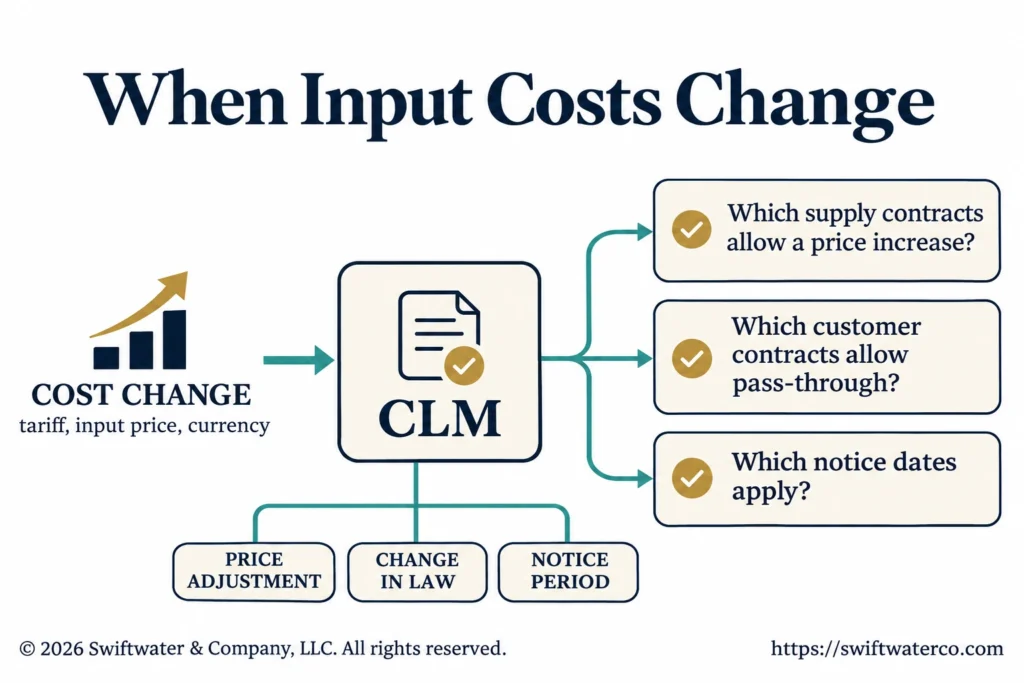
The typical problem in manufacturing appears when a cost changes. A tariff, an input price, or a currency move lands, and leadership asks three questions: which supply agreements allow the supplier to raise prices, which customer agreements allow the company to pass costs on, and which notice periods apply. When the contracts sit as PDFs across plants and inboxes, answering takes weeks, and the notice windows close while the team is still reading. Clause-level data on price adjustment, change in law, and notice turns the same question into a report.
Flowserve, a manufacturer of pumps, valves, and seals operating in more than 50 countries, described a version of this problem in a published customer story with its CLM provider, Docusign. Agreements were spread across email and file boxes, legal operations tracked contract volume in spreadsheets, and teams sometimes worked from expired agreements, selling at outdated prices. Flowserve moved sales agreements, NDAs, and third-party vendor agreements into one CLM connected to its CRM, with expiration alerts so teams renegotiate before agreements lapse and AI-assisted review that compares third-party language with internal playbooks. The company reports saving more than 4,500 hours a year from automated tracking and reporting alone.
The lesson carries to any manufacturer: the price terms that protect the margin only work if someone can see them and act before the dates pass.
Which pages to read next?
- Contract management by industry, for how manufacturing compares with other industries.
- Contract management in procurement, for the buy side and supplier contracts.
- Supplier agreement management, for supplier terms and performance.
- Contract obligation management, for tracking what each side owes after signature.
- Retail contract management, for the customer side many manufacturers sell into.
- Contract lifecycle management tools, for the categories of software.
Bottom Line
Manufacturing contracts sit on both sides of the plant. Supply, quality, tooling, and contract manufacturing agreements secure what the plant needs; customer, OEM, and distribution agreements commit what it delivers. Margins are thin, so the price adjustment, volume, quality, and notice terms on both sides decide how much of each sale the company keeps, and a cost change tests all of them at once. The UCC, export controls, product safety rules, and customer flow-downs sit behind them.
Evaluating legal technology but not sure where to start?
We help legal departments cut through the vendor noise, mapping technology to process maturity and building a roadmap that actually gets adopted.
See Legal TechnologyA manufacturer that can answer “which contracts let us adjust price, and by when?” in an hour is in a stronger position than one that needs a month and a team of readers. That answer comes from a CLM that holds supplier and customer agreements in one place, captures the commercial terms as data beside the ERP, and gives every obligation and notice date an owner. In manufacturing, the margin often sits in clauses nobody reads after signature, so the CLM has to keep price, volume, and quality terms where procurement and sales can act on them before the dates pass.
Our contract management solutions help manufacturing legal, procurement, and commercial teams bring supplier and customer agreements into one record, capture the terms that protect margin, and select and configure the CLM that fits.
Frequently Asked Questions
What is manufacturing contract management?
Manufacturing contract management covers supply, OEM, distribution, and quality agreements with suppliers and customers. It includes capturing price, volume, and quality terms as data, tracking supplier obligations after signature, managing amendments when costs or specifications change, and alerting owners before renewals and notice dates.
How do manufacturing companies manage supply chain agreements using CLM?
They keep every supplier agreement in one repository across plants, capture pricing, volume, price adjustment, quality, and notice terms as searchable fields, assign each supplier obligation an owner, and set alerts before renewals and notice dates. The CLM holds the contract terms and connects to the ERP, which holds purchase orders, invoices, and inventory.
What is CLM for manufacturing?
CLM for manufacturing is contract lifecycle management software and process set up for a manufacturer’s contracts: supplier, quality, tooling, and contract manufacturing agreements on the buy side, and customer, OEM, and distribution agreements on the sell side. It differs from a general CLM mainly in its data fields, plant-level ownership, and ERP connection.
What is a quality agreement in manufacturing?
A quality agreement sets out how a supplier or contract manufacturer meets the buyer’s quality requirements: specifications, inspection and audit rights, change notification, handling of nonconforming product, and records. It usually sits beside the supply agreement, which covers price and delivery, and both should be tracked together.
How should supply contracts handle tariff changes?
Supply contracts usually address tariff changes through price adjustment clauses, change-in-law clauses, country-of-origin terms, and notice periods for price changes. Which clause applies, and how, depends on the wording of each agreement, so counsel should review them. A CLM helps by finding every contract that contains each clause.
What does a contract manufacturing workflow look like?
A contract manufacturing workflow starts with a request and an NDA, moves to a quality agreement and supply terms covering forecasts, capacity, pricing, and intellectual property, then approval and signature. After signature, the buyer monitors forecasts, capacity, quality results, and audits, and manages renewals and changes for the life of the agreement.
This article is provided for general informational purposes only and is not legal, financial, or business advice. Manufacturing contract management decisions should be validated against your organization’s specific structure, regulatory obligations, and counsel guidance, and you should consult a qualified professional for advice on your situation.