

Contract intelligence is the use of AI to extract terms and metadata from executed agreements and report on them. It reads signed contracts, including scanned and legacy ones, pulls out the parties, dates, values, renewal terms, and obligations, and turns them into data that can be searched, tracked, and reported. The result is a view of what the company has actually agreed, across thousands of contracts no one has time to reread.
After contract review, contract intelligence is the most active area in legal AI, and it may be the most valuable one for an enterprise. Contracts hold the company’s prices, commitments, rights, and risks, so the data inside them matters well beyond the legal department. That is why legal AI platforms, finance-focused start-ups, CLM vendors, and service providers are all competing to help enterprises put their own contract data to work.
This guide covers what contract intelligence is, how it differs from AI contract review, what extraction captures, how abstraction works for legacy contracts, what it reports on, and the controls it needs. It is part of our contract lifecycle management guide, and it follows the seven stages of the contract lifecycle from execution onward.
What is contract intelligence?
Contract intelligence uses AI to read executed contracts and turn their terms into structured data. It does three jobs: extraction, which pulls defined fields from each contract; abstraction, which summarizes a contract’s key terms into a standard record; and reporting, which analyzes that data across the whole portfolio.
The need is plain. WorldCC (formerly IACCM) reports that, on average, contract-related data is scattered across 24 different systems. Contract intelligence brings the terms out of those documents and into one data set that legal, procurement, sales, and finance can all use.
How is contract intelligence different from AI contract review?
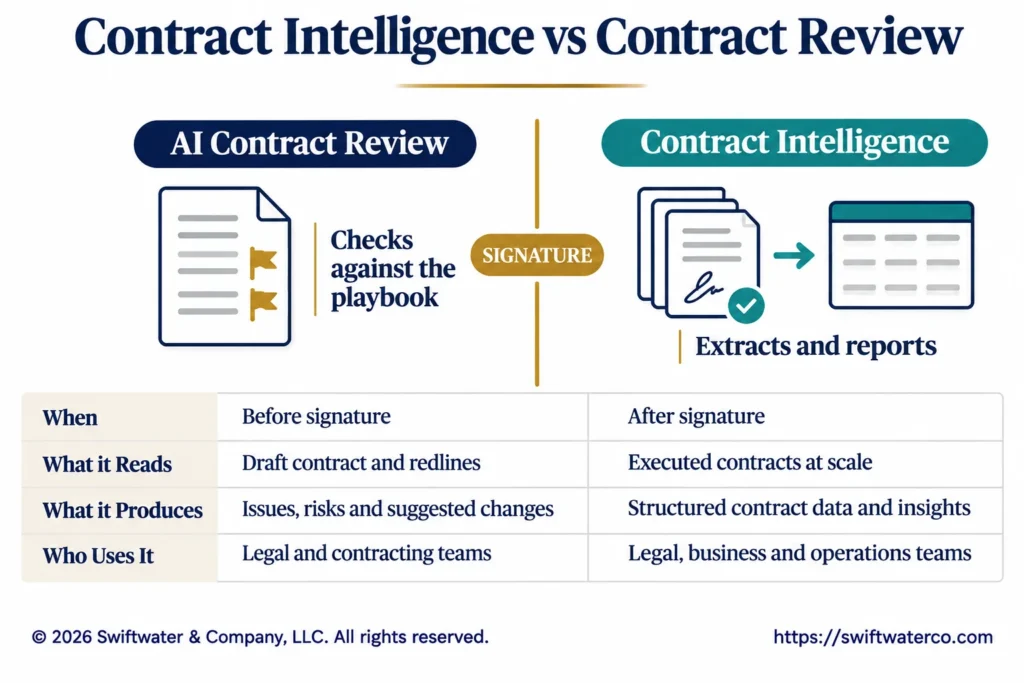
AI contract review works before signature, comparing a draft against the playbook so negotiators can fix deviations. Contract intelligence works after signature, reading executed contracts to capture what was agreed. The technology overlaps; the question each one answers is different.
| Question | AI contract review | Contract intelligence |
|---|---|---|
| When | Before signature | After signature |
| What it reads | A draft or the other side’s paper | Executed contracts, including legacy and scanned files |
| What it produces | Flags against the playbook, suggested edits | Structured data, abstracts, and portfolio reports |
| Who uses it | Lawyers and negotiators | Contract managers, procurement, finance, and leadership |
Our guide to AI contract review covers the pre-signature side.
Evaluating or implementing a CLM platform?
We have guided legal departments through selection, implementation, and adoption, without the vendor bias. Let us talk about where you are and what you actually need.
See CLM ServicesWhat does contract extraction capture?
Contract extraction captures the operational metadata the business needs to run its contracts: the parties and signing entities, effective and end dates, renewal type and notice period, value and payment terms, obligations and service levels, governing law, and links to amendments and parent agreements.
- Identity: contract type, title, counterparty, signing entity.
- Dates: effective date, end date, notice period, renewal type (fixed, auto-renewing, evergreen).
- Money: total value, payment schedule, price increase terms.
- Obligations: deliverables, service levels, reporting duties on each side.
- Relationships: parent agreements, amendments, statements of work.
Extraction works best against a field list decided in advance, because every extra field adds review time. Our guide to the contract repository sets out the metadata model the fields feed.
How does contract abstraction work for legacy contracts?
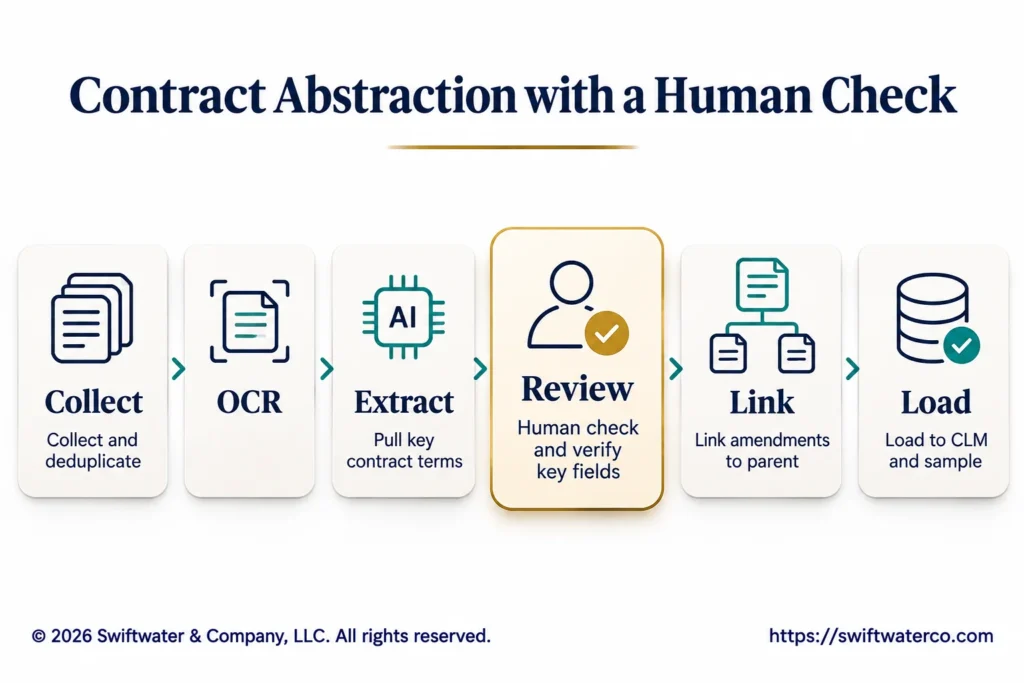
Contract abstraction turns each legacy contract into a standard record of its key terms, with AI doing the first pass and trained reviewers checking the result against the source document. It is the core of most migrations into a new CLM, where thousands of older agreements need their dates and obligations captured before alerts can work.
- Collect and deduplicate. Gather contracts from drives, email, and old systems, and remove duplicates.
- Make the text readable. Run optical character recognition on scanned files.
- Extract. AI pulls the agreed fields from each contract.
- Review. People verify the fields that drive alerts and payments against the source.
- Link. Connect amendments and statements of work to their parent agreements.
- Load and sample. Load the records into the repository and spot-check a sample before go-live.
Many companies hand the volume to an outside team for this step. Our guide to legacy contract migration covers the full method.
What reporting does contract intelligence enable?
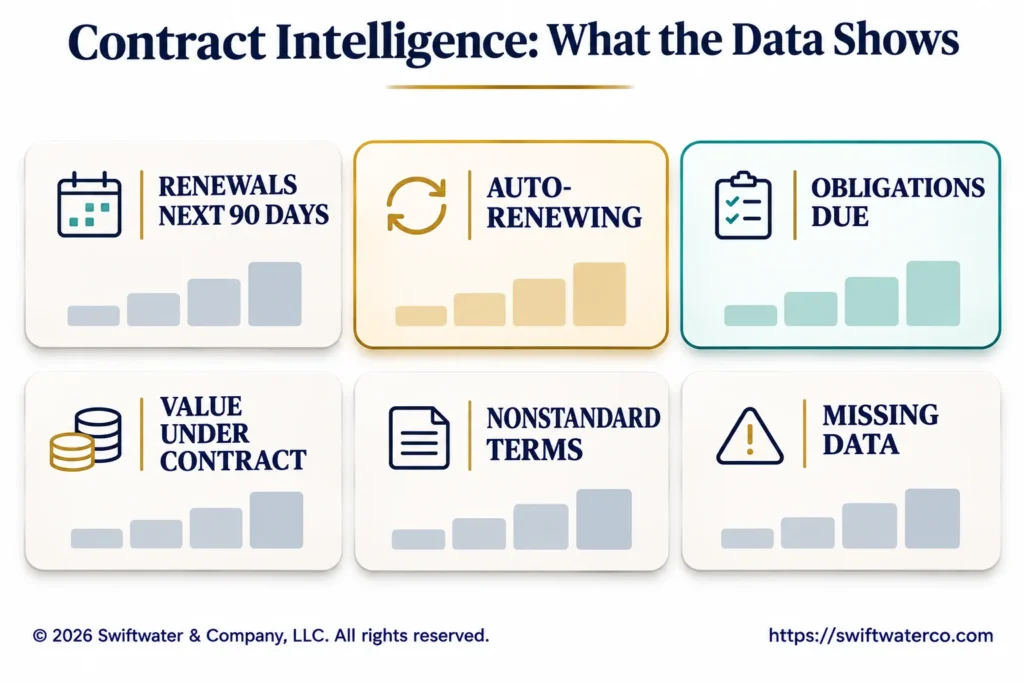
Once the terms are structured, the portfolio can be reported on: renewals and notice dates ahead, auto-renewing contracts, obligations coming due, value under contract by counterparty or business unit, nonstandard terms, and contracts missing key data. These reports turn a document archive into decisions about money and risk.
The stakes are real. Research by WorldCC (formerly IACCM) finds the average business loses almost 9% of value annually through poor contract management; the best performers lose about 3% and the worst 15% or more. Much of that loss sits in terms no one tracked after signature. Our guide to contract management KPIs covers which measures to report.
How do companies put contract intelligence to work?
Companies use contract intelligence for renewal sweeps, supplier reviews, due diligence after an acquisition, price-increase checks, and finding every contract affected by a regulatory change. The common thread is a question about many contracts at once that would take weeks to answer by reading them.
Our professionals helped a client implement Onit’s Extract solution to set up procurement analysis projects, which gave the client a quick view of a 20-year supplier relationship through its contractual terms.
Other tools, such as Docusign and Clearlaw.ai, provide similar capabilities. The project worked because the questions came first: which terms mattered to the supplier review, and which fields would answer them.
What are the approaches to contract intelligence?
There are five main approaches to contract intelligence: legal AI platforms, finance-focused contract data platforms, extraction built into a CLM, individuals using frontier AI models, and packaged services from alternative legal service providers (ALSPs). They differ in who runs them, how far they scale, and how much human checking comes with the result.
- Legal AI platforms. Harvey’s review tables and Legora’s Tabular Review work like a grid: each row is a contract, each column is a question, and the AI fills in the answers with links back to the source text. They suit legal teams answering portfolio questions, such as due diligence or a review of every agreement with a change-of-control term.
- Finance-focused contract data platforms. Newer entrants such as Contracts.ai connect contract terms to invoices and financial systems, for example checking charges against negotiated rates. They serve finance as much as legal.
- Extraction built into a CLM. Most CLM platforms now include some level of extraction and reporting on the contracts they hold. This keeps the data in the system of record, though coverage depends on the vendor’s field model.
- Individuals using frontier models. Many lawyers and contract managers upload contracts to general-purpose assistants such as ChatGPT, Claude, Gemini, or Copilot. This is fast for a handful of contracts, but results vary between runs, there is no shared audit trail, and confidentiality depends on the license the company has in place.
- ALSP packaged services. Alternative legal service providers now offer a packaged combination of technology and trained reviewers: the AI does the first pass and their people verify it, often at a per-contract price.
| Approach | Best for | Watch for |
|---|---|---|
| Legal AI platforms | Portfolio questions and diligence run by the legal team | Getting the results back into the system of record |
| Finance-focused platforms | Spend, billing, and revenue terms for finance | Coverage of non-financial terms and obligations |
| CLM-native extraction | Contracts already held in the CLM | Fields beyond the vendor’s standard model |
| Individuals with frontier models | A few contracts, ad hoc questions | Consistency, audit trail, confidentiality |
| ALSP packaged services | Large volumes with human verification | Turnaround, quality checks, handover |
Most legal departments use more than one. The Blickstein Group’s 18th annual survey found that 88% of generative AI use relies on foundation models in enterprise suites, and 41% also use contract-specific models. Our guides to contract lifecycle management tools and contract management outsourcing cover the platform and service options.
What are the limits and controls?
Contract intelligence is limited by document quality, by terms spread across exhibits and amendments, and by unusual wording, so extracted data needs controls before anyone relies on it. Treat it as a draft until a person has checked the fields that drive alerts and money.
- Document quality. Poor scans, handwritten changes, and missing pages reduce accuracy.
- Scattered terms. Exhibits, schedules, and later amendments can change what the main agreement says.
- Field definitions. Agree what each field means, such as which date counts as the end date.
- Human review. Check every field that triggers an alert or a payment, and sample the rest.
- Audit trail. Record which values came from AI and which were confirmed or corrected.
- Confidentiality. Confirm where the documents are processed and whether the vendor trains on them.
Bottom Line
Contract intelligence turns executed contracts into data: AI extracts the parties, dates, values, renewal terms, and obligations, people confirm the fields that matter, and the portfolio becomes something leadership can report on. It differs from AI contract review in timing and purpose, and it is at its most valuable in migrations, renewal sweeps, and supplier reviews.
With legal AI platforms, finance-focused start-ups, CLM vendors, and ALSPs all offering it, the choice of approach matters less than the discipline around it. The programs that work decide the questions and the field list first, keep human review on what drives alerts and payments, and load the results into one system of record. Let AI do the first pass on extraction, keep people reviewing what it pulls, and turn the data into reports on renewals, obligations, and value.
Evaluating legal technology but not sure where to start?
We help legal departments cut through the vendor noise, mapping technology to process maturity and building a roadmap that actually gets adopted.
See Legal TechnologyOur legal AI solutions help legal and procurement teams choose and configure contract intelligence tools, run abstraction projects with human review, and build the reports leadership uses.
Frequently Asked Questions
What is contract intelligence?
Contract intelligence is the use of AI to extract terms and metadata from executed agreements and report on them. It covers extraction of defined fields, abstraction of key terms into a standard record, and reporting across the portfolio on renewals, obligations, value, and risk.
Can contract data be extracted automatically with minimal manual review?
Yes, for the first pass. AI extracts parties, dates, values, and renewal terms from most clean digital contracts, so reviewers check its output instead of reading every page. Keep human review on the fields that trigger alerts or payments, and sample the rest.
What is contract abstraction?
Contract abstraction summarizes a contract’s key terms into a standard record, such as parties, dates, value, renewal and notice terms, and obligations. AI now does the first pass, and reviewers verify the record against the source before it is loaded into the repository.
Can AI extract renewal and termination dates from scanned PDFs?
Yes, once optical character recognition has made the text readable. Accuracy drops with poor scans, handwritten changes, and dates set by formula, such as a term that ends a set period after delivery, so check every renewal and notice date before alerts rely on it.
How is contract intelligence different from AI contract review?
AI contract review checks a draft against the playbook before signature. Contract intelligence reads executed contracts after signature and turns their terms into data for tracking and reporting. Many platforms offer both, but they answer different questions.
Can contract intelligence flag auto-renewals before they lapse?
Yes. Once the renewal type, end date, and notice period are extracted and confirmed, the system can list auto-renewing contracts and send alerts before each notice deadline. The alert is only as reliable as the dates, so confirm them first.
What are the main approaches to contract intelligence?
Legal AI platforms such as Harvey and Legora, finance-focused platforms such as Contracts.ai, extraction built into most CLMs, individuals using frontier models, and ALSP services that pair technology with trained reviewers. Choose by who will use the data, the volume, and how much human verification you need.
How accurate is AI contract extraction?
Accuracy varies by tool, field, and document quality, so no single figure applies. Clear dates and party names in clean digital files extract reliably; terms spread across exhibits or amendments, or in poor scans, need more checking. Test a tool on a sample of your own contracts and measure accuracy by field.
This article is provided for general informational purposes only and is not legal, financial, or business advice. Contract data and technology decisions should be validated against your organization’s specific structure, regulatory obligations, and counsel guidance, and you should consult a qualified professional for advice on your situation.