

Government contract management covers prime contracts, subcontracts, and task orders under procurement rules, records, and audit duties. It has two sides: the contractor that performs the work and the agency that buys it. Both work from the same document, and much of that document is clauses incorporated by reference from the procurement rules, so the contract carries compliance duties from award through closeout and audit, often for years after the work is done.
This guide covers the key contract types in government work, the laws and regulators behind them, who owns the contracts on each side, what a CLM has to handle, and what a typical lifecycle problem looks like. It focuses on United States federal contracting, with notes on state and local work. It is part of our guide to contract management by industry and our guide to the seven stages of the contract lifecycle.
What does contract management cover in government?
Contract management in government covers the full life of a public contract from both sides. For a contractor, that runs from capture and proposal through award, performance, modifications, subcontract management, invoicing, closeout, and final audit. For an agency, it runs from requirement and solicitation through award, administration, modifications, performance assessment, closeout, and records.
- Contractor side. Prime contracts, task and delivery orders, subcontracts, teaming agreements, NDAs, and the clauses that must flow down to subcontractors.
- Agency side. Solicitations, awards, modifications, contractor performance records, closeout, and the contract file.
- State and local. States, counties, cities, and public universities follow their own procurement codes, with similar stages and different rules.
What are the key contract types?
Prime contracts and task orders carry the most value in government work, and subcontracts, NDAs, and modifications are the most numerous. Teaming agreements are fewer but decide who does which work before the award is even made.
| Contract type | Counterparty | What the CLM tracks |
|---|---|---|
| Prime contracts (fixed-price, cost-reimbursement, time-and-materials) | Agency | Clauses incorporated by reference, line items, ceilings, period of performance, options |
| Indefinite-delivery contracts and task orders | Agency | Ordering period, minimums and maximums, each order’s scope and value |
| Schedule contracts | Agency (for example, GSA) | Pricing, modifications, option periods |
| Subcontracts | Subcontractors | Flow-down clauses, scope, price, small business commitments |
| Teaming agreements and NDAs | Partners | Workshare, exclusivity, conversion to a subcontract at award |
| Modifications | Agency or subcontractor | Changes in scope, price, and dates, in sequence |
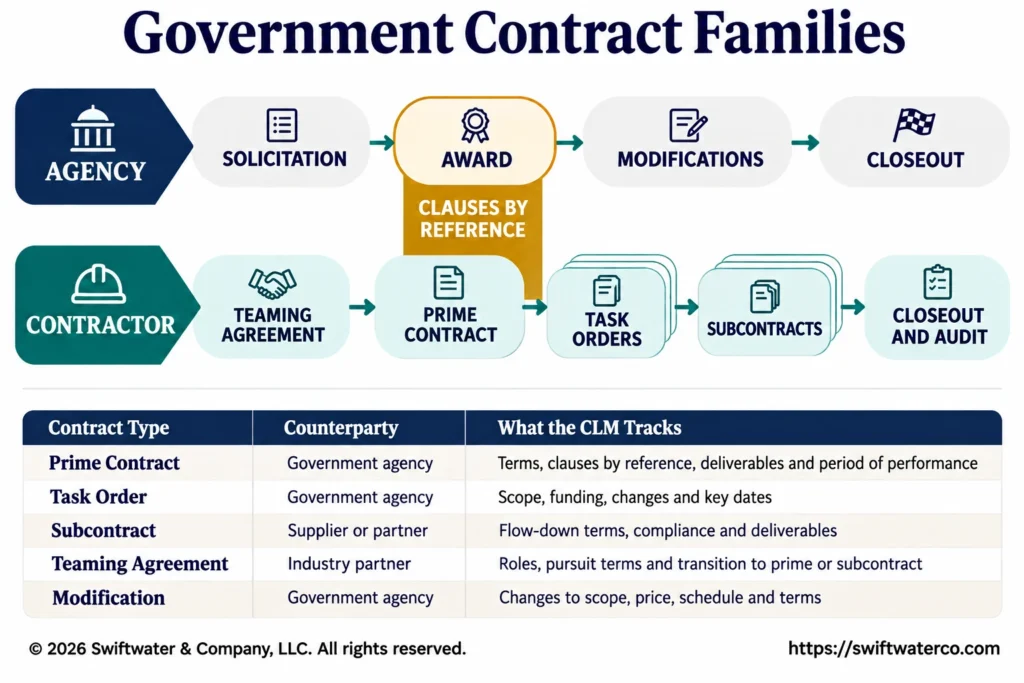
The table is illustrative; a defense prime, a services contractor, and an agency contracting office weight these rows differently.
Which laws and regulators apply to government contracts?
Federal contracts in the United States follow the Federal Acquisition Regulation (FAR) and agency supplements such as the Defense Federal Acquisition Regulation Supplement (DFARS). The FAR is being rewritten through the Revolutionary FAR Overhaul: as of November 2026, the revised parts are moving through formal rulemaking, and agencies are applying many of the changes through class deviations in the meantime, so the clause set in a new award can differ from an older one.
Records and closeout have their own rules. Contractors generally keep records for 3 years after final payment, with longer periods for some records, and the FAR sets time standards for closing contract files: 6 months after physical completion for firm-fixed-price contracts, and 36 months where final indirect cost rates must be agreed. Cost-type contracts are subject to audit, for defense work by the Defense Contract Audit Agency. Prime contractors must pass certain clauses down to subcontractors, for example under FAR 52.244-6 for commercial subcontracts.
Evaluating or implementing a CLM platform?
We have guided legal departments through selection, implementation, and adoption, without the vendor bias. Let us talk about where you are and what you actually need.
See CLM ServicesCybersecurity is written into contracts as well. Defense contracts carry DFARS clauses on safeguarding covered defense information, and the Cybersecurity Maturity Model Certification (CMMC) program adds assessment requirements: as of November 2026, the first phase of self-assessments is in force, and the next phase, which would require third-party certification, was suspended in July 2026 pending a program review. State and local contracts follow each state’s procurement code.
These rules are listed for reference only; counsel and compliance teams should interpret how each applies to the company or agency and contract.
Who owns contracts in government?
At a government contractor, contracts and subcontracts administrators own the prime contract and the subcontracts after award, capture and proposal teams own the work before it, program managers own performance and deliverables, finance and pricing own rates, invoicing, and audits, and legal owns teaming agreements, disputes, and nonstandard terms. At an agency, the contracting officer is the only person who can bind the government or change the contract, the contracting officer’s representative monitors performance, the program office defines the requirement, and agency counsel advises.
The split matters because only certain people can agree to changes. A program manager who accepts extra work on a call has not changed the contract, and the record has to show who agreed to what, and when. Our guides to who owns contract management and contract administration vs contract management cover the roles.
What does a CLM have to handle?
A CLM for government work has to handle clause libraries keyed to the FAR and its supplements, flow-down tracking into every subcontract, modifications as a numbered chain, deliverables and reporting obligations, and contract records kept for closeout and audit. It holds the contract and its terms; accounting, timekeeping, and agency contract writing systems hold the transactions.
- Clause libraries by reference. The FAR and DFARS clauses in each contract recorded by number and date, so a change in the rules can be traced to the contracts it touches. See clause libraries, templates, and playbooks.
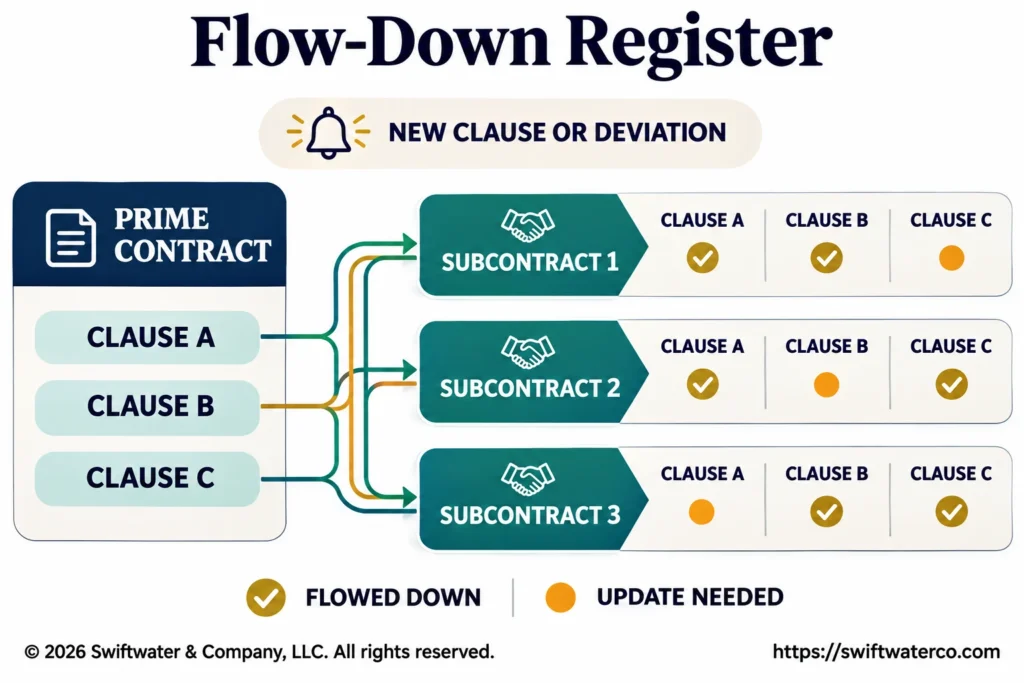
- A flow-down register. For each prime contract, the clauses that must reach each subcontract, and the status of each subcontract against them.
- Modifications in sequence. Every modification recorded against the base award, so the current scope, price, and dates are clear. See amendment vs addendum.
- Deliverables and obligations. Reports, data deliveries, small business plans, and option dates, each with an owner. See contract obligation management.
- Records for closeout and audit. The full contract file, kept for the retention period and easy to produce. See contract repository.
- Security, data, and AI terms. Handling controlled information, cloud and software authorizations, and limits on AI use are obligations that continue for the life of the contract, for the contractor and its suppliers.
Contractors and agencies deploy a CLM differently. A contractor builds around clauses, flow-downs, and subcontracts across many agencies; an agency builds around its own solicitations, approvals, and contract file, and usually connects to a government contract writing system. A request for proposals for a CLM should state which side the buyer is on, list the clause and flow-down requirements, and ask how the system handles records retention. Our guides to CLM requirements and how to choose a CLM vendor cover the rest.
What does a typical lifecycle problem look like?
The typical problem in government work is losing track of status across a large portfolio of contracts that stay open for years. When a new clause or deviation arrives, a contractor cannot say which active subcontracts still carry the old flow-down, or which task orders end inside the notice window. When work is complete, nobody can say which contracts are ready to close.
The Government Accountability Office found this at scale. In a 2017 review of contract closeout at the Departments of Defense, Health and Human Services, Homeland Security, Justice, and State, GAO reported that none of the five tracked, across the agency, how many contracts were eligible for closeout, where each stood in the process, or goals for closing them. Audits of contractors’ incurred costs, which many cost-type contracts need before they can close, took 885 days on average from an adequate proposal to a completed audit, and most of that time was spent waiting for the audit to start. GAO recommended that each agency track closeout status and set goals and measures, and all five recommendations were later marked as implemented.
For contractors, an open contract means unpaid fees, held records, and open audits. For agencies, it means funds that cannot be released. In both cases the fix starts with a contract record that shows status, dates, and owner for every contract, every day.
Which pages to read next?
- Contract management by industry, for how government work compares with other industries.
- Contract administration vs contract management, for the post-award role.
- Clause libraries, templates, and playbooks, for managing standard clauses.
- Contract obligation management, for deliverables and reporting duties.
- Construction contract management, for public construction work.
- Manufacturing contract management, for suppliers to government primes.
Bottom Line
Government contracts carry their rules by reference. A prime contract can incorporate dozens of FAR and agency clauses, pass many of them to subcontractors, change through a long chain of modifications, and stay open for years until final audit and closeout. Contractors and agencies work from the same document, but they need different views of it: the contractor tracks clauses, flow-downs, and subcontracts across many agencies, and the agency tracks its awards, approvals, and contract file.
Evaluating legal technology but not sure where to start?
We help legal departments cut through the vendor noise, mapping technology to process maturity and building a roadmap that actually gets adopted.
See Legal TechnologyThe rules themselves are changing, with the FAR rewrite and cybersecurity requirements both moving in 2026, which makes a clause-level record more valuable each year. GAO’s closeout findings show what happens without one: large organizations unable to say how many contracts are ready to close. For government contractors and agencies alike, the record of which clause applies where is as important as the signed award, so the CLM has to be built around clauses, flow-downs, and status from award to closeout.
Our contract management solutions help government contractors and public sector legal and contracts teams build clause and flow-down records, set up closeout tracking, and select and configure the CLM that fits.
Frequently Asked Questions
What is government contract management?
Government contract management covers prime contracts, subcontracts, and task orders under procurement rules, records, and audit duties. It includes managing the clauses incorporated in each contract, flowing required clauses to subcontractors, recording modifications, tracking deliverables, and keeping the contract file through closeout and audit, on both the contractor and the agency side.
What is government contract lifecycle management?
Government contract lifecycle management is the process and software for managing a public contract from requirement or capture through award, performance, modifications, closeout, and records retention. For contractors it centers on clauses, flow-downs, and subcontracts; for agencies it centers on solicitations, approvals, and the contract file.
What are flow-down clauses?
Flow-down clauses are clauses in a prime contract that the prime contractor must include in its subcontracts, so subcontractors take on the same obligations for their part of the work. The FAR and agency supplements say which clauses flow down and when; FAR 52.244-6 lists them for commercial subcontracts.
How long must government contract records be kept?
Under FAR 4.703, contractors generally keep records for 3 years after final payment, and some records have different periods under FAR 4.705. Agencies follow their own records schedules for the contract file. Counsel and records teams should confirm the period for each contract and record type.
How do agencies use a CLM differently from contractors?
Agencies use a CLM to manage solicitations, approvals, awards, modifications, and the official contract file, usually connected to a government contract writing system. Contractors use a CLM to track the clauses in each award, flow them down to subcontractors, manage teaming agreements and NDAs, and keep records for audit across many agencies.
What should an RFP for a CLM at a government contractor include?
An RFP for a CLM at a government contractor should cover clause libraries keyed to FAR and DFARS numbers, flow-down tracking into subcontracts, modification history, deliverable and option date tracking, records retention and audit access, security for controlled information, and connections to accounting and proposal systems. Ask each vendor to show these with real contracts.
This article is provided for general informational purposes only and is not legal, financial, or business advice. Government contract management decisions should be validated against your organization’s specific structure, regulatory obligations, and counsel guidance, and you should consult a qualified professional for advice on your situation.