
Financial services contract management covers consumer, vendor, and outsourcing agreements under consumer protection and third-party risk rules. Consumer agreements are the bread and butter of a bank: account terms, card agreements, loan agreements, and the terms of use behind every website and mobile app, accepted by millions of customers with a click. Each acceptance has to be tied to the exact version the customer saw, and every change in terms has to reach customers on time. On the other side, when the same bank hands a core function to a technology provider, its regulator expects it to show the contract, the risk assessment, and the ongoing oversight. In financial services the contract is the evidence of control on both sides, so an untracked version or an unowned vendor review becomes a finding.
This guide covers the key contract types in banking, insurance, and asset management, the rules that drive them, who owns them, and what a CLM has to handle. It is part of our guide to contract management by industry and our guide to the seven stages of the contract lifecycle.
What does contract management cover in financial services?
Contract management in financial services covers four groups of agreements: the sell side (consumer and commercial customer agreements), the buy side (technology, data, and outsourcing providers), trading (master agreements with counterparties), and intercompany agreements between the group’s own legal entities. Each group has different owners and different rules, and many institutions run them in separate systems.
- Sell side. Consumer account terms, card, loan, and credit agreements, online banking and mobile app terms of use, electronic consent and privacy notices, insurance policies, and investment management agreements, issued in high volume from approved versions across branches, websites, and apps.
- Buy side. Cloud, software, data, and outsourcing agreements, which carry most of the third-party risk, including cybersecurity and, increasingly, AI.
- Trading. ISDA master agreements and their schedules, credit support annexes, and other master agreements with trading counterparties.
- Intercompany. Service and funding agreements between subsidiaries, often across several countries.
What are the key contract types?
Consumer agreements are the most numerous in financial services, and most of them are now accepted online or in an app. They are rarely negotiated, so the work is version control, consent records, and change management across products, states, and channels. Vendor and outsourcing agreements take the most negotiation work, because they carry the third-party risk that regulators examine. Trading master agreements carry the most value at risk, and intercompany agreements are the most often forgotten.
| Contract type | Counterparty | What the CLM tracks |
|---|---|---|
| Consumer account and card agreements | Consumers | Version each customer accepted, product and state variants, change-in-terms notices |
| Online banking and app terms of use | Digital customers | Version, acceptance date and channel, electronic consent, privacy notice |
| Loan and credit agreements | Borrowers | Disclosures, covenants, key dates, amendments |
| Vendor and technology agreements | Third parties | Risk tier, audit rights, security and AI terms, subcontractors, exit |
| Outsourcing agreements | Service providers | Service levels, business continuity, termination assistance |
| ISDA master agreements and schedules | Trading counterparties | Termination events, collateral terms, governing law, entity |
| Intercompany agreements | Affiliates | Parties, services, pricing terms, renewal |
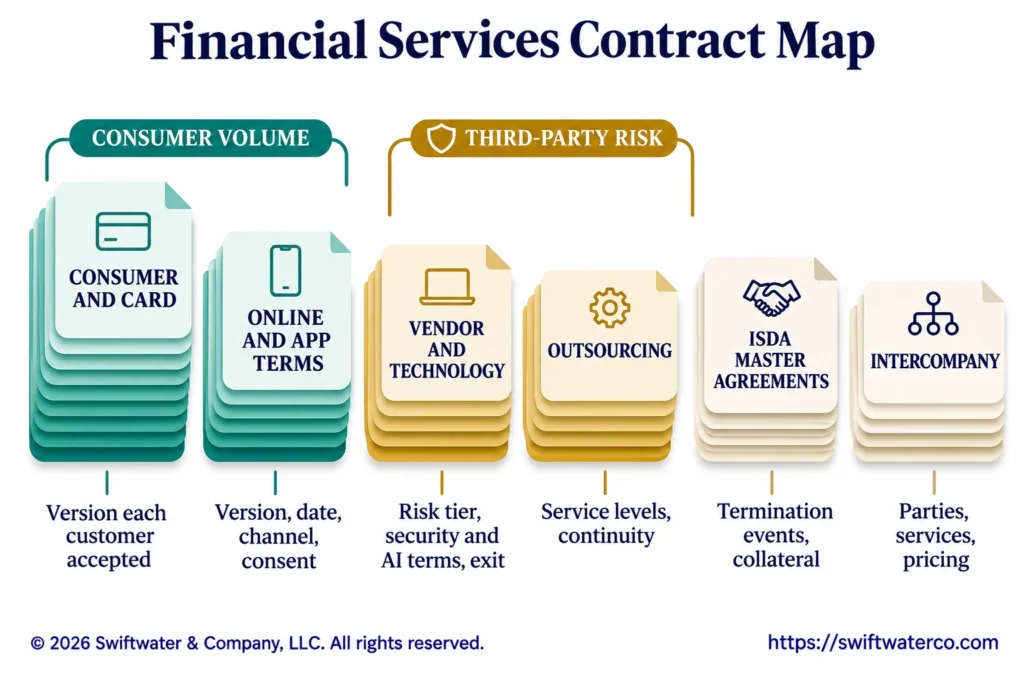
The table is illustrative. Insurers add reinsurance and claims-processing contracts, and asset managers add investment management and distribution agreements.
Which laws and regulators apply to financial services contracts?
Two sets of rules set most of the contracting expectations in financial services: consumer protection rules on the customer side, and third-party risk guidance on the vendor side.
On the customer side, the Consumer Financial Protection Bureau (CFPB) supervises consumer financial products in the United States and administers rules such as Regulation Z (Truth in Lending), which covers credit disclosures and notice of changes in terms. Card issuers submit their consumer credit card agreements to the CFPB, which publishes them in a credit card agreement database. The federal E-SIGN Act sets conditions for delivering required disclosures electronically, which is why digital account opening records a consumer’s electronic consent.
Evaluating or implementing a CLM platform?
We have guided legal departments through selection, implementation, and adoption, without the vendor bias. Let us talk about where you are and what you actually need.
See CLM ServicesOn the vendor side, the Federal Reserve, the FDIC, and the OCC issued joint Interagency Guidance on Third-Party Relationships: Risk Management in June 2023, which covers the life cycle of a third-party relationship, including contract negotiation, ongoing monitoring, and termination. In the European Union, the Digital Operational Resilience Act (Regulation (EU) 2022/2554) has applied since 17 January 2025; its Article 30 lists key contractual provisions for agreements with providers of information and communication technology (ICT) services. Insurers in the United States answer to state insurance regulators, each with its own requirements.
These rules apply differently by institution, size, product, and activity. They are listed here for reference only; counsel and compliance teams should interpret how each applies to the institution.
Who owns contracts in financial services?
In most banks and insurers, product teams and business lines own consumer agreements, with digital channel teams owning the online and app terms, compliance reviewing disclosures and changes, and legal drafting the terms. On the vendor side, procurement or a vendor management office owns vendor contracts and third-party risk management owns the risk assessment and monitoring. Treasury and trading legal own ISDA and other master agreements.
Difficulties arise when each group sees only part of the record. On the consumer side, product sees the pricing, digital sees the version published in the app, and compliance sees the disclosure. On the vendor side, procurement sees the commercial terms, risk sees the assessment, and legal sees the negotiated document. Each team may be able to open the contract itself, yet there is no shared view at the level of clauses and obligations, so each team builds its own tracker or pulls information from several systems whenever a question comes up. A shared contract record, with one owner per relationship and the obligations held as data, gives every team the same answer. Our guides to who owns contract management and contract management in procurement cover the roles.
What does a CLM have to handle?
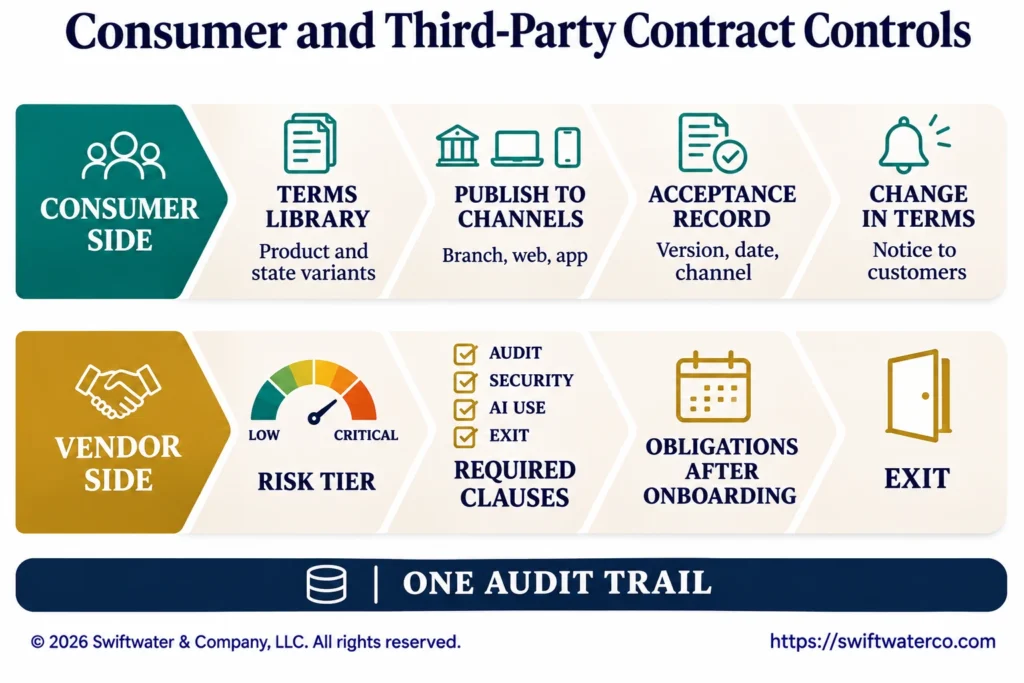
A CLM in financial services has to handle two very different kinds of contract. Consumer agreements need version control, consent records, and change management at very high volume. Vendor agreements need the third-party risk record carried alongside the contract, from risk tier at intake to exit. Both need an audit trail, several legal entities, and connections to the systems where contracts start.
Consumer side
- One library of consumer terms. Every account, card, loan, and app agreement held as an approved version, with product and state variants built from a clause library.
- Acceptance records. Which version each customer accepted, when, and through which channel, linked from the core banking or digital platform to the version in the CLM.
- Change in terms. A workflow for updating terms: drafting, compliance review, approval, publishing to every channel, and the customer notice dates.
- Digital channels. Online and app terms of use, electronic consent, and privacy notices kept in step with the products they cover.
Vendor side
- Risk tiering and required clauses. The request form captures the service, data access, and criticality, and the tier decides the review path and the clauses required, such as audit rights, cybersecurity, AI use, and termination assistance. See contract request and intake.
- Obligations after onboarding. Security assessments, incident notice duties, notice of new AI features or subcontractors, review dates, and exit, each with an owner. See contract obligation management.
- Critical-vendor inventory. A current list of critical third parties, their contracts, and their owners, produced from the contract repository on request.
Across both
- Entities, CRM, and audit trail. Templates and approvals set per legal entity, commercial contracts that start in Salesforce or another CRM, and a record of every approval and change. Our guide to Salesforce, CLM, and ServiceNow covers where each step belongs.
For derivatives, the CLM records the master agreement and its key terms, such as termination events, collateral thresholds, and the legal entity; trading and collateral systems value the positions.
What does a typical lifecycle problem look like?
A typical problem is a CLM program that stalls between the systems where contracts start and the system meant to manage them. A Fortune 1000 financial services firm had spent over a year on its Docusign CLM implementation without a go-live, with several technology teams, consultants, and vendors involved. Contract intake revolved around the sales team, who worked in a proprietary Salesforce-based solution, and the COO was considering shelving the project.
Our professionals ran an independent assessment of the build and timeline and aligned Salesforce, sales, deal desk, legal, and finance on a single target model. The team designed the repository on system-of-agreement best practices, evaluated 30 core templates, hardened the Salesforce workflows, and wrote test scripts for every persona. The result was a stabilized program and a go-live plan for 30+ contract types. The Fortune 1000 financial services case study has the full account.
The lesson for any institution is that the target model, with one owner for each step from CRM to signature, has to come before more configuration.
Which pages to read next?
- Contract management by industry, for how financial services compares with other industries.
- Who owns contract management, for the roles of legal, procurement, and the business.
- Contract lifecycle management tools, for the categories of software.
- Contract obligation management, for monitoring after signature.
- CLM after an acquisition, for combining contract programs across entities.
- SaaS contract management, for the technology contracts banks buy.
Bottom Line
Financial services contract management runs on two fronts of equal weight. Consumer agreements are the bread and butter: account, card, and loan agreements and the terms behind every website and app, accepted by millions of customers, changed by notice, and expected to show exactly which version each customer accepted. Vendor, outsourcing, and technology agreements carry the third-party risk that examiners review, including cybersecurity, data, and AI terms whose obligations continue long after onboarding. Trading master agreements and intercompany agreements complete the picture.
Evaluating legal technology but not sure where to start?
We help legal departments cut through the vendor noise, mapping technology to process maturity and building a roadmap that actually gets adopted.
See Legal TechnologyWhat a financial institution needs from its CLM is one clause- and obligation-level view shared by product, digital, compliance, procurement, risk, and legal: one library of consumer terms with every acceptance linked to its version, a controlled change-in-terms process across channels, the critical-vendor inventory, and the monitoring and exit dates for each third party, with no side spreadsheets. In financial services the contract is the evidence of control, so the CLM has to show which terms every customer accepted and when, how risky each third party is, and what each one still owes until the relationship ends.
Our contract management solutions help banks, insurers, and financial services firms set the target model for consumer and vendor contracts, connect CRM intake to the CLM, and rescue CLM programs that have stalled.
Frequently Asked Questions
What is financial services contract management?
Financial services contract management covers consumer, vendor, and outsourcing agreements under consumer protection and third-party risk rules. It includes version control, acceptance records, and change-in-terms management for consumer, online, and app agreements; risk tiering, required clauses, ongoing monitoring, and exit for third parties; and trading and intercompany agreements, with a record that shows regulators the control behind each contract.
How should a bank manage online and app terms and conditions?
Hold every version of the online banking and app terms in one library, link each customer’s acceptance to the version, date, and channel, and run changes through a single workflow: drafting, compliance review, approval, publishing to every channel, and customer notice. That record answers the question of which terms applied to a customer on a given date.
Can a CLM handle complex derivatives contracts?
Yes, for the contract record. A CLM can store ISDA master agreements, schedules, and credit support annexes, capture key terms such as termination events, collateral thresholds, governing law, and the legal entity, and track amendments. Valuation, margin calls, and trade confirmations stay in trading and collateral systems.
How does a CLM support third-party risk management?
A CLM supports third-party risk management by setting a risk tier at intake, routing higher tiers to the right reviewers, checking that the required clauses are present, and tracking the obligations that follow onboarding, such as security assessments, incident notices, and renewal and exit dates, with owners. It also produces the list of critical third parties and their contracts when an examiner asks.
How does DORA affect ICT contracts?
The EU Digital Operational Resilience Act, which has applied since 17 January 2025, lists key contractual provisions for agreements with ICT service providers in its Article 30, with more provisions for services that support critical or important functions. Counsel should confirm how it applies to each institution and contract.
Can one CLM serve several financial subsidiaries?
Yes. Most CLM platforms support several legal entities in one system, with templates, permissions, and approval rules set per entity, and reporting across the group. Agree the shared contract types, metadata, and core templates first, then allow local variation where a regulator or market requires it.
Who owns vendor contracts at a bank?
Procurement or a vendor management office usually owns vendor contracts, with third-party risk management owning the risk assessment and ongoing monitoring, and legal owning the templates, required clauses, and escalations. The business line that uses the service is accountable for the relationship.
This article is provided for general informational purposes only and is not legal, financial, or business advice. Financial services contract management decisions should be validated against your organization’s specific structure, regulatory obligations, and counsel guidance, and you should consult a qualified professional for advice on your situation.