

CLM after an acquisition requires deciding which contract system, process, and data carry forward when companies merge, a portfolio standardizes, or a CLM vendor changes hands. When a deal closes, the combined company can inherit two contract repositories, several approval processes, and thousands of agreements nobody on the new team has read. Renewals keep coming due while all of this gets sorted out, and the decisions often arrive before anyone has the data to make them.
This guide covers the three situations that lead here, how to consolidate two systems, how to choose between consolidating, migrating, and replacing, and the order to do the work in. It is written for the people who run contracts, and it gives no guidance on deal terms or contract wording. It is part of our contract lifecycle management guide.
What happens to contract management after an acquisition?
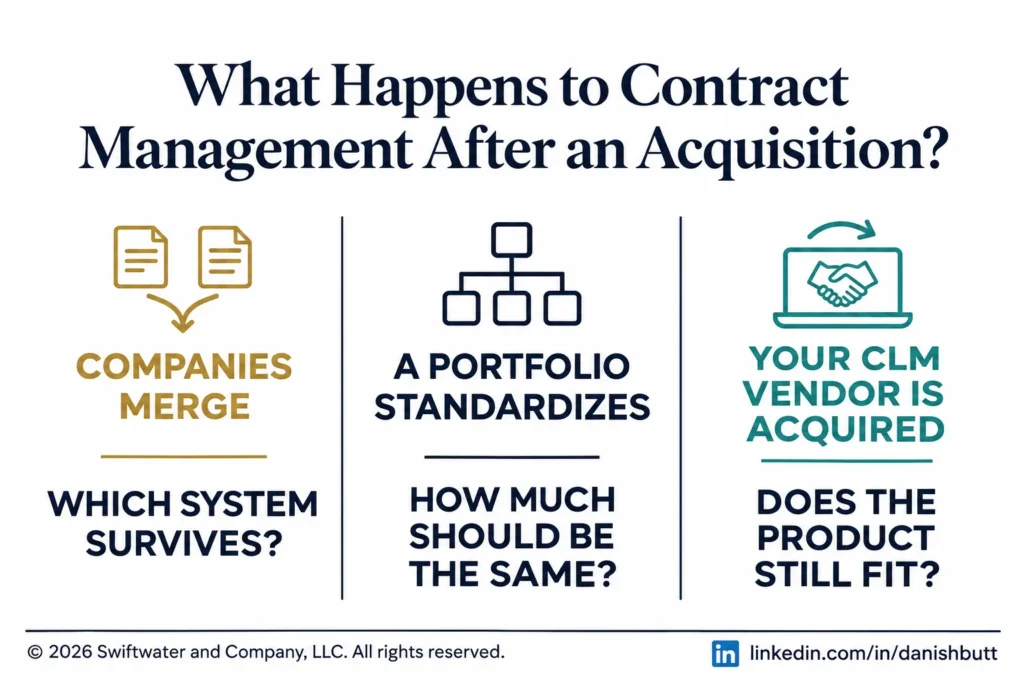
Three situations bring contract management to this point: two companies merge and each has its own contracts and systems; an owner, such as a private equity firm, wants its portfolio companies working the same way; or the CLM vendor itself is acquired. Each one starts from a different question. A merger asks which system survives, a portfolio asks how much to standardize, and a vendor acquisition asks whether the product still fits.
Most of the problems in these situations began before the deal. WorldCC (formerly IACCM) reports that, on average, contract-related data is scattered across 24 different systems. Combine two organizations in that condition and the first task becomes finding out what you own. Most of what goes wrong is a readiness and business problem, which is why the work starts there, ahead of any system decision.
How do you consolidate two CLMs?
Consolidate two CLMs by first deciding on one set of processes, then choosing the system that best supports them, and then moving contracts in stages. Inventory both repositories, compare templates and approval rules, and identify which contract types are in active use. Keep both systems running until the data has been checked. Renewal dates and obligations need an owner throughout, so that nothing lapses during the move.
Integrations often decide the outcome. In a 2026 WorldCC survey of 170 organizations, only 27% stored all executed contracts exclusively in a CLM system, and 54% had no automated data flow between systems. If one company runs on Salesforce and the other on a different sales platform, the system boundaries need deciding early. Our guide to CLM vs ERP, CRM, and document management sets out how to decide which system holds which record.
Ask your counsel which acquired contracts need review for assignment or change-of-control provisions. The operational job is to tag those contracts in the contract repository, give each one an owner, and track its status until counsel has closed it.
Evaluating or implementing a CLM platform?
We have guided legal departments through selection, implementation, and adoption, without the vendor bias. Let us talk about where you are and what you actually need.
See CLM ServicesWhat does standardizing contracting across a portfolio involve?
Standardizing across a portfolio means agreeing on what must be the same everywhere and leaving the rest to each company. Common standards usually include a data model, approval thresholds, core templates, and reporting. Local teams often keep control of day-to-day workflow and contract types specific to their business. Trying to make every company identical tends to slow the program and reduce the local support it depends on.
Start with reporting, because owners usually want to see renewals, obligations, and risk across the group. Define a small set of shared data fields and contract management KPIs, and let each company report against them from whatever system it has. A shared platform can follow once the common definitions are working. The Swiftwater Contract Management Maturity Model can help you see which companies are ready to move first.
There is a lot of conventional wisdom on this topic, and many consultants will sell you a pristine, highly standardized system. The reality is messier. In my experience, you have to know where to push and where to pull back. I advise clients to work toward a standard model across each stage of the contract lifecycle. Standardization gives people a consistent language to work in, and the familiarity that builds trust.
Business, legal, and regulatory needs still differ across business units. Forcing one template or one process across the company stretches out the implementation, and stakeholders get so worn out by the standardization effort that they have checked out by the time they need to adopt it. Once a sense of winners and losers sets in, adoption and change management become very hard.
Too much flexibility creates its own chaos. One client showed me 700 tracked fields across dozens of contract types. Less than 10% of that tracking data was filled out.
What changes when your CLM vendor is acquired?
When a CLM vendor is acquired, the product line, roadmap, pricing, and support model can all change, sometimes gradually. Evisort is the current example: Workday announced in March 2025 that Evisort’s contract products were available through it. Customers in this position should read their current terms, ask the new owner for its plans in writing, and review their options well before renewal.
Ownership by a larger company brings real advantages, including a wider ecosystem and more resources, especially for customers already using that company’s other products. Others may need more diligence on where the product is headed. Our Evisort pricing guide covers what this means for buyers today. Start the review early, because a CLM cannot be replaced in the final weeks of a term.
Many deals run the other way, with your CLM vendor doing the buying, usually to add functionality. Agiloft acquired Screens to add generative AI contract review and redlining. Onit acquired McCarthyFinch and AXDRAFT for AI and contract automation, then SecureDocs for deal rooms and contract management. Conga’s case was closer to a combination: Apttus and Conga merged and continued under the Conga name. When your vendor buys a product, ask whether it is included in your license or priced separately, how closely it is integrated, and where it sits on the roadmap.
Consolidate, migrate, or replace: how do you decide?
Choose by comparing how well each current system fits the combined business, what condition the data is in, and when the existing contracts run out. Consolidate when one system already fits most needs. Migrate to the other platform when it is clearly stronger or when a contract with the vendor is ending. Replace both when neither fits, accepting that this is the longest path and needs the most preparation.
| Option | When it fits | What to plan for |
|---|---|---|
| Consolidate onto a current system | One system meets most needs and has capacity to grow | Moving the other company’s contracts, templates, and users |
| Migrate to the acquirer’s or the other platform | A corporate standard exists, or one vendor contract is ending | Data mapping, retraining, and integrations rebuilt on the new system |
| Replace both | Neither system fits the combined business | A full selection and implementation, with both old systems running meanwhile |
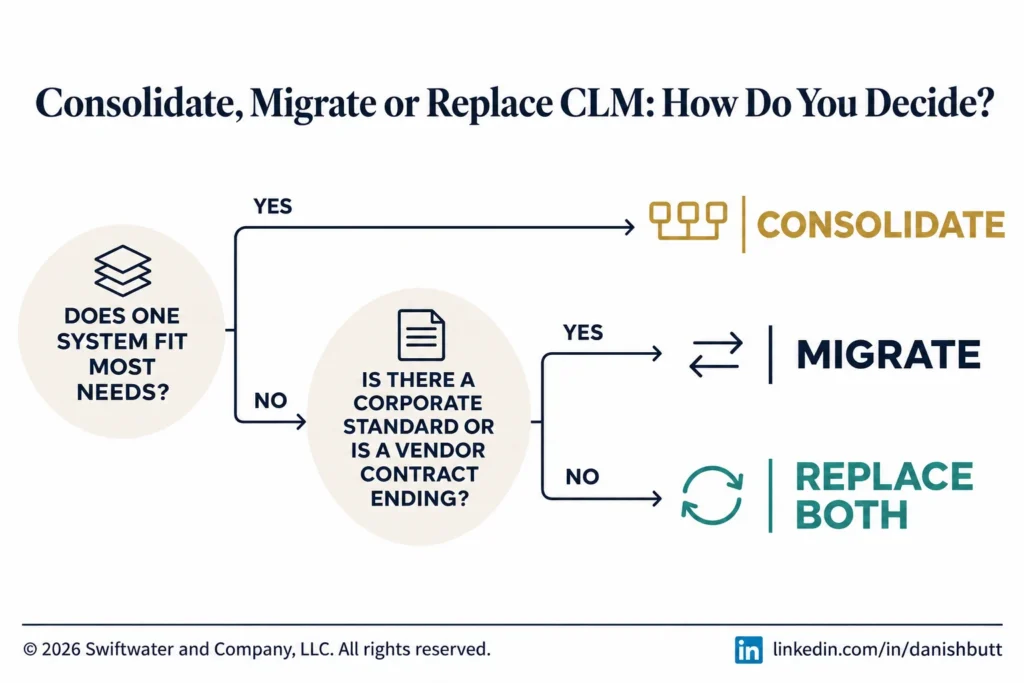
Whichever route you take, check the termination dates and data-return terms of the system you are leaving. Our how to choose a CLM vendor guide and CLM tools landscape can help when replacement is on the table.
What is the sequence?
Work in this order: protect what is coming due, find out what you have, decide on the target, then move in stages. The first weeks should focus on upcoming renewals and critical obligations, because those deadlines will not wait for a system decision. Inventory and process comparison come next. Only then should the organization choose a platform, plan the migration, and retire the old system.
- Protect. List renewals and critical obligations due in the coming months, and name an owner for each.
- Inventory. Find the contracts and systems on both sides, and assess the condition of the data.
- Align. Agree on owners, approval rules, core templates, and the data to capture.
- Decide. Choose to consolidate, migrate, or replace, based on fit, data, and contract dates.
- Move. Bring contracts over in stages, following a legacy contract migration approach and a CLM implementation plan.
- Retire and train. Close the old system once the data has been checked, and support users through the change.
When do you run a discovery sprint first?
Run a discovery sprint first when the organization does not yet know what it owns, when the two companies disagree on process, or when the choice of platform has become political. A short, structured diagnostic produces a shared map of how contracts move, a view of readiness and maturity, and a recommendation that does not belong to either legacy team. That neutral starting point is often what lets the integration move.
A sprint is less useful when a corporate standard has already been set and the task is purely moving contracts. In that case, go straight to migration planning, and put the effort into data quality and change management.
Bottom Line
An acquisition forces decisions about contract systems that most organizations had been able to put off. The deadlines inside the contracts keep running regardless, which makes the first job protection and the second job finding out what you have.
Platform decisions come later and go better when the facts are in hand. Protect what is coming due, take inventory, agree on how the combined business will work, and only then choose the system.
Swiftwater’s CLM Discovery Sprint gives both legacy teams one map of how contracts move and a roadmap to work from, before you commit to a platform.
Evaluating legal technology but not sure where to start?
We help legal departments cut through the vendor noise, mapping technology to process maturity and building a roadmap that actually gets adopted.
See Legal TechnologyFrequently Asked Questions
What is CLM after an acquisition?
CLM after an acquisition requires deciding which contract system, process, and data carry forward when companies merge, a portfolio standardizes, or a CLM vendor changes hands. It covers taking inventory of both sides, agreeing on how contracts will run, and moving to the chosen system without missing renewals or obligations.
What should you do first with contracts after a merger?
Start by listing renewals and critical obligations coming due, and name an owner for each one. Then locate the contracts and systems on both sides and assess the data. Platform decisions can wait until those facts are known, while the dates inside the contracts cannot. Ask counsel which contracts need legal review because of the transaction.
Should we keep both CLM systems after an acquisition?
Keeping both can be a sensible short-term step while the data is checked and processes are aligned. Over the long term, two systems usually mean duplicate licenses, separate reporting, and inconsistent rules. Compare both against the combined business, and set a date to decide based on fit, data quality, and when each vendor contract ends.
What happens to my CLM if the vendor is acquired?
Your contract with the vendor generally continues, but the roadmap, pricing, and support model can change over time. Read your current terms, ask the new owner for its plans in writing, and start reviewing options well before renewal. A larger owner can bring advantages, particularly if you already use its other products.
How long does it take to consolidate two CLM systems?
It depends on contract volume, data quality, and integrations. As a guide, Swiftwater’s published ranges for a CLM implementation run from 45 to 90 days for a repository to as long as 12 months with sales or procurement integrations. Consolidation adds time for aligning two sets of processes and checking migrated data.
Who should lead CLM integration after a deal?
Name one accountable lead, often in legal operations, with an executive sponsor and representatives from legal, procurement, sales, finance, and IT on both sides. Including people from each legacy company matters, because a process imposed by one side tends to get little support from the other.
This article is provided for general informational purposes only and is not legal, financial, or business advice. Contract integration decisions should be validated against your organization’s specific structure, regulatory obligations, and counsel guidance, and you should consult a qualified professional for advice on your situation.