
SaaS contract management covers subscription agreements, order forms, DPAs, and renewals at volume. A software company signs the same few agreements thousands of times: a master subscription agreement, an order form for each deal, a data processing agreement for each customer that sends personal data, and a renewal every year. On the other side of the business, it buys dozens or hundreds of subscriptions of its own. The value is in clean order forms, controlled discounts and fallbacks, and renewals tracked on both sides.
This guide covers the key contract types in SaaS and technology companies, the rules behind them, who owns them, and what a CLM has to handle. It is part of our guide to contract management by industry and our guide to the seven stages of the contract lifecycle.
What does contract management cover in a SaaS company?
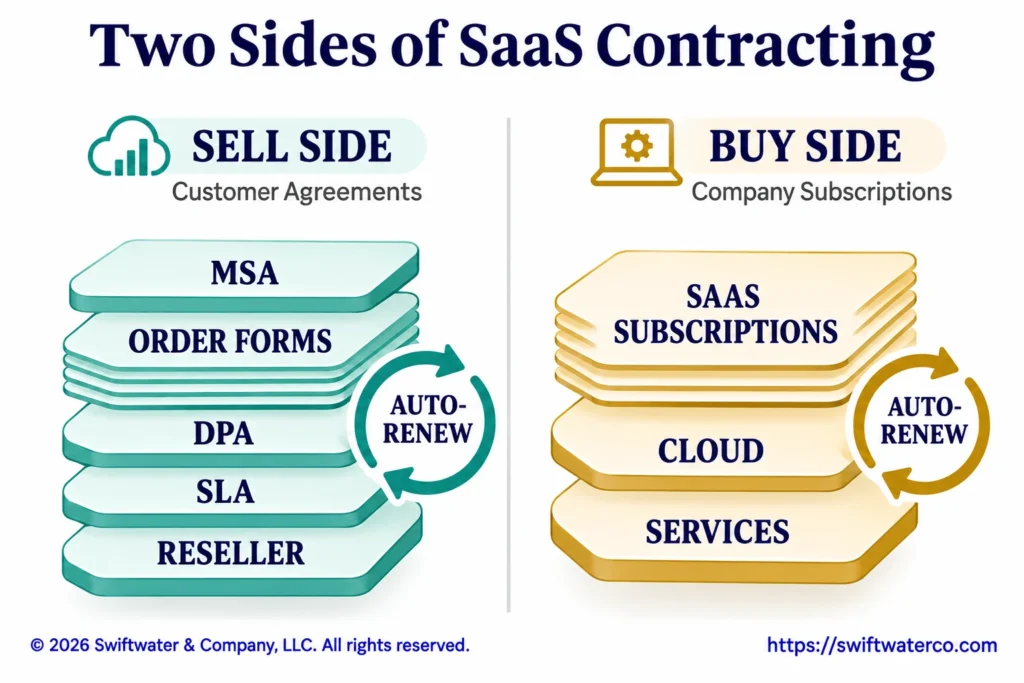
Contract management in a SaaS company covers two sides. The sell side is the revenue: master subscription agreements or terms of service, order forms, data processing agreements (DPAs), service level agreements, and partner and reseller agreements. The buy side is the company’s own software and cloud stack, bought on subscriptions that renew automatically unless someone acts.
- Sell side. Customer agreements, order forms, DPAs, SLAs, and partner and reseller agreements, driven by the sales cycle.
- Buy side. SaaS and cloud subscriptions, infrastructure agreements, and services, driven by procurement and IT.
Most companies manage the sell side carefully and the buy side loosely, even though both renew on the same automatic terms.
What are the key contract types?
Order forms are the most numerous SaaS contracts, because every new deal, upsell, and renewal produces one under the same master agreement. DPAs follow close behind, since most business customers that send personal data need one. Partner agreements are fewer but govern whole sales channels.
| Contract type | Counterparty | What the CLM tracks |
|---|---|---|
| Master subscription agreement or terms | Customers | Version in force, governing terms, amendments |
| Order forms | Customers | Term, price, uplift, auto-renewal, notice dates |
| Data processing agreements | Customers and subprocessors | Version, subprocessor list, transfer terms |
| Service level agreements | Customers | Uptime commitments, service credits |
| Reseller and partner agreements | Partners | Margins, territories, renewal |
| Vendor subscriptions | Suppliers | Renewal dates, seats, price, owner |
The table is illustrative; a company selling to consumers has fewer negotiated agreements and more terms-of-service versions.
Which laws and regulators apply to SaaS contracts?
SaaS contracts are affected by privacy law, revenue accounting, and consumer subscription laws. The EU General Data Protection Regulation (GDPR) requires a contract between a controller and a processor in its Article 28, which is why customers ask software vendors for a DPA. Many US states now have privacy laws with their own contract requirements.
Evaluating or implementing a CLM platform?
We have guided legal departments through selection, implementation, and adoption, without the vendor bias. Let us talk about where you are and what you actually need.
See CLM ServicesRevenue recognition under ASC 606 depends on contract terms such as term, price, and performance obligations, so finance needs accurate data from every order form. For consumer subscriptions, many US states have automatic renewal laws that govern how renewal terms are disclosed and how customers cancel.
These rules are listed for reference only; counsel, compliance, and finance teams should interpret how each applies to the company.
Who owns contracts in a SaaS company?
In most SaaS companies, sales operations and the deal desk own the order form process, commercial legal owns the master agreement, templates, and nonstandard terms, privacy owns DPAs and subprocessor terms, and finance owns revenue data and billing. Procurement and IT own the buy side, though many subscriptions are bought by individual teams on a credit card.
The deal desk, or revenue operations, is where these owners meet: it approves discounts, sends nonstandard terms to legal, and makes sure the order form matches what finance will bill. As a key part of the deal process, it can bring discipline to contracting. Sales leaders often describe terms agreed in the heat of the moment that nobody remembers later: sometimes pricing, sometimes one-sided terms conceded to close the deal, without passing through the proper approvals. Linking the deal desk’s process to the contracting process, so every concession is approved and recorded in the contract record, prevents those surprises. Our guides to who owns contract management and sales contract management cover the roles.
What does a CLM have to handle?
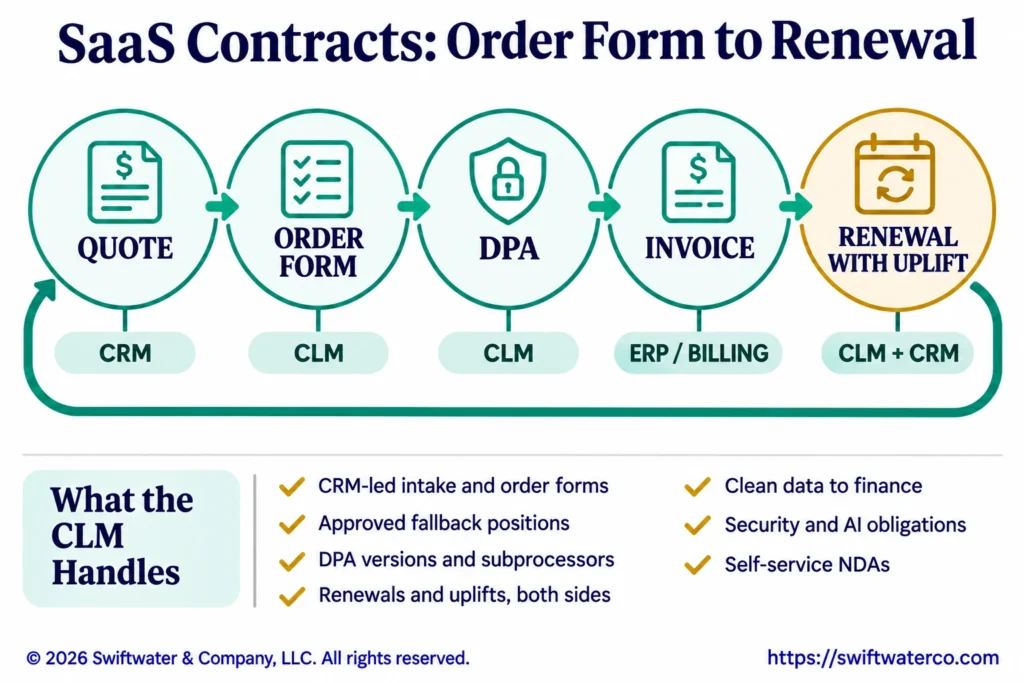
A CLM in a SaaS company has to start contracts from the CRM, control discounts and nonstandard terms with fallbacks, keep DPA versions and subprocessor terms current, track renewals and uplifts on both sides of the business, and send clean contract data to finance. Standard agreements should complete without legal touching them.
- CRM-led intake and order forms. Order forms generated from the opportunity in the CRM, with the CLM holding the signed contract. Our guide to Salesforce, CLM, and ServiceNow covers where each step belongs.
- Controlled fallbacks. Approved fallback positions for common negotiation points, with anything beyond them routed to legal. See templates, clause libraries, and playbooks.
- DPA versions. The DPA version each customer signed, and the subprocessor terms that go with it.
- Renewals on both sides. Customer renewals and uplifts for sales, and vendor renewals and seat counts for procurement. See contract renewal management.
- Data to finance. Term, price, and billing data passed to the ERP and billing systems. See CLM vs ERP and CRM.
- Security and AI obligations. Security commitments, incident notices, subprocessor changes, and AI terms, such as limits on training models with customer data, tracked as obligations on both sides after signature. See contract obligation management.
- Self-service NDAs. Sales and partners complete standard NDAs without waiting. See how to automate NDAs.
What does a typical lifecycle problem look like?
A typical SaaS problem is the quarter-end or year-end fire drill. WorldCC (formerly IACCM) reports that, on average, contract-related data is scattered across 24 different systems, according to the same WorldCC whitepaper. In a software company, that scatter shows up as soon as someone asks a question across many contracts at once.
I have seen how SaaS and software company teams come under pressure at quarter and year end. The business relationship with each customer is written into its contracts, so any question asked at scale can turn into a fire drill. If finance needs to know which contracts have a price step-up coming due, and the sales system does not hold that term, someone has to open each contract and find it. The same happens on the buy side: with a long-standing cloud vendor, a single modification can mean the legal team reads 20 amendments to work out where things stand. That is where a CLM with the right connections to the CRM makes the difference.
The buy side has a larger version of the same problem: a stack of overlapping tools and vendors that grew one subscription at a time. A Fortune 50 technology company facing a sharp workload increase found its IP technology ecosystem fractured, complex, and expensive. Our professionals ran a current-state assessment that recommended consolidating vendors, built the business case, led the requirements and vendor selection for a new IP management system, and negotiated a 5-year contract. One simplified system replaced the fractured ecosystem, with $13M in savings over five years. The Fortune 50 technology case study has the details.
On both sides, the fix is the same: terms held as data in one system, linked to the CRM and the ERP, so the next question takes minutes.
Which pages to read next?
- Contract management by industry, for how SaaS compares with other industries.
- Who owns contract management, for the roles of legal, sales, and procurement.
- Sales contract management, for the sell side in depth.
- Salesforce, CLM, and ServiceNow, for where contracts should live.
- Contract renewal management, for renewals and uplifts.
- How to choose a CLM vendor, for the selection process.
Bottom Line
SaaS contract management runs on two sides. The sell side produces order forms, DPAs, and renewals in volume under one master agreement, owned by the deal desk, commercial legal, privacy, and finance. The buy side is the company’s own subscription and cloud stack, which renews automatically and gathers amendments unless someone owns it. GDPR, revenue recognition, automatic renewal laws, and growing security and AI terms sit behind both.
Evaluating legal technology but not sure where to start?
We help legal departments cut through the vendor noise, mapping technology to process maturity and building a roadmap that actually gets adopted.
See Legal TechnologyAvoiding the quarter-end fire drill comes down to holding contract terms as data: price step-ups, renewal dates, uplifts, and concessions are visible in the CRM and the CLM, every concession passes through the deal desk’s approvals, and every amendment sits with its master agreement. A SaaS company signs the same few agreements thousands of times, so the value is in terms held as data, concessions approved through the deal desk, and renewals and step-ups visible on both sides before the quarter closes.
Our contract management solutions help software and technology companies connect CRM intake to the CLM, set templates and fallbacks for the deal desk, and select and configure the platform that fits.
Frequently Asked Questions
What is SaaS contract management?
SaaS contract management covers subscription agreements, order forms, DPAs, and renewals at volume. On the sell side it manages customer agreements, order forms, and data processing terms through the sales cycle; on the buy side it tracks the company’s own software subscriptions, renewals, and seats.
What is the difference between an MSA and an order form in SaaS?
The master subscription agreement, or MSA, sets the legal terms that apply to every purchase: liability, data protection, warranties, and termination. The order form records each deal: the products, quantities, price, term, and renewal terms. A customer usually signs one MSA and many order forms under it.
How should a SaaS company track auto-renewals and uplifts?
Capture the renewal date, notice period, auto-renewal terms, and price uplift from every order form as fields in the CLM or CRM, and alert the account owner well before the notice date. Track vendor subscriptions the same way for procurement, with an owner and seat count for each.
Who owns DPAs in a software company?
The privacy or data protection team usually owns the DPA template and the subprocessor list, commercial legal negotiates changes customers ask for, and sales operations makes sure the right version is attached to each deal. The CLM records which version each customer signed.
How can a CLM help with GDPR?
A CLM helps by recording which customers and vendors have a data processing agreement, which version they signed, and which subprocessor terms apply, and by producing that list on request. It keeps the contract records; privacy and legal teams remain responsible for GDPR compliance.
This article is provided for general informational purposes only and is not legal, financial, or business advice. SaaS contract management decisions should be validated against your organization’s specific structure, regulatory obligations, and counsel guidance, and you should consult a qualified professional for advice on your situation.