


Contract management outsourcing hands defined contract work to an outside team while legal keeps the decisions. The work moved out is usually repeatable: triaging requests, drafting from approved templates, first-pass review against a playbook, keeping the repository current, tracking obligations, loading legacy contracts into a new platform, and running the CLM itself. Policy, risk positions, and final approvals stay with the legal department.
This guide covers what can be outsourced, the delivery models and how each is priced, when outsourcing makes sense, and how to choose a provider. It is part of our guide to who owns contract management and our contract lifecycle management guide.
What is contract management outsourcing?
Contract management outsourcing is the use of an outside provider to perform defined parts of the contract lifecycle under the client’s rules. The provider works from the client’s templates, playbook, and approval matrix, inside the client’s systems or its own, and reports against agreed turnaround and quality measures. It differs from sending contracts to outside counsel: outside counsel gives legal advice on individual matters, while an outsourced contracts team runs a process at volume.
Most departments still keep the bulk of contract work in-house. The 2025 ACC Law Department Management Benchmarking Report, covering 395 legal departments, found that the share outsourcing contract management to alternative legal service providers rose from 2% in 2021 to 5% in 2025.
What can be outsourced and what stays in-house?
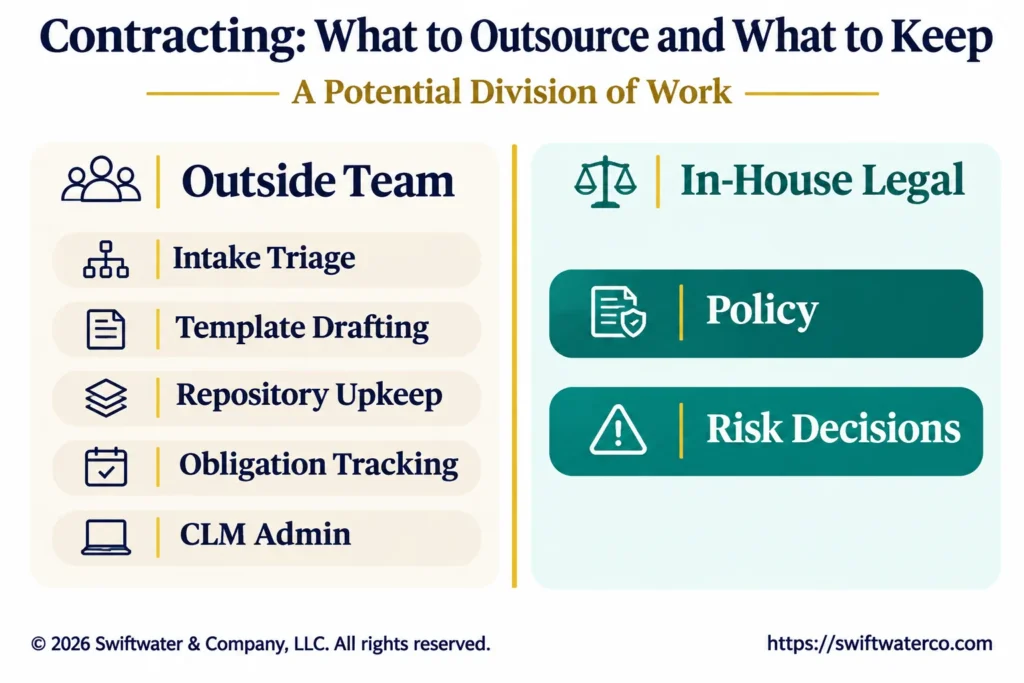
Repeatable work with clear rules can be outsourced; decisions about risk and policy stay in-house. The test is whether the task can be written down well enough for someone outside the department to do it the same way every time. The table shows a potential division of work; the right split depends on your contract types, volumes, and risk appetite.
| Work | Potentially outsourced? | Why |
|---|---|---|
| Request triage and intake | Often | Rules-based routing at volume |
| Drafting from approved templates | Often | The template sets the terms |
| First-pass review against a playbook | Often | Positions and fallbacks are written down |
| Legacy migration and data tagging | Very often | A large one-time project with peaks |
| Repository upkeep and obligation entry | Often | Steady data work that needs consistency |
| CLM administration | Often | Specialist platform skills; ownership of the platform stays internal |
| Policy, risk positions, final approvals | No | Accountability stays with legal |
Bulk migration and data tagging is the most common starting point. When a company moves to a new CLM, thousands of legacy contracts need their key terms, dates, and obligations extracted and checked. AI extraction now does the first pass, but many companies outsource the volume so trained people review what the AI pulled, enter the obligations the AI missed, and confirm parent and child agreements are linked before the data goes live. The same team often stays on afterward to tag new contracts as they are signed, so the obligation register stays reviewed by people. Our guide to legacy contract migration covers the method.
Which outsourcing models are there, and how are they priced?
There are four main outsourcing models for contract work: staffing, alternative legal service providers, managed services, and offshoring. They differ in who manages the work, who carries the result, and how the fee is set.
Evaluating or implementing a CLM platform?
We have guided legal departments through selection, implementation, and adoption, without the vendor bias. Let us talk about where you are and what you actually need.
See CLM Services| Model | What you get | How it is usually priced |
|---|---|---|
| Staffing (staff augmentation) | Contract attorneys, contract managers, or paralegals working under your direction | Hourly or monthly per person |
| Alternative legal service provider (ALSP) | A provider that runs defined legal work at volume, often with its own technology | Per project, per contract, or per document |
| Managed services | An ongoing service that runs a function to agreed service levels | Fixed monthly fee, often with a per-contract variable |
| Offshoring or nearshoring | The work delivered from a jurisdiction with a more favorable cost base, by a provider or a captive center | Hourly or per person, at that jurisdiction’s rates |
In this context, offshore and nearshore both mean delivery from a jurisdiction where the work costs less: offshore usually in a more distant country, nearshore in a nearby country or a similar time zone. The models overlap: an ALSP may deliver from offshore, and a managed service may include staff. Thomson Reuters’ 2025 ALSP report found that 57% of corporate law departments use ALSPs for a range of services, and 36% of corporate buyers plan to spend more on legal managed services. Price ranges vary too widely by contract type, volume, and location to quote reliably, so compare providers on the same scope and the same pricing unit. Our guide to offshore vs onshore legal services covers the location trade-offs.
When does outsourcing make sense?
Outsourcing makes sense when volume outruns the team, when a project creates a temporary peak, when day-to-day administration of the platform is more than the internal team can carry, or when a hiring gap leaves contracts waiting. It works best once templates, a playbook, and approval rules exist, because a provider runs a process faster than it can invent one.
- Volume spikes. Quarter-end sales contracts, a new product launch, or a procurement wave.
- One-time projects. Migration to a new CLM, a repricing exercise, or a review after an acquisition.
- Heavy platform administration. Ownership of the CLM stays internal, but its day-to-day management and administration are outsourced.
- Hiring gaps. A contract manager has left and the role is open.
Flexible staffing is already common: the 2026 ACC benchmarking report found that 42% of legal departments use contract or temporary staff.
What does an outsourced contracts center look like?
An outsourced contracts center is a dedicated team, run by a provider under the client’s rules, that handles contracts from intake to obligation management for the whole business. It usually combines technology for the contracting workflow, a mix of specialists and lawyers, and a rollout that takes on contract types in stages.
I helped build an outsourced transactions support center for a publishing company. Our professionals helped the company implement technology that ran the contracting workflow from intake by the business through signature and obligation management. We built the team from rebadged staff, who moved from the company to the service, together with contract specialists and lawyers who handled the substantive contract work, and the center ran around the clock. It provided workflow leadership, value management, and obligation management, gave the business up-to-date insight into its contract and legal operations, and helped a global professional team run. We set it up in sprints: first the operating model, then staffing, then rolling out contract types one at a time as the center of excellence took them over.
The sprint structure is what made it work. Each contract type moved only when the model, the people, and the workflow for it were ready, so the business saw service improve one step at a time with no gap in between.
How do you evaluate a provider?
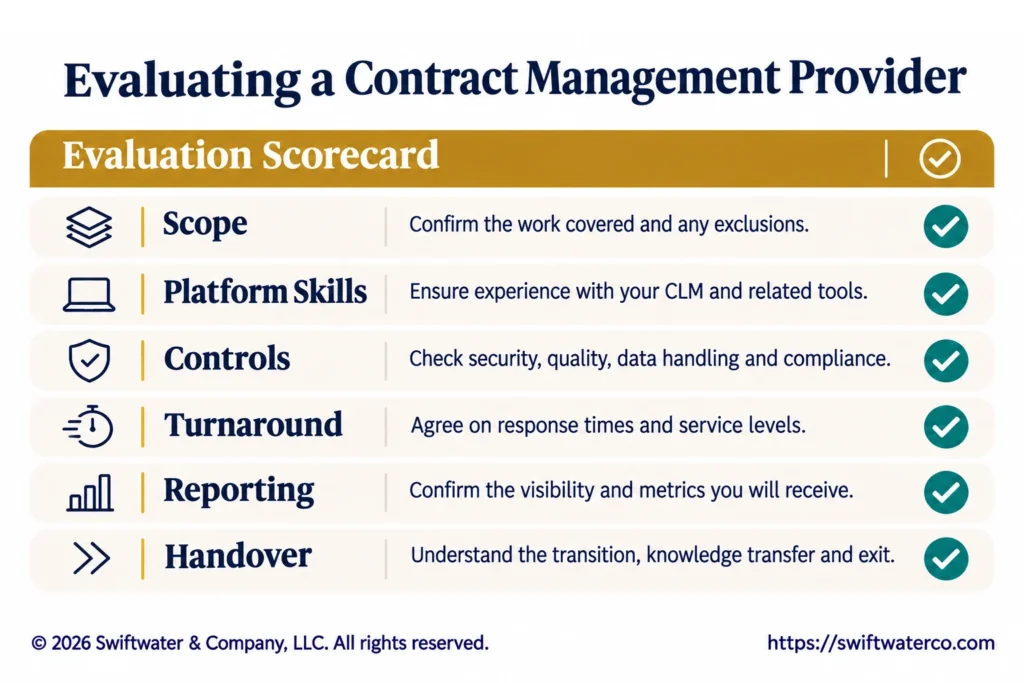
Evaluate a contract management provider on scope, platform skills, controls, turnaround, reporting, and how the handover works. Ask for the people who will do the work, check they have used your CLM, and run a paid pilot on real contracts before a long commitment.
- Scope. Which tasks they will run, and which they will escalate.
- Platform skills. Hands-on experience with your CLM and its data model.
- Controls. Confidentiality, data security, and quality checks on every batch.
- Turnaround. Service levels by task, with reporting against them.
- Reporting. Volume, cycle time, error rate, and escalations each month.
- Handover. How the work and the knowledge come back in-house if you end the service.
Our guide to evaluating a legal managed services provider has the full checklist.
What does managed CLM administration cover?
Managed CLM administration covers the running of the platform after go-live: user and permission changes, template and workflow updates, field and report maintenance, integration checks, and support for the people who use it. Ownership of the platform stays with the department: it decides the configuration, the rules, and the priorities, while the provider does the day-to-day management and administration. It suits departments where that administration is more than the internal team can carry, or that need the skills while they hire. Our CLM administration service describes a fractional administrator through managed services.
How does it connect to legal managed services?
Contract management outsourcing is one part of legal managed services, which can also cover bill review, matter and vendor management, and other legal operations work. Some departments start with contracts and add other functions under the same provider and governance. Our guide to what legal managed services are explains the wider model.
Bottom Line
Outsourcing contract work is a decision about where your team’s time goes. Repeatable work with clear rules, from intake triage and template drafting to migration, obligation entry, and day-to-day platform administration, can run outside the department at volume and around the clock, while ownership, policy, risk positions, and final approvals stay with you.
Evaluating legal technology but not sure where to start?
We help legal departments cut through the vendor noise, mapping technology to process maturity and building a roadmap that actually gets adopted.
See Legal TechnologyThe programs that work are built on purpose: a clear division of work, a provider tested on real contracts, service levels and reporting from day one, and a rollout in sprints that takes on one contract type at a time. Keep ownership and the risk decisions in-house, outsource the repeatable work with clear rules, and build the service in stages so it earns each new contract type it takes on.
Our professionals have helped build an outsourced contracts support center that runs around the clock, and our managed services run contract operations under your governance, from intake and obligation tracking to CLM administration, with practitioners who have run the function in-house.
Frequently Asked Questions
What is contract management outsourcing?
Contract management outsourcing hands defined contract work to an outside team while legal keeps the decisions. The provider works from the client’s templates, playbook, and approval rules, and reports against agreed turnaround and quality measures.
Which contract management services can be outsourced?
Request triage, drafting from approved templates, first-pass review against a playbook, legacy migration and data tagging, repository upkeep, obligation entry, and CLM administration are commonly outsourced. Migration and data tagging is the most common starting point. Policy, risk positions, final approvals, and ownership of the platform stay in-house.
Is contract management outsourcing the same as legal process outsourcing?
Contract management outsourcing is one kind of legal process outsourcing. Legal process outsourcing covers any legal support work sent to a provider, often offshore; contract management outsourcing is limited to the contract lifecycle.
How is contract management outsourcing priced?
Staffing is usually priced hourly or monthly per person, ALSP work per project, contract, or document, and managed services as a fixed monthly fee, often with a per-contract variable. Compare providers on the same scope and pricing unit.
Can you outsource CLM administration?
Yes. Ownership of the platform stays internal, while day-to-day management and administration are outsourced: users and permissions, templates and workflows, fields and reports, integration checks, and user support. It suits departments where that work is more than the internal team can carry, or that need the skills while they hire.
Should contract work be outsourced onshore or offshore?
Offshore and nearshore delivery means using a jurisdiction where the work costs less. It lowers the hourly cost and suits high-volume, rules-based work such as data tagging. Onshore delivery suits work that needs close contact with the business, local law knowledge, or stricter data residency. Many programs combine both.
This article is provided for general informational purposes only and is not legal, financial, or business advice. Outsourcing and sourcing decisions should be validated against your organization’s specific structure, regulatory obligations, and counsel guidance, and you should consult a qualified professional for advice on your situation.