
Contract renewal management is the practice of reviewing every contract before it renews and deciding, on purpose, whether to renew it, renegotiate it, or end it. Many agreements renew automatically unless someone acts by a notice date, and that date can fall weeks or months before the term ends. Miss it, and a software subscription nobody uses rolls into another year, or a supplier’s price increase takes effect with no chance to push back. Renewal management makes sure the right person sees each deadline in time to choose.
This guide explains why renewals get missed, how to set alerts around the notice deadline, how to track auto-renewing and evergreen agreements, how to make and log the decision, and how a CLM runs the cycle. It covers operational practice and gives no guidance on contract wording. It is part of our contract lifecycle management guide, and pairs with contract obligation management, which keeps the performance record the renewal decision uses.
What is contract renewal management?
Contract renewal management is the practice of knowing every upcoming renewal and notice deadline, reviewing each agreement’s value and performance in time, and acting before it renews by default. It runs on the dates held in the contract repository and on the performance history held in the obligation record, and it ends with a decision that is logged on the contract.
Renewal management is one discipline inside contract lifecycle management, and it depends on the stage before it. Contract obligation management keeps the record of what each party delivered, and the contract repository holds the term dates and notice periods.
The stakes are real. Research by WorldCC (formerly IACCM) finds the average business loses almost 9% of value annually through poor contract management; the best performers lose about 3% and the worst 15% or more (WorldCC, August 2025). A renewal that rolls over unreviewed is one of the easiest places for that value to slip.
Why do renewals get missed?
Renewals get missed for operational reasons. Dates sit in documents with no structured field, the notice deadline is tracked as if it were the renewal date, nobody owns the decision, alerts go to one person who has since moved on, and the review starts too late for the time a negotiation takes. Each of these is a data or ownership gap that can be fixed.
The data gap is common. In the WorldCC and Sirion study of 170 organizations (2026), only 27% stored all executed contracts exclusively in a CLM system, and 54% had no automated data flow between systems. When contracts and their dates are spread across systems, no single alert can see them all.
Evaluating or implementing a CLM platform?
We have guided legal departments through selection, implementation, and adoption, without the vendor bias. Let us talk about where you are and what you actually need.
See CLM ServicesTime is the other gap. Ironclad’s 2025 Contracting Benchmark Report, drawn from its customers’ contracting data, puts the average time to execute a contract at 42 days. A renegotiation needs a similar runway, so a review that starts a few days before the notice deadline has already run out of time.
How do you design renewal alerts?
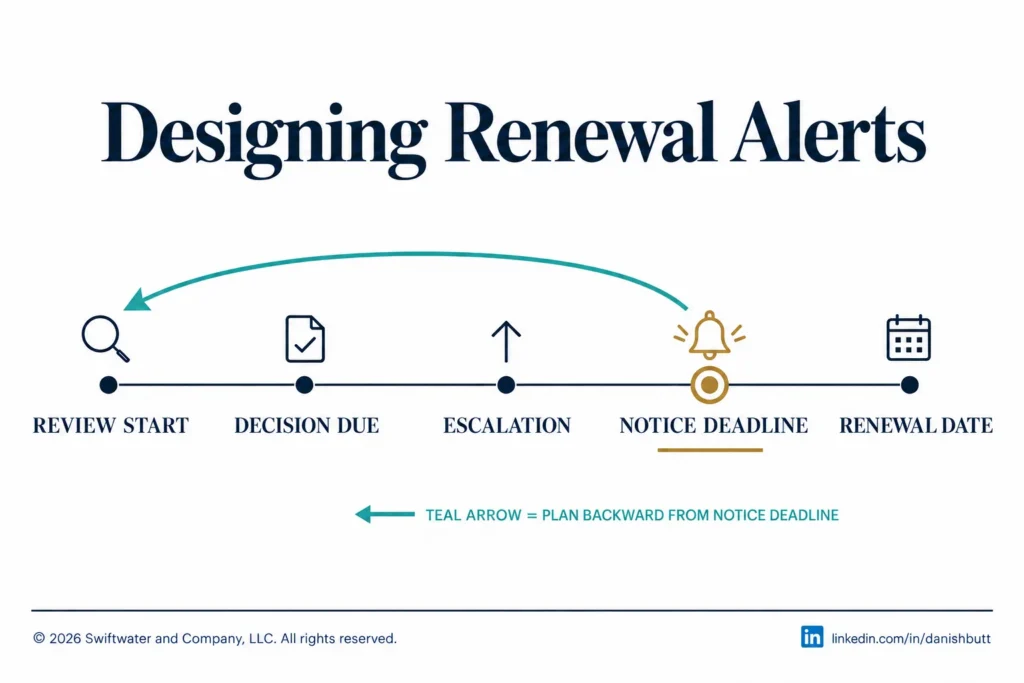
Design renewal alerts by anchoring every alert to the notice deadline, the last day to act, and working backward by the time your review and negotiation need. Send each alert to a named owner and a backup, include the functions the renewal affects, and escalate automatically when no decision has been logged. The renewal date itself matters less than the notice deadline before it.
| Alert | When it fires | Who gets it |
|---|---|---|
| Review start | Far enough ahead of the notice deadline to review and negotiate | The contract owner and backup |
| Decision due | The point by which a renew, renegotiate, or terminate decision must be logged | The contract owner, with legal or contracts |
| Notice deadline approaching | Shortly before the notice deadline, with time to send notice | The contract owner and contract manager |
| Escalation | When no decision is logged by the decision due point | The owner’s manager |
| Renewal confirmed or notice sent | When the decision is recorded and acted on | Sales or finance, where the renewal affects revenue or spend |
Set the lead time per contract from the work it needs. A low-value subscription can be reviewed quickly, while a major supplier agreement may need a sourcing exercise. For customer contracts, send alerts to sales as well as the contract owner; for supplier contracts, include finance and procurement. Escalation rules inside a CLM are covered in our CLM best practices for 2026.
What is auto-renewal risk and how do you track it?
Auto-renewal risk is the chance that an agreement renews without anyone reviewing it. Auto-renewing and evergreen agreements continue unless someone acts by the notice deadline, so the exposure is an unreviewed renewal at an old price or on terms that no longer fit. Track them as tagged categories in the repository, make the notice deadline a required field, and review the tagged list on a standing cadence.
The fields that make auto-renewal visible:
- Renewal type: auto-renewal, evergreen, fixed term, or option to renew.
- Notice deadline: the last date to give notice, held as its own field.
- Notice method and recipient: how notice must be sent and to whom, as recorded in the contract.
- Term end date: when the current term ends.
- Owner: the person who makes the renewal decision.
- Price change at renewal: yes or no, so a review is triggered when the price moves.
These are tracking fields. What a renewal provision means for a given contract is a question for counsel. The obligation register on our contract obligation management page holds the same dates alongside each contract’s other commitments.
How do you decide to renew, renegotiate, or terminate?
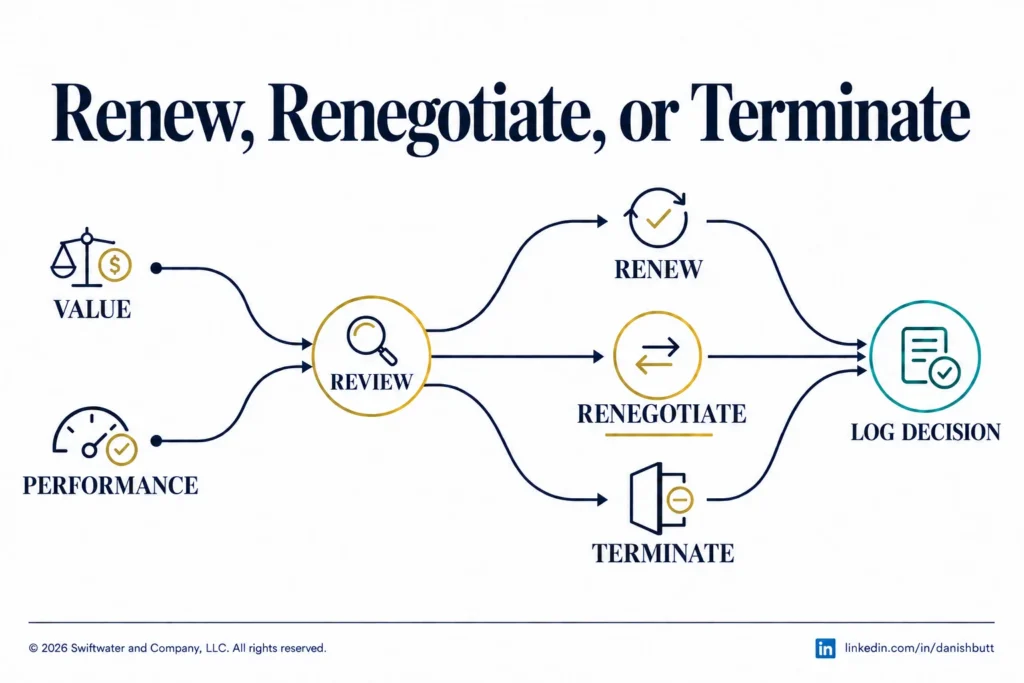
Decide by comparing the agreement’s value and performance against current needs and the market, using the obligation record and spend data. Ask whether the need remains, whether the counterparty met its commitments, and whether the price and terms still fit. Then choose one of three outcomes and log the reason on the contract record, so the next review starts from what was decided and why.
- Renew: the agreement still delivers value at a fair price and performance meets its terms; confirm and update the record.
- Renegotiate: the need remains but price, scope, service levels, or terms no longer fit; start early enough to finish before the notice deadline.
- Terminate: the need has gone or a better option exists; send notice on time, plan the transition, and close out obligations.
Renewal is often the best moment to renegotiate. WorldCC’s August 2025 research finds that 83% of executives say their contracts are too rigid to adapt to change, and a renewal is a scheduled chance to update them. Where a renegotiation changes terms, the change is recorded as an amendment on the contract record. For supplier renewals, our guide to supplier agreement management covers the wider review.
What is renewal capture rate?
Renewal capture rate is the share of renewals that were reviewed and decided before their notice deadline. On the sell side, teams also use it for the share of renewable revenue retained. It shows whether the alert design works: a falling rate means renewals are reaching owners too late or reaching the wrong people, and the alert lead times or routing need to change.
Track it by contract type and owner, and review it alongside the list of agreements that renewed with no decision logged. The calculation and how it sits with other contract measures are covered in our legal department KPIs guide.
How does renewal management work in a CLM?
In a CLM, renewal dates and notice deadlines are held as structured metadata on each contract. The system runs the alert and escalation workflow, shows upcoming renewals by owner on a calendar or dashboard, and records the decision, and any amendment or termination, back on the contract record. The record is then current for the next cycle without anyone re-entering dates.
A working setup has four parts. The repository holds the dates as fields, the workflow sends and escalates the alerts, the dashboard gives each owner and manager a forward view, and the record captures the outcome. Finance can use the same structured dates, values, and decision status for planning; our CFO’s guide to CLM covers forecasting renewal revenue.
Renewal is stage 7 of the seven stages of the contract lifecycle, and it closes the loop: a renewed or renegotiated agreement returns to the obligation register with new dates, and a terminated one is closed out and kept in the repository.
Evaluating legal technology but not sure where to start?
We help legal departments cut through the vendor noise, mapping technology to process maturity and building a roadmap that actually gets adopted.
See Legal Technology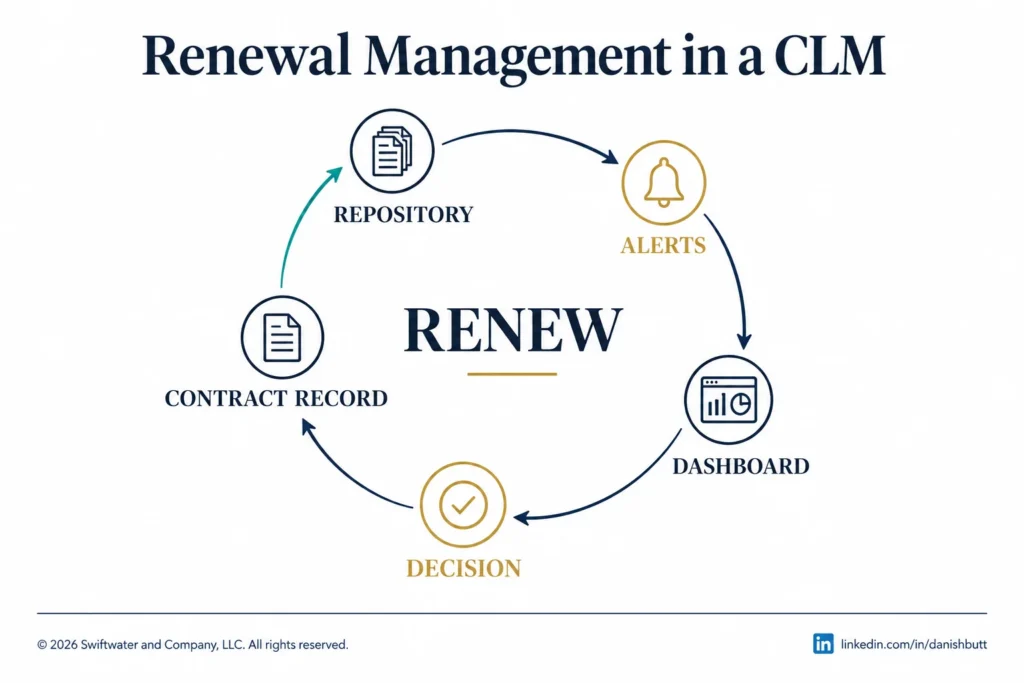
Bottom Line
Renewals are missed for operational reasons: dates that are not captured as data, owners who are not named, and reviews that start too late. Each of those is fixable with structured fields and well-designed alerts.
Anchor every alert to the notice deadline, tag auto-renewing and evergreen agreements, and log a renew, renegotiate, or terminate decision for each one. Every renewal should reach a named owner early enough to renew, renegotiate, or terminate on purpose, with the decision logged on the contract record.
Swiftwater’s CLM administrators run a live CLM after go-live, handling template and clause changes, workflow and approval updates, reporting, and user support, including the alert workflows and renewal reports this guide describes.
Frequently Asked Questions
What is contract renewal management?
Contract renewal management is the practice of reviewing every contract before it renews and deciding, on purpose, whether to renew it, renegotiate it, or end it. It tracks every renewal and notice deadline, reviews each agreement’s value and performance in time, and logs the decision on the contract record.
How do renewal alerts work, and who gets them?
Renewal alerts are scheduled backward from the notice deadline and go to the contract owner and a backup, with escalation to the owner’s manager when no decision is logged. The functions a renewal affects are included too: sales for customer contracts, and finance and procurement for supplier contracts.
What is the difference between a renewal date and a notice deadline?
The renewal date is when a new term begins. The notice deadline is the last day to tell the other party you intend to renegotiate or terminate, and it falls before the renewal date. Alerts should be built around the notice deadline, because missing it usually means the agreement renews.
How do you track auto-renewal risk?
Tag each contract’s renewal type (auto-renewal, evergreen, fixed term, or option to renew), make the notice deadline a required field, record the owner and whether the price changes at renewal, and review the tagged list on a standing cadence.
How do you decide to renew, renegotiate, or terminate?
Compare the agreement’s value and performance against current needs and the market, using the obligation record and spend data. Renew if both hold, renegotiate if the need remains but the terms no longer fit, and terminate if the need has gone. Log the reason on the contract record.
What is renewal capture rate?
Renewal capture rate is the share of renewals reviewed and decided before their notice deadline. It shows whether alerts reach the right owners in time. Our legal department KPIs guide covers how it fits a contract dashboard.
This article is provided for general informational purposes only and is not legal, financial, or business advice. Contract renewal and termination decisions should be validated against your organization’s specific structure, regulatory obligations, and counsel guidance, and you should consult a qualified professional for advice on your situation.