
A CLM implementation plan is the step-by-step schedule for putting a contract lifecycle management system to work: what gets decided, built, and moved, in what order, by whom, and by when. Most CLM programs that disappoint stall for the same reason: the contract types, approval rules, and data were still open when the build began, so every configuration choice became another meeting. A plan settles those questions first, gives each phase an owner, and sets a go-live date the team can meet.
This guide is for legal operations, legal, procurement, and sales operations leaders who are about to buy a CLM, or to relaunch one that never took hold. It covers the seven phases, how long each scope takes, who belongs on the team, and the five places where programs most often lose momentum. It is part of our contract lifecycle management guide; the CLM readiness and change management guide covers the groundwork that comes first.
What is a CLM implementation plan?
A CLM implementation plan is the phased program that takes a contract lifecycle management platform from the buying decision to daily use. It names the scope, the owners, the sequence of phases, the timeline, and the checkpoints where the sponsor decides whether to move on. It covers process and data as much as configuration, because the platform will run whatever process and data it is given.
A good plan fits on a few pages: the goals and success measures, the contract types in the first release, an owner for each phase, and the baseline (cycle time, volume, where contracts sit today) that later results are compared with.
When it scopes process design, the plan works through the seven stages of the contract lifecycle, from request and intake to renewal, renegotiation, or termination, and decides which stages the first release covers. Many programs start with request and intake plus storage, then add authoring, approvals, and obligations in later waves.
Is contract lifecycle management difficult to implement?
Contract lifecycle management is difficult to implement in proportion to how much is undecided at kickoff. Programs struggle when goals, process, data, and ownership are still open, because every configuration choice then turns into a debate between legal, procurement, sales, IT, and security. When those four are settled first, the build becomes a sequence of known tasks. Difficulty tracks readiness far more closely than it tracks the platform.
Without a plan to resolve those questions, implementations run long, stakeholders tire, and budgets overrun.
Evaluating or implementing a CLM platform?
We have guided legal departments through selection, implementation, and adoption, without the vendor bias. Let us talk about where you are and what you actually need.
See CLM ServicesThe stakes justify the effort. Research by WorldCC (formerly IACCM) finds the average business loses almost 9% of value annually through poor contract management; the best performers lose about 3% and the worst 15% or more. Read the figure as a direction for the whole business. A stalled implementation leaves that value where it was.
What are the phases of a CLM implementation?
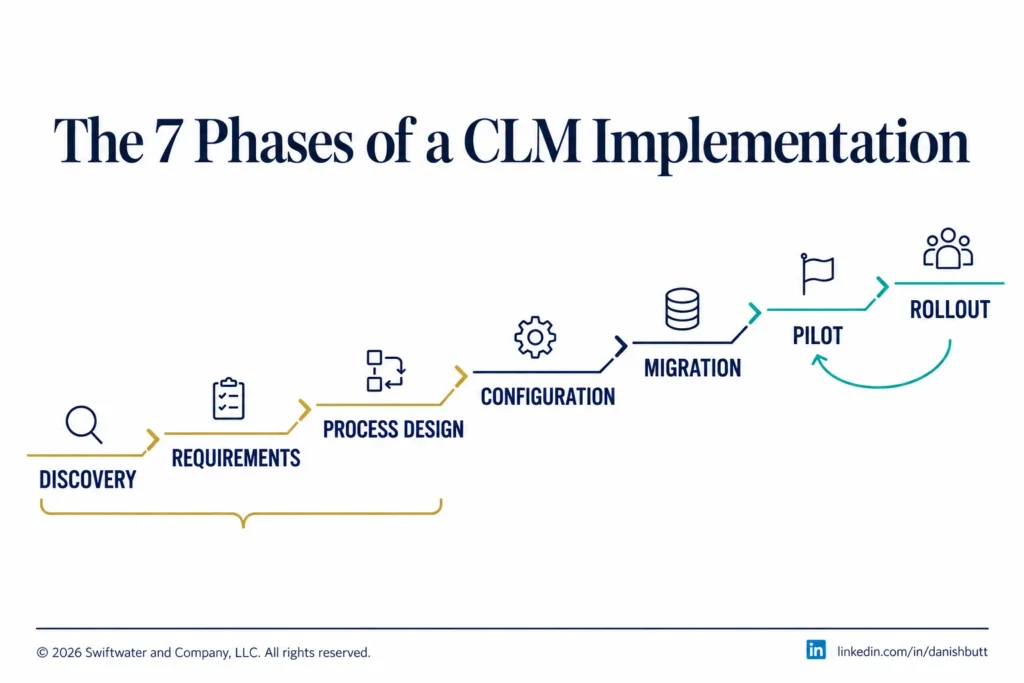
A CLM implementation runs in seven phases: discovery, requirements, process design, configuration, migration, pilot, and rollout. The first three are business work that settles what the platform must do. Configuration and migration build the platform and fill it with data. The pilot proves it on real contracts, and the rollout extends it to the rest of the business. Pilot and rollout often repeat by contract type.
- Discovery. Agree the goals and success measures, take the baseline, draw a current-state map of how contracts move today, and run a CLM readiness check on process, data, ownership, and sponsorship.
- Requirements. Write requirements by theme with the CLM requirements checklist, then run a scored selection (see how to choose a CLM vendor), or a fit check if the platform is already bought.
- Process design. Standardize contract intake, templates, clause libraries and playbooks, and approval workflows before anything is configured, and define who does what at each step.
- Configuration. Build the platform to the design and connect it to the systems where contracts start and end: CRM, ERP, e-signature, and identity. WorldCC reports that, on average, contract-related data is scattered across 24 different systems. Name the systems to integrate, agree the data mapping and sync rules, and test with real scenarios before go-live. The integration choices themselves are covered in CLM vs ERP, CRM, and document management.
- Migration. Extract legacy contracts, clean and normalize the metadata, and load them into the contract repository (see legacy contract migration). In the WorldCC and Sirion study (2026, 170 organizations), only 27% stored all executed contracts exclusively in a CLM system, and 54% had no automated data flow between systems.
- Pilot. Run one team or one priority contract type end to end, from intake to signature and storage, and fix what it exposes. An intake pilot is a common first choice.
- Rollout. Extend in waves by contract type or business unit, with role-based training, champions in each team, and a named administrator. Adoption work for this phase sits in the readiness and change management guide.
How long does a CLM implementation take?
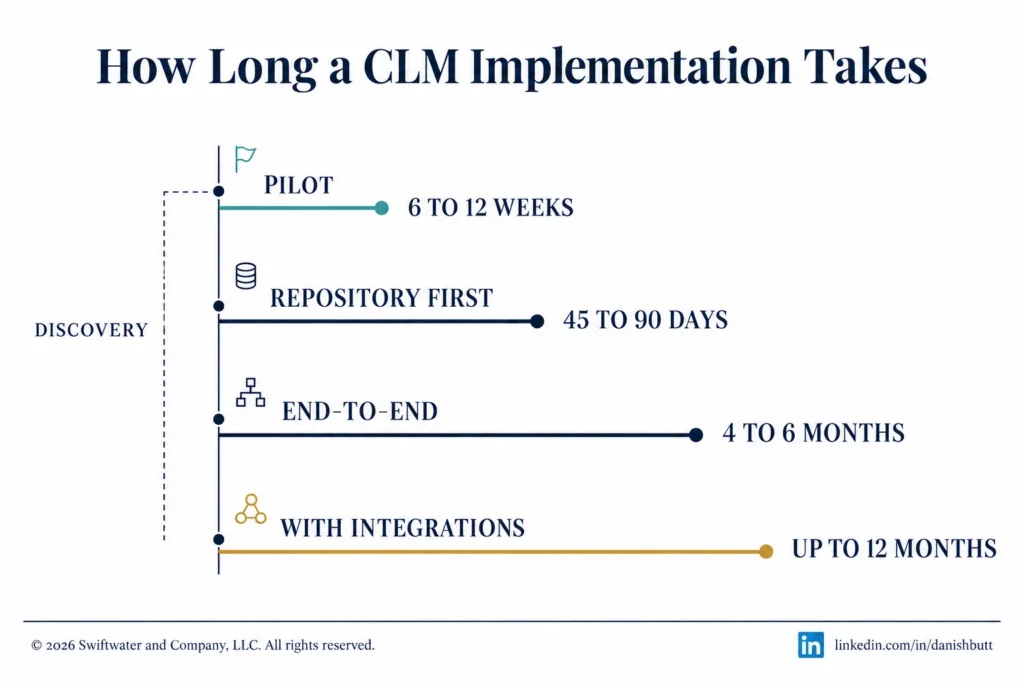
In Swiftwater’s guidance, a repository implementation takes 45 to 90 days, an end-to-end rollout with about a dozen templates takes 4 to 6 months, and a program with sales or procurement integrations can run up to 12 months. A pilot typically runs 6 to 12 weeks on one priority contract workflow. Scope drives the difference: the number of contract types, templates, approval workflows, and integrations.
These ranges are published on Swiftwater’s contract management solutions page and describe the build and rollout. Discovery and requirements come before them.
| Scope | What is in it | Duration and what drives it |
|---|---|---|
| Repository first | Executed contracts and their metadata in one searchable place, with renewal and key-date alerts | 45 to 90 days; driven by the volume and condition of legacy contracts |
| End-to-end rollout | Intake, about a dozen templates, approval workflows, signature, and storage | 4 to 6 months; driven by the number of templates and approval paths |
| With integrations | The end-to-end scope connected to sales or procurement systems | Up to 12 months; driven by the number of systems and the data passed between them |
| Pilot | One priority contract workflow, from intake through approval and signature | 6 to 12 weeks; long enough to run real contracts |
Technical work is only part of the timeline. Templates have to be agreed, people trained, and the rollout carried into the business, and plans that budget time for that work hold their dates.
Where do CLM implementations stall?
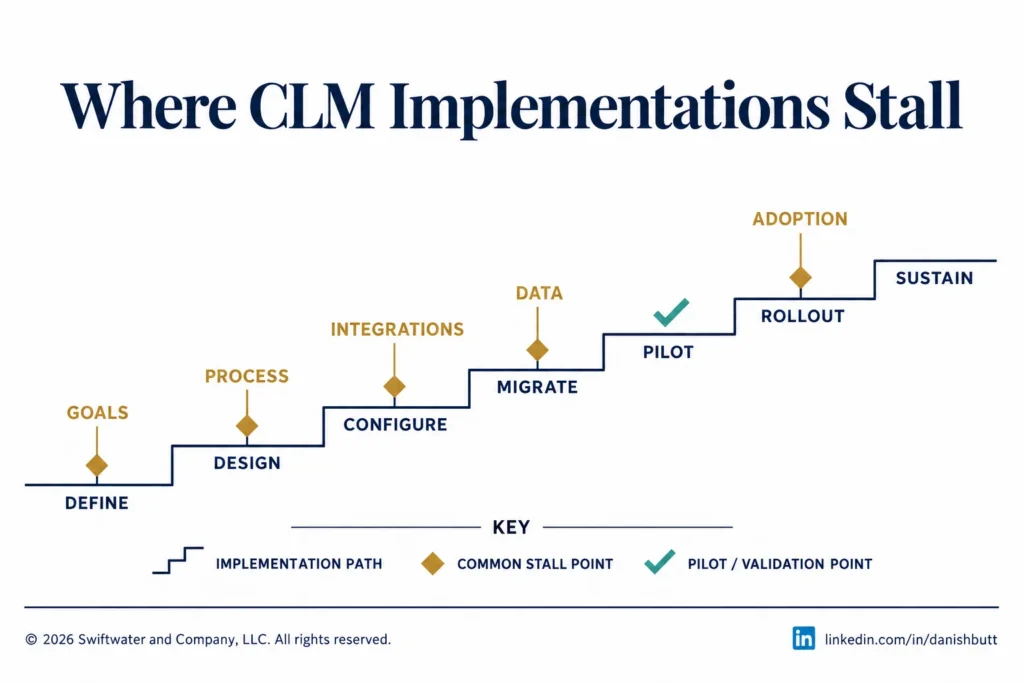
CLM implementations stall at the hand-offs between phases. The five common stall points are goals and success measures that were never agreed, processes automated before they were standardized, legacy data migrated without a cleanup pass, integrations scoped late, and adoption left to training day. Each one costs less to fix in the phase before it surfaces, which is why the plan front-loads the business decisions.
- Goals not agreed. Without a shared vision, every workshop reopens the scope. Name the goals in discovery, document them, and report progress against them to every stakeholder group.
- Process not standardized. Automating an inconsistent process makes inconsistency faster. Map the current workflow, agree one end-to-end process, and only then configure the approval workflow.
- Data not cleaned. Missing parties, dates, and renewal terms break search, alerts, and reports. Audit the data and cleanse it before migration.
- Integrations scoped late. An integration found during testing resets the timeline. List the systems in requirements and design the data flows in process design.
- Adoption left to training day. People keep using email unless the new route is easier. Plan adoption from discovery, with champions and role-based training.
A platform change, such as a merger or a vendor acquisition, restarts several of these risks at once; CLM after an acquisition covers that case.
Why does a CLM implementation start with readiness?
A CLM implementation starts with readiness because most of the problems a legal team attributes to the system turn out to be readiness and business problems. Unclear ownership, templates nobody has agreed, contract data that cannot be found, and a sponsor who has stepped back follow a team onto any platform. Checking goals, process, data, ownership, and sponsorship before configuration protects the timeline more cheaply than any later fix.
Swiftwater’s engagements start there for the same reason. The CLM readiness and change management guide includes a self-assessment that turns those five areas into a short list of gaps to close before the build. Teams that want a smaller first step can run an intake pilot, which tests ownership, routing, and adoption on one front door.
For a wider baseline, the Swiftwater Contract Management Maturity Model looks at the same ground in four layers: process, data, technology, and people.
Who should be on the CLM implementation team?
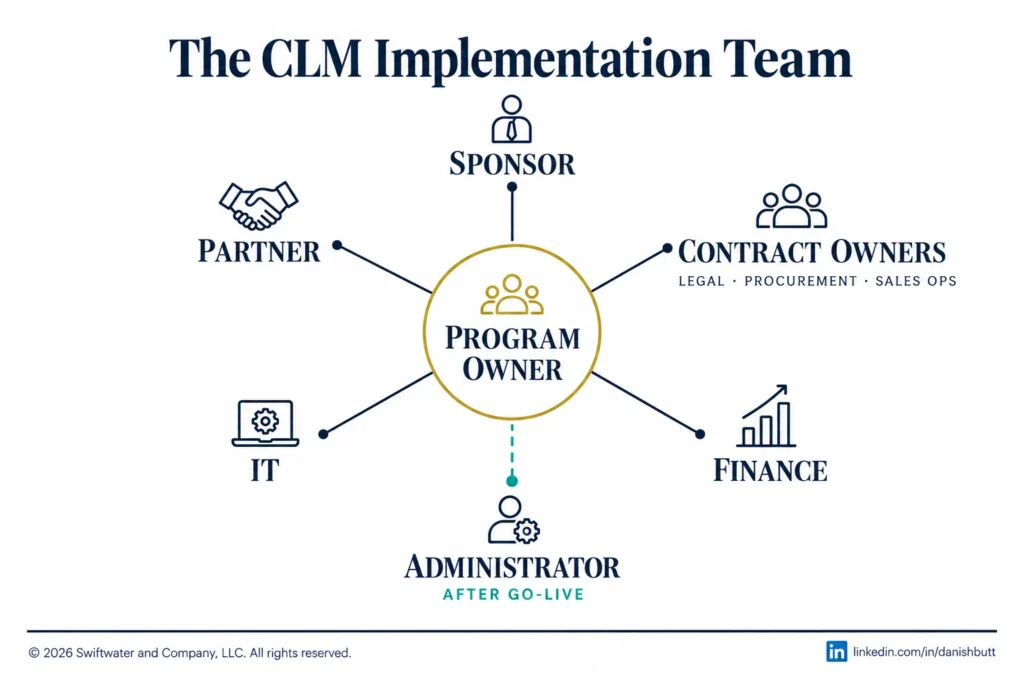
A CLM implementation team needs an executive sponsor, a program owner, the contract owners from legal, procurement, and sales operations, finance and IT, a named CLM administrator for after go-live, and the vendor or implementation partner team. Legal operations commonly owns the program, and the CLOC Core 12 places technology and process within the legal operations remit. Each role needs a named person, with time set aside.
CLOC reports technology strategy as a focus area for 80% of legal operations teams (135 law departments). Who owns contract management outside the program varies by contract type and volume.
| Role | What they own in the program | When they are needed most |
|---|---|---|
| Executive sponsor | Goals, budget, and decisions that cross functions | Discovery, and whenever scope is disputed |
| Program owner (often legal operations) | The plan, the phase gates, and reporting | Every phase |
| Contract owners (legal, procurement, sales operations) | Templates, playbooks, approval rules, and testing | Process design and pilot |
| Finance | Approval thresholds, spend and revenue data | Process design and configuration |
| IT | Integrations, identity, security, and data mapping | Configuration and migration |
| CLM administrator | The platform after go-live | Pilot, rollout, and after |
| Vendor or implementation partner | Configuration and technical delivery | Configuration through rollout |
What happens after go-live?
After go-live, the plan hands the platform to a named administrator, measures adoption and cycle time against the baseline set in discovery, and tunes templates, workflows, and reports on a regular cadence. A CLM that nobody owns after launch drifts: templates age, approval rules stop matching the business, and users go back to email. The last phase of the plan is ongoing ownership.
Evaluating legal technology but not sure where to start?
We help legal departments cut through the vendor noise, mapping technology to process maturity and building a roadmap that actually gets adopted.
See Legal TechnologyTrack the measures agreed in discovery, such as cycle time, template use, and repository completeness, and report them to the sponsor. Feed user feedback into a backlog of fixes, and adopt new platform features that serve the goals.
Swiftwater’s CLM administration service covers this ongoing work, including a fractional CLM administrator.
Bottom Line
A CLM implementation plan runs in seven phases, and the phases that decide the result (discovery, process design, migration, and rollout) are mostly business work. Duration follows scope, from a repository in weeks to an integrated program in months.
Start with readiness and a pilot, put a named owner on every phase, and measure from a baseline. A CLM implementation succeeds when the plan settles goals, process, data, and ownership before the platform is configured, and keeps an owner on the system after go-live.
Swiftwater’s contract management practice takes CLM programs from assessment and selection through implementation, configuring workflows, approval chains, and clause libraries. Where the plan is still open, a CLM discovery sprint maps the lifecycle from intake through renewal and recommends the pilot to run first.
Frequently Asked Questions
What is a CLM implementation?
A CLM implementation plan is the step-by-step schedule for putting a contract lifecycle management system to work: what gets decided, built, and moved, in what order, by whom, and by when. The implementation itself covers process design, templates, configuration, integrations, data migration, training, and the hand-over to an administrator.
Is CLM difficult to implement?
It is difficult in proportion to how much is undecided at kickoff. When goals, process, data, and ownership are settled before configuration, the build is a sequence of known tasks. A discovery phase and a pilot bring those decisions forward.
How long does a CLM implementation take?
In Swiftwater’s guidance, a repository implementation takes 45 to 90 days, an end-to-end rollout with about a dozen templates 4 to 6 months, and a program with sales or procurement integrations up to 12 months. A pilot on one priority workflow typically runs 6 to 12 weeks. The ranges are published on the contract management solutions page.
Why do legal teams put off CLM?
Legal teams put off CLM because of cost, the internal effort, and the fear of a rollout that nobody uses. A discovery phase reduces all three: it fixes the scope before money is committed, shows where the effort will go, and sets up a small pilot that proves value on one workflow before the wider rollout.
What are the hidden costs of a CLM implementation?
The costs that surprise teams are data cleanup before migration, integration work, template rework, the internal time of contract owners, and administration after go-live. Budget for them in the plan. For context on fees, Swiftwater publishes ranges of $20,000 to $150,000 for single-platform implementations in small and mid-size departments and $150,000 to $750,000 at enterprise scale, set out in its legal operations consultant guide.
How do you evaluate a vendor’s implementation support?
Ask for the implementation method, the named team and their experience, the approach to data migration, how integrations are scoped, and what support continues after go-live. Then speak to references with a similar scope. The guide to choosing a CLM vendor includes a scorecard.
How can CLM integration reduce manual contract data entry?
Integrations pass counterparty, deal, and supplier data from the CRM or ERP into the contract request, so nobody retypes it, and push signed contract metadata back to those systems after signature. Agree the fields, the direction of each flow, and the sync schedule during process design, and test them before go-live.
This article is provided for general informational purposes only and is not legal, financial, or business advice. CLM implementation decisions should be validated against your organization’s specific structure, regulatory obligations, and counsel guidance, and you should consult a qualified professional for advice on your situation.