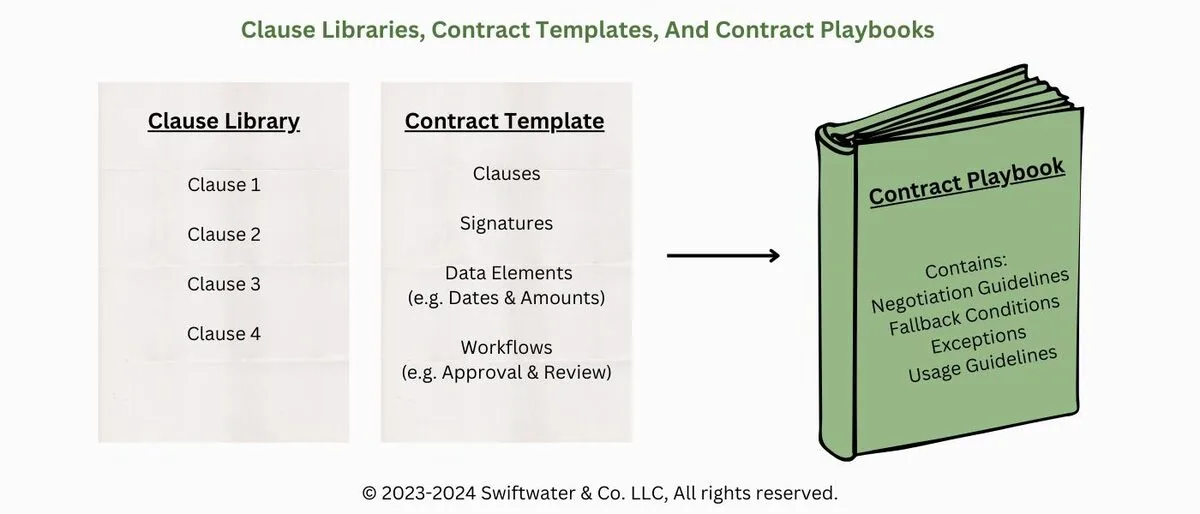

Clause libraries, templates, and playbooks are the tools of contract authoring inside a CLM. A template gives each contract type its structure, a clause library holds the approved wording, and a playbook sets out which positions are standard, how far negotiators can move, and who decides beyond that. Used together, they let more contracts go out on approved terms without a lawyer drafting each one.
Updated fall 2026 with the latest frontier and legal AI contract review skills and plugins. Jump to the AI tools.
This guide covers what each tool is, who owns it, how the three work together, how to keep them current, and how they connect to negotiation and AI review. It describes the operational side only, so please consult counsel on the wording itself. It is part of our contract lifecycle management guide.
What is contract authoring in a CLM?
Contract authoring is the stage of the contract lifecycle where a draft is created, from an approved template, using approved clauses, under the rules in a playbook. It is the second of the seven stages of the contract lifecycle, between intake and negotiation. In a CLM, authoring usually starts with a few questions about the deal, which decide the template, the clauses, and the data that fill the draft.
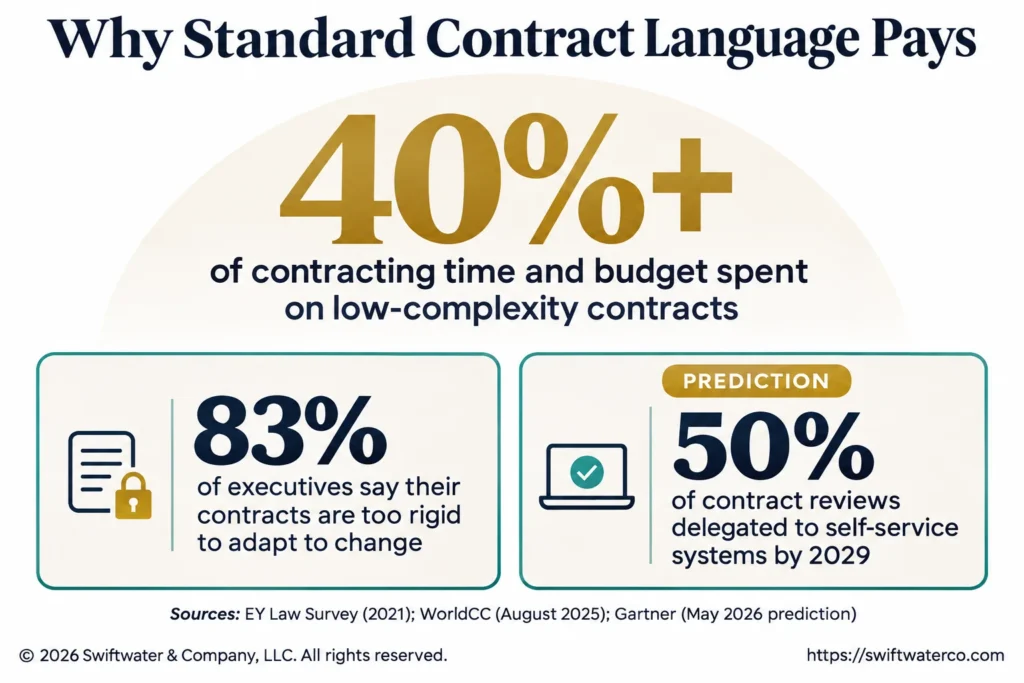
The payoff is time on routine work. In the 2021 EY Law Survey, contracting teams spent over 40% of their time and budget on low-complexity contracts. Standard authoring tools are how much of that work moves to the business, with legal still setting the rules.
What is a contract template, and who owns it?
A contract template is the approved starting document for one contract type, such as an NDA, a master services agreement, or a statement of work. It sets the structure, the standard terms, and the data fields a draft needs, such as effective dates, insurance amounts, and payment terms. Legal usually owns the wording, while the business function that uses the template most often owns how it is applied.
Most organizations already have templates of some kind. The common problem is that copies multiply, and people keep using whichever version they saved last. A CLM solves this by holding one current version of each template and generating drafts from it.
Evaluating or implementing a CLM platform?
We have guided legal departments through selection, implementation, and adoption, without the vendor bias. Let us talk about where you are and what you actually need.
See CLM ServicesIn a CLM, the user is often asked a short sequence of business and legal questions before a draft is generated. The answers decide which template to use, which clauses to include, and which values fill the data fields. Once the draft is generated, the CLM typically allows set portions to be customized. For professional services teams, the statement of work is often the first template to standardize, and the master services agreement sits above it.
What is a clause library?
A clause library is a governed collection of approved contract clauses, with alternate versions for different situations, that teams use when drafting or negotiating. Each clause is categorized, for example by contract type, business unit, product, or jurisdiction, and carries an owner and a version. A library can be extensive, or it can start with a few key clauses such as confidentiality, indemnity, and insurance.
Clause libraries help control legal risk because people use wording that legal has already approved, and the library records which version went into which contract. When a clause changes, the library shows where the old wording was used. The operational work is structure and ownership: how clauses are named, who approves a change, and how users find the right alternate quickly. The wording itself is a matter for your counsel.
What is a contract playbook?
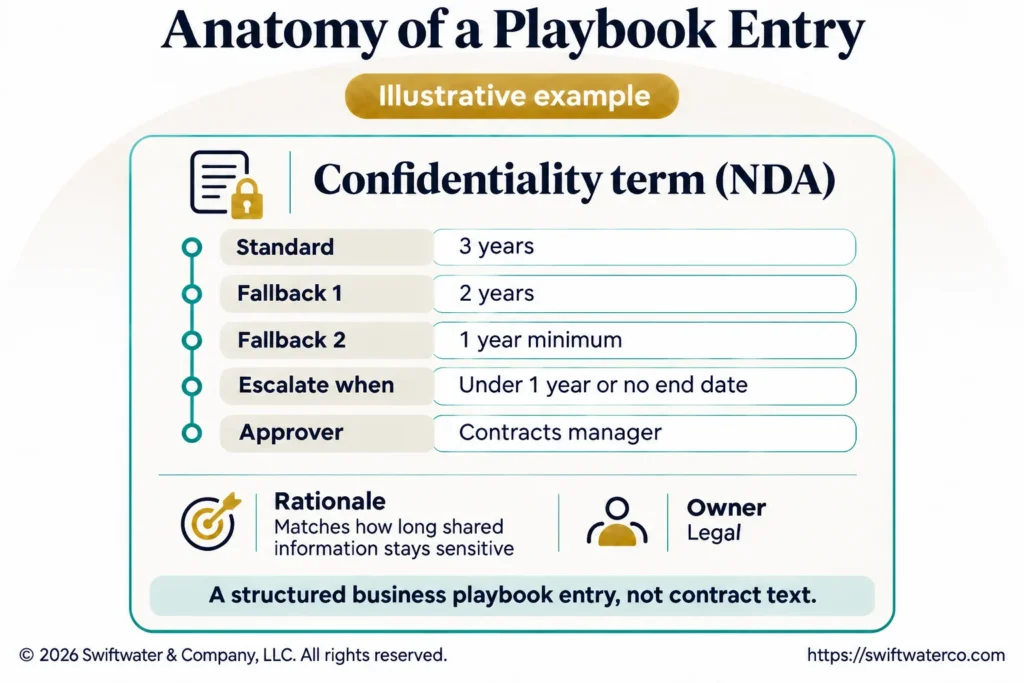
A contract playbook is the rulebook for negotiating a contract type: for each commonly negotiated topic, it states the standard position, the fallback positions the business may accept, when to escalate, who approves, and a short rationale negotiators can share. Playbooks generally define when a contract can take the fastest route to signature, and which conditions need exception handling and more time.
For example, an NDA playbook might state that the preferred duration of confidentiality is three years, with a minimum of one year. That example is illustrative only. A playbook states positions as business outcomes and leaves the wording to the clause library. That keeps approved language in one place, with one owner and one version history, so a change made there reaches every playbook that references it. It also keeps the playbook readable for the negotiators who use it, most of whom are not lawyers. Many AI review tools take example wording alongside each position; supply it from the clause library rather than retyping it, so people and AI work from the same approved text.
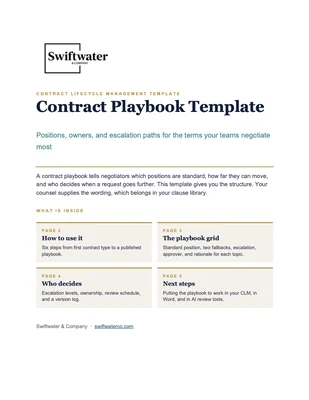
Our free contract playbook template sets out this structure: topic, standard position, two fallbacks, escalation trigger, approver, rationale, and owner, with an escalation path and a version log. It contains no contract language.
How do templates, clause libraries, and playbooks work together?
Templates, clause libraries, and playbooks work together as one authoring system: the template provides the structure, the clause library supplies approved wording and alternates, and the playbook governs which alternates may be used and who decides beyond them. In a CLM, a user answers intake questions, the system assembles a draft from the template and library, and the playbook guides negotiation and routes exceptions for approval.
| Tool | What it holds | Typical owner |
|---|---|---|
| Contract template | Structure, standard terms, and data fields for one contract type | Legal, with the business function that uses it |
| Clause library | Approved clauses and alternates, categorized and versioned | Legal or legal operations |
| Contract playbook | Positions, fallbacks, escalation rules, approvers, and rationale | Legal, with procurement or sales for commercial terms |
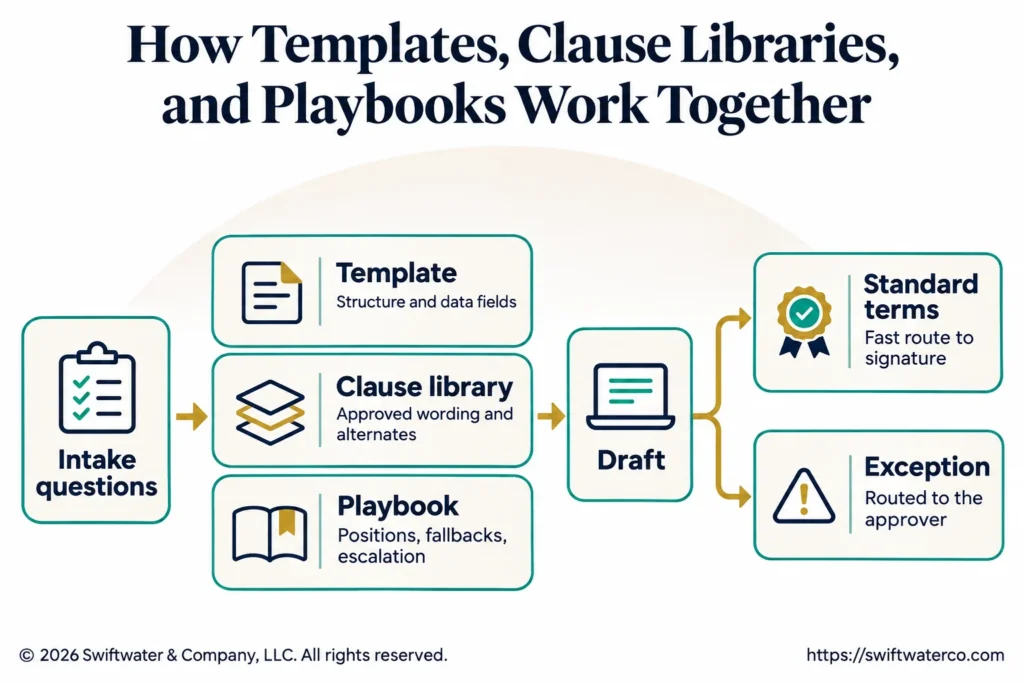
The same rules carry into contract workflow management, where approval routing, signature, and storage follow from the choices made during authoring. For a self-service example, see how teams automate NDAs with one template, a short request form, and playbook rules.
How do you manage template and clause library versions?
Manage template and clause library versions by keeping one published version of each item in the CLM, recording who changed what and why, and retiring old versions so they cannot be used for new drafts. Each template and clause needs a named owner and a review schedule. Changes should go through an approval route, just as a contract would, before they are published.
Some contracting systems allow a playbook or clause to be updated once and applied everywhere it is used, which helps when regulations, policies, or commercial positions change. Track how often reviewers override a position. Frequent overrides signal that a template or playbook no longer matches how the business negotiates, and that is often the first sign a review is due.
WorldCC’s August 2025 research finds that 83% of executives say their contracts are too rigid to adapt to change. Regular review of templates and playbooks is one of the ways to keep standard terms useful as the business changes.
Why does AI redlining need playbooks, clause libraries, and templates?
AI redlining needs playbooks, clause libraries, and templates because the tool can only redline toward a standard someone has defined. The template is the baseline it compares against, the playbook says which deviations are acceptable and who approves the rest, and the clause library supplies the approved fallback wording it proposes. Without them, the tool relies on general market assumptions, which may not match your company’s positions.
Most AI review tools now work inside Microsoft Word. They compare a draft with your positions, mark deviations, and propose edits as tracked changes, so the negotiation record stays intact. Our guide on how to redline in Word covers the mechanics, and our guide to AI contract review explains how the tools work and where they fail.
Evaluating legal technology but not sure where to start?
We help legal departments cut through the vendor noise, mapping technology to process maturity and building a roadmap that actually gets adopted.
See Legal TechnologyConsistency is the other reason. Two reviewers given the same contract and no playbook will often push back on different points, and an AI tool without a playbook can do the same from one user or one day to the next. A written playbook starts every reviewer, person or software, from the same positions, and its escalation rules tell the tool when to stop suggesting and send the issue to a person. Gartner predicts that by 2029, approximately 50% of contract reviews will be delegated to self-service systems that escalate only one in 10 for human review. Clear playbooks are what make that kind of self-service safe.
Which AI tools review contracts against a playbook?
Playbook-based contract review is now offered by the large AI platforms as well as specialist legal AI vendors. Anthropic, Google, OpenAI, and Microsoft each launched a legal product between May and October 2026, and Harvey, Legora, and GC AI run playbooks inside Microsoft Word. The mechanics differ, but every one of these tools applies positions that someone has to define and keep current.
| Provider | Contract review offering | What to know |
|---|---|---|
| Anthropic (Claude) | A legal plugin that reviews contracts clause by clause against a playbook file and suggests redlines; Claude for Legal followed in May 2026 | The default playbook reflects general US positions, and Anthropic says users in other jurisdictions must customize it before relying on the output |
| Microsoft | Copilot for Legal (October 2026), with legal skills in Word, including review against playbooks with tracked-change edits | Reviews against the playbooks you provide |
| Gemini Enterprise for Legal (August 2026), with agents for legal tasks | Launched in preview | |
| OpenAI | Astra for Law (September 2026), with a dedicated legal search index | Access initially limited to selected large firms |
| Harvey | Playbook review in its Word add-in, rebuilt in 2026 to improve risk classification and redline quality | Applies the positions in your playbook |
| Legora | Playbooks with starting positions, non-negotiables, and fallbacks, run in Word | Your organization defines the rules once in Legora |
| GC AI | Playbooks run in Word, with ready-to-use versions for NDAs, DPAs, and MSAs | Starter playbooks can be customized to company standards, or you can upload your own |
Every one of these tools provides the mechanics: the review skill, the Word integration, and the tracked changes. None of them knows your company’s positions. Starter playbooks reflect common market terms, and an AI assistant can suggest positions or turn an old negotiation memo into a draft playbook, which helps with consistency. Your legal and business owners still have to decide the standard position, the fallbacks, and who approves exceptions, then keep it current. That work is the playbook, and it is what our free template is built to capture.
When Anthropic released its legal plugin, I read the contract review skill line by line and shared my assessment on LinkedIn. The skill tells Claude to check for a configured playbook before reviewing any contract. Anthropic has since renamed it review-contract, and the current version still starts by loading the playbook.
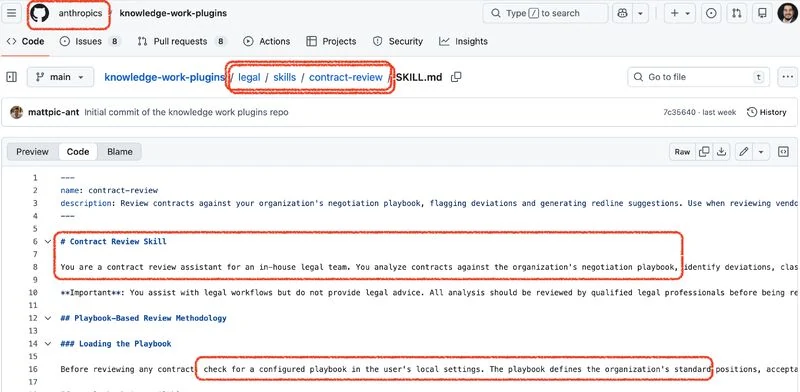
The skill is playbook-driven. It sorts issues into green (acceptable), yellow (negotiate), and red (escalate), and proposes redlines with a rationale you can send to the other side. It also only works if you have a documented playbook, and most legal departments don’t. It cannot tell you what is market, it does not know whether a deal is a $50M partnership or a $5K SaaS renewal, and Anthropic itself says the output should be reviewed by licensed attorneys.
How many general counsel actually have documented negotiation playbooks with standard positions, escalation triggers, and measures? Without those, this is just fancy find and flag.
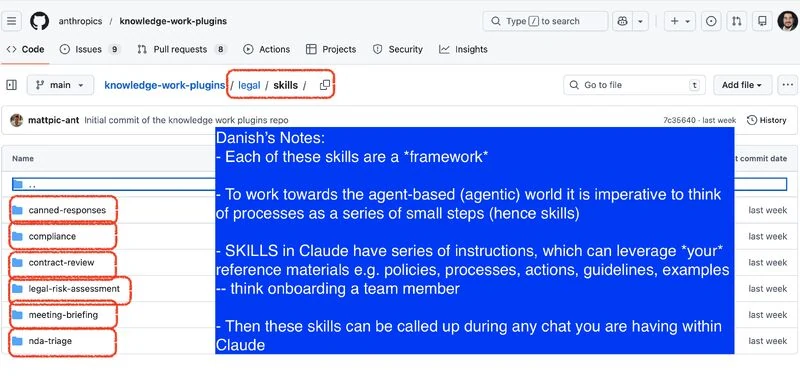
Skills like this are frameworks. Each one is a series of small steps that can draw on your own reference material, such as policies, processes, guidelines, and examples, much like onboarding a new team member. Thinking of contract work as small, defined steps is also how teams prepare for more agent-based work.
How do you build a clause library and a contract playbook?
Build a clause library and playbook by starting with one high-volume or high-risk contract type, listing its most negotiated topics, defining standard and fallback positions with counsel, setting escalation rules, and testing the result with the people who negotiate. Then load it into your CLM or review tool. Expand to the next contract type only after the first is in regular use.
- Pick the contract type. NDAs, supplier agreements, or sales terms are common starting points.
- List the negotiated topics. Ten to fifteen is a workable first set.
- Define positions with counsel. Standard, first fallback, second fallback, and when to escalate.
- Name owners and approvers. Every topic and every escalation level needs a person.
- Test with negotiators. Run real contracts through it before it goes live.
- Configure and publish. Load it into the CLM or AI review tool, and set a review schedule.
Adoption matters as much as the content. The benefits may be clear to the team that built the library and playbook, but the rest of the company needs to see them too. Explain what is in it for each group, and for the company as a whole, then support people with training, a way to give feedback, and reporting on how the tools are used.
Bottom Line
Clause libraries, templates, and playbooks turn legal judgment into rules the business can apply every day. When they are current and owned, routine contracts move faster, exceptions reach the right person, and AI tools have a clear standard to check against.
Not ready to pick a CLM platform yet?
A four to six week diagnostic that maps your current contract lifecycle, sets requirements themes, and tells you what to buy before you sit through another vendor demo.
See the CLM Discovery SprintWhen they are out of date, people work around them and the old risks return. Start with one contract type, write its playbook in plain positions, name an owner for every rule, and review it on a schedule.
Swiftwater’s contract management consultants help with assessment, playbooks, approval design, and vendor-neutral selection, so your templates, clause library, and playbooks work in the tools your teams use.
Frequently Asked Questions
What are clause libraries, templates, and playbooks?
Clause libraries, templates, and playbooks are the tools of contract authoring inside a CLM. A template provides the structure of a contract type, a clause library holds approved wording and alternates, and a playbook sets standard positions, fallbacks, and escalation rules. Together they let teams draft consistently and route exceptions to the right approver.
Can clause libraries help control legal risk?
Yes. A clause library helps control legal risk by giving people approved wording to use instead of drafting their own, and by recording which version of each clause went into which contract. When a clause changes, the library shows where the old wording was used. Results depend on clear ownership, regular review, and users actually drawing from the library.
Can one template serve multiple contract types?
Usually it is better to keep one template for each contract type, because each has different terms and data. A single template can cover variations of the same type, such as mutual and one-way NDAs, when a few intake questions decide which clauses and options to include. Too many variations in one template make it harder to maintain and review.
Can templates reduce contract drafting time?
Yes. Templates reduce drafting time by starting each contract from approved structure and terms, so the drafter fills in deal details instead of writing from scratch. In a CLM, intake questions can generate the draft automatically. The time saved depends on keeping templates current, so people trust them and stop editing old copies saved on their own drives.
How do playbooks keep negotiators on approved positions?
Playbooks keep negotiators on approved positions by stating the standard position, the fallbacks they may accept, and when they must escalate, with a named approver for each level. In a CLM or AI review tool, the same rules can flag deviations automatically. A short rationale for each position helps negotiators explain it to the other side.
How do you keep everyone on the latest template?
Publish one current version of each template in the CLM, generate drafts only from there, and retire old versions so they cannot be used for new contracts. Name an owner for each template, route changes through approval, and tell users when something changes. Removing copies from shared drives and email signatures is often the hardest part.
How can AI support clause libraries and contract playbooks?
AI can compare third-party drafts against your playbook positions, flag deviations, and suggest fallback language from your clause library, often as tracked changes in Word. Tools from Anthropic, Microsoft, Harvey, Legora, and GC AI all work this way, but each depends on positions your team defines and keeps current. People still review the output and make the final decisions.
This article is provided for general informational purposes only and is not legal, financial, or business advice. Contract wording and negotiation positions should be validated against your organization’s specific structure, regulatory obligations, and counsel guidance, and you should consult a qualified professional for advice on your situation.