
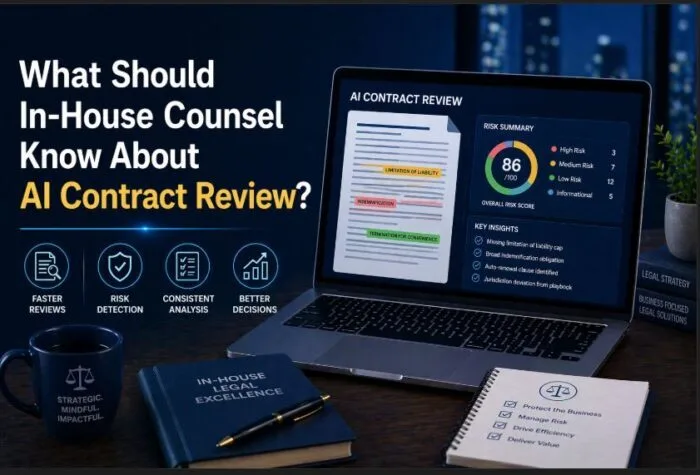

AI for contract review is the use of artificial intelligence to analyze, summarize, and identify risks, clauses, and deviations in legal agreements to improve speed and consistency in contract workflows. Lawyers reach for it most often on third-party paper, where they need to compare incoming language against their own positions and redline the gaps. It is one of the most time-intensive activities in-house legal teams face, and usually the first use case a legal department reaches for.
This article is part of the Legal AI hub and sits alongside the AI legal assistant article and the agentic AI article.
What AI contract review can realistically deliver today:
- Clause identification and redlining: detect key provisions, mark deviations, propose edits.
- Risk flagging: highlight unusual or missing clauses.
- Contract summarization: generate structured summaries for faster decision-making.
- Review acceleration: reduce initial review time for standard agreements.
Without a documented playbook, AI contract review is just fancy find-and-flag.
Why is contract review the first AI use case for legal teams?
Contract review combines volume, repetition, and structure. The workflow is the same every time: review similar contract types, apply standard playbooks or fallback positions, identify known clause patterns.
The Thomson Reuters 2025 Generative AI in Professional Services report confirms contract-related tasks are where legal professionals see the most immediate time savings from AI.
What does AI contract review actually improve?
AI improves the first layer of review, not the final decision (directly). With that said, when some of the initial burden is taken off the lawyer’s plate it allows them to focus more on interpretation and negotiation. The following are reported results achieved by teams using AI for contract review.
Thinking about AI but not sure what is actually ready to deploy?
Swiftwater's AI Lab helps legal departments separate signal from noise, identifying where AI creates real leverage and building the governance to use it responsibly.
See Legal AI Solutions- Speed: faster identification of clauses and issues.
- Consistency: uniform application of review criteria.
- Coverage: reduced likelihood of missing standard issues.
- Scalability: handles large contract volumes.
Are redlining and AI contract review the same thing?
No. Redlining is the act of marking changes to a document. AI contract review is the broader analysis that identifies risks, clause deviations, obligations, and issues against a playbook.
The two get used synonymously because lawyers want the output of a review delivered as tracked-change redlines they can accept, modify, or reject. The AI does the thinking; the redlines deliver the result in a format that fits existing review habits.
The distinction matters when evaluating tools. Some products redline against templates without genuine risk analysis. Others produce strong analysis but output commentary rather than usable redlines. A fit-for-purpose tool does both and delivers them inside Word, where lawyers already work.
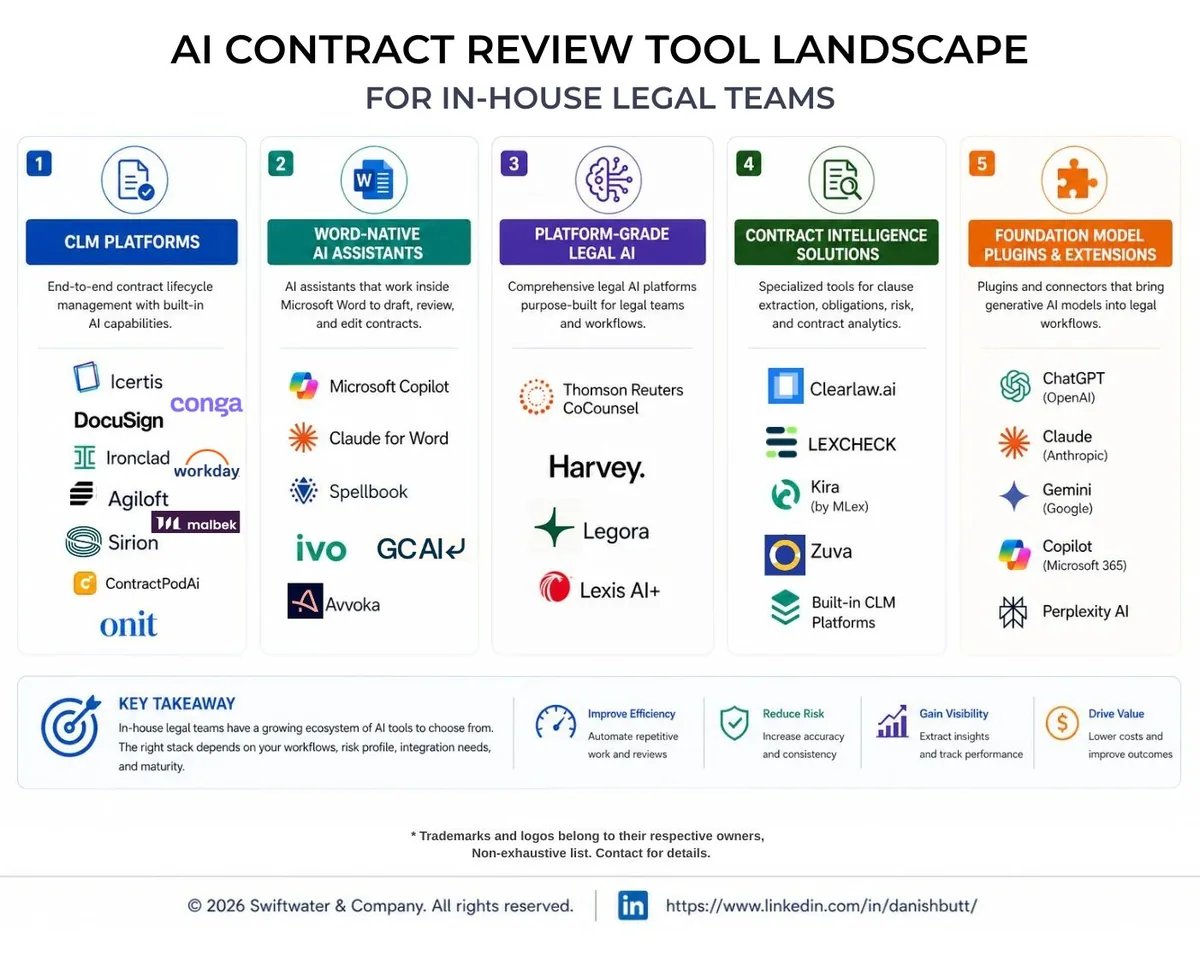
What tools actually exist for AI contract review today?
The market splits into five categories.
CLM platforms with embedded AI are the backbone for most corporate contract operations. Conga, Icertis, Ironclad, DocuSign CLM, Sirion, LinkSquares, Agiloft, and Malbek all offer AI-driven clause extraction, risk scoring, and obligation tracking inside full contract lifecycle workflows. Future Market Insights sizes the global CLM market at $1.8 billion in 2026, heading to $5.4 billion by 2036. Gartner reports half of initial CLM implementations still fail.
Word-native contract AI follows lawyers into the environment they live in. Spellbook runs clause drafting and redlining inside Word. Onit ReviewAI applies a legal playbook to contract review inside Word and connects to Onit’s CLM. Anthropic released Claude for Word on April 10, 2026, with legal contract review listed first among its example use cases and every AI edit landing as a tracked change.
Platform-grade legal AI combines workflow, review, drafting, and research in one workspace. Harvey and Legora lead this category. Legora crossed $100 million ARR in 18 months serving 1,000 customers across 50 markets. The established players namely Thomson Reuters and LexisNexis are offering their platform flavor infused with their research knowledge base.
Contract intelligence and data-extraction tools pull structured data from third-party paper rather than running a CLM. Swiftwater’s partner ClearLaw extracts up to 600 data points per contract and plugs into existing CLM, ELM, procurement, and workflow systems. See the Swiftwater-ClearLaw partnership announcement.
Foundation model plugins are the newest and most disruptive category. Most models are coming up with plugins that are graduating to Word-native tools e.g. as of June 17th, 2026, Microsoft Copilot will have native MS Word co-work capability. Earlier, on February 2, 2026, Anthropic released a legal plugin for Claude Cowork covering contract review, NDA triage, compliance, and briefings, configurable to an organization’s own playbook. The market response was immediate: Thomson Reuters fell 16 percent, RELX fell 14 percent, Wolters Kluwer fell 13 percent the next trading day, wiping roughly $285 billion in market value from legal and data companies.
Tool category alone is not the variable that separates success from failure. Playbook maturity, change management, application to business needs also play a big part in the success.
What does Claude’s legal plugin actually do, and what does it not do?
The contract-review skill runs a clause-by-clause review against an organization’s configured playbook and returns GREEN (acceptable), YELLOW (negotiate), RED (escalate) flags with specific redline language and rationale. It handles clause interactions (an uncapped indemnity may be mitigated by a broad limitation of liability) and covers LOL carveouts, mutual indemnification, IP ownership, DPAs, and cross-border transfers. This is not find-and-flag.
Evaluating legal technology but not sure where to start?
We help legal departments cut through the vendor noise, mapping technology to process maturity and building a roadmap that actually gets adopted.
See Legal TechnologyIt has four real gaps, that the skill itself requires to you fill before using it effectively:
- No playbook, no product: the skill reviews against your documented playbook. Most legal departments do not have one.
- No proprietary data: it cannot tell you what is market, because it has no comparable deals or negotiation outcomes.
- No commercial context: it does not know whether a contract is a $50 million partnership or a $5,000 SaaS renewal.
- No workflow integration on its own: it does not connect to CLM, approvals, or e-signature without the Cowork plugin infrastructure around it.
This does not replace Westlaw. It does replace “AI wrapper” companies with no defensible moat.
On April 10, 2026, Anthropic extended the same approach into Microsoft Word. Edits land as tracked changes. Suggested prompts include summarizing commercial terms, flagging off-market provisions by severity, making indemnification mutual, and working through reviewer comments. For in-house teams who live in Word, the adoption friction just dropped.
The question every general counsel should answer: does the legal department have the playbook maturity to leverage this?
Are AI copilots better than specialized AI contract review tools?
Neither is universally better. The answer depends on the shape of the contract portfolio and the maturity of the playbook.
A Swiftwater client tested both side by side. As a company dealing predominantly with third-party paper, they found that a general-purpose AI copilot paired with a legal research tool gave their lawyers more autonomy to handle novel language creatively. The team concluded their portfolio was not conducive to regimented playbooks with multiple fallback clauses.
The pattern: own paper plus a tight playbook favors specialized tools like Onit ReviewAI, Spellbook, or Harvey. Third-party paper plus creative negotiation often favors a general copilot paired with research. They are different problems.
Where does AI contract review fall short?
AI cannot replace legal judgment in negotiation. Bloomberg Law surveys continue to place accuracy, reliability, and hallucination risk at the top of the concerns legal teams flag about AI. AI can assist review. It cannot replace accountability. The common limitations are:
- Context gaps: difficulty interpreting deal-specific nuances.
- Negotiation strategy: cannot assess trade-offs in real time.
- Jurisdictional variation: limited understanding of local legal nuances beyond what is encoded in the playbook.
- False positives and false negatives: incorrectly flagging or missing issues.
- Hallucinations: fabricated clause references, invented citations, or confidently wrong summaries, especially on complex or unusual language.
How should in-house teams deploy AI for contract review?
To deploy AI for contract review, target contract types with a written playbook, starting with low-risk agreements and expanding only after measurement. Most teams fail by picking a tool before the playbook exists, or by applying AI to complex contracts too early. The evaluation framework for AI tools covers selection, and the CLM best practices guide covers the deployment mechanics of the contract lifecycle environment this AI work sits inside.
Also, remember, not all contract review tools are equal. Here are best practices for deployment:
- Start with standard agreements: NDAs, vendor contracts, low-risk documents.
- Invest in the playbook first: define clause standards, fallback positions, and escalation triggers before selecting a tool.
- Maintain human review: validate AI outputs before they leave the legal department.
- Integrate with CLM: embed AI into existing contract workflows rather than creating parallel ones.
- Measure performance: track time saved and accuracy.
Swiftwater runs these programs through its contract management solution and CLM knowledge hub. The Swiftwater-ClearLaw partnership gives clients a path to extract structured intelligence from existing contract inventories without waiting for a full CLM build.
How does AI contract review impact legal team performance?
AI contract review reduces review time on standard agreements, applies the same standards to every contract, and increases throughput without adding headcount. The 2026 ACC Chief Legal Officers Survey shows legal teams are consistently expected to improve efficiency without new resources. AI directly supports that expectation while freeing lawyer time for work where judgment actually matters.
What risks should legal teams manage?
AI should operate inside a defined legal AI governance framework, not as a standalone solution. The broader risk treatment sits in AI legal risk management in-house.AI contract review concentrates risk in the gap between a confident output and a verified one. Here are risks to be aware of:
- Unvalidated outputs: accepting AI results without review.
- Data exposure: uploading sensitive contracts to tools without enterprise-grade data handling.
- Inconsistent usage: different teams applying AI differently across the department.
- Overconfidence: assuming AI analysis is complete or “market.”
- Bias: AI systems trained on historical contracts can propagate the biases in that data, including one-sided positions and patterns that unfairly disadvantage particular counterparties.
- Hallucinations: confident but wrong clause references or summaries, especially on unfamiliar language.
Bottom line
AI contract review is one of the highest-leverage uses of AI in legal, but only when applied to the right workflows and against a real playbook. AI improves contract review efficiency, but legal responsibility still remains with the lawyer.
If you are ready to improve contract review workflows, explore how Swiftwater’s Legal AI Solutions help in-house teams deploy AI with structured playbooks, CLM integration, and measurable impact.
Evaluating or implementing a CLM platform?
We have guided legal departments through selection, implementation, and adoption, without the vendor bias. Let us talk about where you are and what you actually need.
See CLM ServicesFrequently Asked Questions
What is AI contract review for in-house legal teams?
AI contract review uses artificial intelligence to analyze contracts, identify clauses, flag risks, and suggest redlines, helping legal teams accelerate review and maintain consistency across high-volume agreements.
Why is contract review the first AI use case for legal teams?
Contract review is ideal for AI because it involves repetitive, structured tasks with high volume, allowing legal teams to quickly realize efficiency gains in identifying key clauses and potential risks.
What can AI contract review tools actually improve?
AI enhances the initial review layer by speeding up clause detection, ensuring consistent application of standards, improving coverage of issues, and enabling scalability for large contract portfolios.
Are redlining and AI contract review the same thing?
No. Redlining is the act of marking changes in a document, whereas AI contract review analyzes clauses, identifies risks, and generates actionable insights, which can then be translated into redlines.
What tools are available for AI contract review today?
Tools include CLM platforms with embedded AI, Word-native drafting tools, platform-grade AI solutions, contract intelligence tools for structured data extraction, and foundation model plugins configured for legal workflows.
What are the limitations of AI contract review?
AI cannot replace human judgment. It may struggle with context-specific nuances, negotiation strategy, jurisdictional variations, and complex decision-making beyond the rules encoded in the playbook.
How should in-house teams deploy AI for contract review?
Teams should deploy AI against a documented playbook, start with low-risk agreements, maintain human review for verification, integrate with CLM systems, and measure performance for continuous improvement.
What risks should legal teams manage when using AI contract review?
Key risks include unvalidated outputs, data exposure, inconsistent usage across the team, overconfidence in AI analysis, and hallucinations or misinterpretation of clauses.
This article is provided for educational and informational purposes only. Neither Swiftwater and Company nor the author provides legal advice. This content does not constitute professional legal, financial, or operational advice and should not be relied upon as such. Readers are encouraged to consult a qualified professional before making decisions based on the information provided. External links are included for reference only and reflect the views of their respective authors. Swiftwater and Company takes no responsibility for third-party content.