
Contract lifecycle mapping refers to documenting how a contract actually moves today in your organization, from where it originates in your sell-side and buy-side enterprise platforms, through authoring and approval, to the obligations and renewals it leaves behind, and marking every handoff and gap along the way.
The point is to document reality, not the process you wish you had. Most organizations discover that the lifecycle they describe in a policy and the one their teams actually run are different in ways that explain every downstream problem.
This is the work that should happen before you select a platform or redesign anything, because you cannot fix a process you have not seen clearly. It is the foundation step in any serious contract lifecycle management program.
How do you map your current contract lifecycle?
Map the lifecycle by walking each contract type through its real stages with the people who do the work, recording where it starts, who touches it, where it waits, and where it breaks.
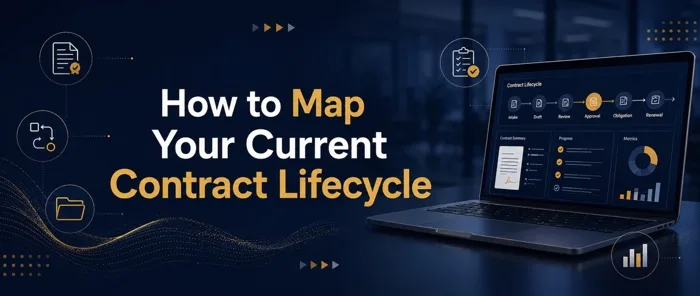
The method borrows from lean value-stream mapping, which documents the current state of a process before designing a future one, and from standard process assessment, which uses interviews with the people who run a process to measure the gap between the official version and the field reality. Applied to contracts, that means following the work across all seven lifecycle phases, intake, authoring, negotiation, approval, signature, obligations, and renewal or termination.
Want to see the finished output first? The current-state lifecycle map below lays out all seven phases with their owners, systems, handoffs, and common gaps in a single matrix.
In a Swiftwater discovery sprint this is the first deliverable, built from stakeholder interviews structured to minimize fatigue, so a sales operations lead, a procurement manager, and a legal reviewer each spend their time on the part of the lifecycle they actually know. The output is a single current-state map the whole organization recognizes.
Why map the current state before changing anything?
Map the current state first because every CLM failure traces back to a process problem that mapping would have exposed. Deloitte research found poor contract management erodes an average of 8.6 percent of contract value, and that contract data sits scattered across an average of 24 systems. Those losses live in the handoffs and gaps, not in any single team.
Not ready to pick a CLM platform yet?
A four to six week diagnostic that maps your current contract lifecycle, sets requirements themes, and tells you what to buy before you sit through another vendor demo.
See the CLM Discovery SprintA map turns vague complaints into specific findings. “Contracts take too long” becomes “sell-side agreements wait an average of nine days between Salesforce generation and legal review, because there is no routing rule.” That is a problem you can fix. The complaint is not.
Mapping also protects you from automating a broken process. Layering a CLM on top of an unmapped lifecycle hardwires the existing dysfunction and makes it more expensive to change later. The disciplines that keep a contract process healthy are covered in Contract Workflow Management.
What stages and handoffs should the map capture?
Capture all seven lifecycle phases, and pay closest attention to the handoffs between them, because the handoffs are where contracts stall and value leaks.
For each phase, record four things: who owns it, what system it runs in, where the work hands off, and where it commonly breaks. A phase that looks fine in isolation often hides a broken handoff on either side of it, which is why the transitions matter more than the stages themselves.
The phases run from intake through renewal and termination. A starting framework for the lifecycle stages themselves is in Contracting Made Easy.
How do you map the sell-side flow?
Map the sell-side flow starting in Salesforce, where contracts originate close to the opportunity and the quote, often driven by CPQ.
The map needs to capture how a sell-side agreement moves from a closing deal into authoring, and where it hands off to the CLM as the system of record once signed. The common gap is that the executed agreement never makes the handoff, so obligations and renewals stay trapped in the sales system that does not manage them.
Where this flow should hand off, and which system owns the record at each point, is the subject of the Salesforce vs CLM vs ServiceNow boundary model.
How do you map the buy-side flow?
Map the buy-side flow starting in ServiceNow for service and vendor requests and in procurement systems like SAP and Coupa for supplier agreements.
The map needs to show how a buy-side request becomes a contract and where it hands off for authoring and into the CLM. The common gap is that procurement and legal run parallel processes with separate records, so the same supplier contract exists in two places with two statuses and no agreed source of truth.
Mapping both sides matters because a map that covers only one flow misses half the handoffs and most of the gaps. Both enterprise-platform flows belong on the same picture, even though you map them separately.
How do you find the gaps that no technology will fix?
Find the gaps by looking at the seams, the points where work crosses between people, functions, or systems, because that is where process problems live and where software alone does nothing.
The recurring gaps are familiar once you look for them: requests that arrive by email because no intake exists, approvals that wait because no one owns the routing, executed contracts that never reach the repository, and renewals that surface only when a vendor invoice changes. None of these is a feature gap. Each is an ownership or handoff gap that a platform will faithfully reproduce if you automate around it.
Evaluating or implementing a CLM platform?
We have guided legal departments through selection, implementation, and adoption, without the vendor bias. Let us talk about where you are and what you actually need.
See CLM ServicesThis is the finding that earns the mapping exercise its place. A platform applied to a clean process compounds value; a platform applied to a broken one compounds the breakage. Mapping tells you which one you have before you spend. When intake is the gap you find first, piloting contract intake is a low-risk way to prove the fix before committing to a platform.
Who needs to be in the room to map it accurately?
Put the people who do the work in the room, not only the people who manage it, because the real process lives with the practitioners and the official process lives with the managers.
For an accurate map you need sales operations for the sell-side flow, procurement for the buy-side flow, legal and legal operations for authoring and governance, and IT or the enterprise platform owners for the system reality. The general counsel sets the standards, but the associate who actually routes a contract knows where it stalls.
The interview structure matters as much as the attendee list. Swiftwater sequences the interviews to minimize fatigue, so each participant covers only their part of the lifecycle, which produces a more honest map than a single large workshop where the loudest voice sets the narrative.
What does a finished lifecycle map look like?
A finished map shows every phase, its owner, its system, its handoffs, and its gaps in one view the whole organization can read.
| Lifecycle phase | Typical owner | Originating system | Common handoff | Common gap |
|---|---|---|---|---|
| Intake (sell-side) | Sales / sales ops | Salesforce | To authoring, then CLM | Request never structured, lives in the deal |
| Intake (buy-side) | Procurement | ServiceNow, SAP, Coupa | To authoring, then CLM | Procurement and legal run parallel records with no agreed source of truth |
| Authoring | Legal | CLM | From intake systems | Incomplete context leads to back-and-forth delays |
| Negotiation | Legal and business | CLM | Back and forth with counterparty | Versions tracked over email |
| Approval | Legal and business owner | CLM or workflow | To signature | No routing rule, approvals wait |
| Signature | Business owner | E-signature | To repository | Executed copy never reaches the CLM |
| Obligations and renewals | Business, legal orchestrates | CLM | Alerts to owners | Renewals surface only at invoice time |
The map is the deliverable everything else builds on. The requirements themes, readiness, and the platform decision all read off it, which is why it comes first.
Bottom Line
A current-state contract lifecycle map is the cheapest insurance you can buy against an expensive implementation, because it shows you the process problems a platform will otherwise automate and entrench. Map the lifecycle across both your sell-side and buy-side enterprise platforms before you change anything, and every later decision gets easier and safer.
This map is the first thing Swiftwater builds in a CLM discovery sprint. We interview the people who run the work across your sell-side and buy-side enterprise platforms, document the real lifecycle across all seven phases, and mark every handoff and gap, so you start your platform decision from reality instead of assumption. If your contract process spans Salesforce, ServiceNow, and procurement systems and no one has mapped how it actually runs, a CLM discovery sprint produces that picture in four to six weeks.
Frequently asked questions
What is contract lifecycle mapping?
Documenting how a contract actually moves through your organization today, from where it originates in your sell-side and buy-side systems, through authoring and approval, to obligations and renewals, marking every handoff and gap. It captures reality, not the process you intend to run.
Should you map your process before buying a CLM?
Yes. Mapping first exposes the ownership and handoff problems a platform will otherwise automate and entrench. A CLM applied to a clean process compounds value; applied to a broken one it compounds the breakage.
Who should be involved in mapping the contract lifecycle?
The people who do the work, not only those who manage it. You need sales operations for the sell-side flow, procurement for the buy side, legal and legal operations for authoring and governance, and the enterprise platform owners for the system reality.
What does a contract lifecycle map include?
Every lifecycle phase with its owner, its originating system, its handoffs, and its common gaps, shown in one view. The handoffs between phases matter most, because that is where contracts stall and value leaks.
What problems does mapping reveal that software cannot fix?
Ownership and handoff gaps: requests with no intake, approvals with no routing owner, executed contracts that never reach the repository, renewals that surface only at invoice time. None is a feature gap, and a platform will reproduce each one if you automate around it.
This article is provided for general informational purposes and does not constitute legal advice. Contract process and system decisions should be validated against your organization’s specific structure, regulatory obligations, and counsel guidance.