
Contract management certifications test contracting knowledge: NCMA’s CPCM, CFCM and CCCM, the WorldCC pathway, and CLM platform credentials. They range from an entry-level associate credential that needs no experience to a professional credential that needs a degree, five years of experience, and a four-hour exam. Which one is worth the time depends on the contracts you work on: commercial, federal, or both, and the platform your employer runs.
The field changed in 2025 and 2026. NCMA and World Commerce & Contracting (WorldCC, formerly IACCM) founded the Commerce & Contract Management Institute (CCM Institute), which now issues a joint entry-level credential, and NCMA’s old associate credential closed to new applicants. Every requirement and fee below was read from the issuer’s own site in November 2026, and the sources are listed with their dates at the end. It is part of our guide to who owns contract management and our contract lifecycle management guide.
A note before you choose. This is an informational guide and does not recommend any one credential. Requirements, fees, and exam formats change, so do your own due diligence: read the issuer’s current handbook, talk to people who hold the credential about what it did for them, and confirm it fits your intended role and the employers you want to work for before you enroll or pay.
Which contract management certifications exist?
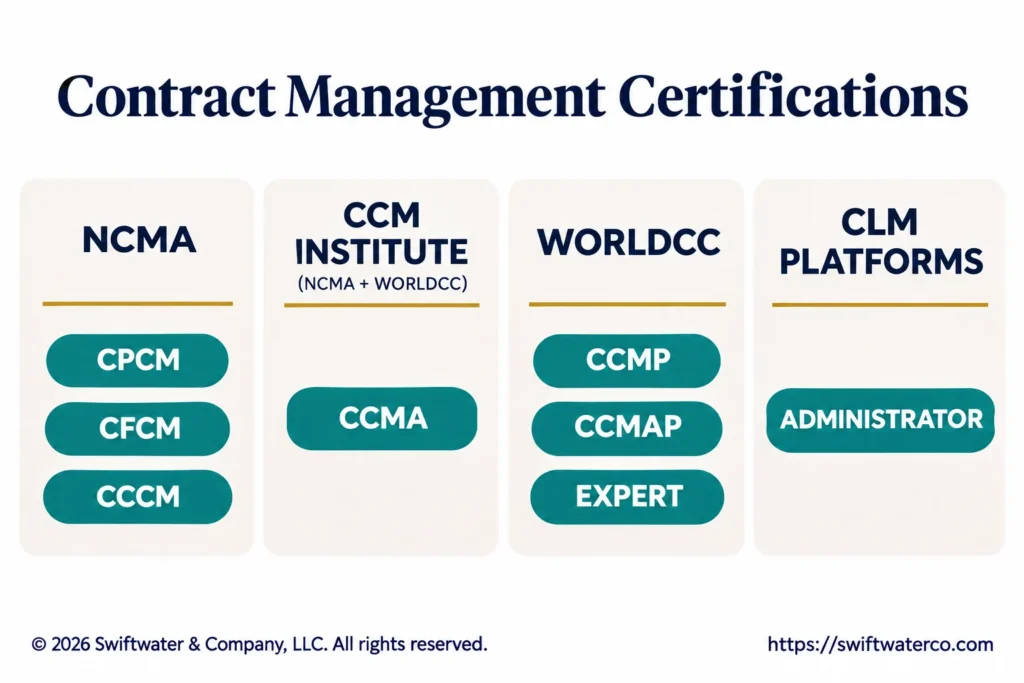
The main contract management certifications are NCMA’s three professional credentials, the joint CCM Institute associate credential, WorldCC’s certification pathway, the US government’s own contracting certifications, and certifications from CLM platform vendors. Procurement professionals also hold procurement credentials that cover contracting.
- CPCM (Certified Professional Contract Manager), NCMA. The senior credential, covering commercial and federal contracting.
- CFCM (Certified Federal Contract Manager), NCMA. Federal contracting under the Federal Acquisition Regulation (FAR).
- CCCM (Certified Commercial Contract Manager), NCMA. Commercial contracting under the Uniform Commercial Code (UCC).
- CCMA (Commercial and Contract Management Associate), CCM Institute. The joint NCMA and WorldCC entry-level credential.
- WorldCC Commercial & Contract Management Certification. Associate, Practitioner (CCMP), Advanced Practitioner (CCMAP), and Expert levels.
- FAC-C (Professional) and the DoD Contracting Professional certification. For the federal acquisition workforce.
- CLM platform certifications. Administrator and consultant credentials from vendors such as Docusign, Icertis, Ironclad, Onit, and Sirion.
What do the NCMA certifications require?
NCMA’s certifications require a mix of education, continuing professional education (CPE), experience, and a proctored exam, with the CPCM the most demanding. NCMA membership is not required for the CPCM, CFCM, or CCCM. Exams are delivered by Kryterion at a test center or online, and an application allows up to three attempts within a year. The table follows each credential’s 2026 candidate handbook.
| Credential | Eligibility | Exam |
|---|---|---|
| CPCM | Bachelor’s degree, 120 CPE, 5 years of experience; no waivers | 180 multiple-choice questions, up to 4 hours, pass mark 72.2% |
| CFCM | Bachelor’s degree (waiver possible with 5 years of experience and 24 college credits), 80 CPE, 2 years of experience | 150 questions based on the FAR, up to 3 hours, pass mark 70% |
| CCCM | Same as CFCM | 150 questions, UCC knowledge, up to 3 hours, pass mark 70% |
| CCMA | The CCM Institute’s CCMA course and membership of NCMA or WorldCC; no experience needed | 80 questions on the Contract Management Standard, 2 hours, pass mark 70% |
Fees. The CPCM application costs $225 for NCMA members and $425 for nonmembers; the CFCM and CCCM applications cost $165 and $365. Each exam attempt costs $135 in the US and Canada and $160 elsewhere. The CCMA is sold as a $770 bundle that includes the course, membership, and a first exam attempt.
Recertification. The CPCM, CFCM, and CCCM renew every five years. CPCM holders recertifying in 2026 or later need 100 CPE over the cycle, up from 60; CFCM and CCCM holders need 60. The CCMA renews every two years with 20 CPE.
Evaluating or implementing a CLM platform?
We have guided legal departments through selection, implementation, and adoption, without the vendor bias. Let us talk about where you are and what you actually need.
See CLM ServicesChanges to watch. NCMA’s legacy Certified Contract Management Associate closed to applications on March 31, 2026, and existing holders move to the new CCMA when they renew. NCMA says it will revise the CFCM exam once the FAR Overhaul is fully codified.
What does the WorldCC certification pathway cover?
WorldCC’s Commercial & Contract Management Certification runs in four levels, from Associate to Expert, delivered as online learning followed by an online assessment. It is built for commercial contracting across industries and countries, and is the more common route outside the US.
| Level | Learning and assessment | Price |
|---|---|---|
| Associate | Entry level, now aligned with the joint CCMA | See the CCMA above |
| Practitioner (CCMP) | 80 hours of learning, then a 2-hour online exam of about 100 questions | From $1,495 |
| Advanced Practitioner (CCMAP) | 60 hours of learning, then a 2-hour online exam of about 100 questions | From $1,495 |
| Expert | 6 to 9 months; a business case, written submission, and presentation assessed by an expert panel; WorldCC members only | $995 |
Levels, hours, and prices are as listed on WorldCC’s certification page in November 2026. The CCMP is WorldCC’s credential; training firms sometimes use the same acronym for unrelated programs, so check the issuer before you enroll.
What about federal contracting certifications?
Federal contracting has its own certifications for the government’s acquisition workforce. The FAC-C (Professional), issued through the Federal Acquisition Institute, applies to civilian executive agencies; the Department of Defense runs its own Contracting Professional certification. FAC-C requires at least 12 months of contracting experience, a set of required training courses, and a 150-question proctored exam with a 70% pass mark, then 80 continuous learning points every two years.
These credentials are for government employees. People working for government contractors usually look to NCMA’s CFCM instead, since it is built on the same regulation.
Government roles, regulations, and certification requirements on this page are summarized from public sources as of November 2026 for information only. Titles, rules, thresholds, and section numbers change, so confirm the current regulation, statute, or agency guidance before relying on them.
Which certification is worth it for an in-house contracts role?
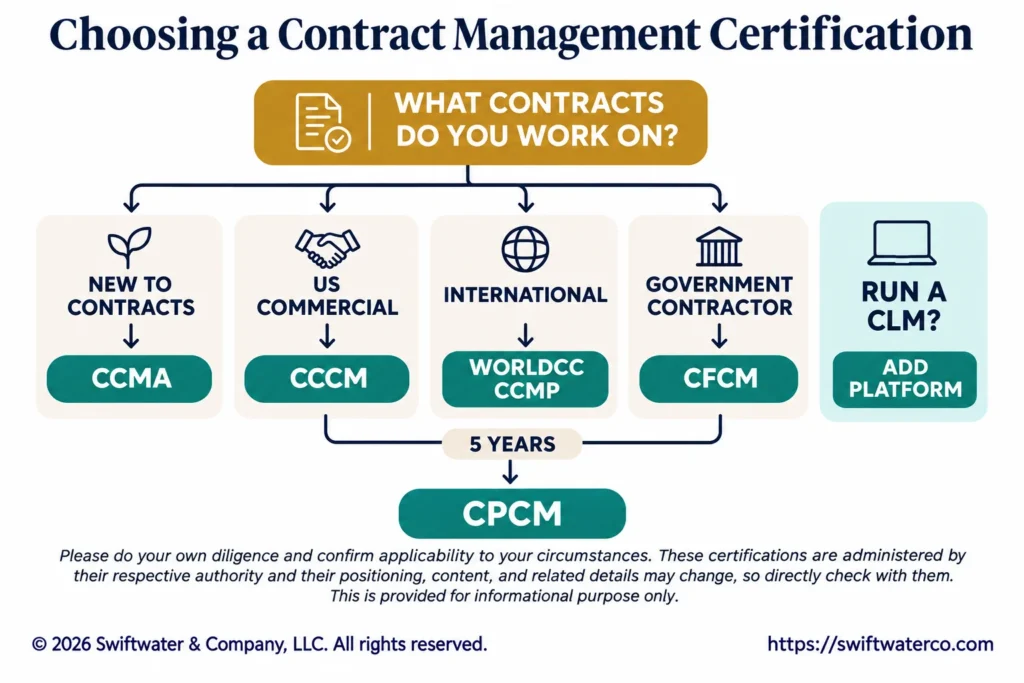
The right certification depends on the contracts you handle, where you work, and what employers in your market ask for. There is no single best credential, and many in-house roles hire without one. Before paying, check recent job postings for the seat you want and ask whether your employer will fund it.
- Commercial contracts in the US. The CCCM, or the CPCM once you have five years of experience.
- Commercial contracts internationally. WorldCC’s Practitioner or Advanced Practitioner level.
- Government contracts, on the contractor side. The CFCM, then the CPCM.
- New to contracting. The joint CCMA, which needs no experience.
- Contracts inside procurement. Procurement credentials such as the CIPS MCIPS or ISM’s CPSM cover sourcing and supplier management alongside contracts.
Our contract manager job description shows how employers list certifications as preferred, and our comparison of contract specialist, manager, and administrator roles shows which roles tend to value them.
How do CLM platform certifications fit?
CLM platform certifications prove you can administer or configure a specific contract lifecycle management system, and they matter most to employers who run that system. They sit alongside a contracting credential, covering the tool while NCMA or WorldCC cover the discipline.
- Docusign. Docusign University offers the Certified Docusign CLM Administrator exam (60 items, 90 minutes, aimed at 6 to 12 months of administration experience), plus Workflow Developer, Implementation Consultant, and Technical Consultant certifications.
- Icertis. The Icertis Academy runs practitioner, administrator, functional, and technical learning paths with online certification exams.
- Ironclad. Ironclad launched a Core Admin Certification in August 2026.
- Onit. Onit’s training program has certification tracks with levels, including a CLM track.
- Sirion. Sirion issues Certified CLM Consultant and Certified CLM Professional credentials.
Our practitioners hold platform certifications, Onit Level 4 among them, and those credentials count most when the work is on that platform. Our CLM tools landscape covers the platforms themselves.
What about legal operations certifications?
Legal operations certifications cover the wider function, and contract management is one part of it. CLOC’s Legal Operations Certified Professional (LOCP) opens to its first candidates in May 2027 and requires three or more years of legal operations experience. It covers the CLOC Core 12, which does not include contract management as a separate competency. Our guide to legal operations certifications compares the options for people moving between contracts and legal operations.
Bottom Line
Contract management certifications fall into three groups: the discipline credentials from NCMA, the CCM Institute, and WorldCC; the government’s own contracting certifications; and CLM platform credentials. The NCMA and CCM Institute credentials changed in 2025 and 2026, so check the current handbook before you apply.
Pick by the contracts you work on: commercial or federal, US or international, and the platform you run. Pick the credential that matches the contracts you work on, and confirm employers in your market ask for it before you pay.
Evaluating legal technology but not sure where to start?
We help legal departments cut through the vendor noise, mapping technology to process maturity and building a roadmap that actually gets adopted.
See Legal TechnologyIf you are building a contracts team and want a view on which credentials matter for the seats you are hiring, our contract management practitioners are happy to pass along what we know.
Frequently Asked Questions
What is a contract management certification?
Contract management certifications test contracting knowledge: NCMA’s CPCM, CFCM and CCCM, the WorldCC pathway, and CLM platform credentials. Most require a course or experience and a proctored exam, and renew every two to five years with continuing education.
What is the best contract management certification?
There is no single best one. The CPCM is NCMA’s senior credential, the CCCM suits US commercial contracts, the CFCM suits government contracts, WorldCC’s Practitioner level suits international commercial work, and the joint CCMA suits newcomers. Choose by the contracts you handle and what employers in your market ask for.
Is NCMA certification worth it?
NCMA certification is most valued in government contracting and by US employers that list it in postings. For commercial in-house roles it is usually preferred, and rarely required. Check recent postings for the role you want and whether your employer will pay.
How much does NCMA certification cost?
The CPCM application costs $225 for NCMA members and $425 for nonmembers, and the CFCM and CCCM applications $165 and $365. Each exam attempt costs $135 in the US and Canada and $160 elsewhere. The CCMA is a $770 bundle including course, membership, and a first attempt. These are NCMA’s published 2026 fees; confirm current fees with NCMA before you apply.
Do you need to be an NCMA member to get certified?
No, not for the CPCM, CFCM, or CCCM: NCMA states membership is not required to apply, obtain, or maintain them. Members pay lower fees. The joint CCMA does require membership of NCMA or WorldCC.
What is the WorldCC CCMP?
The CCMP is WorldCC’s Commercial & Contract Management Practitioner certification: about 80 hours of online learning followed by a 2-hour online exam of about 100 questions. It sits between WorldCC’s Associate and Advanced Practitioner levels.
Is there a contract lifecycle management certification?
Yes, from the platform vendors. Docusign, Icertis, Ironclad, Onit, and Sirion each certify administrators or consultants on their own CLM. These prove skill on one system; NCMA and WorldCC credentials cover the contracting discipline.
Sources and dates
Each requirement, fee, and format on this page was read from the issuer’s own published material on the dates shown. Check the current version before you rely on it.
- NCMA, CPCM page and CPCM candidate handbook (updated March 17, 2026).
- NCMA, CFCM page and CFCM candidate handbook (effective March 20, 2026).
- NCMA, CCCM page and CCCM candidate handbook (effective March 20, 2026).
- CCM Institute, CCMA page and CCMA candidate handbook (effective March 25, 2026); NCMA legacy CCMA notice.
- WorldCC, Commercial & Contract Management Certification (read November 2026).
- Federal Acquisition Institute, FAC-C (Professional) (read November 2026).
- CIPS, MCIPS membership grade; Pearson VUE, ISM CPSM exam page (read November 2026).
- Docusign University, Certified Docusign CLM Administrator; Icertis Academy; Ironclad, Core Admin Certification announcement (August 2026); Onit, training and certification (read November 2026).
- CLOC, Legal Operations Certified Professional (read November 2026).
This article is provided for general informational purposes only and is not legal, financial, career, or business advice, and it does not endorse any certification or provider. Requirements, fees, and exam formats are as published by each issuer on the dates listed under Sources and dates, and they change often; confirm them with the issuer, speak with people who hold the credential, and decide whether it fits your intended role before you enroll or pay. Career and training decisions should be validated against your organization’s specific structure and requirements, and you should consult a qualified professional for advice on your situation. Government roles, regulations, and certification requirements described here are summarized from public sources as of November 2026 for information only and may change; confirm them with the relevant agency, statute, or regulation.