


In today’s data-driven corporate environment, the legal department is no longer just a cost center; it’s a strategic business partner. General Counsel and Chief Legal Officers are increasingly under pressure to demonstrate value, optimize operations, and align with broader enterprise goals. The key to this transformation lies in measurement. Moving beyond anecdotal evidence to concrete data is essential for making informed decisions, managing risk, and communicating the department’s contribution effectively.
This is where Key Performance Indicators (KPIs) become indispensable. But which metrics truly matter? This guide cuts through the noise to focus on the most impactful legal department KPIs that provide a holistic view of performance. We will explore the top metrics covering everything from financial efficiency and operational speed to risk management and stakeholder satisfaction.
Remember: Do not let perfect be the enemy of progress! It’s okay to copy benchmarks from peers but implement what feels comfortable to you. I see so many legal functions take on KPIs that they can neither gather, monitor or influence properly. So, free yourself from the tyranny of KPIs. Any advice you get, take it directionally, try on the fit, and adjust frequently.
With these impactful KPIs, your legal team can not only enhance its own performance but also solidify its role as a proactive, value-generating function. This article provides a practical roadmap for selecting, calculating, and leveraging the indicators that will drive meaningful improvement and showcase your department’s strategic importance to the entire organization.
To take action on specific challenges click to learn more on these topics Legal Spend Management, Outside Counsel Management, or Legal Operations.
For more guides on running the function behind these numbers, explore our legal operations insights hub.
1. Legal Spend by Company Revenue
Legal Spend by Company Revenue is a foundational efficiency metric that provides a high-level view of your department’s cost relative to the size of the organization. It acts as a powerful barometer for resource allocation and helps contextualize legal expenditures against the company’s overall operational scale. This KPI is a cornerstone of many successful legal department KPIs frameworks, offering a straightforward way to communicate value and manage costs.
ACC and other organizations provide this benchmark annually, which you can use for calibration purposes.
Building the legal operations function from scratch?
Assessment, roadmap, and delivery for the operational side of the department: spend, technology, process, vendors, and the data that proves what legal delivers. Advice from operators who ran the function.
See Legal Ops ConsultingHow It Works
To calculate this KPI, you sum all internal and external legal costs over a specific period (typically a year) and compare it to the revenue band benchmark. You can also take your total legal cost (internal + external) and divide it by your company’s revenue. You can track this over quarters, or years for trending view.
Based on where you land you can gauge if you are in the 25th percentile, median or 75th percentile.
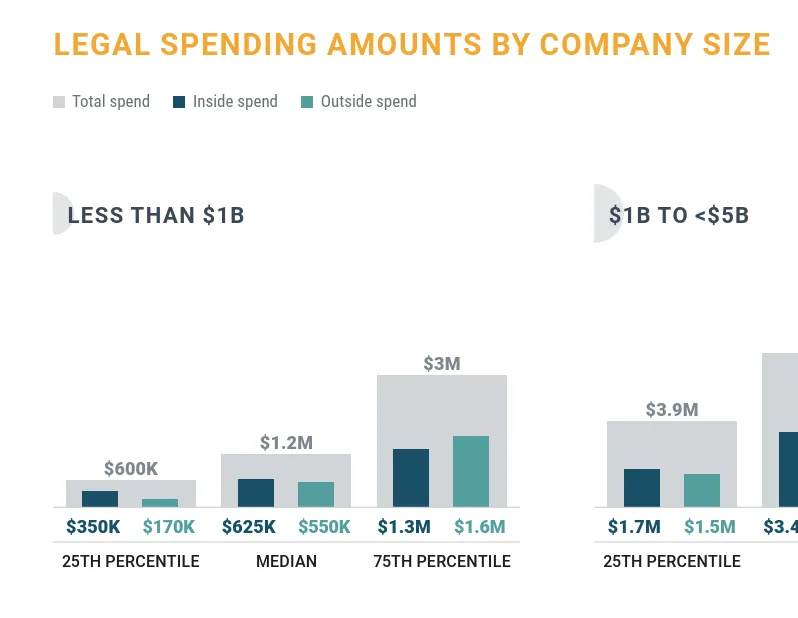
Source: 2023 Law Department Management Benchmarking Report | ACC
This metric is essential for benchmarking your department’s financial footprint against industry peers, especially those with similar business models and risk profiles. For instance, a high-growth tech company’s spend will naturally differ from a mature manufacturing firm’s due to varying regulatory and intellectual property demands.
Actionable Tips for Implementation
- Segment Your Costs: Don’t just look at the total figure. Break down costs by internal (salaries, benefits, technology) and external (law firm fees, eDiscovery, expert witnesses) categories. This reveals where your money is truly going.
- Track Trends Over Time: A single period’s data is a snapshot, not a story. Analyze this KPI over a few years. A sudden spike might indicate a major litigation event, while a steady increase could signal inefficiencies that need addressing.
- Include All Expenses: For an accurate calculation, ensure you capture all legal-related expenses, including software subscriptions, legal research tools, and settlement costs. Overlooking these can skew your results.
The following bar chart breaks down a sample company’s legal spend, showing how internal and external costs contribute to the total per-employee figure.
To dive deeper into optimizing internal legal functions, you can learn more about how the head of legal operations can implement continuous improvement.
2. Matter Resolution Time
Matter Resolution Time is a critical efficiency KPI that measures the average duration from when a legal matter is opened until it is closed. This metric provides direct insight into the legal team’s responsiveness and operational velocity, helping to identify bottlenecks and optimize workflows. For a legal department aiming to be a strategic partner to the business, demonstrating speed and efficiency in resolving issues is paramount, making this one of the most vital legal department KPIs to track.

How It Works
This KPI is calculated by measuring the total time elapsed for all resolved matters within a specific period and dividing it by the number of matters resolved. It is most powerful when segmented by matter type.
- Formula: Total Days for All Resolved Matters / Number of Resolved Matters = Average Matter Resolution Time
For example, a business unit might be frustrated with contract review delays. By tracking this KPI, you can provide concrete data, such as showing that standard Non-Disclosure Agreements (NDAs) are turned around in 48 hours, while complex Master Service Agreements (MSAs) average 10 days. This data-driven approach shifts the conversation from subjective complaints to objective performance measurement and resource planning.
Actionable Tips for Implementation
- Establish Clear Matter Categories: Implement a robust matter management system to categorize every request (e.g., contract review, employment dispute, IP filing). This is foundational for meaningful analysis.
- Set Tiered Targets: A single resolution target is unrealistic. Set different, appropriate service level agreements (SLAs) for different matter types. For instance, a target of 3-7 days for standard contract reviews is reasonable, while a major litigation matter will have a much longer, multi-stage timeline.
- Track Both Mean and Median: The mean (average) can be skewed by a few unusually long cases. Tracking the median (the middle value) provides a more accurate picture of typical performance and helps you understand the standard experience for your business partners.
- Analyze Trends, Not Just Numbers: A sudden increase in resolution time for a specific matter type might indicate a new regulatory hurdle, an under-resourced team member, or a process breakdown that needs immediate attention. Monitor these trends quarterly to stay ahead of potential issues.
3. Contract Turnaround Time
Contract Turnaround Time is a critical efficiency metric that measures the total time from when a contract is first requested to when it is fully executed. As a key indicator among legal department KPIs, it directly reflects the legal team’s ability to support business velocity and avoid becoming a bottleneck. Slow contract cycles can delay revenue, strain partnerships, and frustrate internal stakeholders, making this a vital KPI for business-aligned legal functions.

Need the function run, not just advised on?
Swiftwater embeds senior practitioners directly into legal operations, handling bill review, matter management, and program delivery on your behalf.
See Managed ServicesHow It Works
To calculate this KPI, you measure the number of days or hours between the initial contract request and its final signature. The clock starts when the business team submits the request and stops once all parties have signed.
- Formula: Execution Date – Request Date = Contract Turnaround Time
This metric is most powerful when segmented by contract type, as complexity varies significantly. For example, a standard Non-Disclosure Agreement (NDA) might be expected in 24-48 hours, while a complex strategic partnership agreement could reasonably take 30-60 days. Tracking these separately provides a more accurate view of performance.
Actionable Tips for Implementation
- Standardize and Automate: Use pre-approved templates and clause libraries to accelerate drafting. For legal departments aiming to improve efficiency and responsiveness, a practical guide to document generation automation can be invaluable for streamlining the initial creation phase.
- Establish Service Level Agreements (SLAs): Set and communicate clear turnaround time targets for different contract types (e.g., sales agreements, procurement contracts, NDAs). This manages expectations across the business.
- Implement Contract Lifecycle Management (CLM): Use a CLM system to track contracts at every stage, from request and drafting to negotiation and execution. This technology provides the data needed to measure and identify bottlenecks accurately. To get the most out of these systems, you can learn more about 10 CLM best practices for 2026.
4. External Counsel Spend Management
External Counsel Spend Management is a critical KPI that focuses on one of the largest and most variable expenses for any legal department. It involves tracking, analyzing, and optimizing all costs associated with outside law firms and legal service providers. Effective management of this spend is essential for budget adherence, resource optimization, and ensuring the company receives maximum value from its external legal partnerships. This KPI is a cornerstone for any modern legal operations function looking to drive financial accountability.
How It Works
This KPI is not a single formula but rather a suite of metrics designed to provide a comprehensive view of external spending. It dissects total costs to reveal patterns, opportunities for savings, and firm performance.
- Key Metrics Include:
- Total External Spend: The aggregate cost of all outside counsel and legal vendors over a period.
- Spend by Law Firm: A breakdown of how much is spent with each individual firm.
- Spend by Matter Type: Analysis of costs by practice area, such as litigation, M&A, or intellectual property.
- Average Cost Per Matter: The typical expense for handling specific types of legal work.
These metrics help identify which firms provide the best value and where costs are escalating. For example, technology companies often allocate 60-70% of their legal budget to external firms for specialized IP and regulatory work, making this KPI indispensable for them.
Actionable Tips for Implementation
- Establish Clear Billing Guidelines: Create and enforce strict outside counsel billing guidelines that define acceptable expenses, required invoice details, and prohibited practices like block billing. This sets clear expectations from the start.
- Implement an E-Billing System: Manual invoice review is inefficient and prone to errors. To enhance efficiency in managing external legal costs, exploring solutions like a dedicated platform for invoice management tailored for law firms can automate validation and provide invaluable spending data.
- Conduct Regular Performance Reviews: Don’t wait until a matter is closed. Schedule quarterly business reviews with your key law firms to discuss budgets, performance against KPIs, and strategic alignment.
- Use Competitive Bidding: For significant or high-cost matters, use a Request for Proposal (RFP) process. This encourages competitive pricing and allows you to compare firms’ strategies and proposed budgets systematically.
5. Litigation Win Rate and Outcomes
Litigation Win Rate and Outcomes is a critical performance KPI that evaluates the effectiveness of your department’s litigation strategy and management. It moves beyond simple win/loss statistics to provide a nuanced view of success, encompassing favorable settlements and the overall financial impact of legal disputes. This metric is a powerful tool for assessing both internal and external counsel and justifying litigation-related expenditures to business leaders.
How It Works
This KPI is calculated by evaluating the outcome of all concluded litigation matters over a set period against predefined criteria for success. A “win” isn’t always a complete victory in court; it often includes achieving a settlement below a certain financial threshold or securing a strategic, non-monetary victory.
- Formula: (Number of Favorable Outcomes) / (Total Number of Concluded Cases) = Favorable Outcome Rate
Defining what constitutes a “favorable outcome” is the most crucial step. For some cases, it might be a dismissal. For others, it could be settling for less than the initial claim or below a pre-approved reserve amount. For example, in employment litigation, a company might aim for an 80% favorable outcome rate, while in complex IP disputes, achieving a 60% settlement rate might be considered a success.
I see many departments struggle to define the definition of “win”/”favorable” outcome. Again, I say start with a definition and then see where it takes you. KPIs aren’t there to force you to make decisions, they help you understand the trends. Insurance industry has “favorable” defined to a tee and they continuously update what it means: if a claim is paid or adjudicated better or equal to their expectations then it goes in the favorable column. Over a period of time they get to see and adjust the definition and the downstream decisions they make.
Actionable Tips for Implementation
- Define Clear Success Criteria: Before a case begins, establish clear, objective criteria for what a successful outcome looks like. This could be a specific settlement range, the avoidance of injunctive relief, or the successful defense of a key patent.
- Track Both Financial and Strategic Outcomes: A low-cost settlement might be a financial win but a strategic loss if it sets a negative precedent. Your tracking should capture both dimensions to provide a complete picture of performance.
- Segment by Case Type: Analyze outcomes separately for different types of litigation, such as employment, commercial, and intellectual property. This allows for more meaningful benchmarking and reveals strengths and weaknesses in specific legal areas.
- Conduct Regular Case Reviews: Don’t wait until a case is over. Implement regular reviews of ongoing litigation to assess strategy, budget adherence, and the probability of a favorable outcome, allowing for course correction when needed.
6. Compliance Training Completion Rate
Compliance Training Completion Rate is a critical risk management metric that tracks the percentage of employees who have finished mandatory compliance training. This KPI goes beyond mere box-ticking; it provides tangible evidence of an organization’s proactive commitment to ethical conduct and regulatory adherence. For legal departments, a high completion rate is a powerful defensive tool, demonstrating a culture of compliance that can mitigate penalties and reputational damage in the event of a regulatory inquiry or litigation.
How It Works
This KPI is calculated by dividing the number of employees who have completed a specific training module by the total number of employees required to take it. The result is then expressed as a percentage.
- Formula: (Number of Employees Who Completed Training / Total Number of Required Employees) x 100 = Compliance Training Completion Rate
This metric is vital for highly regulated industries. For example, a financial services firm would track anti-money laundering (AML) training completion, while a healthcare provider would monitor HIPAA training to protect patient data. For public companies, ensuring high completion rates for Sarbanes-Oxley (SOX) or insider trading training is non-negotiable. This is one of the most important legal department KPIs for demonstrating a baseline of organizational governance.
Actionable Tips for Implementation
- Automate Tracking: Use a Learning Management System (LMS) to automate enrollment, send reminders, and track completion rates in real-time. Manual tracking with spreadsheets is prone to error and is not scalable.
- Implement Clear Consequences: Establish a clear policy for non-completion. This could involve escalating notifications to managers, restricting access to certain systems, or linking completion to performance reviews.
- Make Training Engaging and Relevant: Low completion rates are often a symptom of boring or irrelevant content. Use role-specific scenarios, interactive modules, and micro-learnings to increase engagement and knowledge retention.
- Schedule Regular Refreshers: Compliance is not a one-time event. Schedule annual or biennial refresher courses and provide ad-hoc updates when regulations change to keep knowledge current.
7. Legal Department Customer Satisfaction
Legal Department Customer Satisfaction moves beyond purely financial or operational metrics to measure the quality and effectiveness of the legal services provided to internal business clients. It gauges how well the legal team is perceived as a strategic partner, enabler, and service provider. This is one of the most crucial legal department KPIs for aligning legal functions with broader business objectives and demonstrating value in a language that every department head understands.

How It Works
This KPI is typically measured through structured feedback mechanisms like surveys, interviews, and scoring systems. The goal is to collect both quantitative and qualitative data on the internal client’s experience, focusing on responsiveness, clarity of advice, business acumen, and overall support.
- Formula: While there isn’t a single formula, a common approach is using the Net Promoter Score (NPS). Clients are asked, “On a scale of 0-10, how likely are you to recommend the legal department’s services to a colleague?”
- NPS = % Promoters (score 9-10) – % Detractors (score 0-6)
A high satisfaction score indicates that the legal team is not just a cost center but a valued business partner that helps drive success. It provides a direct line of sight into the department’s performance from the perspective of those it serves, such as sales, marketing, and product development teams.
Evaluating legal technology but not sure where to start?
We help legal departments cut through the vendor noise, mapping technology to process maturity and building a roadmap that actually gets adopted.
See Legal TechnologyActionable Tips for Implementation
- Standardize Your Surveys: Use consistent, well-designed survey instruments to track trends accurately over time. Ask specific questions about communication, timeliness, and the practicality of the advice given.
- Combine Quantitative and Qualitative Data: A numeric score like NPS is powerful, but the “why” behind it is critical. Always include open-ended questions like “What is one thing we could do to improve our service?” to gather actionable qualitative feedback.
- Act on Feedback and Communicate Changes: Simply collecting data is not enough. Analyze the results, identify recurring themes, and create action plans. Importantly, communicate back to the business units what you’ve heard and what you’re doing about it to build trust and show responsiveness.
8. Risk Assessment and Mitigation Effectiveness
Risk Assessment and Mitigation Effectiveness moves beyond purely financial metrics to evaluate the legal department’s strategic value in protecting the company. This KPI measures the team’s ability to proactively identify, assess, and neutralize legal risks before they escalate into costly problems. It is a critical component of any modern legal department KPIs framework, demonstrating the legal team’s role as a business protector, not just a cost center.
How It Works
This KPI is often qualitative but can be quantified by tracking specific indicators over time. It involves creating a risk register, assigning scores to potential risks based on likelihood and impact, and then measuring the reduction in those risk scores after mitigation strategies are implemented.
- Formula (Conceptual): (Initial Risk Score – Post-Mitigation Risk Score) / Initial Risk Score = Percentage of Risk Reduction
For example, tracking a decrease in regulatory compliance violations or a reduction in the number of disputes arising from high-risk contracts provides tangible proof of effectiveness. The goal is to show a clear, positive trend in the company’s overall risk profile, driven by legal’s interventions.
Actionable Tips for Implementation
- Develop a Comprehensive Risk Framework: Create a standardized process for identifying and scoring risks across all business units. This framework should define risk categories (e.g., regulatory, contractual, IP, litigation) and scoring criteria.
- Conduct Regular Risk Reviews: Don’t let your risk register become static. Schedule quarterly or semi-annual reviews with business leaders to update existing risks and identify emerging ones, ensuring the legal team stays ahead of potential threats.
- Integrate with Enterprise Risk Management (ERM): Collaborate with the company’s ERM function to align legal risk assessments with broader business objectives. This ensures a holistic view of risk and prevents siloed efforts. For a deeper understanding of how these concepts apply to specific areas like cybersecurity, you can explore detailed insights on managing cyber risk within legal and inherent frameworks.
- Track Both Leading and Lagging Indicators: Measure lagging indicators like the number of lawsuits filed, but also focus on leading indicators like the percentage of employees who have completed compliance training or the number of contracts reviewed using a risk-based checklist.
Legal Department KPI Comparison
Effort to Implement
| KPI | Implementation Complexity | Resource Requirements |
|---|---|---|
| Legal Spend by Company Revenue | Low: simple calculation | Low: requires expense data and headcount |
| Matter Resolution Time | Medium: requires matter tracking | Medium: case management system |
| Contract Turnaround Time | Medium: contract lifecycle tracking | Medium: contract management tools |
| External Counsel Spend Management | High: detailed spend tracking | High: e-billing and tracking systems |
| Litigation Win Rate and Outcomes | High: outcome tracking and analysis | Medium: case outcome data |
| Compliance Training Completion Rate | Low: training tracking systems | Low: LMS and reporting tools |
| Legal Department Customer Satisfaction | Medium: survey design and analysis | Medium: survey tools and administration |
| Risk Assessment and Mitigation Effectiveness | High: complex risk frameworks | High: risk management resources |
Value Delivered
| KPI | Expected Outcomes | Use Cases and Advantages |
|---|---|---|
| Legal Spend by Company Revenue | Understand legal cost efficiency; budget planning | Use: budget monitoring; industry benchmarking Advantage: easy to calculate; supports benchmarking |
| Matter Resolution Time | Identify bottlenecks; improve process speed | Use: workflow efficiency; resource allocation Advantage: highlights inefficiencies; supports improvement |
| Contract Turnaround Time | Faster contract processing; better business support | Use: contract management; business operations Advantage: direct impact on revenue; visible metrics |
| External Counsel Spend Management | Cost optimization; vendor management | Use: managing external legal spend Advantage: enables negotiation; data-driven decisions |
| Litigation Win Rate and Outcomes | Measure litigation effectiveness; risk insight | Use: litigation strategy assessment Advantage: direct measure of success; supports justification |
| Compliance Training Completion Rate | Regulatory compliance; risk reduction | Use: compliance monitoring Advantage: clear compliance evidence; identifies gaps |
| Legal Department Customer Satisfaction | Feedback on legal service quality | Use: service improvement; business relations Advantage: direct client feedback; strengthens relationships |
| Risk Assessment and Mitigation Effectiveness | Proactive risk management; prevent issues | Use: enterprise risk management Advantage: supports strategic decisions; risk prevention |
From Metrics to Momentum: Activating Your KPI Strategy
Moving from a theoretical understanding to practical application is the pivotal moment in any performance management journey. We’ve explored a comprehensive set of legal department KPIs, from financial metrics like Legal Spend by Company Revenue to operational benchmarks such as Contract Turnaround Time and risk indicators like Compliance Training Completion Rate. Each metric offers a unique lens through which to view your department’s efficiency, impact, and alignment with broader business objectives.
The core takeaway is that data, in isolation, is inert. Its power is only unlocked when it fuels strategic conversations and inspires tangible action. The most successful legal teams don’t just track numbers; they use them to tell a story about their value, identify bottlenecks, and make compelling cases for resources. They transform metrics from a rearview mirror into a high-powered GPS, guiding them toward a more proactive and strategic future.
Your Blueprint for Implementation
Embarking on this journey doesn’t require a complete overhaul overnight. The key is to build momentum through a deliberate, phased approach. Here’s a practical roadmap to get started:
- Start Small, Win Big: Don’t try to implement all eight KPIs at once. Select two or three that directly address your department’s most critical pain points. If external counsel costs are a concern, start with External Counsel Spend Management. If the sales team is frustrated by delays, focus on Contract Turnaround Time.
- Leverage Technology as an Ally: Manual data collection is inefficient and prone to error. Modern legal tech is essential for success. E-billing and matter management systems are non-negotiable for tracking spend and resolution times, while Contract Lifecycle Management (CLM) platforms provide invaluable data on your contracting process.
- Foster a Culture of Transparency: KPIs should not be a secret weapon wielded by leadership. Create accessible dashboards and share them regularly with your team and key business partners. This transparency builds trust and empowers every team member to contribute to departmental goals.
- Shift from Scorekeeping to Strategy: The ultimate goal is not just to hit a target but to understand the “why” behind the numbers. Use your KPI reviews as a forum for strategic discussion. Ask questions like, “What process change could improve this metric?” or “What does this data tell us about our risk exposure?”
By systematically measuring what matters, you shift the perception of the legal department from a cost center to a strategic business enabler. Effective KPI tracking provides the objective evidence needed to justify budgets, optimize processes, and demonstrate a clear return on investment. This data-driven approach allows General Counsel and legal operations leaders to secure their seat at the executive table and contribute meaningfully to the enterprise’s success. Your legal department’s journey from a reactive support function to a proactive strategic partner begins with the first metric you choose to master.
Bottom Line
Legal department KPIs earn their place when they inform a decision. The eight metrics in this guide cover cost (legal spend by company revenue, external counsel spend), speed (matter resolution time, contract turnaround time), outcomes (litigation results, internal client satisfaction), and risk (compliance training completion, risk mitigation effectiveness).
Start with the two or three that match your most pressing problem. Define each one clearly, segment it by matter or contract type so the numbers reflect real work, and capture the data in your e-billing, matter management, and CLM systems so it is reliable.
Then share the results. A dashboard your business partners can see turns the numbers into a conversation about resources, bottlenecks, and risk. Pick the first metric you can actually gather and influence, and let the trend tell you what to measure next.
Swiftwater and Company helps corporate legal teams implement KPI frameworks they can sustain and use the results to optimize how the department runs. If you want help choosing and standing up the right metrics, our legal operations consulting services are the place to start.
Frequently Asked Questions
What KPIs do corporate legal departments track?
Corporate legal departments commonly track KPIs that together cover cost, speed, outcomes, and risk. The eight covered in this guide are legal spend by company revenue, matter resolution time, contract turnaround time, external counsel spend management, litigation win rate and outcomes, compliance training completion rate, legal department customer satisfaction, and risk assessment and mitigation effectiveness. Financial metrics show cost efficiency and support benchmarking against peers. Operational metrics show how quickly legal supports the business. Outcome and satisfaction metrics show the quality of the work, and risk metrics show how well the department protects the company. The practical approach is to start with the two or three that address your most critical pain points and add more as your data matures.
What KPIs should legal operations present to the board or General Counsel?
The most useful metrics for leadership connect legal work to cost, risk, and business speed. Legal spend by company revenue places the department’s cost against peer benchmarks such as the ACC Law Department Management Benchmarking Report. External counsel spend management shows where outside counsel dollars go and which firms deliver value. Contract turnaround time shows legal’s effect on revenue and deal velocity. Risk assessment and mitigation effectiveness shows the reduction in risk scores driven by legal’s interventions, and customer satisfaction, often measured with Net Promoter Score, shows how the business rates legal as a partner. Presented together, these give General Counsel objective evidence to justify budgets, optimize processes, and demonstrate a return on investment.
What contract metrics should legal operations track?
Contract turnaround time is the core contract metric. It measures the days or hours from the initial contract request to final signature, calculated as execution date minus request date. Segment it by contract type because complexity varies widely: a standard NDA might be expected in 24 to 48 hours, while a complex strategic partnership agreement could reasonably take 30 to 60 days. Set service level agreements for each contract type so expectations are clear across the business. A Contract Lifecycle Management (CLM) system tracks each contract from request and drafting through negotiation and execution, which provides the data needed to measure turnaround accurately and identify bottlenecks. Pre-approved templates and clause libraries help shorten the drafting stage.
How do legal departments measure outside counsel performance?
Outside counsel performance is measured through a suite of spend metrics: total external spend, spend by law firm, spend by matter type, and average cost per matter. Together they show which firms provide the best value and where costs are escalating. Clear billing guidelines set the rules for acceptable expenses, required invoice details, and prohibited practices such as block billing. An e-billing system automates invoice validation and captures the spending data. Quarterly business reviews with key firms cover budgets, performance against KPIs, and strategic alignment. For significant or high-cost matters, a Request for Proposal process lets you compare firms’ strategies and proposed budgets systematically.
What tools do legal departments use to track KPIs?
Legal departments rely on a handful of system types. E-billing and matter management systems track external spend and matter resolution time. Contract Lifecycle Management (CLM) platforms capture contract turnaround data at every stage. A Learning Management System (LMS) automates enrollment, reminders, and completion tracking for compliance training. Survey tools collect internal client feedback such as Net Promoter Score, and a risk register supports scoring and re-scoring legal risks. Dashboards then make the results visible to the legal team and its business partners. Manual tracking in spreadsheets is prone to error and does not scale, so choose whichever system captures your chosen metrics reliably.
How many KPIs should a legal department track?
Start with two or three. Taking on all eight KPIs at once often leaves a department with metrics it can neither gather, monitor, nor influence properly. Choose the ones that address your most critical pain points: if external counsel costs are the concern, begin with external counsel spend management, and if the sales team is frustrated by delays, focus on contract turnaround time. It is fine to borrow benchmarks from peers, but implement what fits your department and adjust frequently. Once the first metrics produce reliable trends and support real decisions, add the next ones. Do not let perfect be the enemy of progress.
Disclaimer: This article is provided for educational and information purposes only. Neither Swiftwater and Company nor the author provides legal advice. External links reflect the thinking of their respective authors and are provided for informational purposes only.