


Legal operations roles run from analyst and specialist through manager and Director or Head of Legal Operations to Chief Legal Operations Officer, and each one owns a wider slice of the same six things: spend, technology, process, vendors, data, and the department’s relationship with the rest of the company. The ladder is short and the function is small. The 2026 ACC Law Department Management Benchmarking Report puts legal operations professionals at 5% of legal department headcount, eight lawyers to every one of them, with a median of zero dedicated legal operations staff below $5 billion in company revenue. Most people in these roles are the only person in the department doing the job, which is why the titles matter less than what each seat actually owns.
The benchmarks on this page are worth having and worth reading with care. They come from a small population: the ACC report draws on 576 departments and the Blickstein Group survey on 68 companies, so a handful of participants can move a median. Our read of the job market over the past year is that startups and scale-ups are posting Director of Legal Operations and Head of Legal Operations roles in numbers the surveys do not show, because those companies rarely have time to take part in them, and many of the largest departments sit out for the same reason. Treat the figures as directional, with the ends of the distribution under-counted.
This guide covers what each role does, how the team is composed at each department size, the skills the function now needs, how the career path works, and when the seat is a hire, a fractional leader, or a consultant. It is written for General Counsel deciding what to hire, for legal operations professionals deciding what to become, and for the HR and finance partners who increasingly have to approve both.
What roles make up a legal operations team?
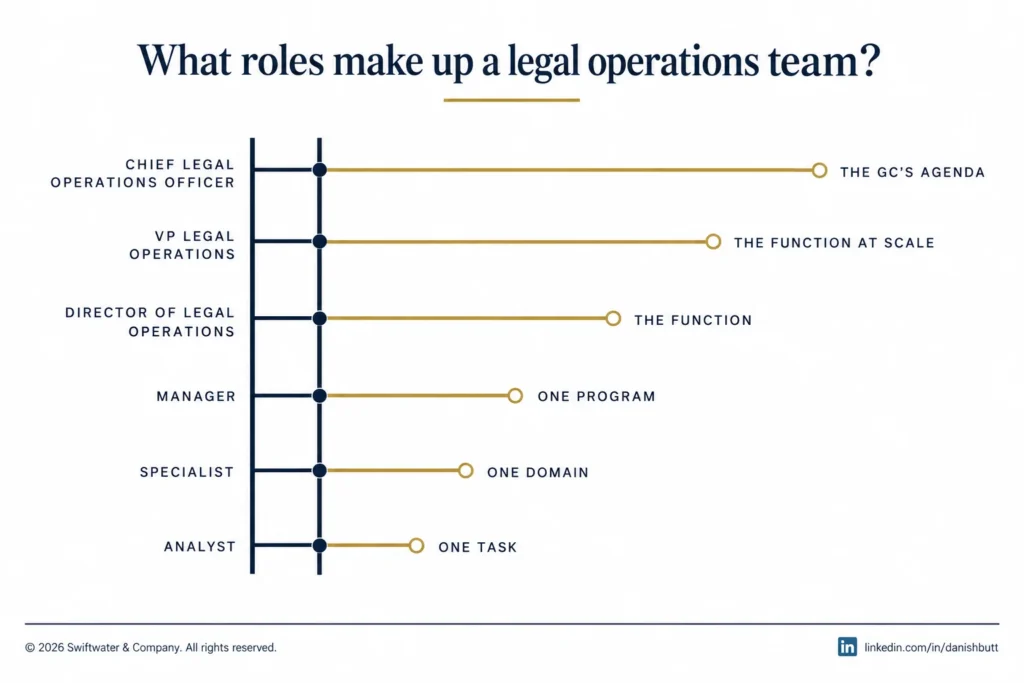
A legal operations team is made up of six seats: legal operations analyst or coordinator, legal operations specialist, legal operations manager, Director or Head of Legal Operations, VP of Legal Operations, and Chief Legal Operations Officer, also titled Legal COO or Chief of Staff to the General Counsel. Few departments have all six; most have one or two, and the person in the seat covers the rest. The table reads from the bottom of the ladder up.
| Role | What the seat owns | Where it sits |
|---|---|---|
| Legal operations analyst or coordinator | Data pulls, invoice and accrual processing, system administration tasks, reporting production, matter and vendor record hygiene, intake queue handling | Reports to a manager or Head of Legal Operations; in a one-person function, this work is done by whoever holds the seat |
| Legal operations specialist | A named domain owned end to end: e-billing and outside counsel billing compliance, CLM administration, ELM administration, knowledge management, or legal technology support | Reports to a manager or Head of Legal Operations; the most common second hire after the leader |
| Legal operations manager | Runs one or more programs with a budget and a team: spend management, technology, or process; owns vendor relationships for the programs they run; the first seat with hiring authority | Reports to the Head of Legal Operations, or directly to the General Counsel where the manager is the senior seat |
| Director of Legal Operations or Head of Legal Operations | The function: budget, strategy, the operating rhythm, all programs, the technology estate, the data the General Counsel reports on, and the department’s operational relationship with HR, IT, finance, and procurement | Reports to the General Counsel or Chief Legal Officer; sits on the legal leadership team in mature departments |
| VP, Legal Operations | The same scope at a scale where the function has several managers and a multi-year transformation to run; often also owns legal shared services or the department’s managed services relationships | Reports to the General Counsel; found in large global departments |
| Chief Legal Operations Officer, Legal COO, or Chief of Staff to the General Counsel | Everything above plus the General Counsel’s own agenda: board and executive reporting, department strategy, headcount and budget negotiation with the CFO, and the business side of the General Counsel’s role | Reports to the General Counsel as a peer to the deputy GCs; still rare, and the title varies more than the job |
The responsibility list the top seat carries has become long. In the Blickstein Group’s 18th Annual Law Department Operations Survey, legal operations functions report responsibility for outside counsel and vendor management (89.2%), technology selection and procurement (83.1%), budgeting (81.5%), billing and invoice approval (80.0%), matter management (78.5%), reporting and analytics (76.9%), knowledge management (67.7%), financial analysis (66.2%), AI deployment (63.1%), and legal service request and work intake (61.5%), among others. That is the job description of a Director of Legal Operations, and in most departments it is being carried by one person with a specialist beside them.
What does a legal operations analyst do?
A legal operations analyst processes and codes invoices, chases accruals, keeps matter and vendor records clean, runs the standard reports, administers user accounts and routine configuration in the ELM or CLM, and works the intake queue. The analyst is where the function’s data comes from: an entry role in title and a foundational one in practice, because every KPI the General Counsel takes to the CFO was built on work this seat did correctly, or not.
A good analyst learns the department’s spend and systems faster than anyone else in it, which is why the role is the usual route into specialist and manager seats. Departments that treat it as administrative support, with no path, lose the person at the point they have become useful.
Need the function run, not just advised on?
Swiftwater embeds senior practitioners directly into legal operations, handling bill review, matter management, and program delivery on your behalf.
See Managed ServicesWhat does a legal operations specialist do?
A legal operations specialist owns one domain end to end, and the common ones are e-billing and outside counsel billing compliance (guidelines, invoice review, rate enforcement, the e-billing system itself), CLM administration (templates, workflows, clause libraries, user support), ELM or matter management administration, knowledge management, and legal technology support. In larger functions the specialist title also covers legal project managers and data or reporting specialists.
The seat is defined by depth. A specialist should be the person in the company who knows the most about their system or program, able to configure it, train on it, and tell the General Counsel what it can and cannot do without calling the vendor. It is the most common second hire after a leader, and in departments that rely on managed services, it is often the role the managed team fills.
What does a legal operations manager do?
The manager runs programs, usually one of three: spend management (billing guidelines, panel programs, rate negotiations, invoice review, accruals and forecasting), technology (the roadmap, implementations, administration, vendor management, adoption), or process (intake, workflow, playbooks, continuous improvement). Each comes with a budget, vendor relationships, and, in larger functions, a small team of specialists and analysts.
The manager is the first seat with hiring authority and the first that spends most of its time outside the legal department, with finance on budgets and accruals, with IT on systems and security, with procurement on vendors and contracts, and with the business on intake and self-service. In departments without a Director or Head of Legal Operations, the manager is the senior operational seat and reports directly to the General Counsel, carrying the leader’s scope without the title. That arrangement is common and it is the point at which a department should decide whether to create the head role or keep growing the manager into it.
Our legal operations manager job description shows what departments put in the posting for this seat, with a template.
What does a Director of Legal Operations do?
A Director of Legal Operations owns the legal operations function: the budget and the spend story the General Counsel tells the CFO, the technology estate and its roadmap, the operating rhythm of planning and reporting, the KPIs and the data behind them, and the department’s operational relationship with HR, IT, finance, and procurement. Head of Legal Operations is the same seat under a second title.
The Director of Legal Operations and the Head of Legal Operations are the same seat under two titles, with Director the more common title in US postings and Head more common in the UK and in startups that borrow technology-company conventions. Either way, the five things the seat owns break down as follows. The budget and the spend story. The technology estate and its roadmap. The operating rhythm: annual planning, prioritization, continuous improvement, and quarterly reporting. The KPIs and the data behind them. And the department’s operational relationship with every other function in the company.
That last one is the part of the job least often written into the job description and most often the reason the role succeeds or fails. The legal operations team is the operational face of the law department. HR deals with it on headcount and onboarding, IT on every system and security review, finance on budget and accruals, procurement on vendors. A Head of Legal Operations who is trusted in those four functions can get a platform through IT’s stage gates, a headcount request through finance, and a panel program through procurement in a fraction of the time it takes a lawyer to do the same, and that is where the role earns its seat on the leadership team. It is also the seat the job market is creating fastest: Director of Legal Operations and Head of Legal Operations are the titles startups and scale-ups post when they create the function, usually as a first and only hire, which makes the scope question in the table above the one to settle before the posting goes out.
The role was once an administrative one. The Law Department Operations Survey shows how far that has moved: 36.0% of legal operations teams are very frequently involved in cross-functional projects, up from 17.7% the year before, and a further 38.0% frequently. The function has become the connective tissue between legal and the rest of the enterprise, and the Director of Legal Operations is the person holding it.
What is a Chief Legal Operations Officer?
The Chief Legal Operations Officer, Legal COO, and Chief of Staff to the General Counsel are three titles for roughly one job: running the business of the legal department at the General Counsel’s side. The scope is the Director of Legal Operations role plus the General Counsel’s own agenda, including board and executive reporting, department strategy, the budget negotiation with the CFO, and whatever the General Counsel needs taken off their desk.
The seat is still rare and the title is unstable. The same job appears as VP, Legal Operations in one company, Chief of Staff in another, and Legal COO in a third, and the choice usually says more about the company’s title conventions than about the role. What the seats share is a reporting line to the General Counsel as a peer to the deputy GCs, and a scope that covers the whole department. It is the natural destination of the career ladder and the one fewest people reach, because most departments grow a Director of Legal Operations into it rather than creating it outright.
How is a legal operations team composed at each department size?
A legal operations team is composed according to company revenue: a median of zero dedicated legal operations professionals under $1 billion, zero to one between $1 billion and $5 billion, one between $5 billion and $20 billion, and six at $20 billion and above, by the 2026 ACC benchmark. The composition follows revenue more closely than any other variable, and the table describes the typical function at each tier.
| Company revenue | Median legal operations professionals | Typical composition of the function |
|---|---|---|
| Under $1 billion | 0 (mean 0.3) | No dedicated seat. The work sits with a paralegal, the General Counsel’s assistant, or the General Counsel. The first hire is usually a manager-level generalist, or fractional leadership |
| $1 billion to under $5 billion | 0 (mean 1.1) | One person, often titled manager, owning spend and the e-billing system and acting as the General Counsel’s chief of staff. A managed services team frequently sits behind them |
| $5 billion to under $20 billion | 1 (mean 2.7) | A Director of Legal Operations with one or two specialists, usually split along spend and technology lines, and an analyst or managed team for processing |
| $20 billion or more | 6 (mean 9.5) | A full function: Director or VP, managers for spend, technology, and process, named specialists, analysts, and often a Legal COO or chief of staff above it |
The caveat from the opening applies with most force here: medians from a few hundred participating departments will under-count the startups and scale-ups creating the Director seat and the largest departments that do not take part. Two further findings frame the hiring picture. The ACC report puts the median at 367 employees per lawyer and 3 lawyers per $1 billion of revenue, both pointing to leaner departments, with 42% using contract or temporary staff and 74% of companies over $20 billion doing so. And the Law Department Operations Survey finds the build-out phase largely over: only 4.8% of functions were launched in the past year, 58.5% expect their team to stay the same size over the next twelve months, 30.8% expect growth, and 10.8% expect to shrink, up from roughly 4% the year before. The function most departments have now is the function they will have for a while, which puts the weight on getting the existing seats right.
Building the legal operations function from scratch?
Assessment, roadmap, and delivery for the operational side of the department: spend, technology, process, vendors, and the data that proves what legal delivers. Advice from operators who ran the function.
See Legal Ops Consulting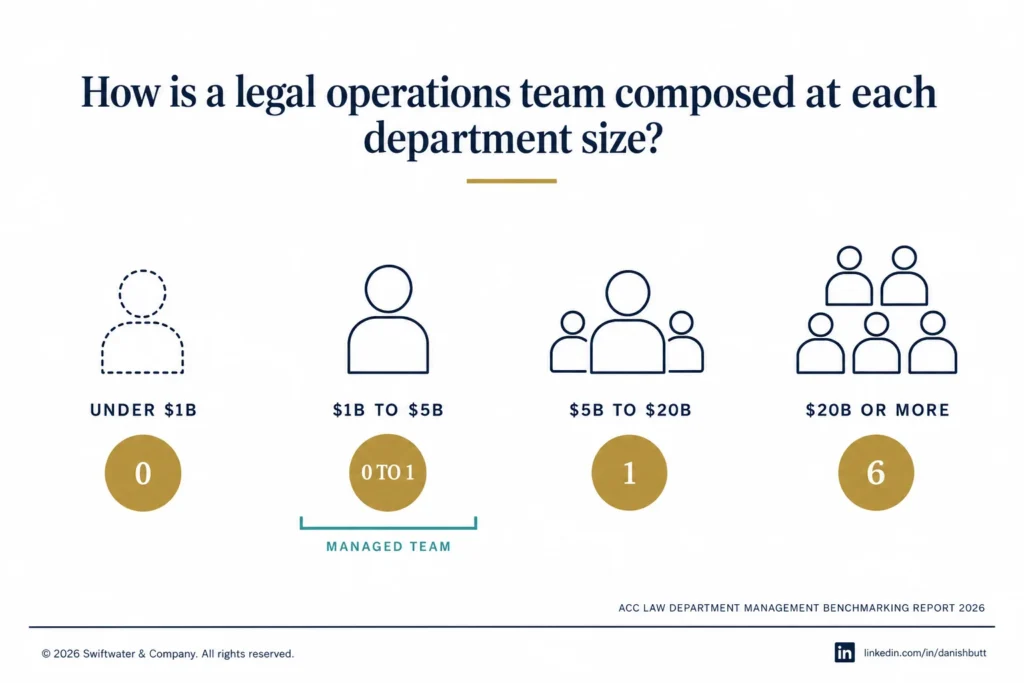
For what employers post for each seat, including titles, levels, and posted pay ranges, see our legal operations job market report.
What skills do legal operations roles need?
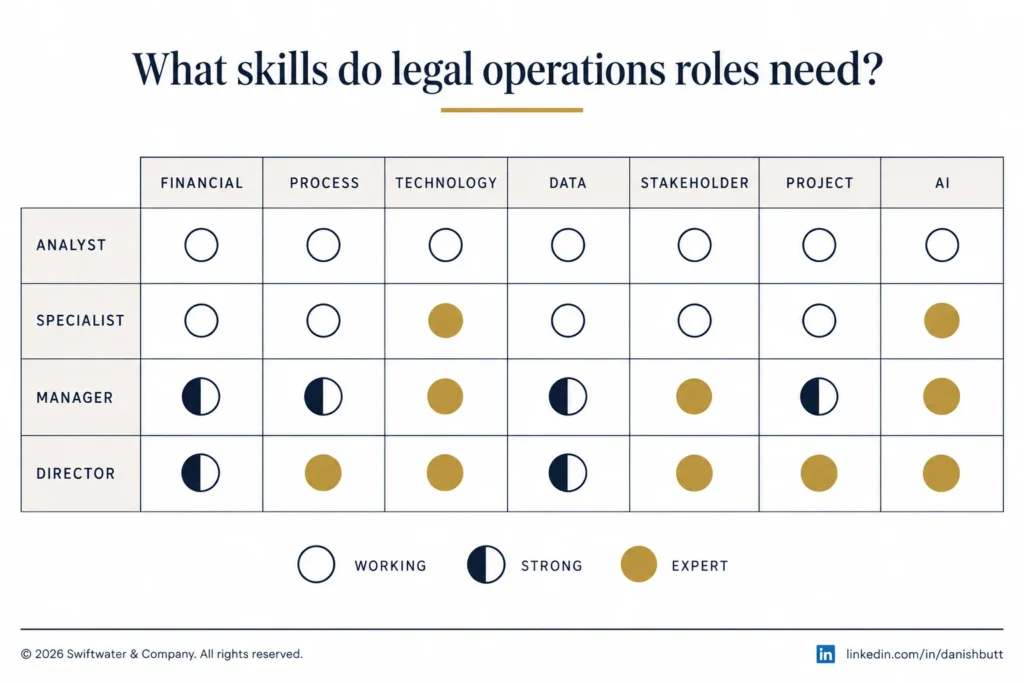
Legal operations roles need six skills at increasing depth up the ladder: financial literacy, process design, technology ownership, data and reporting, stakeholder and change management, and project and program management, with generative AI competence now expected in every seat. Skills belong to roles rather than to one person, and the distinction matters because the industry frameworks have a way of ending up in a single job description.
The CLOC Core 12 and comparable frameworks describe the function in 12 to 16 functional areas. Those areas are a map of what a legal operations function covers; they were never a specification for one person, and a posting that lists all of them is hiring for a function and calling it a job. Nobody can be expert in financial management, technology, vendor management, knowledge management, data, project management, and change at once, and the person who accepts that posting will be set up to fail in whichever area the department needed most.
The function hires from operations, finance, technology, project management, consulting, and paralegal backgrounds more than from legal practice, and the skills reflect that. Six show up across the roles, at increasing depth as the ladder rises and in different combinations depending on which seat is being filled. A specialist role needs depth in one or two; a manager role needs working competence in most and depth in the program it runs; a Director role needs enough of all of them to lead people who are deeper in each.
- Financial literacy. Budgets, accruals, forecasting, rate analysis, and the ability to present legal spend in the CFO’s language. The first skill most General Counsel hire for and the one most often tested in the first quarter.
- Process design. Mapping how work actually flows, finding where it stalls, and redesigning it so the business and the lawyers both use the new path. Intake, triage, and workflow are the proving ground.
- Technology ownership. Enough depth in ELM, CLM, e-billing, document management, and now legal AI to configure, administer, select, and defend a system, and to carry it through IT’s architecture, security, and change processes.
- Data and reporting. Building the KPI set, the dashboards, and the data model underneath them, and the judgment to know which numbers the General Counsel should take upstairs.
- Stakeholder and change management. The lawyers who have to adopt what the function builds, and the HR, IT, finance, and procurement partners it works through. The skill that separates a Director of Legal Operations from a very good manager.
- Project and program management. Scoping, sequencing, and delivering across a year, with the discipline covered in our guide to project scoping for legal, risk, and compliance work.
AI has added a seventh, and it has arrived unevenly. The Law Department Operations Survey finds nearly nine in ten legal operations professionals comfortable or very comfortable using generative AI, while only 44% are confident in their attorneys’ abilities with it, and the majority name evaluating and implementing AI use cases as their greatest current challenge. The function is now expected to be the department’s AI competence, which means every seat on the ladder is being asked to add a skill the job descriptions have not caught up with. It belongs in the role scope the same way the other six do: at the depth the seat needs.
How does a legal operations career progress?
A legal operations career usually starts sideways and then runs analyst to specialist to manager to Director of Legal Operations, with lateral moves across spend, technology, and process and across companies along the way, because the function is small enough that the next seat up is often occupied or absent.
Most people enter sideways: a paralegal who took over e-billing, a finance analyst assigned to legal, a project manager who ran the CLM implementation and stayed, a consultant who joined a client. Our guide to career progression as a cargo net rather than a ladder covers the pattern, and the mindset and skillset balance it demands.
Two things accelerate it. Owning a program end to end early, with its budget and its vendors, because that is the experience the manager and head seats are hired for. And building the cross-functional relationships before the title requires them, because the Director of Legal Operations who is already known to IT, finance, and procurement is promoted into a job they are already doing. The professional community matters too: the Corporate Legal Operations Consortium and the Association of Corporate Counsel are where the function’s standards, benchmarks, and peer networks live, and where most of its hiring conversations start.
Credentials are arriving as well. Our guide to legal operations certifications covers what exists, from CLOC’s announced LOCP to platform certifications, and whether to spend on one yet.
When is the legal operations seat a hire, a fractional leader, or a consultant?
The benchmarks make this a live question for most departments, since the median function below $5 billion in revenue has nobody in it. The short version: continuous work needs a seat, scoped work needs a consultant, and a department still working out what the seat should own is better served by assessing first and hiring into a defined role, with fractional leadership covering the gap. The legal operations consultant guide sets out the decision in full, including the situations where each option fits and what each costs.
One pattern is worth naming here because it is specific to the roles. Departments frequently hire a manager-level generalist as the first seat, then discover the job needs a Director of Legal Operations with a managed team behind them, and the first hire is now underpowered for the role they are being asked to carry. The CLOC 2026 State of the Industry Report shows the direction of travel: only 32% of departments expect attorney headcount to grow, while legal operations teams report technology strategy (80%), financial management (72%), and outside counsel and vendor management (62%) as their focus areas. The seat is being asked to carry more; the hire should be scoped for where the role is going.
Bottom Line
Legal operations roles run from analyst through Director of Legal Operations to Chief Legal Operations Officer, and each seat owns a wider slice of the same work: spend, technology, process, vendors, data, and the department’s relationship with HR, IT, finance, and procurement.
The function is small by every benchmark, 5% of headcount and eight lawyers to each legal operations professional, so most seats are held by someone covering the rungs above and below their title, and the benchmarks under-count the startups creating the Director seat and the largest departments that do not take part.
The composition of the team follows company size: nobody below $1 billion, at most one person to $5 billion, a leader with specialists to $20 billion, a full function above it. Skills belong to roles rather than to a single posting that asks for every framework area at once: financial, process, technology, data, stakeholder, and project management, with AI now expected at the depth each seat needs. Scope the seat for where the role is going, and hire, borrow, or build the function to match.
Swiftwater provides fractional Directors of Legal Operations and managed legal operations teams, matched to the level of experience the work needs and backed by the wider firm, so a department can run the function before it can hire for it.
Evaluating legal technology but not sure where to start?
We help legal departments cut through the vendor noise, mapping technology to process maturity and building a roadmap that actually gets adopted.
See Legal TechnologyFrequently Asked Questions
What are the roles in a legal operations team?
Legal operations analyst or coordinator, legal operations specialist, legal operations manager, Director of Legal Operations or Head of Legal Operations, VP of Legal Operations, and Chief Legal Operations Officer, also titled Legal COO or Chief of Staff to the General Counsel. Most departments have one or two of these seats, and the person in the seat covers the rest.
What does a legal operations manager do?
A legal operations manager runs one or more programs with a budget and vendor relationships, usually spend management, technology, or process, and is the first seat with hiring authority. In departments without a Director or Head of Legal Operations, the manager is the senior operational seat and reports directly to the General Counsel.
What does a legal operations specialist do?
A legal operations specialist owns a domain end to end: e-billing and billing compliance, CLM administration, ELM or matter management administration, knowledge management, or legal technology support. The seat is defined by depth in that domain and is usually the second hire after a leader.
What does a legal operations analyst do?
A legal operations analyst processes and codes invoices, chases accruals, maintains matter and vendor records, runs standard reports, handles routine system administration, and works the intake queue. It is the entry role and the one the function’s data depends on.
What does a Director of Legal Operations do?
A Director of Legal Operations, also titled Head of Legal Operations, owns the function: the budget and spend story, the technology estate and roadmap, the operating rhythm of planning and reporting, the KPIs and the data behind them, and the department’s operational relationship with HR, IT, finance, and procurement. The role reports to the General Counsel.
What is a Chief Legal Operations Officer?
The Chief Legal Operations Officer, Legal COO, or Chief of Staff to the General Counsel runs the business of the legal department at the General Counsel’s side, covering the Director of Legal Operations scope plus board and executive reporting, department strategy, and the budget negotiation with the CFO. The seat is rare and the title varies by company.
How many people are on a legal operations team?
Benchmarks come from small populations and under-count startups and the largest departments, but as a guide the 2026 ACC Law Department Management Benchmarking Report puts the median at zero dedicated legal operations professionals for companies under $5 billion in revenue, one between $5 billion and $20 billion, and six at $20 billion and above, with legal operations at 5% of legal department headcount overall and eight lawyers per legal operations professional.
What skills do legal operations roles need?
Skills belong to roles rather than to one person; the 12 to 16 functional areas in frameworks such as the CLOC Core 12 describe a function, and a posting that lists all of them is hiring for a function. The skills across roles are financial literacy, process design, technology ownership across ELM, CLM, e-billing, and legal AI, data and reporting, stakeholder and change management, and project and program management, at increasing depth as the ladder rises. Comfort with generative AI is now expected in every seat.
This article is provided for informational purposes and reflects Swiftwater’s experience staffing, advising, and running legal operations functions. It does not constitute legal or employment advice. Benchmark figures are quoted from the reports cited, which survey small populations; compensation is not addressed.