


A legal operations consultant is an external practitioner who assesses, designs, and implements the processes, technology, vendor programs, and reporting that let a General Counsel run the legal department as a business unit. The role exists because most corporate legal departments have more operational work than operational people. The 2026 ACC Law Department Management Benchmarking Report puts the median number of dedicated legal operations professionals at zero for companies under $5 billion in revenue and one between $5 billion and $20 billion, against a median of 22.5 lawyers at that size. The work still has to be done by someone.
This guide covers corporate legal departments and in-house legal functions. Law firm practice management consulting is a different discipline with different buyers. Here, the client is a General Counsel, Chief Legal Officer, or Head of Legal Operations, and the question is how the legal function runs: what a legal operations consultant does, what the first 90 days should produce, how the consultant handles technology selection and implementation, when to hire a consultant rather than a Head of Legal Operations, how fractional and embedded models work, how to evaluate one, and what one costs.
What does a legal operations consultant do?
A legal operations consultant assesses the department, designs its operating model, process, technology, spend programs, and reporting, and implements them inside the department until they run.
The work falls into the same six areas that make up a legal operating model, and a consultant is usually brought in for one or two of them at a time. The distinction that matters is between what the consultant does and what the department keeps. A consultant who takes ownership of the function away from the department has created a dependency; one who builds the department’s own capability has done the job.
| Area | What the consultant does | What the department keeps |
|---|---|---|
| Assessment and operating model | Maps how work actually flows, benchmarks the department, and designs the target structure, sourcing mix, and governance | The decisions. The consultant frames options and trade-offs; the General Counsel chooses |
| Process and workflow | Designs intake, triage, matter workflow, playbooks, templates, and self-service; documents them so they survive the engagement | Ownership of the process once it runs, including the triage rules and the playbooks |
| Technology strategy and implementation | Requirements, vendor selection, configuration, data migration, integration, go-live, and adoption across ELM, CLM, e-billing, intake, DMS, and legal AI | System ownership and administration, or a managed services arrangement for it, defined before go-live |
| Spend and vendor programs | Billing guidelines, rate governance, panel design, invoice review process, outside counsel scorecards | The panel relationships and the rate conversations, with the consultant’s data behind them |
| Data and reporting | The KPI set, the dashboards, the data model underneath them, and the reporting rhythm to the CFO | The numbers and the story. The department reports its own performance |
| Change and adoption | The adoption plan, the lawyer-facing training, the redirect discipline, and the measurement of whether people actually use what was built | The leadership behavior that makes adoption stick, which only the General Counsel can supply |
The breadth of the function the consultant is supporting has widened. In the Blickstein Group’s 18th Annual Law Department Operations Survey, 89.2% of legal operations functions are responsible for outside counsel and vendor management, 83.1% for technology selection, 81.5% for budgeting, 78.5% for matter management, and 63.1% for AI deployment, and the majority name evaluating and implementing generative AI use cases as their single greatest current challenge. A consultant is most often engaged against the item on that list the department has no capacity or experience for.
There is a second role underneath the list. The legal operations team is the operational face of the law department: the people HR, IT, finance, and procurement deal with when they need something from legal or legal needs something from them. Headcount and onboarding run through HR. Every system, integration, and security review runs through IT. Budget, accruals, and vendor payments run through finance and procurement. A consultant extends that face when the department cannot staff it, and the clearest case is a technology project. Enterprise IT runs stage gates: architecture review, security assessment, data classification, integration standards, change advisory. A legal department rarely has anyone who has been through them, and a legal operations consultant who has carried an ELM or CLM through a Fortune-scale IT process is the difference between a project that clears the gates on schedule and one that stalls at the first one.
What does a legal operations consultant deliver in the first 90 days?
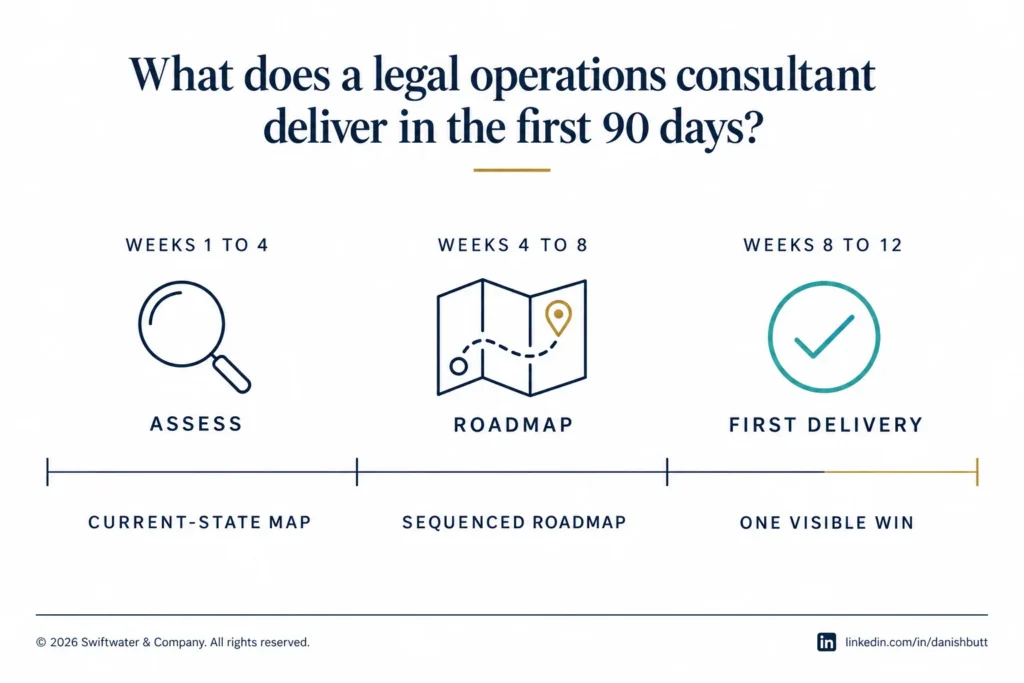
In the first 90 days a legal operations consultant should deliver a current-state assessment in weeks one to four, findings and a sequenced roadmap with an engagement model recommendation in weeks four to eight, and one visible improvement the department feels by week twelve. The first 90 days should produce a decision-ready picture of the department and the first visible improvement, in that order. An engagement that reaches day 90 with a long deck and nothing changed has been run as a study.
Building the legal operations function from scratch?
Assessment, roadmap, and delivery for the operational side of the department: spend, technology, process, vendors, and the data that proves what legal delivers. Advice from operators who ran the function.
See Legal Ops Consulting- Weeks 1 to 4: current-state assessment. Interviews across lawyers, legal operations, finance, procurement, and a sample of business requesters. Spend data pulled and normalized. Technology estate inventoried with ownership and age. Process walked end to end for the two or three highest-volume work types. Department benchmarked against published data and the consultant’s own comparables.
- Weeks 4 to 8: findings and roadmap. The gap between how the department thinks it runs and how it runs. A sequenced roadmap with dependencies, cost, and the capacity the department has to absorb each move. A recommendation on engagement model for what follows: advisory, project, or managed operation.
- Weeks 8 to 12: first delivery. One quick win that the department feels, chosen because people will notice it: a triage pot replacing a shared mailbox, a billing guideline enforced in the e-billing system, a dashboard the General Counsel takes into the next CFO meeting. Its purpose is to prove the roadmap is real and to buy the credibility the larger moves need.
Swiftwater runs this as Assess, Roadmap, Deliver, Measure, with the assessment priced as a fixed fee scaled to department size and typically taking four to twelve weeks. The output is a roadmap the department can execute with or without us, which is the test of whether the first 90 days were done properly.
How does a legal operations consultant select and implement legal technology?
A legal operations consultant selects and implements legal technology in five steps: define the operating model the tool has to serve, select against written requirements, configure to the department’s operating model, migrate and integrate through IT’s own stage gates, and drive adoption and hand over to a named owner.
Technology is where most engagements start and where the most money is at stake, so the method matters. A consultant’s job across ELM, CLM, e-billing, intake, document management, and legal AI runs in five steps, and the first one is the one departments skip when they buy without help.
- Define the operating model the tool has to serve. Request types, triage rules, matter taxonomy, billing guidelines, reporting needs. A tool configured against undefined work produces an expensive version of the old process.
- Select against written requirements. A short requirements set weighted by what the department actually does, scripted demos on the department’s own scenarios, reference calls at comparable scale, and a total cost of ownership that includes administration and adoption, which is what the Legal Tech ROI Calculator is for.
- Configure for the department. Workflows, fields, approval paths, and integrations built to the operating model from step one. This is where platform certification and prior implementations matter most.
- Migrate and integrate, through IT’s process. Legacy matter and contract data cleaned and loaded; finance, procurement, HR, and e-signature integrations built so the system becomes the single record. All of it carried through IT’s own stage gates, with the security, architecture, and data documentation prepared in the form IT expects, which is work the consultant should own.
- Drive adoption and hand over. Training by role, the redirect discipline that stops email running around the system, adoption measured weekly, and administration handed to a named owner or a managed services arrangement before the consultant leaves.
The AI question now sits inside this, and it is the reason technology selection has become harder. The Law Department Operations Survey found 57.7% of legal operations leaders citing executive pressure as a primary driver of their AI strategy, and three quarters already piloting or operating generative AI tools, while only about a third can show tangible cost savings from them. A consultant’s value here is less about knowing the tools than about holding the line that the operating model comes first, whichever agent or assistant the department buys.
When should a General Counsel hire a consultant instead of a Head of Legal Operations?
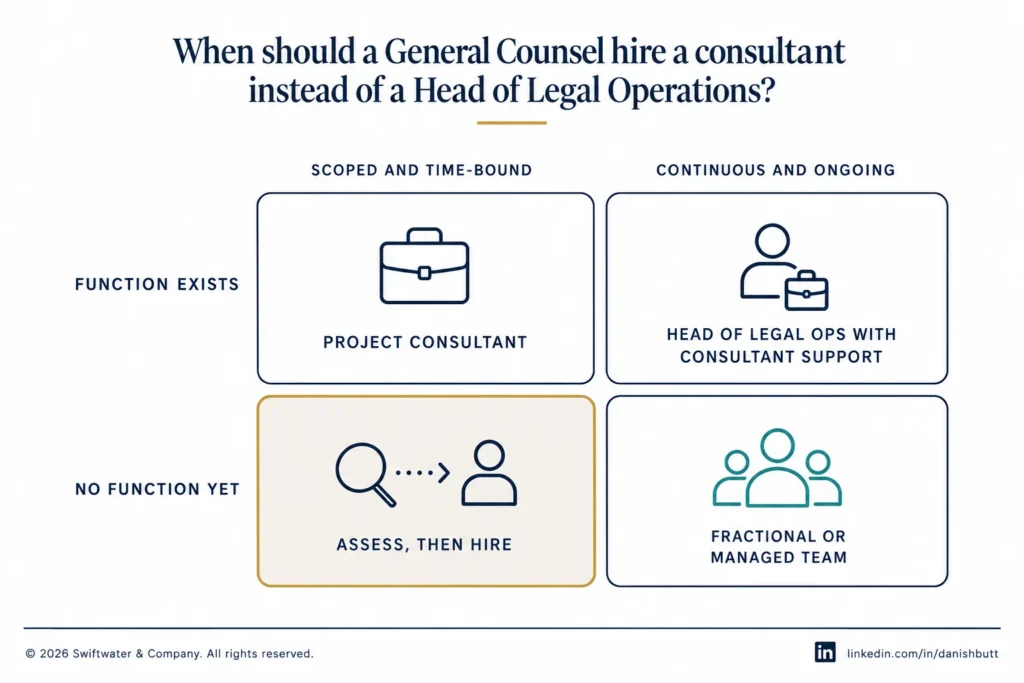
A General Counsel should hire a consultant for scoped, time-bound work such as a platform selection, an intake redesign, or a spend program, and a Head of Legal Operations for continuous operation of the function. Most departments below $5 billion in revenue have no dedicated legal operations headcount, so the usual sequence is assess first, then hire into a defined seat, with fractional capacity between.
The ACC benchmark frames the choice. At eight lawyers per legal operations professional and a median of zero dedicated legal operations headcount below $5 billion in revenue, most General Counsel are deciding whether to create the seat at all, and the answer depends on what the work is.
| Situation | Consultant or fractional | Head of Legal Operations |
|---|---|---|
| A defined build: a platform selection, an intake redesign, a spend program | Fits. Scoped work with an end date and specialist experience the department will not need again at that depth | Only if the build is the first of several and someone has to own what gets built |
| Ongoing operation: running e-billing, administering systems, reporting every quarter | Fits as managed services or fractional capacity when the volume does not justify a full seat | Fits when the volume is continuous and the function needs a leader on the General Counsel’s team |
| No legal operations function yet, department under 20 lawyers | Fits. Assess, design the function, run it fractionally, and hire into it once the scope is clear | Premature until the function’s scope is defined; the first hire often ends up doing whatever is loudest |
| Existing function that has stalled | Fits for the assessment and the reset; an outside view on a function that cannot assess itself | The seat already exists; the question is how to support it |
| A multi-year transformation across structure, spend, and technology | Fits as the delivery capacity and the method; most departments cannot staff a transformation from a function held at 5% of headcount | Required. Someone inside has to own the target state after the consultants leave |
The common failure is sequencing them backwards: hiring a Head of Legal Operations into an undefined role and then bringing in a consultant to work out what the role should be. The cheaper order is the assessment first, then the hire into a defined seat, with fractional or managed capacity covering the gap. The legal operating model article covers where the seat sits in each department structure.
What is fractional legal operations?
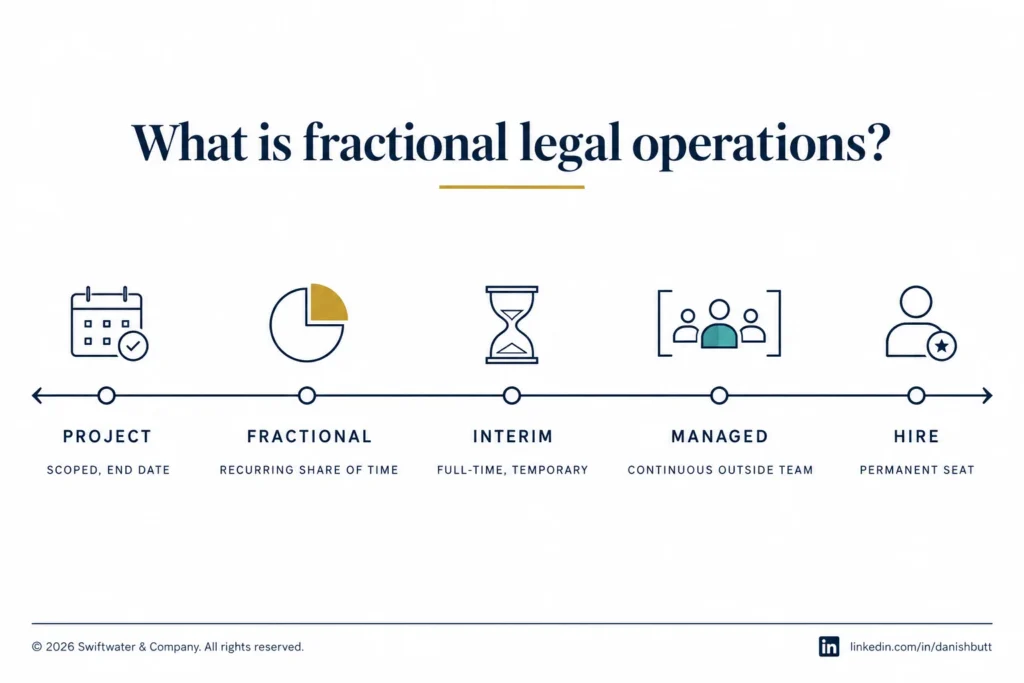
Fractional legal operations is a defined share of an experienced legal operations practitioner’s time, on a recurring basis, for a department whose volume does not justify a full-time seat or whose seat is temporarily empty. It sits between a project engagement and a hire, and it has become the most common way departments below the ACC medians get the function at all.
Three models are in use and they are often confused with each other. Fractional is recurring part-time capacity, typically a fixed number of days a month against a defined scope. Interim is full-time cover for a vacant seat, with an end date tied to a permanent hire. Embedded or managed is an outside team operating a defined part of the function continuously, under the department’s governance, which is what managed legal operations means on this site. Departments frequently need two of the three at once: fractional leadership and a managed services team behind it.
What separates the models in practice is less the contract than who shows up. The difference Swiftwater designs for is matching the level of experience to the work and pricing it at that level rather than at a blended consultancy rate, and backing the individual with the firm’s frameworks and the wider team so the department is buying a practice with a person at the front of it. A fractional Head of Legal Operations who can call on an e-billing specialist, an Onit administrator, and a data analyst as needed is a different proposition from one who works alone.
The Axiom 2026 GC Report found 80% of legal departments planning to move significant law firm work in-house or to alternative providers within 24 months, while 90% still face pressure to improve efficiency. Work coming in-house needs operational capacity to land on, and fractional legal operations is frequently how that capacity arrives before the headcount does.
How do you evaluate a legal operations consultant?
Evaluate a legal operations consultant on six checkable points: whether they have run the function in-house, who by name will do the work, what they have implemented on which platforms at what scale with callable references, whether the assessment is fixed fee and separable, what the exit and handover look like, and what adoption they achieved on prior rollouts and how it was measured.
- Have they run the function in-house? Legal operations is an operating discipline. Someone who has owned a legal department’s spend, systems, and reporting under a General Counsel asks different questions from someone who has only advised on them.
- Who, by name, will do the work? The person in the pitch and the person on the engagement should be the same. Ask for the named practitioner, their background, and how much of their time the engagement gets.
- What have they implemented, on which platforms, at what scale? Platform certifications are a floor. References at comparable department size, geography, and complexity are the test, and the references should be callable.
- Is the assessment fixed fee and separable? A consultant confident in the assessment will price it as a fixed fee and let the department take the roadmap elsewhere. One who will only assess as part of a larger commitment is selling the larger commitment.
- What does the exit look like? Documentation, trained owners, administration handed over, and a defined end state. Ask what the department will own on the last day that it did not own on the first.
- Can they show adoption after go-live? Any consultant can point to a system that launched. Ask for the adoption figure and how it was measured. Our own standard is 100% adoption of the front door on an intake rollout, and we expect to be asked how.
The questions a General Counsel should ask about the engagement itself, as distinct from the consultant, are covered in what is legal operations consulting.
Need the function run, not just advised on?
Swiftwater embeds senior practitioners directly into legal operations, handling bill review, matter management, and program delivery on your behalf.
See Managed ServicesHow much does a legal operations consultant cost?
A legal operations consultant costs less than most General Counsel assume at the entry point: Swiftwater’s quick-start spend and technology consults are free, AI-supported assessments start at $5,000, full diagnostics run $15,000 to $75,000, single-platform implementations $20,000 to $750,000 depending on scale, and multi-year transformations $1 million to $5 million.
The first steps are where the decision gets made. A good consultant prices the entry point so the department can find out what it needs before it commits to anything, and then shows how the larger investment returns itself. Swiftwater’s ranges, which are the ranges that apply to this article:
| Engagement | What it covers | Fee and duration |
|---|---|---|
| Quick-start consult | A spend consult or a technology consult: a working session on a defined question with a practitioner, and a written view of where the department stands and what to do next | Free |
| AI-supported assessment | A legal spend assessment or a legal technology health check, run on the department’s own data with AI-assisted analysis and practitioner review | From $5,000 |
| Diagnostic or assessment | The full current-state assessment when size or complexity calls for the broader team: stakeholder interviews, multiple document and system reviews, benchmarking, and the sequenced roadmap | $15,000 to $75,000 over four to eight weeks |
| Single-platform implementation, small and mid-size departments | Selection through go-live and adoption for one ELM, CLM, e-billing, intake, or document management platform | $20,000 to $150,000 over 90 days to nine months, with adoption work adding three to six months |
| Single-platform implementation, enterprise and large departments | The same scope at enterprise scale: multiple business units or regions, integrations, data migration, and IT stage gates | $150,000 to $750,000 over 90 days to nine months, with adoption work adding three to six months |
| Multi-year transformation | Structure, spend, process, and technology across the operating model | $1 million to $5 million over 18 to 36 months |
| Fractional and managed | Recurring leadership or an operating team for e-billing, administration, bill review, or reporting | Priced to scope and to the level of experience the work needs |
The sequence is the point. A department can take a free consult, then a $5,000 assessment, and walk away with a clear answer and no further obligation. The larger engagements are priced against what they return, and a consultant who cannot show the General Counsel how the investment pays for itself, in outside counsel savings, in capacity recovered, in a system that gets adopted and stays in use, has not earned the larger engagement. The Legal Tech ROI Calculator exists so that conversation starts from the department’s own numbers.
The comparison a General Counsel should run is against the alternatives, not against zero. A Head of Legal Operations is a fully loaded salary plus the time it takes to define the role and fill it. A platform bought and configured without help is the license plus whatever it costs when the department rebuilds the configuration eighteen months later.
What is the difference between a legal consultant and a legal operations consultant?
A legal consultant advises on the law: a specialist brought in for regulatory, transactional, or litigation expertise the department lacks. A legal operations consultant advises on how the legal function runs: its structure, process, technology, spend, and data. The first is practicing law in some form. The second is running a business unit that happens to be a legal department, and the people who do it well usually come from operations, technology, finance, or legal operations roles rather than from practice.
The distinction matters when hiring. A department that brings in a legal consultant to fix an operational problem gets a well-reasoned memo about it. A department that brings in a legal operations consultant to answer a legal question has hired the wrong specialist. The CLOC 2026 State of the Industry Report shows the operational side is where the pressure sits: only 32% of departments expect attorney headcount to grow, and 85% now hold dedicated AI oversight or resources. That gap between rising demand and flat lawyer headcount is operational by definition, and it is the gap legal operations consultants are hired to close.
Bottom Line
A legal operations consultant assesses, designs, and implements the operating side of a corporate legal department. The role exists because the benchmarks show most departments have almost nobody dedicated to that work, and because the legal operations team is the department’s operational face to HR, IT, finance, and procurement, a face a consultant extends when a project has to clear IT’s stage gates or needs experience the department has never had reason to hold.
Hire for the work in front of you: scoped work points to a consultant, continuous work to a Head of Legal Operations or a managed team, and the cheapest sequence is assess first, then hire into a defined seat. Evaluate on in-house experience, a named practitioner, callable references, a separable fixed-fee assessment, a defined exit, and measured adoption. Expect the entry point to be cheap and the larger investment to be shown paying for itself. Measure the engagement by what the department owns when it ends.
Swiftwater’s consultants have run legal operations in-house and work as named practitioners from assessment through adoption. Our legal operations consulting practice publishes its pricing and starts every engagement with a free consult.
Frequently Asked Questions
What does a legal operations consultant do?
A legal operations consultant assesses, designs, and implements the processes, technology, vendor programs, and reporting that let a General Counsel run the legal department as a business unit. The work covers operating model and structure, intake and workflow, technology selection and implementation, outside counsel spend programs, KPIs and reporting, and change and adoption.
When should a legal department hire a legal operations consultant?
For scoped, time-bound work such as a platform selection, an intake redesign, or a spend program; to assess and design the legal operations function before creating the seat; to reset a function that has stalled; or as delivery capacity for a multi-year transformation. Continuous operational work points to a Head of Legal Operations, a managed services arrangement, or both.
What is the difference between a legal operations consultant and a Head of Legal Operations?
A Head of Legal Operations is a permanent seat that owns the function day to day and sits on the General Counsel’s team. A legal operations consultant is external, engaged for defined work or a defined share of time, and should build the department’s own capability rather than replace it. Most departments below $5 billion in revenue have no dedicated legal operations headcount, so the consultant is often how the function first gets built.
What is fractional legal operations?
A recurring, defined share of an experienced legal operations practitioner’s time for a department whose volume does not justify a full-time seat. It differs from interim, which is full-time cover for a vacant seat, and from managed or embedded services, where an outside team operates part of the function continuously under the department’s governance.
How much does a legal operations consultant cost?
Entry points should be inexpensive. Swiftwater offers quick-start spend and technology consults free, AI-supported assessments such as a legal spend assessment or a legal technology health check from $5,000, and full diagnostics at $15,000 to $75,000 over four to eight weeks when the department’s size or complexity needs the broader team. Single-platform implementations run $20,000 to $150,000 for small and mid-size departments and $150,000 to $750,000 at enterprise scale, and multi-year transformation programs $1 million to $5 million. Fractional and managed arrangements are priced to scope. A good consultant shows how the larger investment returns itself before asking for it.
How do you evaluate a legal operations consultant?
Ask whether they have run the function in-house, who by name will do the work, what they have implemented on which platforms at what scale with callable references, whether the assessment is fixed fee and separable, what the exit and handover look like, and what adoption they achieved on prior rollouts and how it was measured.
Is a legal operations consultant the same as a legal consultant?
No. A legal consultant advises on the law and is usually a practicing specialist. A legal operations consultant advises on how the legal function runs: structure, process, technology, spend, and data. The two are hired for different problems.
Do legal operations consultants work with law firms?
This guide covers consultants to corporate legal departments and in-house legal functions. Law firm practice management consulting addresses a different buyer and a different set of problems.
This article is provided for informational purposes and reflects Swiftwater’s experience as legal operations consultants to corporate legal departments. It does not constitute legal advice. Pricing ranges are Swiftwater’s own and are indicative; engagement fees are confirmed in writing after a discovery call.