

A preferred counsel program is the set of law firms a company has approved for its legal work, together with the terms, rates and rules those firms work under. Some companies call it a panel program, others an outside counsel program. Whatever the name, the program decides which firms get the work, what they can charge, how they bill and how they are reviewed. This guide covers what a program includes, how it differs from the panel itself, who runs it, what the yearly administration involves, and the signs that a program has fallen behind.
What is a preferred counsel program?
A preferred counsel program is the approved list of law firms a company uses, along with the engagement terms, rates, billing guidelines, performance measures and governance that apply to those firms. Insurers, financial services companies and Procurement teams tend to call it a preferred counsel program; other departments say panel program or outside counsel program. The three names describe the same subject: which firms do the work, and on what terms.
Running the program is a core legal operations job. In the Blickstein Group’s 18th Annual Law Department Operations Survey, outside counsel and vendor management was a legal operations responsibility at 89.2% of the 68 companies surveyed, more than any other area. The CLOC 2026 State of the Industry Report lists outside counsel and vendor management as a focus area for 62% of the 135 law departments in its survey. Both populations are small, so read the figures as directional.
How is a preferred counsel program different from a law firm panel?
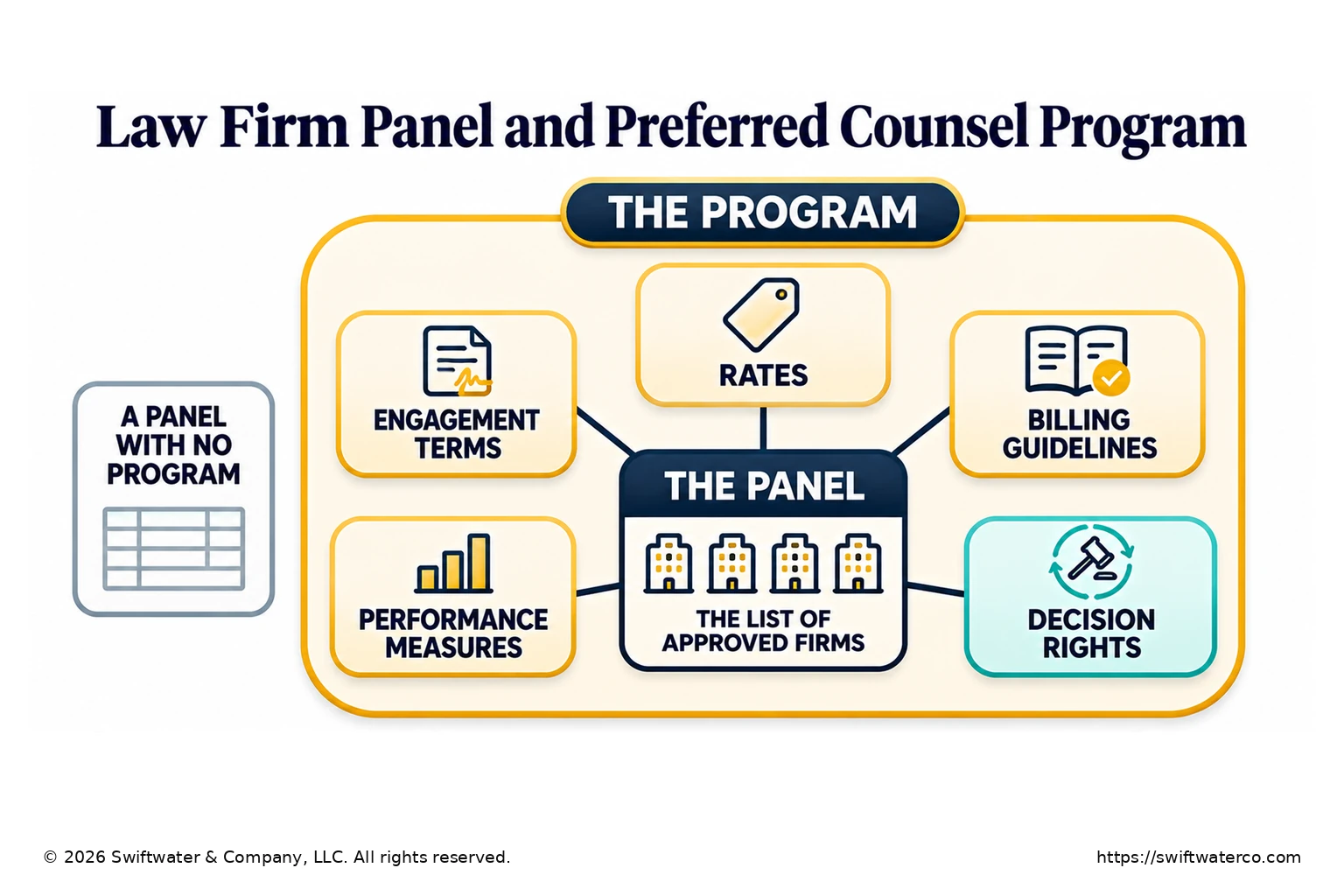
The panel is the list of approved firms. The program is the list plus everything that governs how those firms are engaged, paid and reviewed: engagement terms, rates, billing guidelines, performance measures and decision rights. A company can have a panel with very little program around it, such as a roster kept on a spreadsheet, rates agreed several years ago and no regular reviews. The program is what makes the panel work the way the department intended when it chose the firms.
For what panel counsel means and what panel membership involves for a firm, see our guide to panel counsel. For how the list itself is designed, see law firm panel design.
What does a preferred counsel program include?
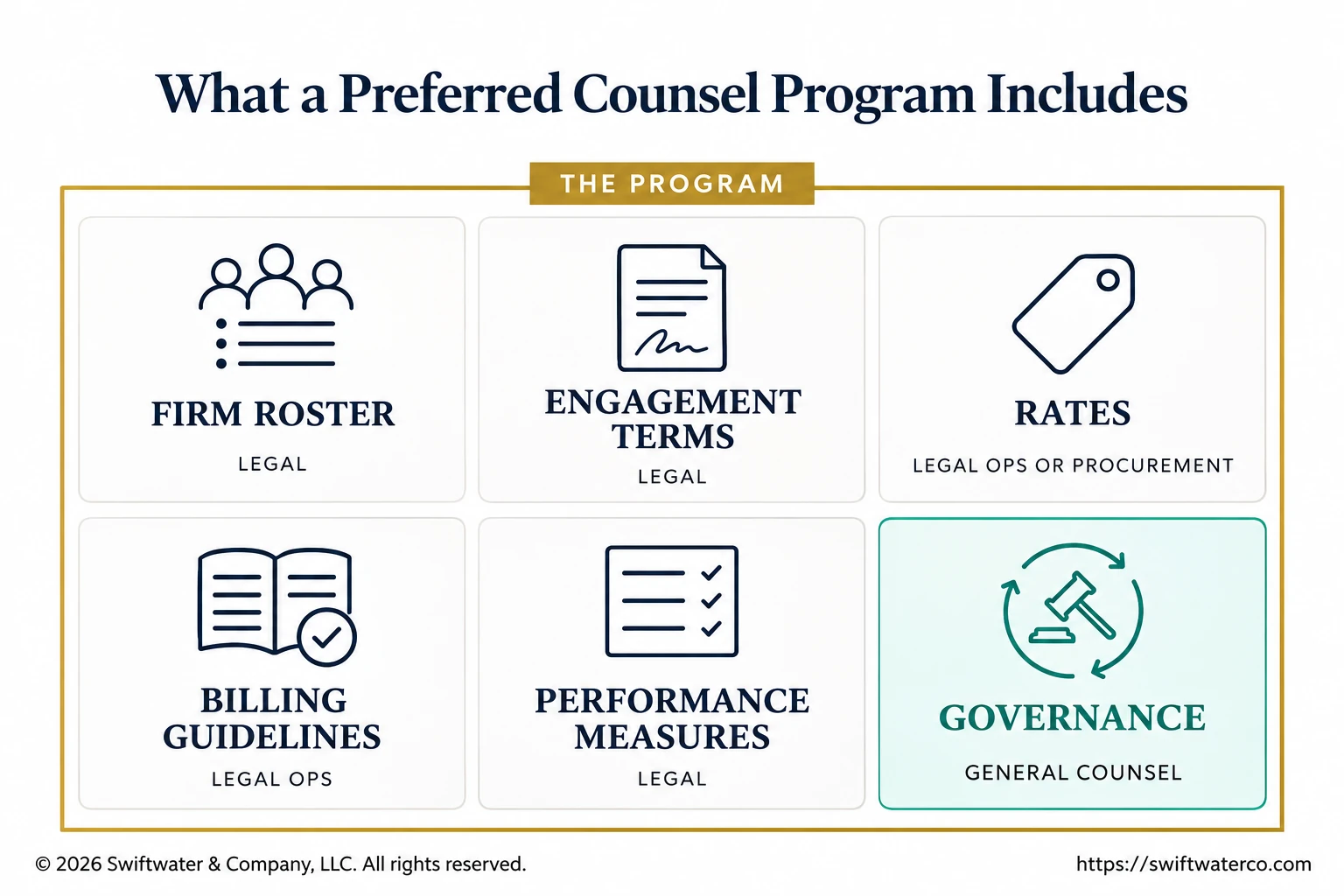
A preferred counsel program includes six elements: the firm roster, the engagement terms, the rates, the billing guidelines, the performance measures and the governance that holds them together. Each one is set when the program starts and then kept current through the year. The elements depend on each other. Rates without billing guidelines are hard to enforce, and performance measures without governance produce reports that nobody acts on.
| Element | What it sets | Who usually owns it |
|---|---|---|
| Firm roster | Which firms are approved, for which practice areas and regions | Legal, with legal operations |
| Engagement terms | How firms are engaged, staffed and kept informed on a matter | Legal, with Procurement where it is involved |
| Rates | Agreed rates by timekeeper level, and how increases are requested | Legal operations or Procurement |
| Billing guidelines | What firms may bill and how invoices are submitted | Legal operations |
| Performance measures | How each firm is assessed on cost, quality and responsiveness | Legal, with legal operations |
| Governance | Who decides, on what calendar, and how off-panel requests are handled | The General Counsel or the legal operations lead |
The program does not need a new system. The roster, rates and billing guidelines usually live in the department’s eBilling or matter management platform, where they can be applied to every invoice. For the wider discipline these elements belong to, see outside counsel management.
Is your legal spend data telling you the full story?
We help legal departments build the analytics, rate governance, and reporting infrastructure to move from invoice processing to strategic spend management.
See Legal Spend ServicesWho runs a preferred counsel program?
Ownership is usually shared. The legal department chooses the firm for each matter and owns the relationships. Legal operations runs the administration: the roster, rates, billing guidelines, eBilling configuration and reporting. Procurement, where it is involved, brings sourcing discipline to panel reviews and rate negotiations. The General Counsel, or a legal operations lead acting for them, holds the decision rights that tie the three together.
How much Procurement is involved varies widely. The Blickstein Group survey found procurement of legal services among legal operations responsibilities at 75.4% of companies, yet 52.4% of legal operations teams said they never collaborate with their Procurement function. How the two divide the work is covered in our guide to legal procurement and the outside counsel program.
What does ongoing administration involve?
Ongoing administration is the recurring work that keeps a program current between panel reviews. It covers adding and removing firms, keeping firm records and engagement terms up to date, collecting and loading annual rate requests, updating billing guidelines and the eBilling rules that enforce them, preparing scorecards and business reviews, handling off-panel requests and producing program reports. Most of it follows a calendar, and most of it runs inside the eBilling or matter management system.
Each task is small in any one month, which is why the work slips. A rate cycle missed in one year becomes two years of increases accepted by default. A business review skipped once is easy to skip again. Swiftwater runs this administration for corporate legal departments as outside counsel program management, under the department’s own governance.
How is a preferred counsel program measured and reported?
A program is measured at two levels. Each firm is assessed through a scorecard and periodic business reviews. The program as a whole is reported through spend by firm, rate compliance, the share of work going to panel firms and the invoice adjustments made under the billing guidelines. Results go to the General Counsel and, where Procurement is involved, to Procurement leadership, on a set schedule.
For how firm scorecards are built, see law firm scorecards. For how the review meeting runs, see law firm business reviews.
When does a program need outside support?
A program needs outside support when its recurring work stops happening on schedule. The usual signs are a program with no named owner, business reviews that have not taken place in over a year, rates last refreshed several cycles ago, off-panel work growing without anyone approving it, and reports produced only when someone asks for them. Each sign means the administration has fallen behind the panel it is meant to run.
There are three ways to close the gap: hire a dedicated program manager, bring in a fractional practitioner for part of the week, or have a managed team run the administration under the department’s governance. The right answer depends on the size of the panel, the volume of invoices and how much of the work the department wants to keep in house. The ACC Legal Operations Maturity Model is a useful way to judge where the program stands before choosing.
Bottom Line
A preferred counsel program is the approved list of law firms plus the engagement terms, rates, billing guidelines, performance measures and governance that decide how those firms are engaged, paid and reviewed. Panel program and outside counsel program are other names for the same subject.
Want the review function run for you?
Every outside counsel invoice checked against your guidelines, rates, and matter context, inside the eBilling platform you already own, with the exception handling, vendor coaching, and savings reporting that separate a review program from invoice processing.
See Bill Review ServicesMost of the value of a program comes from the recurring administration: rate cycles run on time, guidelines enforced at invoice, reviews held on schedule and reports delivered without being asked for. Ownership is usually shared between Legal, legal operations and Procurement, and the program works best when one of them is clearly accountable for the calendar. Choosing the firms is a decision made every few years; running the program is work done every month.
Swiftwater runs outside counsel and preferred counsel programs for corporate legal departments: panel maintenance, program governance, law firm performance reviews, rate negotiations, guideline enforcement and reporting, under your governance. See outside counsel program management.
Frequently Asked Questions
What is involved in establishing a formal legal panel program?
A preferred counsel program is the set of law firms a company has approved for its legal work, together with the terms, rates and rules those firms work under. Establishing one formally means setting selection criteria, choosing the firms, agreeing engagement terms, rates and billing guidelines with each of them, and setting the review cycle and governance that keep the panel current.
Is a preferred counsel program the same as panel counsel?
They are closely related. Panel counsel are the firms on the approved list. The preferred counsel program is that list plus the engagement terms, rates, billing guidelines, performance measures and governance around it. Our guide to panel counsel covers what membership involves for a firm.
How many law firms should be in the program?
There is no single number. The right size depends on the department’s practice areas, regions and matter volume, and on how much work it wants each firm to receive. Fewer firms usually means more attention from each and more say over rates. See how many law firms a legal department should use.
What is panel counsel for insurance?
In insurance, panel counsel are the law firms an insurer approves to defend its policyholders or handle claims litigation, working under agreed rates and the insurer’s billing guidelines. Our guide to panel counsel covers the term in more detail.
How often should the program be reviewed?
The program runs on a calendar. Rates are reviewed each rate cycle, business reviews with the main firms are held through the year, and the roster gets a fuller review when the department’s needs change, such as a new practice area, a merger or a shift in matter volume. Reporting should arrive on a set schedule.
Who should administer the program day to day?
Legal operations usually administers the program, with Legal owning firm choice and relationships and Procurement supporting sourcing and rates. When the team does not have the hours, a managed team can run the administration under the department’s governance. Swiftwater does this as outside counsel program management.
This article is for general information and education and is not legal advice; consult your own counsel on any contract or compliance question. Figures cited are from the sources named and are presented to show direction, not as targets. If you believe any material on this page should be corrected or removed, contact us through the contact form.