


The right number of law firms for a legal department can be determined by analyzing your spend distribution, practice-area coverage, and geographic footprint, and that analysis matters far more than any benchmark target. Still, I have listed a few benchmarks for reference. Most departments ask “how many law firms should we use?” looking for a universal answer, but the question itself is premature. The legal spend challenge centers on whether you know why you have each firm, what each one costs relative to the value it delivers, and whether your panel is a deliberate structure or an accumulation of relationships nobody has reviewed. A well-run outside counsel management program treats firm count as an output of analysis, never a target to hit.
Why is firm count is a misleading first question?
Firm count tells you how many relationships exist. It tells you nothing about whether those relationships are working. Departments that set a target number before analyzing their spend distribution end up making cuts that look decisive but accomplish little. Dropping from thirty firms to twenty means nothing if the twenty you keep still represent the same fragmented spend patterns, the same rate structures, and the same lack of coverage discipline.
The instinct to start with a number is understandable. Benchmarks circulate at every conference, and leadership wants a clean metric. But a legal department with fifteen firms and no governance over how work reaches them is worse off than a department with twenty-five firms and clear allocation rules. The number matters only after you understand what each firm does, what it costs, and whether that work could be handled better, cheaper, or both by a different arrangement.
Starting with the number also creates a false sense of progress. A panel “rationalization” that reduces firm count by 30 percent makes a compelling slide, but if the same tail-spend patterns persist and the remaining firms have not been given enough volume to justify preferred pricing, the exercise was cosmetic.
What do the benchmarks actually show?
The benchmarks show wide variance and a clear directional trend, but they do not show a magic number. ACC’s 2025 Law Department Management Benchmarking Report, covering 395 departments across 23 industries and 34 countries, found the median number of firms used by companies declined from 14 to 10 in the past year. That is a meaningful directional signal, but the median conceals enormous range by company size, industry, and geographic complexity.
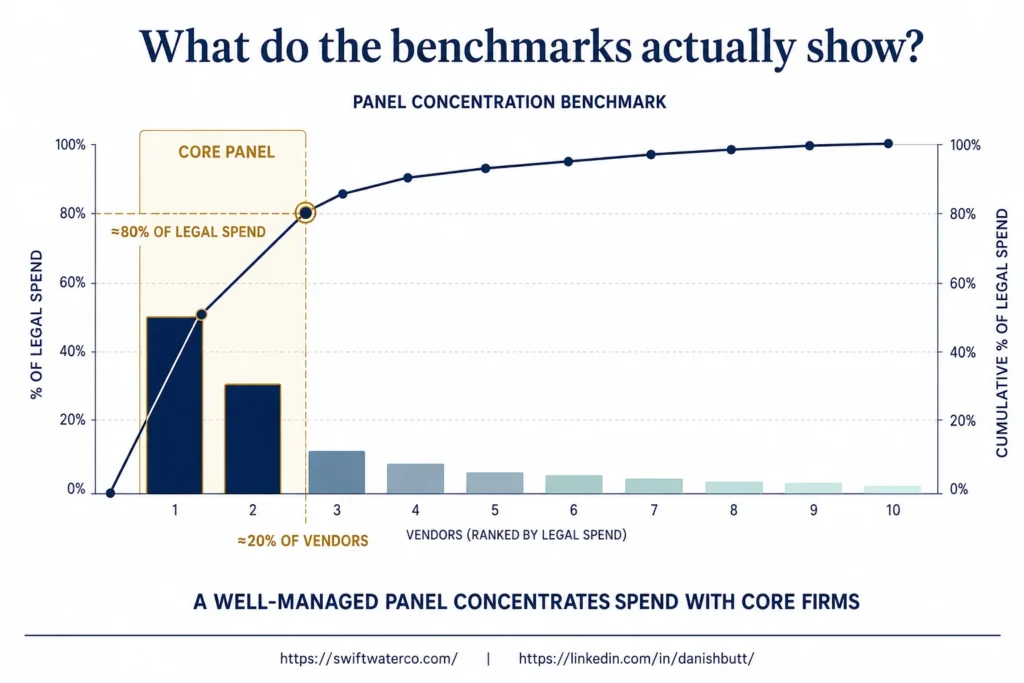
The gap between “firms on the formal panel” and “firms actually used” is enormous. Wolters Kluwer’s LegalVIEW Insights report found a median of roughly 122 providers per law department, with large companies averaging about 451. Meanwhile, Chorus Insight’s research across 121 organizations found the average formal panel size is just 8 firms, ranging from 2 to 69. That contrast tells you that most departments have a small governed panel and a large ungoverned tail of providers accumulating underneath it.
Is your legal spend data telling you the full story?
We help legal departments build the analytics, rate governance, and reporting infrastructure to move from invoice processing to strategic spend management.
See Legal Spend ServicesA $500 million single-country manufacturer and a $20 billion multinational with operations across 40 jurisdictions will never converge on the same firm count. The manufacturer might work with four firms. The multinational might need fifty and still have a tight, well-governed panel if every firm has a defined role, a negotiated rate card, and a clear scope of coverage.
The more useful benchmark is the trend toward deliberate consolidation. The 2025 Law Department Survey distributed by CLOC found that 61 percent of legal departments have completed or are implementing convergence or preferred-provider panels, up sharply from 50 percent the prior year. That Chorus Insight research found that 65 percent of organizations reduced their panel size at the last review. The profession has moved past debating whether to consolidate and is now working on how.
For a deeper look at what peer departments spend on outside counsel and how those figures break down, see the full outside counsel spend benchmarks analysis.
What drives firm count up?
Firm count rarely increases because someone made a deliberate decision to add a relationship. It accumulates through five predictable channels.
Practice-area spread. Every new practice area that requires outside support tends to bring a new firm. Employment, IP, antitrust, regulatory, commercial litigation, tax, and real estate each have their specialist shops, and unless someone is actively managing coverage across practice areas, each hiring manager or business unit reaches for the firm they know.
Geographic requirements. Local counsel mandates in multiple jurisdictions add firms that are structurally necessary but easy to lose track of. A department operating in 15 states or 10 countries may need local coverage in each, and those relationships are often established at the matter level without panel-level visibility.
M&A inheritance. Every acquisition brings the target company’s outside counsel relationships into the combined department. Post-close integration rarely includes a deliberate review of which inherited firms should be retained, consolidated, or released.
Relationship inertia. Partners move firms. Associates become partners. Business unit leaders have firms they have worked with for years. These relationships persist because nobody revisits whether they are still the best option, not because anyone has affirmatively decided to keep them.
Matter-level engagement without panel governance. When individual lawyers can engage outside counsel without routing through a formal intake process, firms accumulate at the matter level. This is the single largest driver of panel bloat, and it is the one most directly solvable through process and technology. Without a clear intake gate, the firm count grows with every new matter.
Thomson Reuters’ Legal Department Operations Index has consistently found that the majority of legal departments are handling increased work volume with flat or declining headcount, which means the pressure to engage outside counsel on new matters is constant. That pressure, without panel governance, is what turns a managed panel into an unmanaged roster.
When does concentration create risk?
Law firm consolidation has real limits, and departments that pursue it without guardrails can create a different set of problems.
Key-firm dependency. When one firm handles 40 percent or more of your total outside counsel spend, your department’s capacity depends on that firm’s capacity. If the lead partner retires, the relationship team turns over, or the firm takes on a conflicting client, you have a single point of failure that affects a large portion of your legal work.
Conflicts exposure. The more work a single firm handles across your portfolio, the higher the probability of conflicts. A firm that handles your M&A, your commercial litigation, and your regulatory work will eventually encounter a situation where one engagement conflicts with another. That risk scales with concentration.
Want the review function run for you?
Every outside counsel invoice checked against your guidelines, rates, and matter context, inside the eBilling platform you already own, with the exception handling, vendor coaching, and savings reporting that separate a review program from invoice processing.
See Bill Review ServicesRate leverage erosion. Counterintuitively, giving one firm too much volume can weaken your negotiating position. As a rule of procurement, if any firm knows it already holds a dominant share and you have no credible alternative for its core practice areas, your leverage on rate negotiations diminishes. Healthy concentration means two or three firms can cover each critical practice area, not one.
Succession planning gaps. Over-reliance on a small number of firms makes panel transitions harder. If you need to move work away from a firm due to performance, conflicts, or cost, you need receiving firms that already understand your business. A panel with no bench depth for critical practice areas creates transition risk every time a change is needed.
The question to answer is how much concentration is prudent, and that answer differs by practice area and risk tolerance. Law firm convergence works best when departments concentrate deliberately, maintain alternatives for critical coverage areas, and review their concentration ratios as part of ongoing panel governance.
How do you find the right number of law firms in your panel?
The right panel size emerges from three analyses, run in sequence. None of them starts with a target firm count.
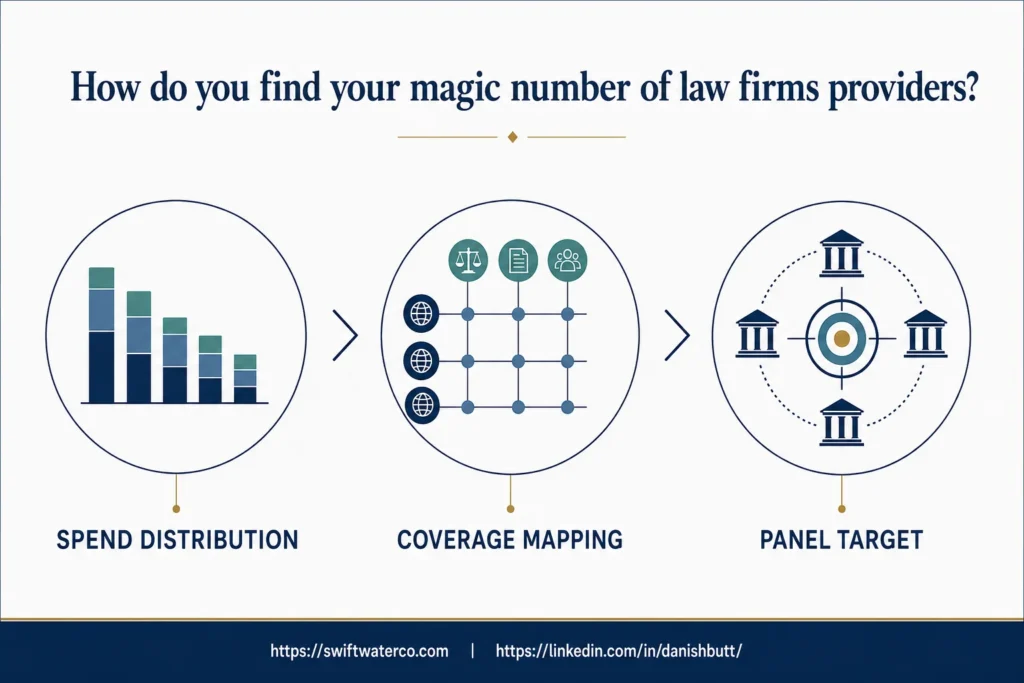
Start with spend distribution. Pull your outside counsel spend for the past two to three years and rank firms by total spend. In nearly every department, you will find a steep Pareto curve: a small number of firms account for the majority of spend, and a long tail of firms each account for a trivial share. McKinsey found that leading organizations consolidate 80 to 90 percent of external legal spend within a tightly managed panel, shifting volume from elite firms to qualified regional firms and embedding performance KPIs into engagement frameworks. Establishing a legal spend baseline is the essential first step because it shows you where your money actually goes before you start deciding where it should go.
Its often eye-opening when I start this work with corporate law departments and as we are about to embark on this exercise, the first thing I hear is that they cannot trust the data in their systems. While this is not a showstopper but also underlines an operating model question. How much focus is your team putting on process and business management? It confirms the fact that technology isn’t the problem or the solution. This is not an unsurmountable problem as over the years we have developed capabilities to directly get data from law firm and legal service providers directly and ingest them in our proprietary systems or identify the gaps in the data and “clean” it up. However, the underlying cause is a discussion worthwhile having.
Audit the tail. The long tail is where panel bloat lives. Firms with less than $25,000 in annual spend are usually there because of a single matter engagement that was never formalized into a panel relationship. For each tail firm, ask three questions: Is the work ongoing or was it a one-time engagement? Could a panel firm have handled it? Was the engagement routed through intake, or did it bypass the process? This tail audit will identify firms that can be released or replaced without any coverage loss.
Map practice-area and geographic coverage. After cleaning the tail, map your remaining firms against your practice-area needs and your geographic footprint. The goal is to identify gaps (practice areas or jurisdictions with no panel coverage) and redundancies (multiple firms covering the same work in the same jurisdiction without a deliberate reason). Structured legal spend services support exactly this kind of analysis, connecting spend data to coverage maps so the panel decisions are grounded in evidence rather than instinct.
The number that remains after these three steps is your number. It is the count of firms you need given your actual practice coverage, geographic footprint, spend distribution, and risk tolerance for concentration. It may be higher or lower than the benchmark median, and that is fine. What matters is that you can explain why each firm is on the panel and what happens if one of them leaves.
Managing off-panel spend leakage is the ongoing discipline that keeps this number honest after the initial analysis. Without intake controls and regular spend reviews, the tail will grow back.
Struggling to control outside counsel spend?
We help legal departments build the governance, billing guidelines, panel structure, and rate programs that take back control of what outside counsel costs.
See Legal Spend ServicesBottom Line
Benchmarks can tell you what peer departments look like, and directional trends like falling median firm counts and rising convergence adoption tell you where the profession is headed. But the right number of law firms for your department depends on your own spend data, coverage needs, and risk appetite. Analyze the distribution first, and the number takes care of itself.
Swiftwater helps legal departments connect their outside counsel spend data to their panel structure, identify where concentration risk and tail-spend waste sit, and define the panel size and coverage model that fits their actual needs. If your firm count feels like it grew by accident rather than by design, Swiftwater’s legal spend services can help you find the right number and build the governance to hold it.
Frequently Asked Questions
What percentage of law firm panel spend should top firms hold?
McKinsey found that leading organizations consolidate 80 to 90 percent of external legal spend within a tightly managed panel, shifting volume from elite firms to qualified regional firms and embedding performance KPIs into engagement frameworks. That level of concentration reflects deliberate allocation. The concern is when three firms hold a majority of spend and nobody chose that distribution. If spend concentration happened without a conscious coverage strategy, the panel has a governance gap.
Does a smaller law firm panel always mean lower cost?
Not automatically. Consolidation creates the conditions for better rates, volume commitments, and alternative fee arrangements, but those savings only materialize if the department negotiates them. Reducing from forty firms to fifteen without renegotiating rate structures or shifting work to lower-cost providers just concentrates the same spend with fewer relationships. The savings come from what you do with the consolidated panel, not from the consolidation itself.
How does geography change the law firm panel answer?
Geography is one of the strongest drivers of firm count. A department operating across twenty jurisdictions may need local counsel in each one regardless of how disciplined the panel is. The goal is to distinguish between firms on the panel because a jurisdiction requires them and firms on the panel because someone hired them once and nobody removed them.
What is off-panel spend on a law firm panel?
Off-panel spend is any outside counsel engagement routed to a firm not on the approved panel. Some off-panel spend is expected, particularly for specialized or jurisdiction-specific matters that panel firms cannot cover. Well-managed departments keep off-panel spend to a small fraction of total outside counsel budget. When it creeps higher, the panel is either too narrow to cover the department’s actual needs or the intake process is failing to enforce it.
This article is provided for informational purposes and reflects general patterns in legal department operations. It does not constitute legal, financial, or procurement advice. Consult qualified professionals for guidance specific to your organization’s circumstances.