


A law firm scorecard works when it measures what the department can actually act on, and wastes time when it tracks metrics that look rigorous but drive no decisions. Legal departments generate enough eBilling data to fill a scorecard with dozens of metrics. The harder question is which five or six will change how you allocate work, negotiate rates, or manage firm relationships. The answer starts with the decisions the scorecard is supposed to drive and the metrics that inform those decisions.
Legal spend management programs that build scorecards around actionable signals, rather than comprehensive data catalogs, consistently produce better panel governance outcomes.
What is a law firm scorecard supposed to change?
A law firm scorecard should change three things: how work gets allocated across the panel, how rate conversations are grounded in performance, and how firm relationships are structured over time. If a scorecard does not inform at least one of those decisions, it is a reporting exercise, and less of a governance tool.
The distinction matters because most law firm scorecards stall at the reporting stage. The department invests in building the framework, populates it once or twice, and then stops using it because no one connects the scores to a downstream action. The scorecard then becomes a file that is expensive to maintain without commensurate results. For legal operations teams that can be quite a burden and source of frustration.
Start by naming the decisions. If you want to rebalance work away from underperforming firms, the scorecard needs metrics that distinguish performance in ways that justify reallocation. If you want to anchor rate negotiations in something other than last year’s rate plus a percentage, the scorecard needs spend-discipline and value metrics that give you a factual basis. If you want to build structured outside counsel management practices, the scorecard becomes the shared language between your team and your firms.
The Thomson Reuters 2026 State of the US Legal Market report found that worked rates grew 7.4% in 2025, nearly triple the rate of inflation. When rate increases outpace every other cost in the legal budget, law firm scorecard-driven governance is no longer optional. It is the mechanism that forces a factual conversation about whether the rate increase is matched by performance.
What metrics belong on a law firm scorecard?
An effective law firm scorecard has metrics that belong in five categories, each tied to a decision the department actually makes. The categories are spend discipline, outcome quality, guideline compliance, responsiveness, and staffing diversity.
Is your legal spend data telling you the full story?
We help legal departments build the analytics, rate governance, and reporting infrastructure to move from invoice processing to strategic spend management.
See Legal Spend Services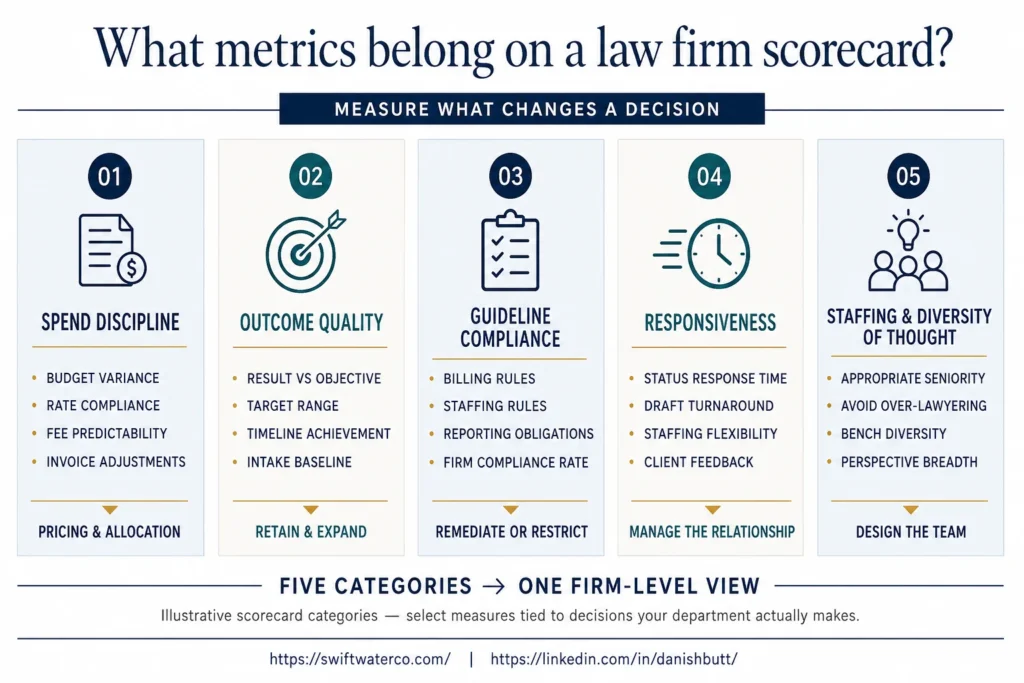
Spend discipline covers budget accuracy, rate compliance, and fee predictability. Track the variance between budgeted and actual spend at the matter level. Track whether the firm bills at approved rates or submits timekeepers above the agreed schedule. Track how often the firm’s invoices trigger adjustments during bill review. These are the metrics that ground rate negotiations in data rather than anecdote. They also connect directly to your outside counsel billing guidelines and reveal whether guidelines are being followed or quietly ignored.
Outcome quality covers matter results relative to objectives set at intake. Did the litigation resolve within the target range? Did the transaction close on the projected timeline? Did the regulatory matter produce the expected outcome? Outcome metrics require a baseline set at matter opening, which means your intake process has to capture what “good” looks like before the work begins.
Guideline compliance measures adherence to billing rules, staffing requirements, and reporting obligations. This is the most automatable category because eBilling platforms already flag violations. The scorecard aggregates those flags into a firm-level compliance rate. And, notice it is just one of the categories. Most newly formed legal operations team spend significant amount of time curating their ebilling tools only to find out it is only feeding a portion of decision making. Realizing the other dimensions and roadmapping how to get the other data points helps mature the outside counsel management very quickly.
Responsiveness captures how the firm performs as a working partner. Response times on status requests, turnaround on draft deliverables, willingness to staff according to matter needs rather than firm economics. These metrics typically come from internal client surveys or relationship partner assessments rather than system data.
Staffing and diversity of thought evaluates whether the firm staffs matters with appropriate seniority, avoids over-lawyering, and brings diverse perspectives to the work. PERSUIT’s analysis of scorecard patterns across 8,000+ RFP processes found that expertise and diversity rank alongside price as the categories legal departments weight most heavily in outside counsel evaluation. Staffing diversity is not a compliance checkbox. It is a proxy for whether the firm is deploying its best thinking or defaulting to a narrow bench.
Not every category carries equal weight, and not every firm needs to be measured on every metric. A firm handling ten patent prosecutions a year gets a different scorecard than a firm running bet-the-company litigation. The structure stays the same while the emphasis shifts.
Where does law firm scorecard data come from?
Law firm scorecard data comes from three sources: eBilling and matter management systems, matter-close assessments, and internal client surveys. Each source covers different metric categories, and none covers all of them.
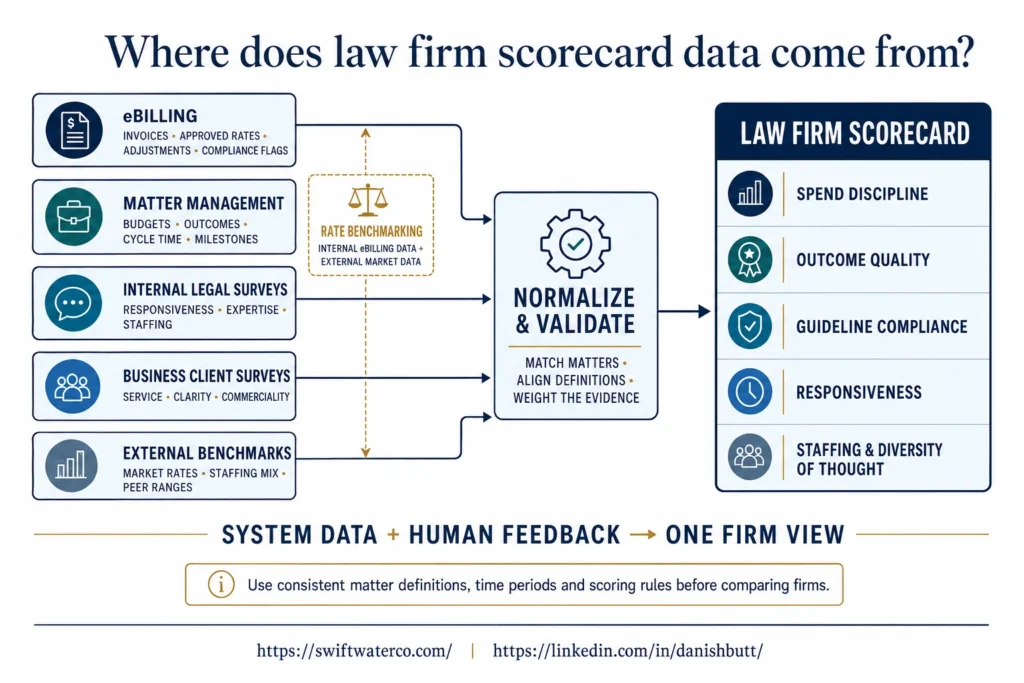
eBilling data feeds spend discipline and guideline compliance directly. Budget variance, rate compliance, invoice adjustment rates, and billing-rule adherence are all captured in the normal course of invoice processing. The quality of this data depends entirely on how well your eBilling platform is configured. Departments with weak eBilling governance produce scorecard inputs that look precise but reflect inconsistent data. If billing rules are not enforced at the platform level, compliance metrics will show false positives.
Structuring invoices with UTBMS codes makes the eBilling data dramatically more useful for scorecards. UTBMS-coded line items let you compare firms on cost-per-phase and cost-per-activity, which surfaces efficiency differences that flat invoice totals obscure.
Side-bar: However, there is a broader discussion to be had. Every few years we have been adding a new framework, outside counsel guideline, a tool, an integration, a view, a dashboard, the question, however, remains if that is making the attorney/ the bill reviewers life better. It may be giving them yet another point of data but it still requires them to take everything they are presented with and put it together in their head. The cognitive load of all that. Well, we will have more conversations on this later.
Matter management data feeds outcome quality. This requires the department to capture expected outcomes at matter intake and actual outcomes at matter close. Most matter management systems support this workflow, but most departments skip it because the intake fields feel like overhead. Without intake baselines, outcome scoring becomes retrospective opinion rather than measured variance.
Internal client surveys feed responsiveness and relationship quality. A short survey sent to the business client and the supervising attorney at matter close captures whether the firm was responsive, proactive, and appropriately staffed. Keep surveys to five or six questions on a consistent scale. Long surveys get abandoned. The CLOC 2026 State of the Industry report found that 62% of legal operations professionals now include outside counsel and vendor management among their key focus areas, which means the infrastructure to collect and use this data is becoming a baseline expectation rather than an advanced practice.
Want the review function run for you?
Every outside counsel invoice checked against your guidelines, rates, and matter context, inside the eBilling platform you already own, with the exception handling, vendor coaching, and savings reporting that separate a review program from invoice processing.
See Bill Review ServicesThe difference between legal spend analytics and reporting shows up clearly in scorecard programs. Reporting tells you what a firm billed. Analytics tells you whether that billing pattern signals a problem worth acting on. Scorecards live on the analytics side.
How do you weight and score legal service providers with simplicity?
Scoring law firm scorecards needs to be simple. So, use a simple weighting scheme and resist the urge to build a formula that looks more precise than the underlying data warrants. A three-point scale (below expectations, meets expectations, exceeds expectations) on each metric category, with category weights that sum to 100, is enough to rank firms and drive decisions.
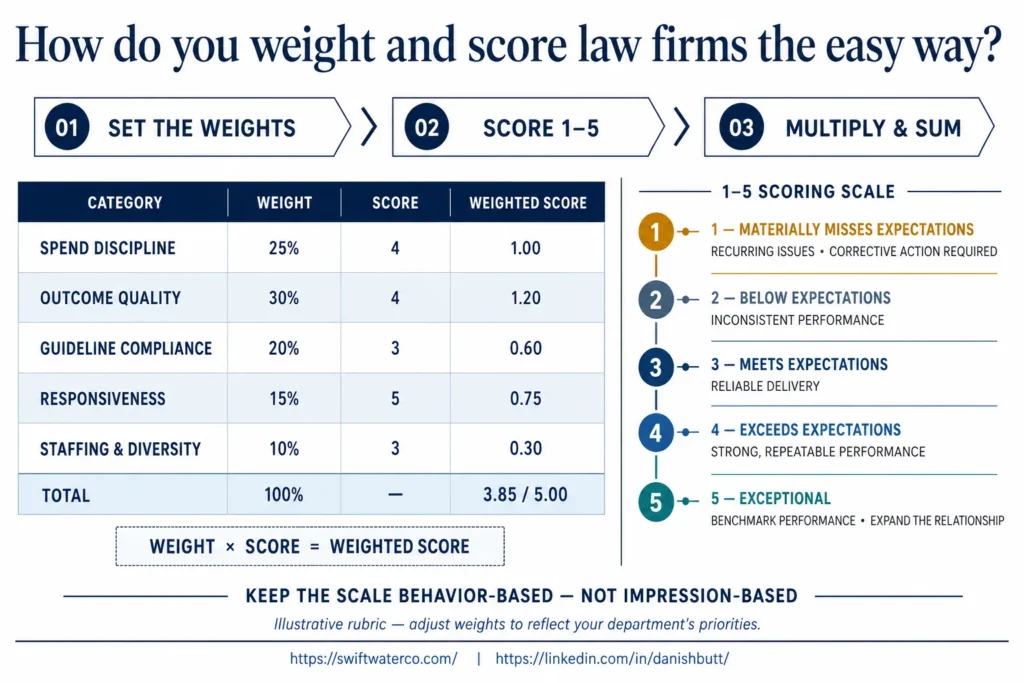
The weighting should reflect the decisions the scorecard serves. If the primary use case is rate negotiation, weight spend discipline and budget accuracy more heavily. If the primary use case is panel rebalancing, weight outcome quality and responsiveness. If the primary use case is compliance governance, weight guideline adherence.
A common mistake is weighting all categories equally. Equal weighting sounds fair but produces undifferentiated scores. A firm that delivers excellent outcomes but bills aggressively scores the same as a firm that bills cleanly but delivers mediocre results. The scorecard fails to distinguish them, so it fails to drive reallocation.
Another common mistake is decimal-point precision on subjective inputs. If responsiveness is scored on a 1-to-10 scale by a single survey respondent, the difference between a 6 and a 7 is noise. Converting that to a three-point scale and weighting it at 15% of the total produces a score that is honest about its precision.
For departments building scorecard infrastructure alongside broader legal spend management programs, the weighting conversation is also a prioritization exercise. It forces the leadership team to say out loud which aspects of firm performance matter most, and that clarity cascades into rate negotiations, panel reviews, and work allocation decisions. It then makes it helpful for the outside counsel manager and the legal ops team to manage, collect and present the required decision support information.
How should scorecards differ for panel law firms versus ad hoc firms?
Panel firms and ad hoc firms serve fundamentally different roles, and the scorecard should reflect that difference rather than forcing both into the same law firm scorecard framework. A panel firm carries an ongoing relationship with recurring matters, a negotiated rate structure, and an expectation of strategic partnership. An ad hoc firm handles a discrete engagement, often specialized, with no assumption of continuity.
For panel firms, apply the full five-category scorecard. The relationship generates enough data across multiple matters to make each metric category meaningful. Spend discipline trends over quarters. Outcome quality averages across a portfolio. Responsiveness patterns emerge from repeated interactions. The law firm panel scorecard becomes a longitudinal record of the relationship, and the business review conversation draws on that history to set expectations for the next period.
For ad hoc firms, narrow the legal provider scorecard to spend discipline and outcome quality only. A firm that handled one cross-border regulatory matter does not generate a meaningful responsiveness trend or a compliance pattern. Scoring it on those dimensions produces a number that looks like data but reflects a single observation. The scorecard for ad hoc engagements is really a matter-close evaluation: did the firm deliver the outcome within the budget and timeline, and did it comply with billing guidelines on that specific matter?
The distinction also affects how scorecards feed panel decisions. Panel firms are scored to maintain or improve their standing. Ad hoc firms are scored to determine whether they earn a spot on the panel. A strong single-matter evaluation is the entry point, not the ongoing governance mechanism. Departments that apply panel-level law firm scorecards to every engagement regardless of relationship depth create administrative burden without governance value.
Where this gets nuanced is with firms in transition. A firm that starts as ad hoc, handles three matters well, and is being considered for the panel needs a different evaluation lens than either category alone provides. In those cases, weight the available data heavily on outcomes and spend discipline, note the limited sample explicitly, and treat the first full scoring cycle after panel admission as the true baseline rather than back-fitting earlier single-matter scores into the framework.
How do you share the law firm scorecards with firms?
Share the individual law firm’s scorecard in structured business review, not as a standalone document dropped into an email. A scorecard without a conversation is a report card. A scorecard inside a business review is a relationship tool.
The sharing cadence should match the scorecard refresh cycle, typically quarterly for strategic firms and semiannually for the broader panel. Each review session covers the scorecard results, discusses the drivers behind each score, identifies specific actions for the next period, and documents commitments on both sides.
Three rules make the sharing productive rather than adversarial.
Struggling to control outside counsel spend?
We help legal departments build the governance, billing guidelines, panel structure, and rate programs that take back control of what outside counsel costs.
See Legal Spend Services- Share the methodology before you share the results. Firms that understand how they are being measured can respond constructively. Firms that receive a score without context get defensive.
- Share each firm’s scorecard with that firm only. Comparative rankings across the panel create competition without collaboration.
- Anchor the conversation in specific matters and specific data points, not aggregate scores. A firm that scores 2 out of 3 on budget accuracy will engage more productively if you can point to the three matters where budget variance exceeded 20% than if you simply report the number.
The business review structure is where scorecards and law firm business reviews converge. The scorecard provides the data. The business review provides the forum. Together they create an accountability loop that improves firm performance over time rather than simply measuring it.
When done well, sharing scorecards actually strengthens firm relationships. It signals that the department takes the relationship seriously enough to measure it, that performance data drives decisions rather than politics, and that firms have a clear path to improving their standing. The firms that resist transparency in scorecard reviews will often be the firms the department will be scrutinizing most closely.
Bottom Line
A law firm scorecard is only as useful as the decisions it drives. Start from those decisions, work backward to the five or six metrics that inform them, source the data from eBilling and matter-close assessments, weight the categories to reflect your priorities, differentiate the framework between panel and ad hoc firms, and share the results in structured conversations that treat firms as partners rather than vendors. If you build the law firm scorecard around what you can act on, then it becomes the most productive tool in your panel governance program.
Law firm scorecards are one piece of a broader outside counsel governance architecture. Swiftwater helps legal departments design the metrics, configure the data feeds, and build the business review cadence that turns a legal provider scorecard from a spreadsheet into a management discipline. If your law firm panel program needs that structure, start with a legal spend assessment.
Frequently Asked Questions
How often should law firm scorecards refresh?
Most legal departments refresh law firm scorecards quarterly, aligned with billing cycles and business review cadences. Annual refreshes miss too many course-correction opportunities. Monthly refreshes create noise unless the department has high matter volume and automated data feeds from eBilling.
Should law firms see each other’s rankings?
No. Share each firm’s individual scorecard with that firm only. Comparative rankings create defensiveness and undermine the relationship-building purpose of the exercise. If panel tiering is part of your governance program, communicate tier status separately from the scorecard itself.
What sample size makes law firm outcome metrics fair?
A firm needs at least eight to ten completed matters in a scoring period before outcome metrics carry meaningful weight. Below that threshold, a single unusual result skews the average. For firms with smaller portfolios, weight process and compliance metrics more heavily until the outcome sample is large enough.
Can law firm scorecards be automated from eBilling data?
Partially. eBilling platforms can feed spend discipline, rate compliance, budget variance, and guideline adherence metrics automatically. Outcome quality, responsiveness, and strategic value still require human input, typically through matter-close surveys or relationship partner assessments. The goal is to automate the data collection, not the judgment.
How should scorecards differ for panel law firms versus ad hoc firms?
Panel firms warrant a full scorecard across all five metric categories because the relationship is ongoing and the data sample is large enough to be meaningful. Ad hoc or single-matter firms should be evaluated on spend discipline and outcome quality only. Applying the full framework to a firm that handled one matter produces scores that look precise but reflect nothing actionable.
This article is for informational purposes only and does not constitute legal, financial, or consulting advice. Law firm scorecard design and panel governance practices should be tailored to each organization’s specific circumstances, data maturity, and outside counsel relationships.