

Legal spend management is a core function of legal department operations. Because legal teams are stuck between a rock and a hard place: increasing legal and regulatory complexity, growing business demands and tightening budgets. A smart, proactive approach to spend management is the only way out, transforming the legal department from a cost center into a genuine strategic business partner.
For a deeper look, browse our guide at How GC’s Can Build a Spend Management Program.
Why Legal Spend Management Is No Longer Optional
The modern business environment expects more from its legal department than ever before. You’re handling a massive volume of complex work – from litigation to M&A to compliance – often without a bigger budget to match. Trying to manage this by just reacting to bills as they come in simply doesn’t work anymore.
The data backs this up. A recent ACC Chief Legal Officers Survey found that 42% of CLOs received cost-cutting mandates that directly impacted their hiring plans. This really gets to the heart of the challenge: do more with less. It’s forcing legal teams to get creative and find new ways to control costs without compromising the quality of their work. You can find more insights on these industry pressures over at Bottomline.com.
The Shift From Cost Center to Strategic Partner
Let’s be clear: effective legal spend management isn’t just about slashing expenses. It’s about achieving financial clarity so you can make smarter strategic moves. If a General Counsel can’t see exactly where the money is going, how can they justify their department’s value or accurately forecast what they’ll need next year?
A solid program gives you the data to answer the tough questions
Many legal departments discover that controlling spend is only one part of the challenge. The underlying issue is often operational. Teams struggling with budget predictability frequently face broader legal operations capacity constraints. Understanding why legal operations teams remain under-resourced can help explain why spend management programs fail to gain traction despite strong executive support.
Is your legal spend data telling you the full story?
We help legal departments build the analytics, rate governance, and reporting infrastructure to move from invoice processing to strategic spend management.
See Legal Spend Services- Which of our outside firms deliver the best value for specific types of work?
- Are our litigation costs going up or down? What’s driving that trend?
- Where are the real opportunities to bring work in-house and be more efficient.Answering these questions with hard data, not just a gut feeling, is how the legal department proves its contribution to the company’s bottom line. This data-driven mindset is what finally changes the old “cost center” perception and earns legal a real seat at the strategy table.
The Pillars of an Effective Program
Building a successful legal spend management program isn’t about guesswork; it requires a structured, deliberate approach. I’ve found it helps to think about it in terms of several core pillars. When they work together, you get the visibility, predictability, and control you’ve been looking for. Getting these components right provides a clear roadmap for a system that delivers real results and long-term value.
Here’s a quick breakdown of the foundational pillars that every successful program needs.
Core Pillars of an Effective Legal Spend Management Strategy
This table outlines the fundamental components of a successful program, including the main goal and key actions for each pillar.
| Pillar | Primary Objective | Key Activities |
|---|---|---|
| Data & Analytics | Create a single source of truth for all legal spending. | Consolidating invoice data, categorizing spend, and tracking KPIs like average matter cost. |
| Matter Management | Gain proactive control over the lifecycle of legal matters. | Establishing matter-level budgets, tracking progress against budgets, and managing scope changes. |
| Vendor Management | Optimize relationships with outside counsel for value and performance. | Enforcing billing guidelines, negotiating rates and AFAs, and evaluating law firm performance. |
| Technology & Automation | Increase efficiency and enforce compliance through technology. | Implementing e-billing software, automating invoice review, and using reporting dashboards. |
Think of these pillars as the essential building blocks. Without a strong foundation in each of these areas, any attempt to manage spend will eventually run into roadblocks. Getting them right from the start is the key to creating a program that truly works.
Eventually, you will ask the question of what does Artificial Intelligence (AI) do for me in legal spend management. Here is a conversation with industry experts on all topics legal spend, AI, tools!

Can Legal Spend Management Work for a Small Legal Departments?
Absolutely, legal spend management is even more impactful for a small team where every dollar and every hour counts. Effective spend management is about discipline and visibility, not the price tag of your software. You don’t need a massive, all-encompassing Enterprise Legal Management (ELM) suite to get a handle on your costs.
You can start small and see a huge difference almost immediately. The goal is the same for any size team: get control of your data and your processes.
Here’s a simple way to start:
- Write It Down: Create a simple one- or two-page billing guidelines document. Just outlining your basic rules and expectations and sharing it with every firm is a massive first step.
- Standardize Your Data: Insist that all invoices use standard UTBMS (Uniform Task-Based Management System) codes. This simple change allows you to finally categorize and analyze where your money is going.
- Use Smarter, Not Pricier, Tools: You can achieve a lot with a well-designed spreadsheet. Or, look into the growing number of vendors who offer lighter, more affordable e-billing tools built specifically for smaller legal teams.
Building Your Framework for Spend Analysis
You can’t control what you can’t see. I’ve seen it time and again: effective legal spend management only begins when you can demystify your expenditures. This isn’t about some complex theory; it’s about taking practical steps to build a clear, data-driven foundation for every decision you make.
The goal is to stop being a bill-payer and start being a strategic partner. To do that, you need to pull together data from all the scattered places it lives – invoices, finance systems, e-billing platforms, and law firm reports. This visibility is your first real step away from reactive firefighting and toward proactive financial oversight.
Consolidating Your Data Sources
The first hurdle for most legal departments is data chaos. Invoices flood in through different formats (PDF, LEDES, paper), land in various email inboxes, and are processed by separate accounting systems. Your first job is to bring all this information into one central place.
A solid framework for spend analysis absolutely depends on the quality of your data. This is where many initiatives fail before they even start. Investing in strategies to improve data quality is non-negotiable, especially for mid-sized companies where resources are precious. Without clean, consistent data, any analysis you run is fundamentally flawed.
This centralization effort is a core pillar of successful legal operations management. It’s what lets you compare apples to apples when you’re looking at firm performance or the true cost of a matter.
Want the review function run for you?
Every outside counsel invoice checked against your guidelines, rates, and matter context, inside the eBilling platform you already own, with the exception handling, vendor coaching, and savings reporting that separate a review program from invoice processing.
See Bill Review ServicesThe pressure to get this right is only growing. Just look at the projected growth in the U.S. legal services market. This trend highlights the increasing need for legal departments to manage costs with discipline. The U.S. legal services market is on track to grow from USD 304.93 billion to roughly USD 466.42 billion by 2034, fueled by complex regulations in finance, healthcare, and tech. This expansion makes a structured approach to spend management less of a “nice-to-have” and more of a “must-do” for controlling costs.
Categorizing Spend and Identifying Patterns
Once your data is in one place, the real work begins. You have to categorize every single dollar. This goes way beyond just noting which law firm sent the bill. Good categorization should answer the critical “what” and “why” behind your legal spend.
Start by tagging expenses with meaningful labels:
- Practice Area: Is this for litigation, M&A, intellectual property, or labor and employment?
- Matter Type: Within litigation, is it a commercial dispute, a patent case, or a class action?
- Internal Business Unit: Which department requested the legal work?
- Geographic Region: Where is the legal work being performed?
This level of detail lets you spot trends that were invisible before. You might find that one business unit consistently generates high-cost, low-complexity legal work – a perfect candidate for developing standardized playbooks or even bringing the work in-house.
Key Insight: The point of categorization is to turn raw payment data into business intelligence. It helps you see not just how much you’re spending, but why and where you’re spending it. That shift is the very foundation of strategic legal spend management.

Tracking Key Performance Indicators
With clean, categorized data, you can finally track meaningful Key Performance Indicators (KPIs) that paint a clear picture of your department’s financial health. Forget vague metrics; you need specific, actionable KPIs.
Here are the essential KPIs you should build into your framework:
- Average Matter Cost by Type: What does a standard patent filing typically cost you versus a complex M&A deal? This is crucial for accurate forecasting and budgeting.
- Law Firm Performance: Go beyond the final bill. Track metrics like budget-to-actual variance, average timekeeper rates, and how well each firm adheres to your billing guidelines.
- Spend Under Alternative Fee Arrangements (AFAs): What percentage of your spend is moving away from the billable hour? This KPI signals your progress toward cost predictability.
- Invoice Compliance Rate: How many invoices get rejected or adjusted because they don’t follow your billing guidelines? This is a direct measure of how effectively you’re managing your vendors.
Tracking these KPIs gives you the objective data you need to justify decisions, spot quick savings opportunities, and powerfully demonstrate the value of your legal spend management efforts to the C-suite.
Evaluating and Selecting the Right Technology
Technology is the engine of modern legal spend management, Technology alone rarely solves spend management problems. Many legal departments invest in eBilling and enterprise legal management platforms only to discover that adoption, governance, and day-to-day administration remain unresolved. This is one reason legal technology initiatives often fail without dedicated operational support. but stepping into the marketplace can feel like wandering through a maze. With countless vendors all promising the moon, how do you find the solution that actually solves your problems – without overpaying for features you’ll never use?
This isn’t just about buying software; it’s a strategic investment. The right tool automates tedious work, delivers powerful insights, and gives you unprecedented control. The wrong one becomes expensive “shelfware” that creates more friction than it solves. The key is to start with a clear-eyed view of your department’s specific needs before you even glance at a product demo.
Defining Your Core Requirements
Before getting dazzled by flashy dashboards, you need to build a practical checklist of must-have capabilities. What are the real problems you’re trying to solve? Are you drowning in manual invoice review, or is your biggest struggle a complete lack of visibility into matter-level spending?
Ground your evaluation in these real-world challenges. For many teams, the best place to start is with one of the top invoice review automation software solutions. This technology can dramatically streamline your accounts payable process, slash manual errors, and deliver an immediate impact.
Your core requirements list might look something like this:
- Automated Invoice Review: The system must be able to automatically flag non-compliant billing entries based on your specific outside counsel guidelines, like block billing or charges for administrative work.
- Matter-Level Budget Tracking: We need a way to set, monitor, and report on budgets for individual legal matters, with real-time alerts when a matter approaches its budget threshold.
- Intuitive Reporting and Analytics: Dashboards have to be easy enough for anyone to analyze spend by practice area, business unit, or law firm. This data will fuel conversations with both our team and company leadership.
- Seamless Integration: The tool must connect with our existing finance and ERP systems to ensure a smooth flow of data without clunky manual workarounds.
From Standalone Tools to Comprehensive Suites
The legal tech market offers a wide spectrum of solutions, each designed for different levels of operational maturity and scale. Knowing the difference is crucial for creating a relevant shortlist of vendors.
Generally, you’ll encounter two main categories:
Struggling to control outside counsel spend?
We help legal departments build the governance, billing guidelines, panel structure, and rate programs that take back control of what outside counsel costs.
See Legal Spend Services- Standalone E-billing Platforms: These tools are laser-focused on one thing: automating the invoice intake, review, and approval workflow. They are perfect for departments whose primary pain point is efficiently processing a high volume of invoices and enforcing billing guidelines.
- Enterprise Legal Management (ELM) Suites: These are the all-in-one platforms. They combine e-billing with other modules like matter management, contract management, and advanced analytics. ELMs are built to provide a holistic view of all legal operations and are best suited for larger departments trying to manage the entire legal function from a single system.
Expert Tip: Don’t fall into the “bigger is better” trap. A powerful ELM suite is total overkill if your team just needs to fix a broken invoicing process. Match the solution’s complexity to your department’s actual needs to guarantee a high return on your investment.
To make forecasting more accurate, many teams I’ve worked with use a workflow that integrates historical spend data directly into future planning.
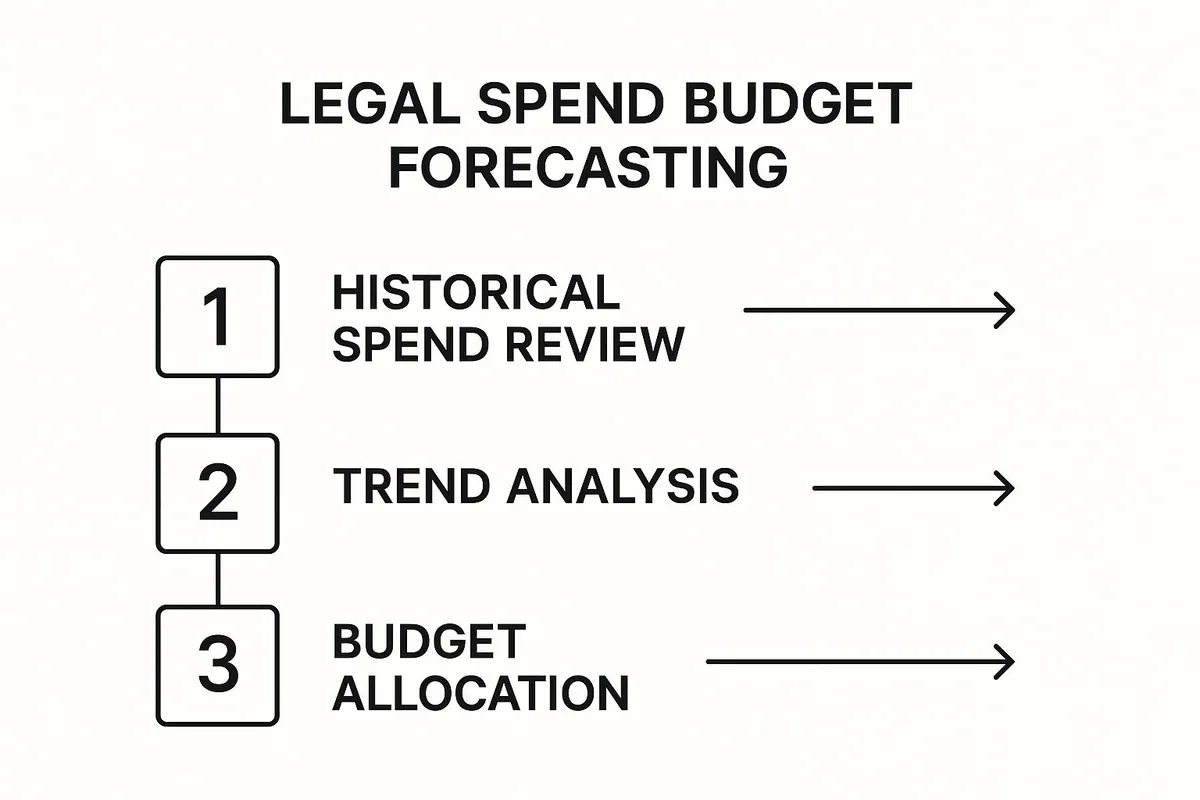
This kind of process flow shows how reviewing past expenditures and analyzing trends can directly inform how future budgets are allocated, creating a data-driven cycle of continuous improvement.
Asking the Right Questions During Demos
Once you have a shortlist, the product demo is your most important evaluation tool. This is your chance to push past the slick sales pitch and see how the software would actually function in your day-to-day reality.
You need to show up prepared. Have specific scenarios and tough questions ready that reflect your unique challenges. Don’t just sit back and watch the presenter click through a canned presentation.
Essential Demo Questions to Ask:
- Onboarding Outside Counsel: “Show me the exact process for onboarding a new law firm. How much training and support will they require from my team?”
- Custom Reporting: “I need to build a report showing our top 10 most expensive litigation matters for the last quarter, broken down by phase. Can you show me how to create that report from scratch right now?”
- Handling Exceptions: “What happens when an invoice has a valid but unusual charge that our automated rules flag as non-compliant? Walk me through the workflow for reviewing and approving that specific line item.”
- Data Security: “Our company has strict data residency requirements. Where will our data be stored, and what security certifications do you maintain?”
By focusing on practical, scenario-based questions like these, you force the vendor to prove the tool’s real-world utility instead of just talking about features. This rigorous approach is how you find a technology partner that will truly support your legal spend management goals.
These are questions that are essential to ask but not the only questions you should ask. Reach out to the Swiftwater team for help. We typically take a diagnostic based approach to come up with the demo script. This is necessary as key stakeholders from whom you need the buy-in are involved. And, lets say they provide you buy-in upfront but if the product they bought doesn’t work according to the “actual” needs then it can severely affect user satisfaction and adoption later.

Implementing Your New Spend Management Program
Rolling out a new legal spend management program is far more about people and process than it is about software. Many organizations eventually determine that ongoing administration, invoice review, vendor management, reporting, and platform governance are better handled through dedicated operational support models. Understanding how managed services improve legal spend control can help legal teams evaluate whether internal ownership remains the most efficient approach. I’ve seen many well-intentioned projects stumble because they treated it like a simple IT update. It’s not.
This is a fundamental shift in how your department operates. A successful launch hinges on a structured plan that focuses on the human side of change. The big mistake is just announcing a new tool and expecting everyone to fall in line. To get real adoption, you need a thoughtful change management strategy that brings everyone – from your internal team to your most trusted outside counsel – along for the ride.
Securing Genuine Stakeholder Buy-In
Before you even think about configuring software, your first job is to build a coalition of support. And I don’t mean just sending a kick-off email. You need to secure genuine, vocal buy-in from key stakeholders across the business.
Who do you need to convince?
- Your Internal Legal Team: They need to see this as a tool that frees them from administrative headaches, not a “big brother” system designed to micromanage them. Frame it around how it helps them focus on high-value legal work they actually enjoy.
- The Finance Department: These are your natural allies. Show them how the new program will finally deliver the accruals and forecasting data they’ve always wanted, moving them from messy spreadsheets to real-time visibility. This is a huge win for financial controls and makes their month-end close so much smoother.
- IT and Data Security: Bring them into the tent early. Their partnership is non-negotiable for handling system integrations, data security protocols, and ensuring everything aligns with company-wide tech standards.
Getting this multi-departmental support transforms the project from a “legal initiative” into a “business improvement.” You’re building a network of champions who will help you push through the inevitable roadblocks.
Crafting and Communicating Billing Guidelines
Your billing guidelines are the constitution of your new program. They have to be crystal clear, fair, and easy to follow. If they’re vague or overly restrictive, you’re just setting yourself up for disputes and friction with your firms.
Start by defining the absolute non-negotiables. These usually include things like:
- No Block Billing: Insist on itemized time entries. You need to see exactly what work was performed.
- Clear Expense Rules: Be specific about what is and isn’t a reimbursable expense. Are first-class flights okay? What about meal per diems? Spell it out.
- No “Clerical” Charges: Define what you consider administrative work that shouldn’t show up on an invoice, like the time it takes to prepare the bill itself.
Once you’ve drafted the guidelines, don’t just email the PDF and hope for the best. That’s a rookie mistake. Schedule brief “kick-off” calls with your primary law firm partners. Walk them through the document, explain the why behind the rules, and answer their questions. This simple, collaborative step frames the guidelines as a tool for mutual efficiency, not a punitive mandate. It shows respect for the partnership and dramatically increases compliance from day one.
A Phased Rollout for Internal and External Teams
A “big bang” launch – where everyone goes live on the same day – is a recipe for pure chaos. Trust me. A phased approach is far more manageable and lets you learn and adapt as you go.
My big 4 launch no-no’s
1. Big bang launch
2. Dec 31st (end of year launch)
3. End of fiscal quarter launch
4. Launching when not ready
Phase 1: The Pilot Group
Hand-pick a small group of tech-savvy internal attorneys and one or two of your most collaborative law firms. Use this pilot phase to test your entire process, from creating a new matter to approving an invoice. This small-scale rollout will expose any workflow kinks or system bugs in a controlled environment where they’re easy to fix.
Phase 2: Gradual Onboarding
Using the lessons learned from the pilot, start onboarding the rest of your team and firms in small, manageable waves. Don’t use a one-size-fits-all training. For your internal team, focus on budget tracking and reporting. For outside counsel, concentrate on invoice submission and compliance.
Phase 3: Full Implementation and Reinforcement
Once everyone is on the system, the real work shifts to reinforcement. Regularly share reports that highlight the program’s wins, like cost savings from flagged invoices or improved budget predictability. Keep offering support and gathering feedback for ongoing improvements. This structured approach helps in managing spend effectively, and some organizations even find that leveraging a PMO-as-a-Service can help reduce legal spend by managing these complex implementations.
By treating implementation as a strategic change management project, you build a solid foundation for your legal spend management program. This structured, communicative, and phased approach minimizes disruption and ensures you actually achieve the visibility and control you set out to gain.
Advanced Strategies for Optimizing Legal Spend
Once you have the fundamentals locked down, it’s time to shift your legal spend management from simply controlling costs to actively creating value. The most sophisticated legal departments don’t just passively track spending – they use data to shape it. This is where your legal operations team can become a genuine strategic partner to the business.
These advanced tactics are all about moving beyond reactive invoice reviews. Instead, you’ll be structuring smarter firm partnerships, forecasting future needs with confidence, and making data-backed decisions that deliver major savings and efficiencies.

Mastering Alternative Fee Arrangements
The billable hour is no longer the only game in town. I’ve seen leading legal teams get aggressive about moving toward Alternative Fee Arrangements (AFAs) to lock in cost predictability and, more importantly, to better align incentives with their outside law firms.
AFAs are fundamentally changing how companies buy legal services, shifting the focus from rewarding hours worked to rewarding successful outcomes. Research shows AFAs now make up about 23% of all external legal spend, and that number is steadily climbing. While things like fixed fees or success-based fees have huge potential, they aren’t without risk. Scope creep, for example, can blow up a fixed-fee matter if you aren’t watching it closely.
Getting AFAs right means you need robust oversight and real-time visibility into how a matter is progressing. Keep learning about and tweaking AFAs, here are some AFA trends on Apperio.com.
Expert Tip: Don’t treat AFAs as a “set it and forget it” tool. Real success depends on a crystal-clear scope of work and constant monitoring. A true partnership means both you and your firm have visibility into how the matter is tracking against the agreed-upon budget. Leverage a partner like Swiftwater to help determine what is the right AFA, how it can be setup, and how it can be monitored and reported upon. Take it from us if you put 5 lawyers in a room and ask them to define flat-fee… try it… let us know how it went.
Consolidating Your Law Firm Panel for Maximum Value
Spreading your legal work across dozens of different law firms might seem like a good way to foster competition, but in my experience, it usually just dilutes your buying power and creates an administrative nightmare. A much more effective strategy is to use performance data to consolidate your outside counsel panel.
The goal here isn’t just to work with fewer firms; it’s about working with the right ones. By analyzing metrics like budget adherence, average cost per matter, and case outcomes, you can quickly see who your true high-performers are.
The key benefits of panel consolidation are pretty clear:
- Stronger Negotiating Power: When you direct a larger volume of work to a select group of firms, you gain significant leverage to negotiate better rates, volume discounts, and more favorable AFA structures.
- Deeper Partnerships: Your primary firms develop a much deeper understanding of your business, your risk tolerance, and your strategic goals. This leads to more practical and effective legal advice.
- Increased Efficiency: Simply put, managing fewer relationships drastically cuts down on the administrative burden for your legal ops team, freeing them up to focus on more strategic initiatives.
This data-driven approach ensures you’re partnering with firms that consistently deliver the best value, not just the ones with the lowest hourly rate.
Leveraging Analytics for Predictive Forecasting
The most mature legal departments I’ve worked with don’t just report on what they spent last quarter; they use historical data to accurately predict what they’ll need next year. This is the critical shift from rearview reporting to forward-looking strategy.
Using your spend management platform, you can analyze past trends to build surprisingly sophisticated forecasting models. For instance, once you understand the average lifecycle and cost of different matter types, you can create far more accurate annual budgets. This empowers the General Counsel to have data-driven conversations with the CFO, turning “we think we’ll need this much” into “based on our data and projected business activity, we forecast a need of X.”
Of course, it’s not just about your internal data. Staying on top of broader industry shifts is also vital. To truly optimize legal spend, it pays to be aware of emerging disruptions impacting legal and insurance costs.
This predictive capability is a hallmark of a truly optimized legal function, paving the way for better planning and resource allocation. It’s a prime example of how the Head of Legal Operations can implement continuous improvement across the entire department.
How Do We Get Our Outside Law Firms to Adopt Our New Billing Guidelines and Software?
This is a big one. The secret is to treat it like a partnership, not a top-down mandate. While, most large to mid-size firms are used to e-billing, remember, your law firms are businesses, and their biggest concerns are doing great work and getting paid on time. If you can show them how your new system helps them achieve that, you’re halfway there.
Frame the whole thing around mutual benefits. Explain that the new platform and guidelines are designed to kill the endless administrative back-and-forth. For them, this means fewer invoice rejections, less chasing down information, and ultimately, faster, more predictable payments.
- Make It Easy for Them: Nobody wants to learn a clunky new system. Provide short video tutorials, one-page guides, and maybe even a quick 15-minute training session. The easier you make it, the less resistance you’ll get.
- Start with Your Champions: Roll it out first to your most trusted, collaborative law firm partners. Once they’re successfully on board, you have a powerful case study to show other, more hesitant firms.
- Stand Your Ground: While collaboration is key, you have to be ready to enforce the rules. A “no platform, no payment” policy should be your firm-but-fair backstop for any persistent holdouts. But leading with the “what’s in it for them” angle is always the best first move.
What Is the Biggest Mistake Companies Make When Starting with Legal Spend Management?
Hands down, the single biggest pitfall is getting mesmerized by technology while completely ignoring the people and the process. I’ve seen it time and again: a team gets excited, buys a powerful new software tool, and six months down the line they do not see the value they thought they would get.
A tool is only as effective as the strategy it supports. If you buy a top-of-the-line e-billing system without first cleaning up your data, defining what “success” even looks like, or establishing clear billing guidelines, you’re just automating a mess.
Think of this as a change management project, not an IT installation. You have to win the hearts and minds of your own team and fix your underlying processes first. The technology is there to enable and enforce those better habits, not create them out of thin air.
How Do We Measure the ROI of Our Legal Spend Management Program?
To really prove the value of your efforts, you need to track both hard savings and soft savings. Hard savings are the direct, easy-to-calculate cost reductions. Soft savings are the crucial (but often overlooked) efficiency gains.
Hard Savings Examples:
- Dollars saved from catching duplicate invoice entries.
- Money saved by enforcing your negotiated rates and blocking unapproved staff from billing time.
- Reductions from rejecting non-compliant charges, like vague “block billing” entries.
Soft Savings Examples:
- Attorney hours saved by eliminating manual line-by-line invoice reviews.
- Reduction in the invoice approval cycle time (e.g., from 30 days down to 5).
- Vastly improved budget predictability and forecasting, which makes the CFO very happy.
By tracking hard savings and soft savings, you can build a rock-solid business case that shows the total value of your legal spend management program that controls costs, reduces risk and helps operate an efficient legal function.
If you are ready to move beyond invoice review and build a more disciplined approach to legal spend management, Swiftwater’s Outside Counsel Optimization Program provides a structured framework across Diagnose, Govern, and Optimize to help legal departments improve visibility, strengthen vendor governance, and control legal spend.
Frequently Asked Questions
What is the difference between legal spend management and legal operations?
Legal spend management focuses specifically on controlling, forecasting, and optimizing legal costs, particularly outside counsel spend. Legal operations is a broader discipline that includes spend management alongside technology, vendor management, process improvement, reporting, and service delivery.
Who should own legal spend management within a legal department?
Most mature legal departments place day-to-day ownership with legal operations, while the General Counsel provides strategic direction. Finance, procurement, and matter-owning attorneys often contribute to budgeting, reporting, and governance activities.
How often should legal spend be reviewed?
Most legal departments benefit from quarterly legal spend reviews. Quarterly reviews provide enough time to identify trends, compare actual spend against budgets, review law firm performance, and adjust forecasts before year-end planning cycles.
What role does outside counsel performance play in legal spend management?
Legal spend management is not only about cost. Evaluating outside counsel performance helps legal departments understand whether firms are delivering the right combination of expertise, responsiveness, efficiency, and budget predictability for the work being performed.
What data should a legal department track first?
Departments starting their legal spend management journey should begin with total spend by law firm, spend by matter type, approved budgets, invoice adjustments, and outside counsel utilization. These data points provide a practical foundation for more advanced analytics later.
Can legal spend management improve budget forecasting?
Yes. Historical spend patterns, matter budgets, and law firm performance data help legal departments forecast future costs more accurately. Better forecasting also improves communication with finance teams and business leadership.
How does legal spend management support General Counsel reporting?
Legal spend management provides the data needed to explain where legal budgets are being used, which matters are driving costs, how outside counsel are performing, and where opportunities exist to improve efficiency and predictability.
What is the first step in building legal spend discipline?
The first step is creating visibility. Legal departments should establish a clear baseline of current spend, identify their highest-cost matters and firms, and implement consistent review processes before introducing more advanced controls.
Disclaimer: This article is provided for educational and informational purposes only. Neither Swiftwater and Company nor the author provides legal advice. This content does not constitute professional legal, financial, or operational advice and should not be relied upon as such. Readers are encouraged to consult a qualified professional before making decisions based on the information provided. External links are included for reference only and reflect the views of their respective authors. Swiftwater and Company takes no responsibility for third-party content.