
Outside counsel management is the discipline of selecting, governing, and evaluating outside law firms as a structured program, and it is the single highest-leverage point of control inside legal spend management. For a typical corporate legal department, outside counsel represents the largest single line item in the budget. ACC found that companies allocate roughly 50 to 60 percent of total legal expenses to outside counsel and alternative legal service providers, with that share climbing higher at larger organizations. When the largest category of spend runs on individual relationships and institutional habit rather than a repeatable governance structure, rate creep, panel sprawl, and billing surprises are predictable outcomes.
This guide covers every component of a mature outside counsel program, from panel design to scorecards, and explains why structure is the strategy that turns law firm relationships into a controllable asset.
What is outside counsel management?
Outside counsel management is the end-to-end process a legal department uses to decide which law firms it works with, on what terms, and how it measures their performance over time. It spans the full lifecycle of the firm relationship: defining panel counsel criteria, running selections, onboarding new firms, setting billing guidelines, monitoring work quality, and governing spend.
The distinction matters because most legal departments do hire outside counsel. Fewer manage them. Hiring is a transaction while management requires a system. A department that hires firms reactively, matter by matter, with no shared criteria for selection, no standard for onboarding, and no consistent way to evaluate whether the firm delivered value, is in for a lot of unintended consequences, with a key one being legal spend increase.
Outside counsel management turns that spending into a program with defined inputs, measurable outputs, and a feedback loop that improves both cost outcomes and service quality over successive cycles.
Why does outside counsel management fail without structure?
The cost of unstructured outside counsel relationships compounds quietly. Rates increase year over year without a negotiation framework. New firms get added to the roster without anyone retiring underperforming firms or firms that do not fit your delivery model. Billing guidelines exist in a document no one references, and invoices arrive with charges that no one benchmarked against expectations.
Axiom’s 2024 General Counsel Survey found that 89% of general counsels no longer view law firms as a completely effective resourcing solution. Note: Axiom is an Alternative Legal Service Provider. This statistic does not necessarily indicate dissatisfaction with law firms. Instead, it points toward the need for a more deliberate service delivery model.
Is your legal spend data telling you the full story?
We help legal departments build the analytics, rate governance, and reporting infrastructure to move from invoice processing to strategic spend management.
See Legal Spend ServicesSo, if there is not a structured approach to outside counsel management, it often leads to informal performance expectations, no structured feedback, and no expectations for quality or service levels.
Without structure, three common failures repeat:
- Rate creep without leverage. When there is no competitive panel and no formal review cycle, annual rate increases from firms are hard to push back on. Departments that negotiate with law firms beyond rates gain leverage on staffing, scope, and alternative fee arrangements. Departments that negotiate only on rate, or not at all, absorb increases passively.
- Panel sprawl. A department that adds firms without a deliberate panel design ends up with dozens of relationships, each too small to command attention and too scattered to benchmark. Deciding how many law firms a legal department should use requires a deliberate framework, not a rolling accumulation of who got the last call.
- No performance data. Without scorecards and business reviews, the only feedback mechanism is the managing attorney or general counsel’s impression. Impressions and feelings now need to be backed with data. This may be sufficient for day-to-day management, but without data, it is difficult to compare firms over time. Without data, it is also difficult to justify decisions about reallocating work.
What are the components of an outside counsel program?
A mature outside counsel program has six components, each reinforcing the others.
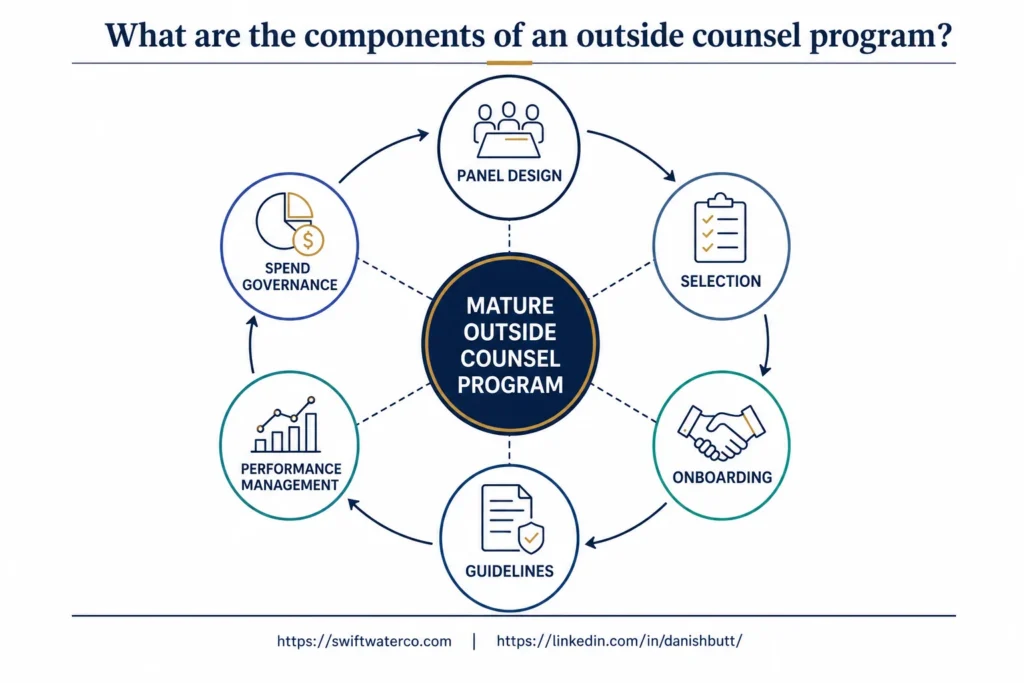
Panel design. The panel defines which firms the department uses and for what work. A structured panel matches firm capability to matter types, sets concentration and diversification targets, and creates the competitive dynamic that gives the department negotiating leverage. How Do You Design a Law Firm Panel? covers the architecture in detail.
Selection. Getting the right firms onto the panel requires a disciplined selection process, whether through a formal legal panel RFP or a structured evaluation. The selection criteria should reflect what the department actually values: responsiveness, staffing discipline, rate competitiveness, subject-matter depth, and willingness to work within the department’s governance model.
Onboarding. A firm that wins a panel spot but never receives clear expectations on billing, staffing, and communication will default to its own standard practices, which may not match the department’s. Onboarding a law firm onto your panel sets the operating norms before the first invoice arrives, not after the first dispute.
Billing guidelines. Guidelines govern how firms bill, what they can bill for, and how invoices are reviewed. They are the department’s operating rules for outside counsel spend. When guidelines are unclear or unenforced, invoice disputes become reactive and adversarial rather than preventive. [Note: go to the Swiftwater ->Insights -> Legal Spend and Insights -> Enterprise Legal Management hubs to learn more about the art and science of billing guidelines]
Performance management. Scorecards and business reviews close the feedback loop. They translate subjective impressions into structured evaluations that can be compared across firms and tracked across cycles. Performance management is what turns a panel from a static list into a governed relationship portfolio.
Spend governance. The financial controls layer: rate management, matter budgets, invoice review rules, and eBilling panel configuration that enforces guidelines through technology rather than manual effort. Spend governance also includes monitoring off-panel legal spend leakage, where work flows to firms outside the panel, bypassing every control the program was designed to provide.
How does outside counsel management connect to legal spend management?
Outside counsel is the largest controllable cost category in most legal departments. When departments talk about reducing legal spend without sacrificing quality, they are almost always talking about outside counsel. Internal headcount is relatively fixed. Technology costs are growing but still a fraction of total spend. Outside counsel is where the money moves, and it is where governance has the highest return.
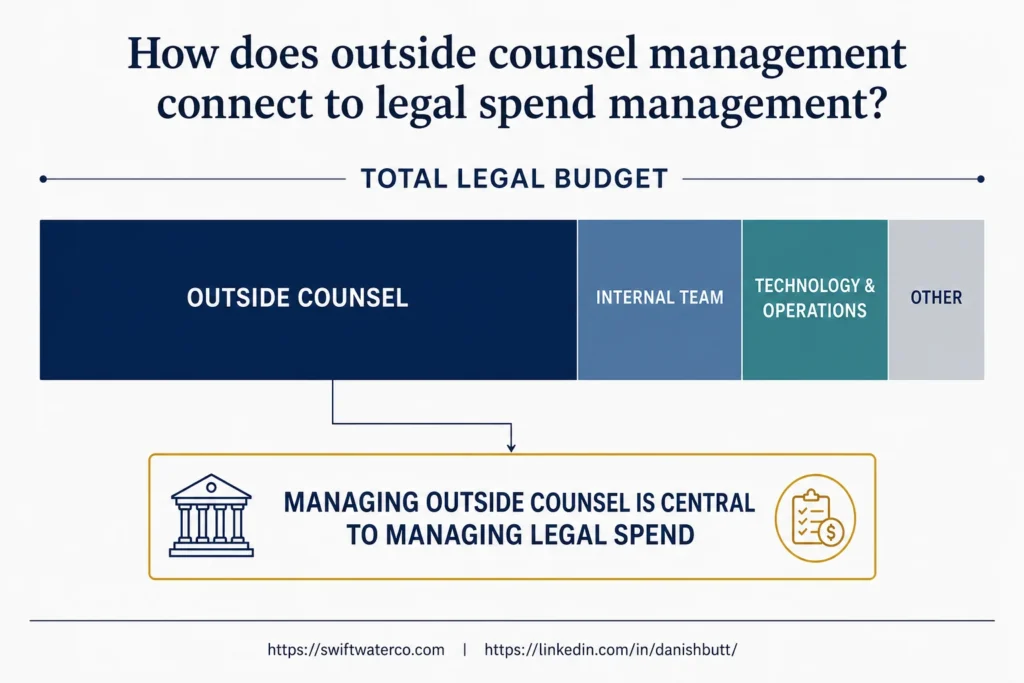
CLOC’s 2026 State of the Industry Report found that only 37% of legal departments now expect an increase in outside counsel spend, down sharply from 58% the prior year. Demand is not declining. Budgets are tightening. That gap between rising workload and flattening budgets makes outside counsel management the operational discipline that determines whether the department absorbs the pressure through discipline or absorbs it through cuts.
The connection between outside counsel management and legal spend management is direct. Every component of the outside counsel program feeds the spend management program: panel design controls concentration risk, billing guidelines prevent overbilling, scorecards justify reallocation decisions, and eBilling configuration automates enforcement. Without the outside counsel program producing clean, governed data, the legal spend baseline is unreliable, and legal spend analytics have nothing trustworthy to analyze.
Want the review function run for you?
Every outside counsel invoice checked against your guidelines, rates, and matter context, inside the eBilling platform you already own, with the exception handling, vendor coaching, and savings reporting that separate a review program from invoice processing.
See Bill Review ServicesA department that tries to manage legal spend without managing outside counsel is only managing part of its budget and may face challenges in meeting its business objectives.
Who owns outside counsel management in the legal department?
The general counsel sets the direction. Legal operations runs the program. Practice leads own the firm relationships within their domains. That three-part model works in most mid-to-large departments, but the critical requirement is that someone is explicitly accountable for the program as a whole.
In departments without dedicated legal operations, the general counsel often owns the relationships personally, and the “program” is their personal knowledge of which firms do what and whether they are satisfied. That approach works at small scale. It breaks when the department manages 15 or more firms, because no single person can hold the performance data, rate history, billing patterns, and relationship context for that many firms in their head.
Legal operations brings the systems: the eBilling platform configuration, the scorecard process, the data that makes business reviews productive rather than ceremonial. When legal ops is strong, the general counsel can focus on strategic firm relationships while the program infrastructure runs consistently underneath.
Some departments involve procurement. Procurement brings negotiation discipline and vendor management methodology. But outside counsel management requires legal judgment that pure procurement processes cannot supply. The work is not interchangeable. The risk profile varies by matter. The relationship carries strategic value that a lowest-cost framework would miss. The best model is collaboration: either there is a dedicated role for outside counsel management or an external partner can help or procurement supports rate benchmarking and contract terms while legal operations owns program design and performance management.
How do you know your program is working?
A working outside counsel program produces measurable outcomes across four dimensions: cost, quality, compliance, and leverage.
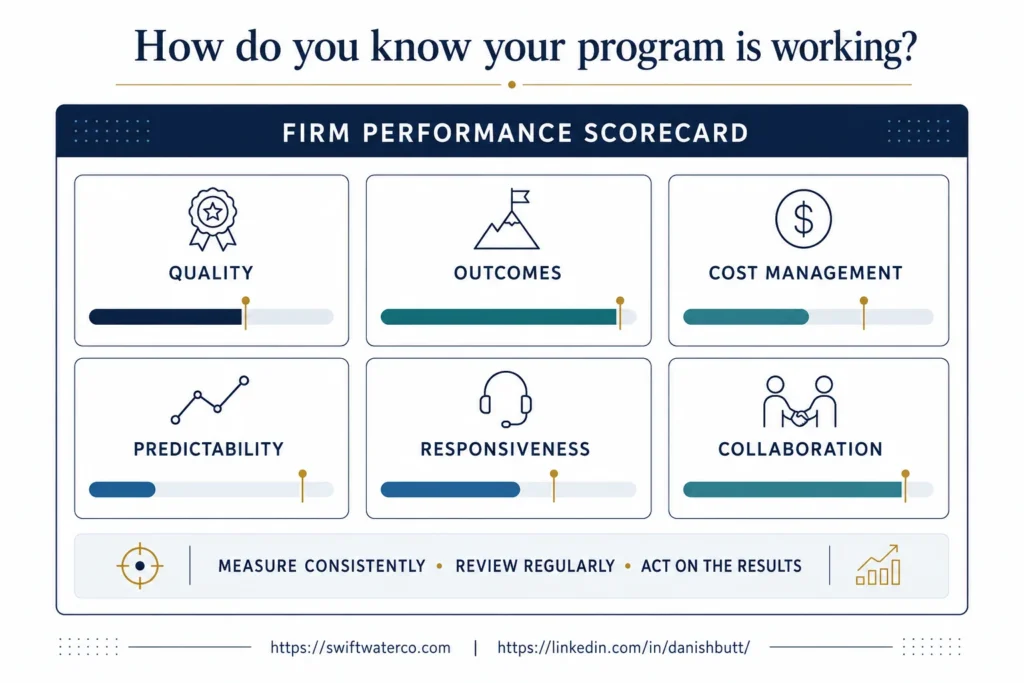
Cost outcomes. Total outside counsel spend trends in a direction the department chose deliberately, not one it discovered after the fact. Matter-level spend variance against budget decreases. Rate increases stay within negotiated bands. How much a department should spend on outside counsel becomes a question the department can answer with data rather than intuition.
Quality outcomes. Scorecard results improve over successive review cycles. Firms that consistently underperform are identified and put on performance improvement or replaced. The department can articulate why it uses each firm on its panel and what differentiates that firm from alternatives.
Compliance outcomes. Billing guideline adherence rates increase. Invoice rejection rates for guideline violations decrease as firms internalize the rules. Off-panel spend stays within a defined tolerance, and exceptions require documented justification.
Leverage outcomes. The department enters rate negotiations with data. Firms compete for work based on performance, not tenure. The panel composition reflects the department’s current needs, not its historical accumulation of relationships.
These outcomes do not arrive in the first quarter. A mature outside counsel program typically takes 12 to 18 months to produce consistent, measurable results. The leading indicators are earlier: a clean panel roster, functioning scorecards, enforced guidelines, and a structured approach to vendor management that replaces ad hoc oversight with repeatable process.
Bottom Line
Outside counsel management is the spend-control backbone of every legal department that takes its budget seriously. The firms are strategic partners and should be managed/considered as such. The absence of a system for selecting, governing, and evaluating them is typically the reason challenges occur.
Panel design, billing guidelines, scorecards, and eBilling enforcement are not administrative overhead. They are the operating infrastructure that turns the largest line item in the legal budget into a managed asset.
Build the outside counsel program before optimizing anything else, because without it every other spend initiative is working around the biggest number in the budget.
Struggling to control outside counsel spend?
We help legal departments build the governance, billing guidelines, panel structure, and rate programs that take back control of what outside counsel costs.
See Legal Spend ServicesOutside counsel management is the work Swiftwater does with legal departments, from panel architecture and billing guidelines to scorecard design and eBilling configuration. If your department manages ten or more firms and the program runs on relationships rather than structure, Swiftwater’s legal spend services can help you build the governance backbone in weeks, not quarters.
Frequently Asked Questions
What is the difference between outside counsel management and vendor management?
Outside counsel management focuses specifically on selecting, governing, and evaluating law firms that provide legal services to a corporate legal department. Vendor management is a broader procurement discipline that covers all third-party suppliers. Outside counsel management borrows vendor management principles like performance scorecards and business reviews, but applies them to the unique dynamics of legal relationships where scope, complexity, and risk make simple cost comparisons insufficient.
How many people does it take to run an outside counsel program?
The staffing depends on panel size and matter volume. A mid-sized department managing 15 to 30 firms can typically run the program with one dedicated legal operations professional supported by part-time involvement from the general counsel and practice leads. Larger departments with 50 or more firms often need a small team covering panel governance, rate management, and performance reporting. The key is dedicated ownership, not headcount.
What software supports outside counsel management?
Enterprise legal management and eBilling platforms handle the operational backbone of outside counsel management, including invoice review, rate enforcement, matter tracking, and spend reporting. Some departments add dedicated panel management or vendor management modules. The technology matters less than the governance structure it supports. A well-configured eBilling system enforcing clear billing guidelines will outperform an advanced platform with no rules behind it.
How long does it take to stand up an outside counsel program?
A first-generation outside counsel program typically takes three to six months to design and launch, covering panel definition, billing guidelines, scorecard criteria, and system configuration. Full maturity, where the program drives measurable spend outcomes and firm behavior change, usually takes 12 to 18 months of consistent execution. Starting with a spend baseline and a clear panel roster shortens the timeline considerably.
This article is provided for informational purposes and reflects Swiftwater’s experience advising corporate legal departments on outside counsel management. It does not constitute legal advice. Specific program decisions should account for your organization’s regulatory environment, risk profile, and existing firm relationships.