

A law firm business review is a structured, recurring meeting where the legal department evaluates a firm’s performance, cost, staffing, and alignment with departmental priorities, and uses the findings to change how that firm works for you going forward.
That is the definition. But it can easily take a different form. I have seen many times that the “law firm business reviews” becomes a checkbox item. A far less useful but typical version is: a lunch, a courtesy call, or a relationship check-in where nobody says anything difficult. The result is that billing guidelines go unenforced, scorecards gather dust, and the same rate letter arrives every November with the same five percent increase and the same lack of justification.
Legal spend management depends on accountability, and accountability requires a meeting structure that produces consequences. This article walks through what that structure looks like, from cadence and data preparation to the conversations most departments avoid but all of them need.
How to make law firm business reviews effective?
A law firm business review that changes behavior requires three things: data the firm cannot dispute, an agenda that cannot be redirected, and a willingness to connect review outcomes to real consequences like work allocation and rate approval.
Imagine this, departments have eBilling platforms generating reports, and their review meetings are designed for compliance rather than governance. A relationship partner flies in, the GC takes the meeting as a courtesy, both sides exchange pleasantries, and the session ends without a single deliverable, expectation, or follow-up item. Nothing changes because nothing was asked to change.
Three patterns make reviews ineffective. First, the meeting lacks a structured agenda tied to measurable data, so it defaults to anecdotes and relationship maintenance. Second, the department sends no performance data in advance, which means the firm cannot prepare a substantive response and falls back on a capabilities pitch. Third, nobody in the room has the plan or willingness to deliver uncomfortable messages about underperformance, rate compression, or work reallocation.
CLOC’s 2026 State of the Industry Report found that 62% of legal departments now identify outside counsel and vendor management as a strategic priority. Yet the same report shows that most departments lack the structured review processes to act on that priority. The intent is there while the execution is lacking.
Is your legal spend data telling you the full story?
We help legal departments build the analytics, rate governance, and reporting infrastructure to move from invoice processing to strategic spend management.
See Legal Spend ServicesWhat cadence and format for law firm business reviews works?
Two review types at two cadences cover the full range. An annual strategic review addresses the relationship as a whole: total spend trajectory, panel positioning, rate outlook, and whether the firm’s capabilities still match the department’s direction. A quarterly operational review addresses current performance: scorecard results, budget compliance, staffing patterns, and billing guideline adherence.
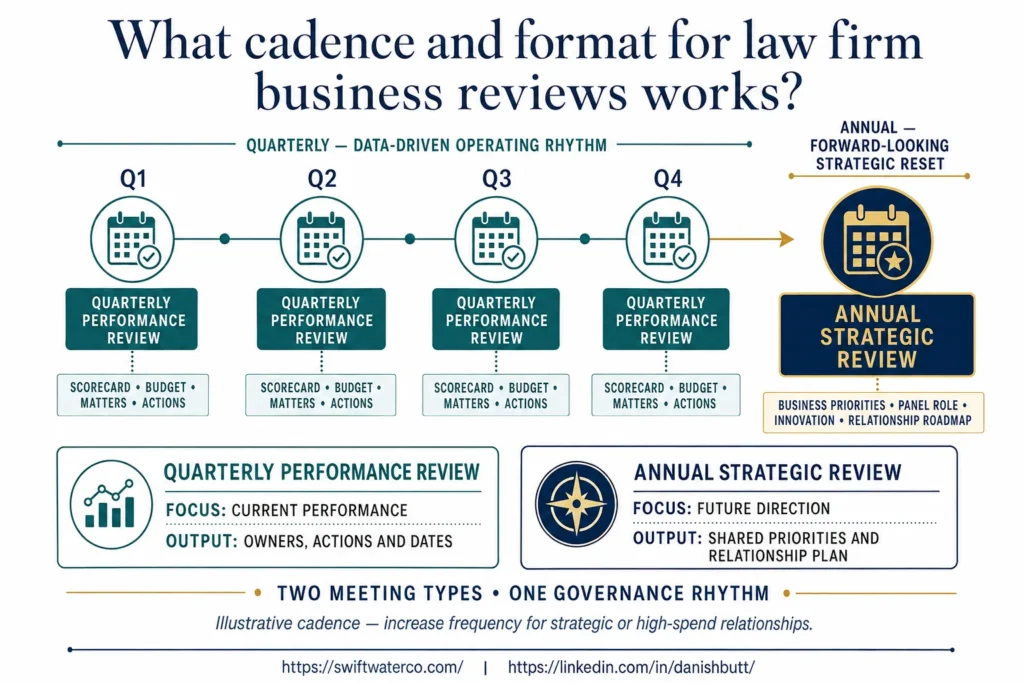
The annual review belongs in Q3 or early Q4, before rate season. This timing means performance data informs the rate conversation rather than arriving after the rate letter is already submitted. The General Counsel or CLO should attend the annual review for top-tier panel firms, signaling that the department treats the relationship as a governance matter, not a social one.
Quarterly reviews are shorter, more data-driven, and run by Legal Ops with the matter owners who work with that firm daily. Not every firm needs quarterly reviews. Reserve them for firms in the top tier of your panel by spend, typically the five to ten firms that account for the majority of your outside counsel budget. The ACC 2025 Law Department Management Benchmarking Report found that companies now use a median of 10 outside counsel firms, down from 14 the prior year, reflecting the consolidation trend that makes structured reviews of remaining firms even more important.
For firms with modest spend, an annual review is sufficient. For firms below a materiality threshold, a simple written scorecard delivery with no meeting may be the right approach.
What belongs on the law firm business review agenda?
The agenda should cover four areas in a fixed order, with defined time allocations that prevent any single topic from consuming the session.
A personal note from experience: For teams and members doing this for the first time a question always arises. The “R” word is invoked. I have heard so many times that “But what about the “relationship”, Danish?”
My answer is that this exercise is a business activity. The exercise of putting together a scorecard is to separate the emotion and subjectivity from the facts.
The budget, numbers, staffing, etc are all facts. They allow you to make decisions and provide the calibration and guidance needed to your “partner firm”. The relationship is much stronger at the end if you are providing them the calibration in time. Similarly, with concrete information documented your partner can share what can be mutually approved.
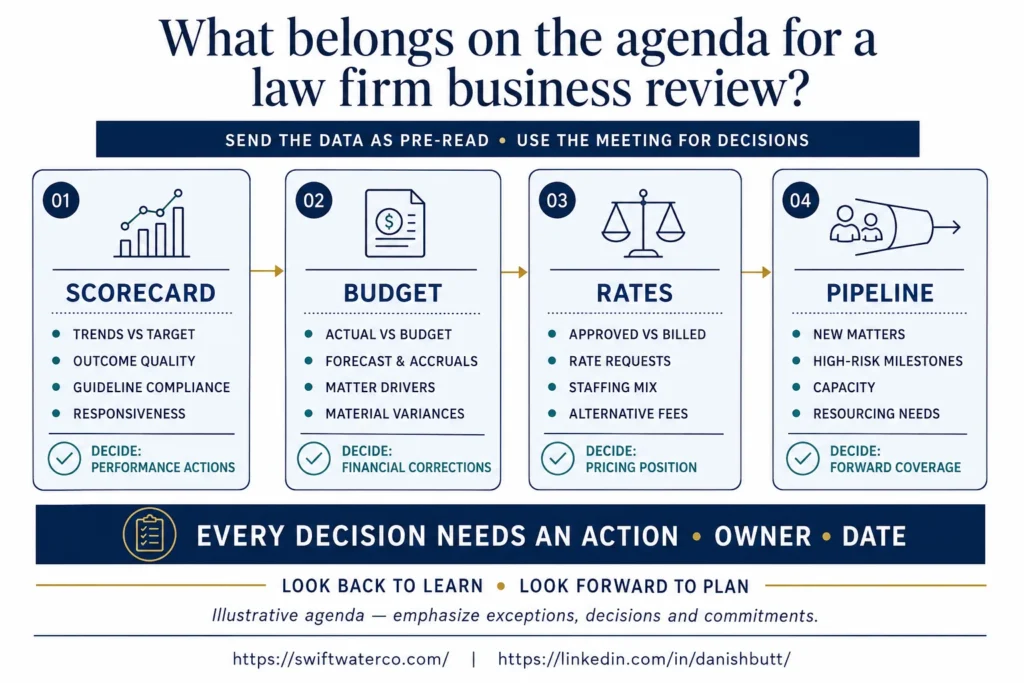
Scorecard walkthrough. Start with the data. Walk through the firm’s scorecard results: responsiveness, budget accuracy, staffing ratios, billing guideline compliance, and outcome quality. Present the scores, compare them to panel averages where available, and ask the firm to respond to any areas below threshold. This is the section that sets the tone. If you skip it or soften it, the rest of the meeting follows suit.
Budget and spend performance. Review actual spend against budgets for each active matter and for the relationship overall. Flag overruns, discuss the causes, and establish whether the budgeting process itself needs adjustment. This is also where you surface billing guideline compliance rates: what percentage of invoices were submitted clean versus adjusted or rejected.
Rate and staffing review. Examine the effective rate by matter type, the ratio of partner to associate hours, and whether the firm is staffing work at the right level. A firm that quotes competitive rates but assigns 60% of hours to partners on a matter that is not commensurate to that level of staffing is not delivering competitive value. This section prepares the ground for rate season by establishing the data both sides will reference. Departments that approach rate negotiations with this analysis already in hand negotiate from a position of evidence rather than assertion.
Want the review function run for you?
Every outside counsel invoice checked against your guidelines, rates, and matter context, inside the eBilling platform you already own, with the exception handling, vendor coaching, and savings reporting that separate a review program from invoice processing.
See Bill Review ServicesPipeline and forward look. Share, at an appropriate level, what work is coming. This is not a favor to the firm. It is a governance mechanism that lets you set expectations about staffing, budgets, and timelines before matters open, rather than negotiating after they are underway.
How do you prepare the data for the law firm business reviews?
Data preparation for law firm business reviews is important. The outside counsel management leader or the legal ops team should be working with other stakeholders to gather the information. It is the difference between a review that changes behavior and one that changes nothing. The firm should receive a data package at least two weeks before the meeting, giving them time to prepare a substantive response rather than reacting in real time.
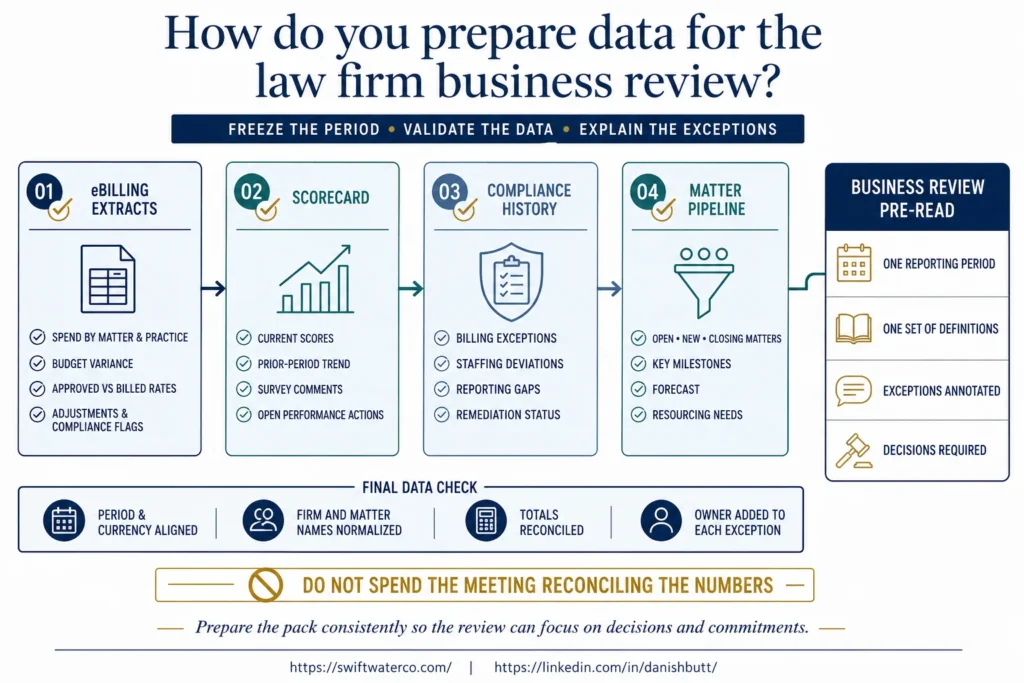
The package should at a minimum include four elements.
- Scorecard with current scores and trend over the prior two to four quarters (see, my law firm scorecard article for more details and examples)
- Spend summary by matter showing budget versus actual, with variances highlighted.
- Billing guideline compliance summary showing rejection rates, common adjustment reasons, and any repeat violations.
- Staffing analysis showing the ratio of partner, senior associate, and junior associate hours by matter type.
Pull this data from your eBilling platform. If your eBilling system cannot produce these reports reliably, that is a separate problem worth solving, but it does not excuse skipping the review. Even a manual spreadsheet with the basics, total spend, budget variance, and top-line staffing ratios, is better than walking in empty-handed.
For departments that track legal spend analytics systematically, the data preparation step becomes a matter of pulling standard reports rather than building one-off analyses. The investment in analytics infrastructure pays dividends across every firm relationship, not just the one under review.
How do you handle the difficult conversations with your law firms?
Three conversations account for most of the discomfort in law firm business reviews: underperformance, rate pushback, and staffing concerns. Each one has a structure that makes it productive rather than adversarial.
Underperformance. Lead with the data, not the conclusion. Show the scorecard results, identify the specific metrics that are below threshold, and ask the firm to explain the gap before you characterize it. A firm that scores poorly on budget accuracy may have a legitimate reason, such as a matter that expanded in scope. Or the reason may be poor project management. The data opens the conversation; the firm’s response determines what happens next. If the firm cannot explain the gap credibly, state the consequence clearly: a performance improvement plan, reduced work allocation, or panel probation.
Rate pushback. Thomson Reuters and Georgetown found in the 2026 Report on the State of the US Legal Market that worked rates grew 7.3% in 2025, nearly triple the 2.8% inflation rate. Firms will cite rising costs. Your counter is the effective rate analysis from the data package: what you are actually paying per hour after adjustments, how that compares to panel benchmarks, and whether the firm’s value justifies the premium. Rate discussions grounded in data are difficult but manageable. Rate discussions grounded in competing assertions are just arguments.
Staffing concerns. This is where departments often pull punches. A firm that routinely assigns a partner to work a senior associate could handle, or that staffs three associates on a matter that needs one, is extracting margin through leverage rather than delivering it through efficiency. Show the staffing ratios by matter type, compare them to what the engagement letter contemplated, and ask the firm to justify the variance. If the justification is weak, state the expectation going forward and tie it to future work allocation. In a healthy relationship, you would either hear the right justification or the right answer.
The common thread is that none of these conversations works without data, and none of them matters without consequences. A department that identifies underperformance and then changes nothing has made the problem worse, not better, because the firm now knows the review has no teeth.
How do you use business reviews to manage law firm panel performance?
Individual law firm performance reviews transform to a panel governance mechanism when you standardize the process across all firms and compare results. A firm’s scorecard is informative on its own. Compared to the law firm panel average, it becomes actionable.
Side bar: I also want to restate that this is a business exercise. Years of relationships, ways of working and philosophical conflicts can arise when you start formalizing performance management. But, remember, this is not a punitive exercise. It is a business relationship management exercise.
Example: Recently, I had a client who was candid in sharing that they had to call their best and biggest M&A firm and tell them they would not be able to maintain the work volume this particular year, as the board has decided to revisit the company’s M&A posture. If I am on the other side of the call, I may be disappointed in the outcome but appreciative of the heads up so I can plan my business accordingly.
Start by establishing a consistent law firm business review framework applied to every panel firm above your materiality threshold. Use the same law firm scorecard dimensions, the same agenda structure, and the same data package format. This consistency lets you rank firms against each other on the metrics that matter to your department, not just evaluate each firm against its own history.
Panel-level insights emerge quickly. You will see which firms consistently deliver under budget and which consistently overrun. You will see which firms staff efficiently and which over-leverage partner time. You will see which firms comply with billing guidelines and which treat them as suggestions. This data drives three panel management decisions: work allocation, rate approval, and panel composition.
Struggling to control outside counsel spend?
We help legal departments build the governance, billing guidelines, panel structure, and rate programs that take back control of what outside counsel costs.
See Legal Spend ServicesWork allocation is the most powerful lever. Firms that perform well earn more work. Firms that underperform see their share shift to higher-performing competitors. When firms understand that review outcomes drive allocation, the review itself gains credibility and the firm’s preparation for it improves.
Rate approval follows the same logic. A firm with strong scorecard results and efficient staffing has a credible case for a rate increase. A firm with mediocre scores and over-leveraged staffing, for your appetite, does not. Tying rate decisions to review data makes the annual rate conversation far more straightforward for both sides.
Panel composition decisions, adding, removing, or reclassifying firms, should happen on a defined cycle informed by cumulative review data. A firm that underperforms for two consecutive annual reviews is a candidate for removal. A firm that consistently outperforms may warrant elevation from a specialty to a primary role. Structured reviews give you the evidence to make these decisions defensibly.
For departments managing outside counsel relationships across a full panel, the business review is the governance layer that makes scorecards, billing guidelines, and rate frameworks operational rather than aspirational.
Bottom Line
A law firm business review works when it has structured data, a fixed agenda, defined consequences, and someone willing to deliver the message. Departments that treat reviews as relationship maintenance get relationship maintenance in return. Departments that treat reviews as governance get accountability, better rates, and firms that show up prepared to earn the next year’s work.
Build your legal spend management program around the expectation that every panel firm will sit across the table from its own performance data on a regular cadence, and then hold that expectation. The review that changes behavior is the one that connects performance to consequences, and the department that runs it is the one that controls its outside counsel spend.
Swiftwater helps legal departments build the review frameworks, scorecards, and data infrastructure that make law firm business reviews a governance mechanism rather than a courtesy. If your outside counsel program needs structured accountability, start with a legal spend assessment.
Frequently Asked Questions
Who should attend law firm business reviews from each side?
From the legal department, the relationship partner owner, a Legal Ops lead with the data, and optionally the GC for strategic annual reviews. From the firm, the relationship partner, the billing partner if different, and a senior associate who runs day-to-day work. Keep the room small enough for candid conversation. If more than eight people are in the room, the meeting becomes a presentation, not a review.
Should law firm business reviews be tied to rate season?
Separating law firm business reviews from rate negotiations is usually more productive. Run the annual strategic review in Q3 or early Q4, before the firm submits its rate proposal. That way the performance conversation informs the rate conversation rather than competing with it. When the rate letter arrives, both sides already know where performance stands.
How do you review law firms with only a few matters?
Low-volume firms rarely justify a full law firm business review cycle. A single annual check-in is enough, focused on whether the firm should remain on the panel at all. Review the matters they handled, compare cost and outcomes to what a higher-volume firm would have delivered, and decide whether to consolidate that work elsewhere or keep the relationship for specialized needs.
What do law firms actually want from these busienss reviews?
Most service providers want predictability and transparency from the law firm business review process. They want to know where they stand relative to other panel firms, what it takes to earn more work, and whether rate increases will be supported. A structured review that delivers honest performance data and clear expectations is more valuable to a firm than a polite meeting that says nothing. The firms that resist structured reviews are usually the ones with the most to worry about.
This article is for informational purposes only and does not constitute legal, financial, or consulting advice. Outcomes vary based on organizational context, panel size, and existing outside counsel management maturity. Consult qualified advisors for guidance specific to your situation.