


A law firm panel is a structured framework that determines which outside counsel handle which categories of legal work, at what cost, and under what performance expectations. Without one, legal departments default to informal preferences and inherited relationships, and legal spend drifts accordingly.
The ACC 2025 Law Department Management Benchmarking Report found that the median number of outside firms used by corporate legal departments dropped from 14 to 10 in a single year, a sign that consolidation pressure is real but that many departments are still running without a deliberate architecture behind it.
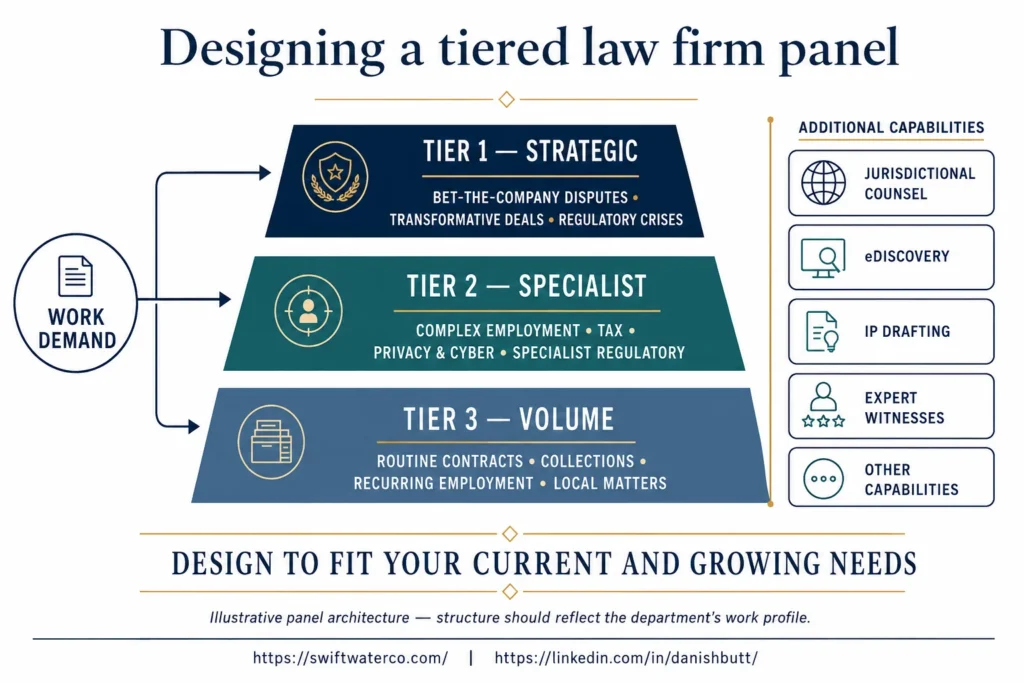
Designing a law firm panel is the structural work that turns that consolidation from a cost-cutting exercise into a legal spend strategy. This article walks through the design decisions that shape whether a panel actually controls cost and quality, or just creates a shorter list of the same problems.
For a broader view of how law firm panel design fits into the full outside counsel management discipline, start there.
What is a law firm panel and what problem does it solve?
A law firm panel is a defined set of outside counsel, organized by work type, tier, or region, that a legal department uses as its primary source of external legal services. The term gets used loosely. Some departments call any approved vendor list a “panel.” Others treat it as a formal program with competitive selection, negotiated rates, volume commitments, and regular performance reviews. The difference matters because only the second version actually changes spending behavior.
The problem a legal services provider panel solves is structural. In most legal departments, outside counsel relationships accumulate over time. A GC brings firms from a prior role. A litigator has a preferred trial counsel. A business unit hires a local firm for a one-off matter that becomes recurring. Nobody designed the resulting portfolio. It grew.
Is your legal spend data telling you the full story?
We help legal departments build the analytics, rate governance, and reporting infrastructure to move from invoice processing to strategic spend management.
See Legal Spend ServicesThe consequences are predictable: rate inconsistency across similar work, no leverage in fee negotiations because volume is scattered, limited visibility into which firms deliver results and which simply bill hours, and no mechanism to redirect work when performance falls short. The concept of panel counsel only becomes meaningful when the legal service provider panel itself carries rules about what work goes where and what firms must deliver to stay on it.
A well-designed law firm panel addresses all of this by making four things explicit: which firms are approved for which work, what the commercial terms are, how performance will be measured, and what happens when a firm underperforms or a matter falls outside the panel’s coverage.
What law firm panel structures actually work?
There is no single correct law firm panel architecture. The right structure depends on the department’s size, spend profile, geographic footprint, and the complexity of its legal work. But most effective panels follow one of four basic models, and understanding the tradeoffs between them is the first real design decision.
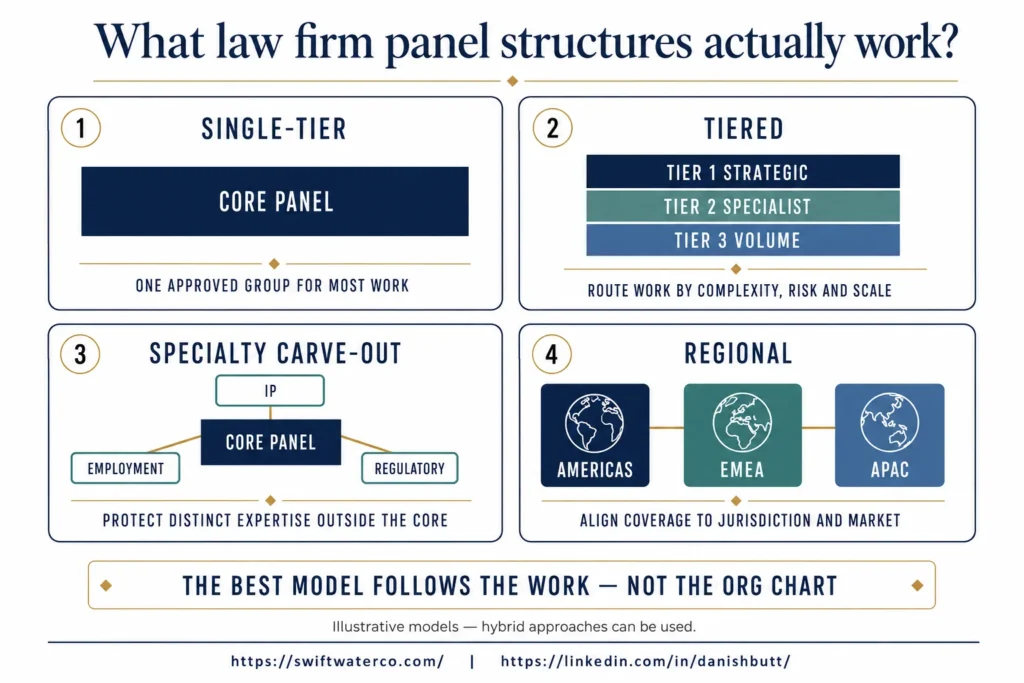
Single-tier panels place all firms on equal footing. Every panel firm is approved for the same categories of work at similar rate structures. This works for smaller departments with relatively homogeneous legal needs. It is simple to administer but, by design, it does not differentiate firm selection by type of work, the business value, etc.
Tiered provider panels assign law firms to levels based on the complexity, risk, and strategic importance of the work they handle. A typical three-tier model places bet-the-company litigation and M&A counsel in one tier, routine commercial and employment work in tier, and high-volume, lower-complexity work in yet tier. Tiering creates natural rate differentiation and gives the department a framework for matching cost to risk. It also gives firms a clear picture of what they are competing for. It helps in understanding where specialized providers e.g. for e-discovery or IP, or alternate legal service providers (or law companies) can be brought in.
Specialty carve-out panels maintain a general panel but designate specific firms for defined practice areas, often IP, regulatory, or tax, where deep subject-matter expertise matters more than general commercial capability. This model acknowledges that not all legal work is fungible and prevents the false economy of routing specialized matters to generalist firms at lower rates.
Regional or jurisdictional law firm panels organize firms by geography rather than practice area. This is common in multinational departments or companies with heavy state-by-state regulatory exposure. The risk is fragmentation: too many regional firms with too little volume each, undermining the leverage that makes a panel worthwhile in the first place. Companies evaluating how many law firms a legal department should use often find that a regional structure has quietly multiplied their firm count beyond what spend patterns justify.
Most mature law firm panels combine elements. A tiered core panel with specialty carve-outs for IP and regulatory, and regional slots only where local presence is genuinely required, tends to balance coverage against concentration. The 2026 Thomson Reuters State of the Legal Market report found that clients are increasingly shifting demand from the most expensive firms to lower-cost alternatives, which only works sustainably when there is a tiered structure that defines where that lower-cost work actually goes.
How do you decide what work goes to which tier?
Tier assignment is where law firm panel design becomes operational. The question is not which firms you like, but which attributes of the work determine where it belongs.
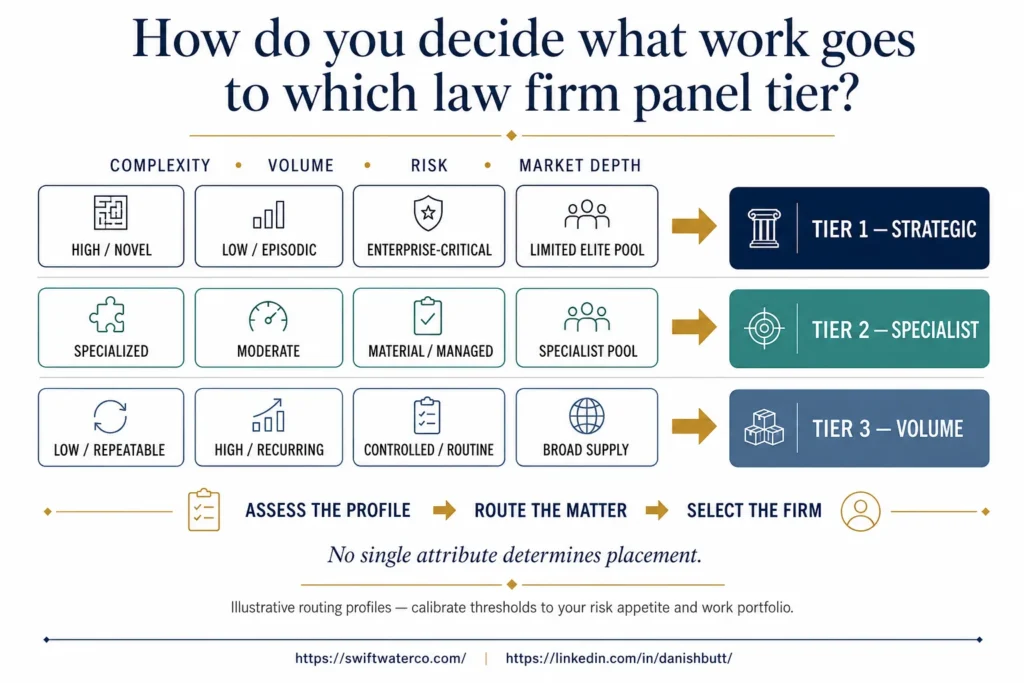
Four factors drive most tier-assignment decisions:
Complexity and stakes. Matters involving existential risk, regulatory exposure with enterprise-wide consequences, or bet-the-company litigation belong at the top (rate/risk/complexity) tier, handled by law firms with deep bench strength and relevant track records. The defining question is whether the matter requires strategic judgment that cannot be replicated by a competent but less specialized firm.
Want the review function run for you?
Every outside counsel invoice checked against your guidelines, rates, and matter context, inside the eBilling platform you already own, with the exception handling, vendor coaching, and savings reporting that separate a review program from invoice processing.
See Bill Review ServicesVolume and repeatability. High-volume, pattern-based work, such as routine employment claims, standard commercial contracts, collections, and regulatory filings, belongs in a middle or lower tier where rates reflect the repetitive nature of the work and firms can build efficiency through familiarity. This is also where alternative fee arrangements, specialized providers and ALSPs tend to deliver the most value, because the work is predictable enough to price on a fixed or capped basis.
Market depth. Some practice areas have deep competitive markets with many capable firms. Others, like niche regulatory specialties or specific jurisdictional expertise, have limited qualified providers. Where market depth is high, competitive pressure should drive tier placement toward the lower-cost end. Where it is thin, the law firm panel design should acknowledge the premium and plan for it rather than trying to manufacture leverage where it does not.
Strategic alignment. Some firms are on the panel not because they are cheapest or even best at a specific task, but because they bring strategic value: industry knowledge, track record with key regulators, secondment capacity, or innovation in legal service delivery. Placing these firms deliberately, rather than defaulting them into whatever tier their rates suggest, is a design choice that should be made explicitly and reviewed regularly.
The practical output of this analysis is a work-allocation matrix: a document that maps matter types to tiers and, within tiers, to specific firms. This matrix becomes the routing logic for new matters and the basis for law firm convergence over time, concentrating spend where it delivers the most value.
What do firms get in exchange for panel membership?
Law firm panel design is a two-sided arrangement. Firms accept rate concessions, billing guidelines, and performance scrutiny because panel membership delivers something in return. If it does not, the best firms will either decline to participate or treat the panel as a secondary relationship, reserving their strongest teams for clients who commit more.
The most common forms of exchange are:
Volume commitments. A panel position signals that the firm will receive a defined share of the department’s work in its assigned categories. This does not mean guaranteed revenue, but it does mean preferential routing. Firms price accordingly. The more concrete the volume commitment, the more meaningful the rate concession the department can expect.
Predictability. Panel counsel get visibility into the client’s legal portfolio, upcoming needs, and budget cycles. This predictability lets them staff more efficiently, invest in understanding the client’s business, and plan capacity. Firms value this more than most clients realize, because it reduces the cost of the relationship on the firm’s side.
Relationship depth. Law firm panel membership, especially at the top tier, signals a long-term relationship. Firms invest differently in clients they expect to keep for years versus clients running one-off competitive pitches. This investment shows up as better staffing, more senior attention, proactive advice, and willingness to absorb scope creep without immediately billing for it.
Exclusivity within categories. Some law firm panels grant category exclusivity: one firm for all employment litigation in a region, for example. This is a powerful incentive because it eliminates intra-panel competition for that work and gives the firm confidence to invest in efficiency and institutional knowledge.
The design decision is how much of this value to make explicit. Departments that formalize volume commitments, even directionally, and communicate them clearly tend to get better rate structures and better service than those that simply announce a law firm panel or a legal service preferred provider program and expect firms to compete on hope.
I have seen first hand where a company has selected a law irm to be on a panel but isn’t able to fulfill its volume or work promises. In turn the volume discount they baked in to their budget or the time of the partner they planned on did not materialize.
Building a structured legal spend program around the law firm panel makes these commitments measurable and the exchange transparent.
How do you handle work that does not fit the panel?
Every law firm panel will encounter matters that fall outside its coverage. A novel regulatory investigation in a jurisdiction where no panel firm practices. A conflict that disqualifies the assigned firm. A specialized litigation requiring a nationally recognized trial lawyer who is not on the roster.
So it is a matter of time when exceptions will happen and question as to whether the panel has a defined process for handling them.
Struggling to control outside counsel spend?
We help legal departments build the governance, billing guidelines, panel structure, and rate programs that take back control of what outside counsel costs.
See Legal Spend Services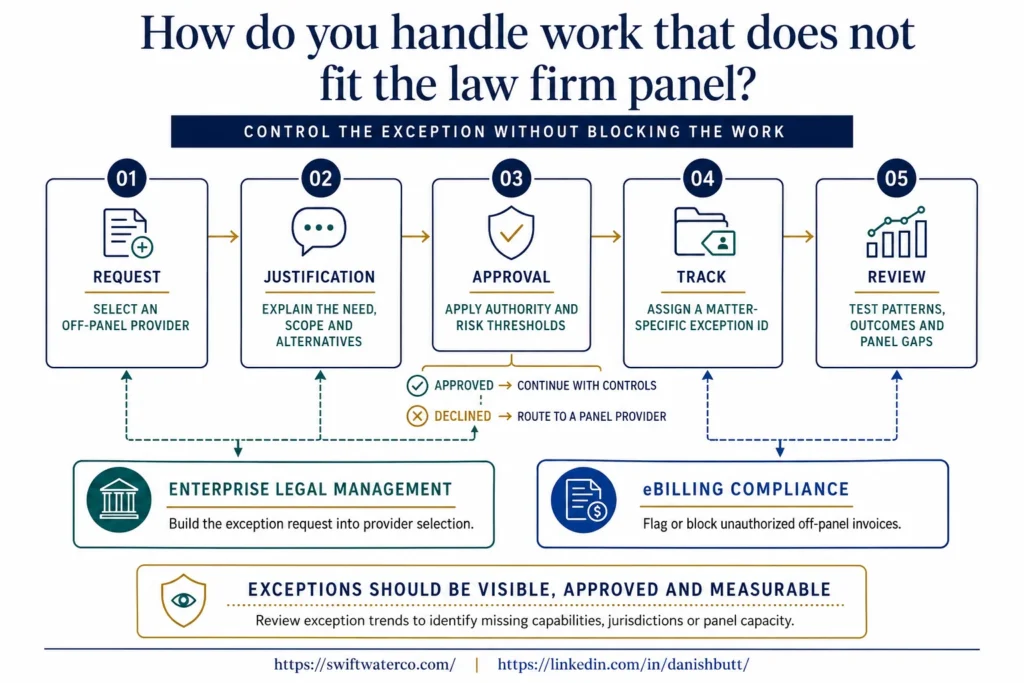
The most uncontrolled outcome is an informal exception culture where any senior lawyer can engage any firm for any reason.
This leads to other unintended consequences as bypassing the panel whenever it is inconvenient. This is how panels erode. Within two years, off-panel spend creeps back to pre-panel levels, and the structure exists only on paper.
An effective exception process has four elements:
A clear trigger. Define what qualifies as an exception: conflicts, practice areas not covered, jurisdictional gaps, matters above a defined complexity threshold. Everything else routes through the law firm panel.
A justification requirement. The requestor explains why no panel firm can handle the matter. This does not need to be bureaucratic, a short written rationale reviewed by legal operations or the managing attorney is sufficient, but it must exist.
Approval authority. Someone other than the requestor approves the exception. In most departments, this is the GC, the CLO, or the head of legal operations. The point is not to create a bottleneck but to ensure visibility and accountability.
Tracking and review. Every exception is logged, and exception patterns are reviewed at least quarterly. If the same practice area or region generates repeated exceptions, the law firm panel structure needs to change. This feedback loop is what keeps the panel current.
Taking a structured approach to legal vendor management means treating exceptions as data about the panel’s gaps, not as failures to be hidden.
The CLOC 2026 State of the Industry Report found that 62% of legal departments now rank outside counsel and vendor management as a key operational priority, yet many still lack the governance structure to handle the exceptions that inevitably arise.
Bottom Line
Law firm panel design comes down to a set of structural decisions: how many tiers you need, what work goes where, what firms receive in return, and how you handle the work that does not fit.
Get those decisions right and the panel becomes the architecture that everything else in your outside counsel program, convergence, scorecards, rate negotiations, matter routing, builds on.
Decide the law firm panel structure before you pick the firms, and the firm decisions become dramatically simpler.
Swiftwater helps legal departments design and restructure outside counsel panels as part of a broader legal spend engagement. If your law firm panel has grown by accumulation rather than design, or if you are building one for the first time, that is the work we do.
Frequently Asked Questions
How is a law firm panel different from a preferred provider list?
A preferred provider list is a roster of approved firms. A law firm panel adds structure on top of that roster: tiered placement, defined work allocation, volume commitments, performance expectations, and governance rules that determine which firms get which matters. The list names the firms. The panel defines how they are used.
Should ALSPs be on the law firm panel?
Yes, if the work fits. Alternative legal service providers handle document review, contract management, compliance support, and other high-volume work that does not require partner-level judgment. Placing ALSPs on the law firm panel as a dedicated tier or within an existing tier formalizes the relationship and makes cost comparisons transparent.
How often should law firm panel structure change?
Most law firm panels benefit from a full structural review every three to five years, with annual performance evaluations of individual firms within the structure. Trigger events like a major acquisition, a shift in litigation profile, or geographic expansion may justify an off-cycle redesign.
Do small legal departments need law firm panels?
A department that uses three or more outside firms regularly benefits from even a simple law firm panel structure. The value is not in the number of tiers but in the discipline of deciding in advance which firm handles which work, what rates apply, and how performance is measured. A two-person legal team with five firms and no structure can overspend just as reliably as a fifty-person team in the same position.
This article is provided for informational purposes and reflects general practices in legal department management. It does not constitute legal advice. Specific law firm panel design decisions should account for your organization’s regulatory environment, risk profile, and outside counsel requirements.