


Legal procurement is the application of sourcing discipline to the buying of legal services, usually shared between the legal department and the Procurement function. It covers how law firms are selected, what they are paid, the terms they work under and how their performance is reviewed. Who leads each part differs from one company to the next, and the outside counsel program is where the two functions meet. This guide covers what legal procurement is, who owns the program, what each side brings, how the work is usually divided and how the program should be governed.
What is legal procurement?
Legal procurement is the buying of legal services with the same discipline a company applies to other purchases: a defined sourcing process, agreed terms with suppliers, benchmarked prices and records of what was bought and from whom. In many companies it is shared. The legal department decides which firm handles a matter and judges the work, and Procurement supports sourcing, rate negotiations and supplier governance across the outside counsel program.
The share of the work Procurement takes on varies widely. In the Blickstein Group’s 18th Annual Law Department Operations Survey of 68 companies, procurement of legal services was a legal operations responsibility at 75.4%, yet 52.4% of legal operations teams said they never collaborate with their Procurement function. In many departments, legal procurement is done by legal operations alone.
Who owns the outside counsel program: Legal, legal operations or Procurement?
Ownership follows a few common patterns. In some companies the legal department owns the program outright and legal operations runs it. In others Procurement leads sourcing and rates while Legal keeps the choice of counsel. In a third group, the two run the program jointly under the General Counsel’s decision rights, with a shared calendar and shared reporting. Each pattern can work. What fails is an arrangement where nobody is clearly accountable for the calendar.
The CLOC 2026 State of the Industry Report lists outside counsel and vendor management as a focus area for 62% of the 135 law departments surveyed, behind technology strategy and financial management. For the legal operations seats that usually hold this work, see legal operations roles.
What does Procurement bring to the buying of legal services?
Procurement brings four things the legal department often lacks the time to build: a repeatable sourcing process for panel reviews and RFPs, standard supplier terms and onboarding, benchmarking discipline for rates and fee proposals, and complete contract and vendor records. It also brings experience negotiating with suppliers that know their client well, and a view of legal spend alongside the rest of the company’s third-party spend.
That discipline matters most in rate negotiations. The Blickstein Group survey found 71.7% of companies relied solely on engagement partners for fee negotiation, down from 85% the year before. Our guide to outside counsel rate negotiation covers the approaches that work, and the guide to the legal panel RFP covers the sourcing process itself.
Is your legal spend data telling you the full story?
We help legal departments build the analytics, rate governance, and reporting infrastructure to move from invoice processing to strategic spend management.
See Legal Spend ServicesWhat stays with the legal department?
The legal department keeps the decisions that depend on legal judgment. It chooses the firm for each matter, owns the relationship with the lawyers doing the work, judges the quality of that work, and decides when a matter needs a different firm or a different approach. Lawyers also set what the billing guidelines need to protect, since they know which tasks and staffing patterns a matter actually requires.
Procurement can support every one of these decisions with data and process. The decisions themselves stay with Legal, because the cost of the wrong firm on a significant matter is usually far larger than any saving on rates.
How do Legal and Procurement divide the work?
The work divides by activity. Legal leads where a decision rests on knowledge of the matter or the lawyers, and Procurement or legal operations leads where the work is sourcing, process or data. Many activities have a lead and a supporting function, and the program works best when that split is written down and agreed by both sides. The table below shows a common division.
| Activity | Usually led by | Supported by |
|---|---|---|
| Panel selection and RFPs | Legal, for the choice of firms | Procurement, for the sourcing process and scoring |
| Rate negotiation | Procurement or legal operations | Legal, for staffing and matter needs |
| Billing guidelines | Legal operations | Legal, for what the guidelines need to protect |
| Invoice review | Legal operations, or a managed bill review team | The matter lawyer, for substantive questions |
| Performance reviews | Legal | Legal operations and Procurement, for the data |
| Reporting | Legal operations | Procurement and finance, for wider spend views |
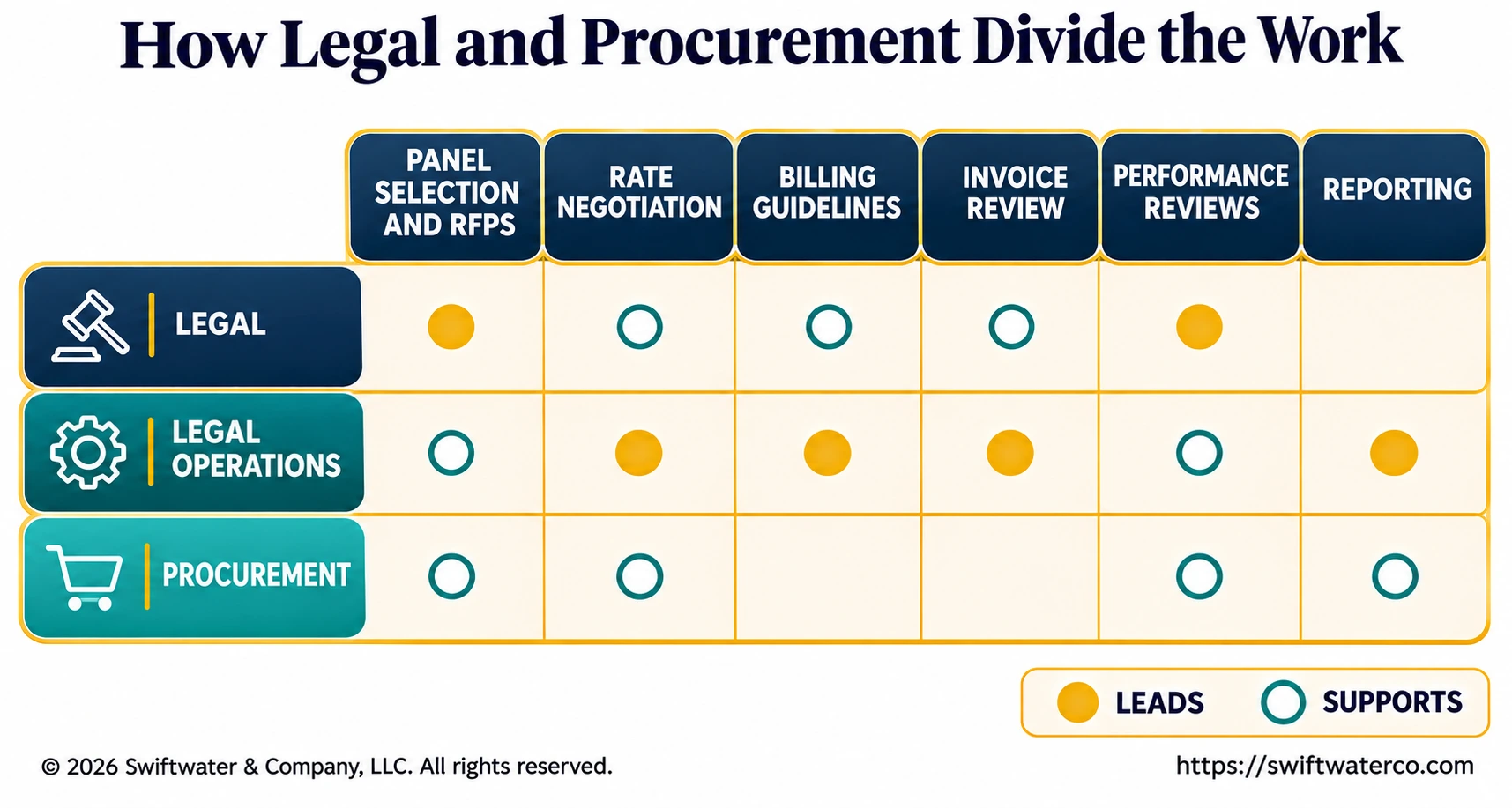
Where the department has no Procurement involvement, legal operations usually covers both supporting roles. For the wider discipline, see outside counsel management.
How should the program be governed?
The program needs three things to stay governed: clear decision rights, a shared calendar and shared reporting. Decision rights say who approves a new firm, an off-panel request or a rate increase. The calendar sets when rate cycles, business reviews and panel checkpoints happen. Shared reporting means Legal and Procurement work from the same scorecards and spend data, so decisions about the panel rest on one set of numbers.
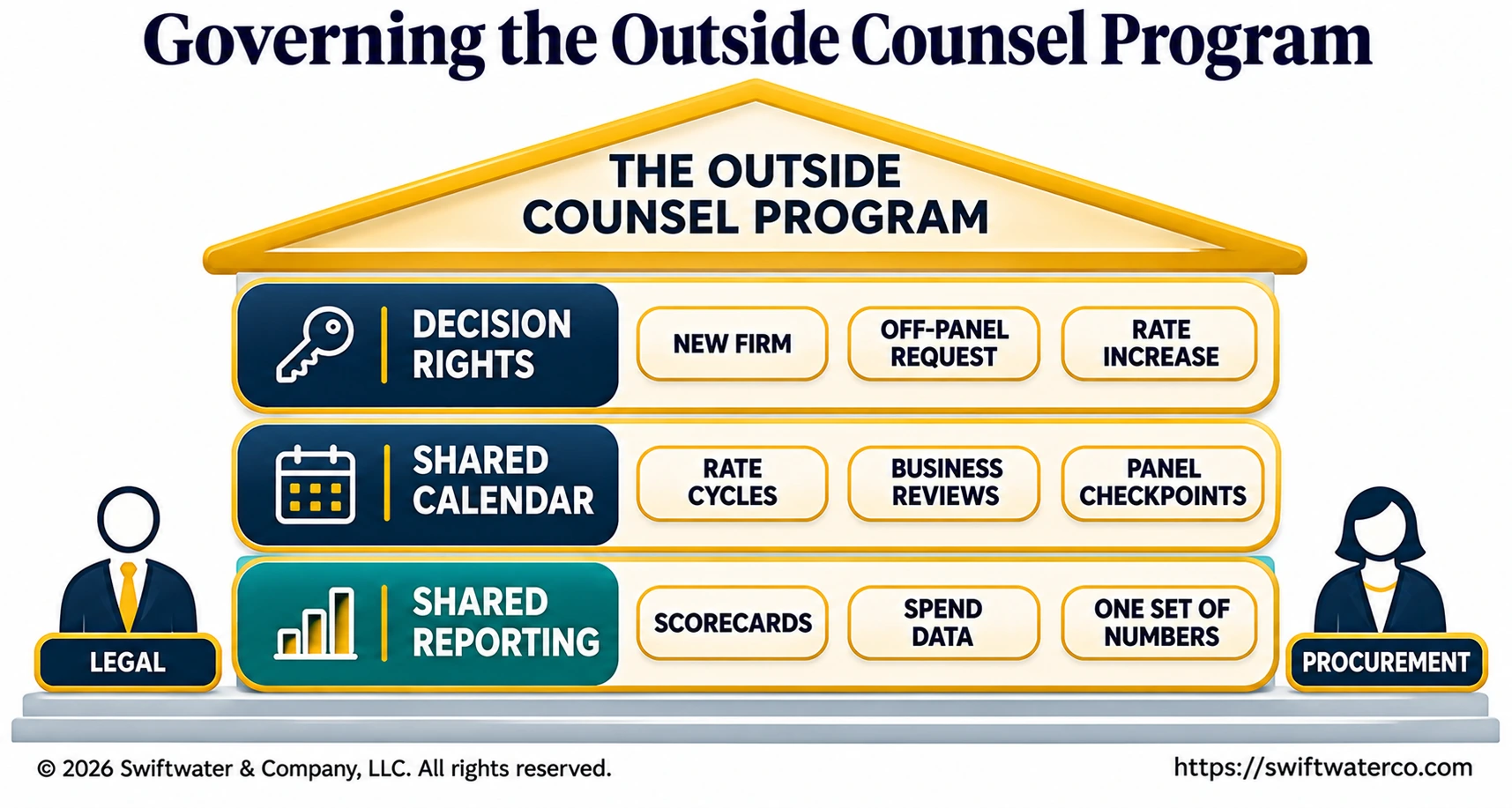
Governance is also where the program’s elements connect: the roster, engagement terms, rates, billing guidelines and performance measures. Our guide to the preferred counsel program covers each of those elements and who usually owns them.
When should a company bring in outside support?
Outside support makes sense when the program’s recurring work is not getting done, or when Legal and Procurement agree on the program but neither has the hours to run it. Common triggers are a rate cycle that has slipped, business reviews that stopped, a panel review that needs a structured RFP, or a new Procurement mandate that the legal department needs help putting into practice.
Swiftwater runs the administration of outside counsel and preferred counsel programs as outside counsel program management: panel maintenance, program governance, law firm performance reviews, rate negotiations, guideline enforcement and reporting. The work runs inside the systems the department already owns and under its governance. The ACC Legal Operations Maturity Model is a useful way to judge where the program stands before deciding what to hand over.
Bottom Line
Legal procurement applies sourcing discipline to the buying of legal services. In many companies it is shared: Legal chooses the firms and judges the work, while Procurement and legal operations bring sourcing process, rate benchmarking, supplier terms and records. The outside counsel program is where the two meet.
Want the review function run for you?
Every outside counsel invoice checked against your guidelines, rates, and matter context, inside the eBilling platform you already own, with the exception handling, vendor coaching, and savings reporting that separate a review program from invoice processing.
See Bill Review ServicesThe split differs by company, and each common pattern can work. What every pattern needs is written decision rights, one calendar for rate cycles, reviews and panel checkpoints, and reporting that both sides trust. Agree who leads each activity, run it on one calendar, and report from one set of numbers.
Swiftwater runs the administration of outside counsel and preferred counsel programs under your governance and inside your systems. See outside counsel program management.
Frequently Asked Questions
Can Procurement manage outside counsel?
Legal procurement is the application of sourcing discipline to the buying of legal services, usually shared between the legal department and the Procurement function. Procurement can lead sourcing, rate negotiations, supplier terms and records. The choice of firm for a matter and the judgment of the work usually stay with Legal, so many companies run the outside counsel program jointly.
What tools help manage outside counsel sourcing?
Many departments manage outside counsel sourcing with their eBilling or matter management platform, which holds the firm roster, rates and billing guidelines, together with an RFP process run in a sourcing tool, a spreadsheet or the eBilling platform’s own RFP module. Scorecards and spend reports drawn from eBilling data support panel decisions.
How do legal operations connect with finance and procurement systems?
Usually through the eBilling or matter management platform, which passes approved invoices, accruals and vendor records to finance and procurement systems through integrations or scheduled exports. Our guide to the legal operations platform covers how those connections are set up.
What should a legal RFP ask?
A legal RFP asks about the firm’s relevant experience, the proposed team and staffing, rates and alternative fee proposals, billing practices, technology and diversity. Our guide to the legal panel RFP lists the core questions.
Who should run the preferred counsel program day to day?
Legal operations usually runs it day to day, with Legal owning firm choice and Procurement supporting sourcing and rates. When neither team has the hours, a managed team can run the administration under the department’s governance. Swiftwater does this as outside counsel program management.
This article is for general information and education and is not legal advice; consult your own counsel on any contract or compliance question. Figures cited are from the sources named and are presented to show direction, not as targets. If you believe any material on this page should be corrected or removed, contact us through the contact form.