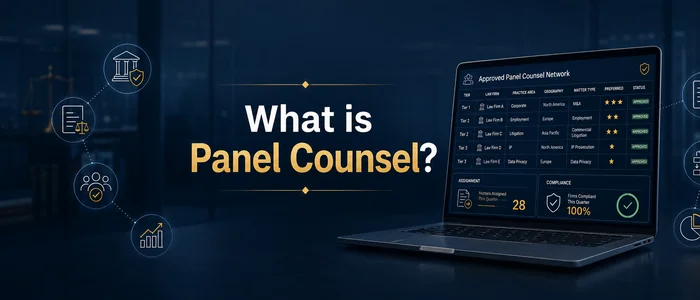

Panel counsel are law firms or attorneys that an organization has pre-approved to handle its legal work, selected through a structured evaluation process and governed by agreed-upon rates, guidelines, and performance standards.
In corporate legal departments, panel counsel describes the curated roster of outside firms (law firms, legal service providers, advisors, expert witnesses, ALSPs) a general counsel relies on for ongoing matters across practice areas and geographies.
The term also appears in insurance defense, where it carries a different meaning covered in its own section below.
For legal operations and legal spend professionals, panel counsel is a governance concept: the shift from ad hoc firm engagement to a deliberate, managed program.
Understanding how law firm panels work is foundational to the broader legal spend discipline and connects directly to how organizations structure their outside counsel management programs.
What does panel counsel mean?
Panel counsel refers to any attorney or law firm or legal service provider that has been formally approved to receive work from a specific organization. The term “panel” comes from the idea of a curated list or roster. Rather than engaging firms ad hoc, the organization establishes criteria, evaluates candidates, and designates a defined group of firms authorized to handle its legal matters.
The designation carries practical consequences. Panel firms typically agree to negotiated rate structures, commit to the organization’s billing and reporting requirements, and accept performance expectations that non-panel firms do not face. In return, the corporation sends steady flow of work to panel members and offers a closer relationship with the client’s legal leadership.
Is your legal spend data telling you the full story?
We help legal departments build the analytics, rate governance, and reporting infrastructure to move from invoice processing to strategic spend management.
See Legal Spend ServicesThe ACC’s 2025 Law Department Management Benchmarking Report, drawing on data from 395 legal departments across 23 industries and 34 countries, tracks a consolidation trend in outside counsel usage, reflecting the shift toward tighter, more deliberately managed panels rather than open-ended firm rosters. Bloomberg Law’s 2024 Legal Ops and Tech Survey reinforces the point: 72% of in-house teams now formally track outside counsel spend, the kind of discipline that only works when firms are organized into a structured panel rather than engaged one-off.
How does panel counsel work in corporate legal departments?
Corporate legal departments use panel counsel programs to bring structure and accountability to outside counsel spending and service delivery. Instead of allowing individual lawyers or business units to engage whichever firm they know personally, the general counsel and the senior leadership along with the legal operations team establishes a formal panel of approved firms, each selected for specific practice areas, geographies, or matter types.
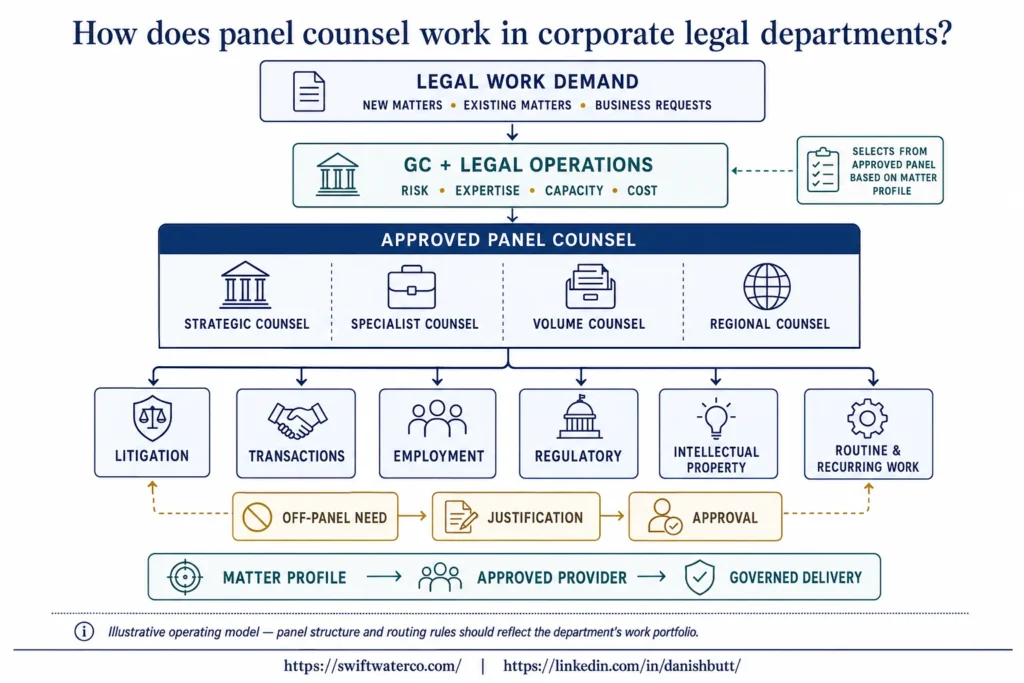
A well-run panel program typically defines which firms handle which categories of work, what rates and fee arrangements apply, what billing and reporting standards firms must follow, and how performance is measured. This is the foundation of a structured panel design that aligns firm selection with the department’s actual needs.
The practical benefit is leverage. When a legal department consolidates its work among fewer firms, it gains pricing power, deeper institutional knowledge from its outside counsel, and the data to evaluate whether firms are actually delivering value. That consolidation also creates the conditions for legal spend management to function: you cannot govern what you have not organized.
Panel counsel programs also create accountability on the client side. Legal operations teams must maintain the panel, track utilization, enforce compliance with billing guidelines, and periodically reassess whether each firm still earns its place. Without that governance layer, a panel quickly becomes a list in name only.
What does panel counsel mean in insurance?
In insurance, panel counsel refers to defense attorneys that an insurance carrier has pre-approved and appointed to represent policyholders when a covered claim arises. The carrier maintains a roster of firms, and when a policyholder faces a lawsuit or claim, the carrier selects and retains one of those panel firms to handle the defense.
This arrangement creates what legal ethics scholars call the tripartite relationship: the insurer pays the legal fees, the insured is the client, and the defense attorney must serve the insured’s interests while operating within the carrier’s cost and reporting framework. The San Diego County Bar Association has examined the ethical dimensions of this relationship, establishing that defense counsel’s primary duty of loyalty runs to the insured, not to the carrier paying the bills. When conflicts arise between the insurer’s financial interests and the insured’s defense needs, the attorney’s obligation to the insured takes priority, and in many jurisdictions the insurer must fund independent counsel.
Insurance panel counsel is common in professional liability, general liability, directors and officers (D&O), and medical malpractice coverage. The insurer selects attorneys who specialize in the relevant defense area and who agree to the carrier’s rate schedules and litigation management guidelines. Policyholders typically do not choose their own attorney under a standard duty-to-defend policy, though some policies allow the insured to request a specific panel firm.
Insurance panels tend to be larger than corporate panels and more geographically dispersed, reflecting the need for defense counsel across every jurisdiction where policyholders face claims. Carriers select panel firms based on defense expertise, jurisdictional coverage, willingness to accept the carrier’s rate schedule, and historical outcomes.
The key distinction from corporate panel counsel is who controls the relationship. In a corporate legal department, the general counsel selects and manages the panel. In insurance, the carrier builds and controls the roster, and the insured has limited say in which firm is assigned.
How do firms get onto a panel?
Earning and retaining a panel counsel position should be a transparent and standardized process for a company’s law firms, legal service providers and ALSPs. It should be through a formal selection process. This usually starts with a legal panel RFP, a structured request for proposals that evaluates firms across practice-area expertise, rate competitiveness, geographic coverage, diversity commitments, and capacity to meet the organization’s billing and reporting standards.
For an already functioning law department you may already created a criteria of who can participate e.g. preferred firms with a track record with the company. In certain cases you may be looking to fill gaps or alternatives.
Want the review function run for you?
Every outside counsel invoice checked against your guidelines, rates, and matter context, inside the eBilling platform you already own, with the exception handling, vendor coaching, and savings reporting that separate a review program from invoice processing.
See Bill Review ServicesThe evaluation process varies by organization, but common elements include a written RFP response, rate proposals and fee arrangement terms, references and track-record review, interviews or oral presentations for shortlisted firms, and a formal decision by the general counsel or a selection committee.
Some organizations run panel reviews on a fixed cycle, reconsidering the entire roster every two to three years. Others add or remove firms on a rolling basis as needs change. Regardless of the cadence, the underlying principle is the same: panel membership is earned, not assumed, and it comes with obligations that run in both directions.
What obligations come as panel counsel membership?
Panel counsel membership is a two-sided commitment. The organization offers a steady flow of work and a closer strategic relationship. The firm agrees to a set of requirements that typically exceed what a non-panel firm would accept.
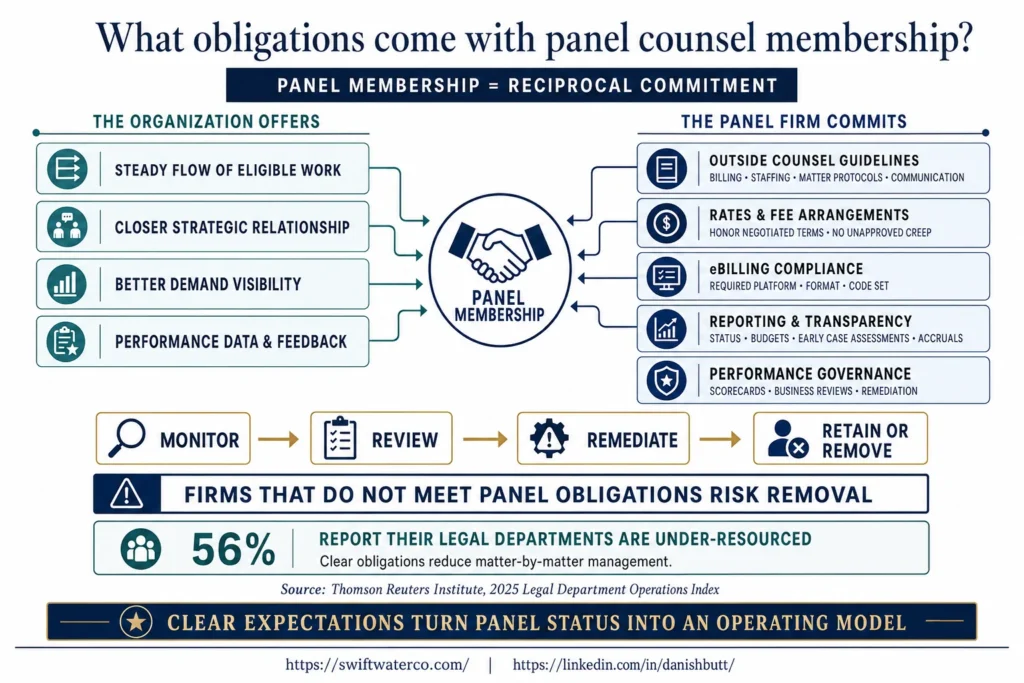
These obligations usually include compliance with the organization’s outside counsel guidelines, covering billing practices, staffing expectations, matter management protocols, and communication standards. Rate commitments are central: panel firms agree to negotiated rates or fee arrangements that hold for the term of the panel, and the organization expects those rates to be honored without creep. eBilling compliance is increasingly standard, requiring firms to submit invoices through the organization’s legal billing platform in the required format and code set.
Reporting and transparency obligations go further. Many panel agreements require firms to provide regular matter status updates, budget forecasts, early case assessments, and accruals data. Some require firms to participate in periodic law firm business reviews where the organization evaluates the firm’s performance against agreed metrics.
The Thomson Reuters Institute’s 2025 Legal Department Operations Index found that 56% of legal department professionals reported their departments as under-resourced, a pressure that makes panel governance more important.
When internal teams are stretched thin, a well-structured panel with clear obligations reduces the management burden by making expectations explicit rather than negotiated matter by matter.
Firms that do not meet panel obligations risk removal. Most panel agreements include performance review provisions that allow the organization to reassess panel membership if compliance or quality standards slip.
Struggling to control outside counsel spend?
We help legal departments build the governance, billing guidelines, panel structure, and rate programs that take back control of what outside counsel costs.
See Legal Spend ServicesBottom Line
Panel counsel means the same thing at its core: a pre-approved firm authorized to receive an organization’s legal work under agreed terms. In corporate legal departments, panels are the governance mechanism that turns outside counsel spending from an ad hoc activity into a managed program. Whether you are building a panel program or tightening an existing one, the concept works only when the selection criteria are clear, the obligations are mutual, and the governance is enforced.
This is the work Swiftwater does in its legal spend practice. We help legal departments design panel structures, define selection criteria, build the governance framework, and measure whether outside counsel relationships are delivering the value they promised. If your panel has grown organically and you are ready to bring structure to it, Swiftwater’s legal spend services are the starting point.
Frequently Asked Questions
Is panel counsel the same as preferred counsel?
They overlap but are not identical. Panel counsel refers to firms formally approved through a structured selection process and bound by the organization’s outside counsel guidelines, rate schedules, and reporting requirements. Preferred counsel is a looser designation that may simply reflect a working relationship or past satisfaction without the governance framework a true panel carries.
Can panel counsel decline work?
Yes. Panel membership means a firm is pre-approved to receive work, not obligated to accept every matter. Firms may decline an assignment due to conflicts of interest, capacity constraints, or lack of subject-matter fit. Most panel agreements address the process for declining work, including notice requirements and any limits on how frequently a firm may turn down assignments before its panel status is reviewed.
Who pays panel counsel in insurance matters?
The insurance carrier pays panel counsel’s fees when it appoints defense counsel to represent a policyholder under a duty-to-defend policy. The insured does not select or pay the attorney directly. If a coverage dispute arises and the insured retains independent counsel, the insured bears that cost unless the policy or local law requires the carrier to fund independent representation.
How is panel counsel different from staff counsel?
Panel counsel are outside law firms approved to receive work from the organization. Staff counsel are attorneys employed directly by the organization, whether that is a corporation’s in-house legal team or an insurance carrier’s captive law office. Panel counsel operate under an engagement governed by outside counsel guidelines, while staff counsel are salaried employees managed through normal HR and reporting structures.
This article is provided for informational purposes and does not constitute legal advice. Panel counsel structures, insurance defense arrangements, and outside counsel governance vary by jurisdiction, organization, and policy. Consult qualified legal counsel for guidance specific to your situation.